Bankless: How Should the Future of NFT Royalties Look Like to Protect the Creator Economy?
TechFlow Selected TechFlow Selected
Bankless: How Should the Future of NFT Royalties Look Like to Protect the Creator Economy?
Under the current model, NFT royalties are not mandatory.
 Navigating Web3 tides with focused insights
Translation: Wendy, DeFi Dao
Over the past few years, a large number of artists have entered the crypto economy.
What motivates these creators?
The ability to earn royalties from secondary sales of their work.
However, under the current model, NFT royalties are not mandatory.
Traditional NFT marketplaces enforce royalties via off-chain infrastructure, but many platforms have recently begun moving toward making these payments optional—or eliminating them altogether.
OpenSea is the latest major project exploring this option, leaving many wondering what comes next.
In my view, one thing we’re certainly going to see is an explosion of new NFT marketplaces.

First, Let’s Review the Basics of NFT Royalties
Suppose Alice mints an NFT and sells it to Bob for 1 ETH.
Bob then resells the NFT on OpenSea’s secondary market to Charlie for 5 ETH.
Because Alice previously set a 10% royalty fee on OpenSea, she earns 0.5 ETH from this sale.
However, OpenSea tracks and pays these royalties through its own off-chain system.
If Alice hadn’t set royalty parameters—and if OpenSea didn’t use such a system—she wouldn’t automatically receive that 0.5 ETH. Bob would have to voluntarily send it, which in most cases, won’t happen.
Why is this the case? Because currently, there is no robust way at the smart contract level to enforce NFT royalties.
You could hardcode royalties directly into the NFT’s transferFrom() function, but that would force the sender to pay fees regardless of transaction type. This approach fails when simply transferring an NFT to another wallet or gifting it.
As a result, over recent years, NFT marketplaces have relied on independent off-chain systems to enforce royalties. OpenSea has its own technology; other platforms have their own infrastructures—and these systems can’t “talk” to each other due to lack of standardization.
This leads to situations where NFTs minted on one platform fail to pay royalties when sold on another. Innovative efforts like The Royalty Registry are helping marketplaces adopt a unified on-chain royalty standard, but the system remains non-binding and hasn’t achieved widespread adoption yet.
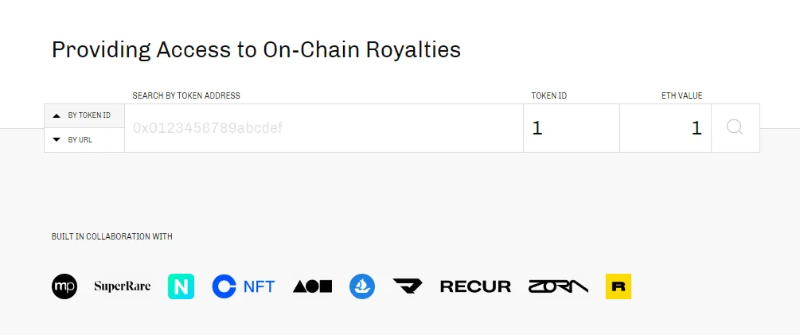
The Royalty Registry lookup system
In summary, over recent months, an increasing number of NFT marketplaces have either cut or made royalties optional—including Blur, LooksRare, X2 Y2, and sudoswap. Now, OpenSea may be the latest domino… perhaps.
Latest Developments
OpenSea recently announced it has created a new on-chain royalty enforcement tool that can “restrict NFT sales to only those marketplaces that enforce creator fees.”
Additionally, the company stated it will decide its final stance on royalties by December 8, 2022—one possibility being a full shift toward optional royalties:
“We recognize this is just the first step, so we’re committed to engaging with our community about solutions for existing collections. Given how difficult it is to collect on-chain fees for existing collections, we won’t make any changes to existing collections before December 8, 2022. For transparency, considerations for what happens after December 8 are completely open—we’re evaluating various options, from continuing to enforce off-chain fees for certain collections, to allowing optional creator fees, to collaborating with creators on alternative on-chain enforcement mechanisms. We recognize that not all creators, collections, and communities are the same, and we’re working to develop a long-term policy that reflects this.”
Understandably, this statement sparked extensive community debate.
Some, like the BAYC team, argue that skirting around royalties would betray the creators who helped make OpenSea great.
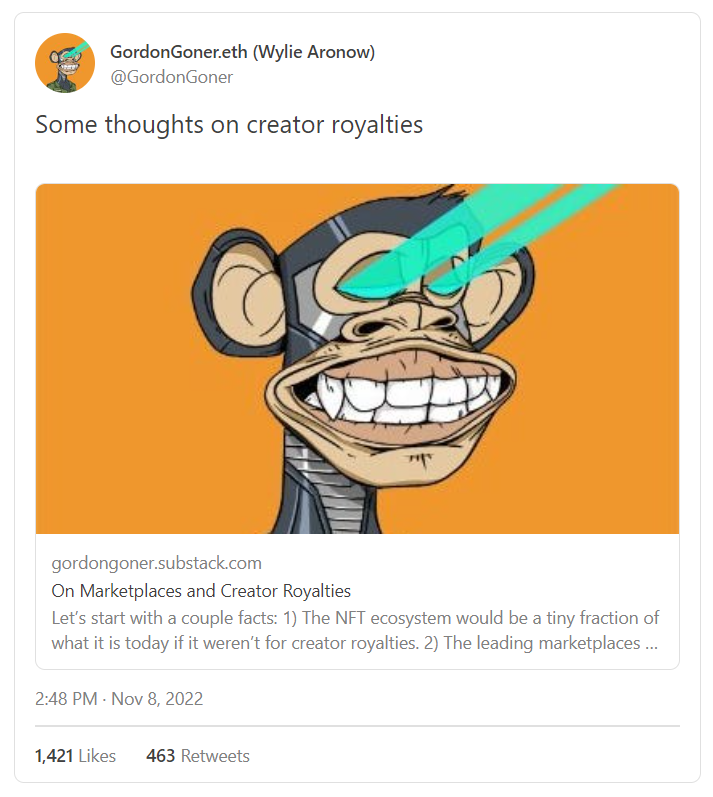
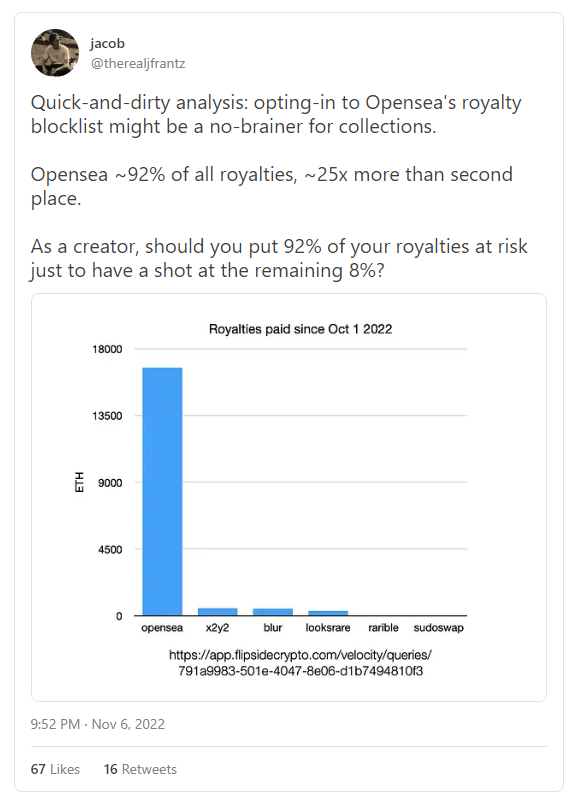
Others have noted that upon closer inspection of recent royalty statistics, OpenSea’s on-chain royalty list represents “low-hanging fruit” for NFT projects.
Regardless of OpenSea’s decision next month, one thing is clear: all NFT marketplaces need to clarify their royalty stances so creators can always decide where best suits them.
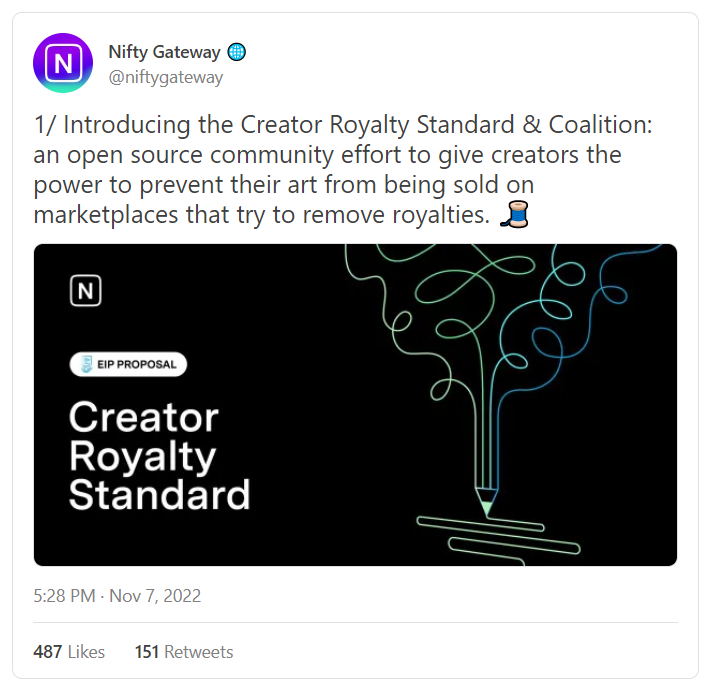
For example, Nifty Gateway recently announced it will forever respect NFT royalties and published its own Creator Royalty Standard proposal. Going forward, other marketplace platforms are likely to follow with similar breakthroughs on this issue.
Toward More Customized NFT Marketplaces
Different types of NFTs trade differently.
For instance, profile picture (PFP) projects like BAYC are highly liquid and have high trading volumes. In contrast, a unique crypto artwork, such as an early XCOPY NFT, tends to be illiquid with low trading volume.
These differences create distinct dynamics: large-volume collections thrive on royalty-optional platforms like Blur, while one-of-a-kind works continue to dominate on royalty-friendly platforms like Nifty Gateway and SuperRare.
But what about projects that fall between these two extremes—such as Art Blocks, XCOPY’s Grifters, or Finiliar?
Artistry is absolutely central, yet their NFTs trade more like high-volume collections than rare singular pieces. Should these creators forfeit their royalties simply because their works trade on optional or no-royalty platforms?
I object. Creators should earn this income. That’s what I tell every artist regarding NFT royalties. But what is truly the best path forward—for both large and small creators alike?
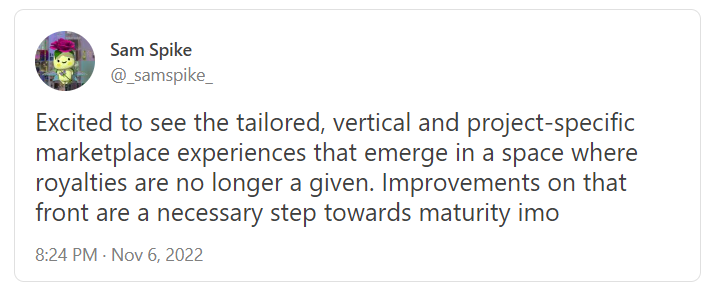
In my view, the answer lies in custom, creator-owned NFT marketplaces.
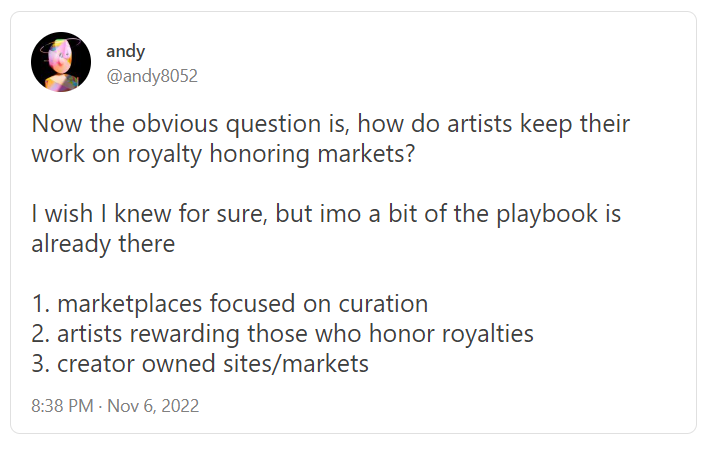
In other words, the future may see every artist and project operating their own customized marketplace, tailored to their specific NFT needs—including royalty requirements.
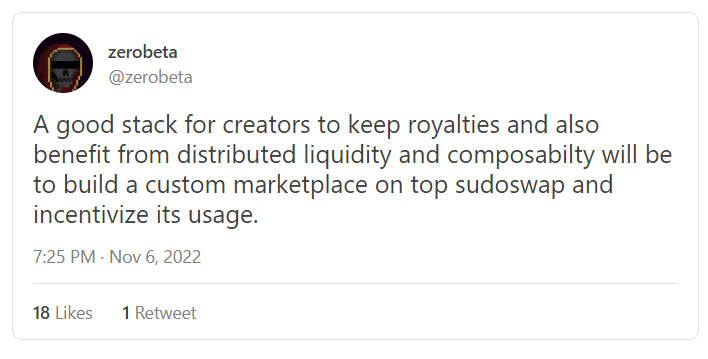
Whether built atop underlying infrastructures like sudoswap, Reservoir, Zora, or others, these creator-owned markets—managed individually or through artist DAOs—can offer incentives such as NFT airdrops to concentrate trading activity and better ensure ongoing royalty payments.
What exactly should be done?
-
Make your marketplace the primary destination for your work, so fans come here to trade when they must—or want to.
-
Expect that as innovation around NFTs continues, creating these DIY, royalty-friendly markets will become increasingly easy.
Why Does This Matter?
Galaxy’s research division recently estimated that nearly $2 billion in NFT royalties have already been paid on Ethereum. In my opinion, this figure stands as one of the greatest achievements of the young crypto economy, delivering life-changing income to countless creators—and reminding us that we can live in a world where creativity is deeply valued.
In a sense, the discussion around NFT royalties has only just begun. But I know many will continue fighting to help creators secure royalties, and I believe many of these artist-owned markets can serve as powerful answers. We’ll just have to wait and see!
Join TechFlow official community to stay tuned
Telegram:https://t.me/TechFlowDaily
X (Twitter):https://x.com/TechFlowPost
X (Twitter) EN:https://x.com/BlockFlow_News