








Web3 Games Big Speculation – Thoughts on SLG in Web3 Gaming
TechFlow Selected TechFlow Selected
Web3 Games Big Speculation – Thoughts on SLG in Web3 Gaming
SLG might be more suitable for blockchain games.
 Navigating Web3 tides with focused insights
W Labs Editor's Note:
Last week I wrote about my thoughts on SLG games in the blockchain gaming space. Coincidentally, Xiao Fei has just completed a research piece on SLG games—readers can cross-reference the two. Xiao Fei is a core member of W Labs, a professional in the WEB3 industry, and also an experienced blockchain gamer. At the recent Singapore Token2049 blockchain gaming hackathon, Xiao Fei was part of the W Labs judging team, reviewing over a dozen projects within a week and providing detailed feedback. Readers are welcome to follow Xiao Fei on Twitter: @daifei520
I
Six months ago, I believed that building an SLG project in the blockchain gaming space would be extremely difficult.
Why is it so hard?
At the time, this judgment was based on the characteristics of the WEB2 SLG game ecosystem:
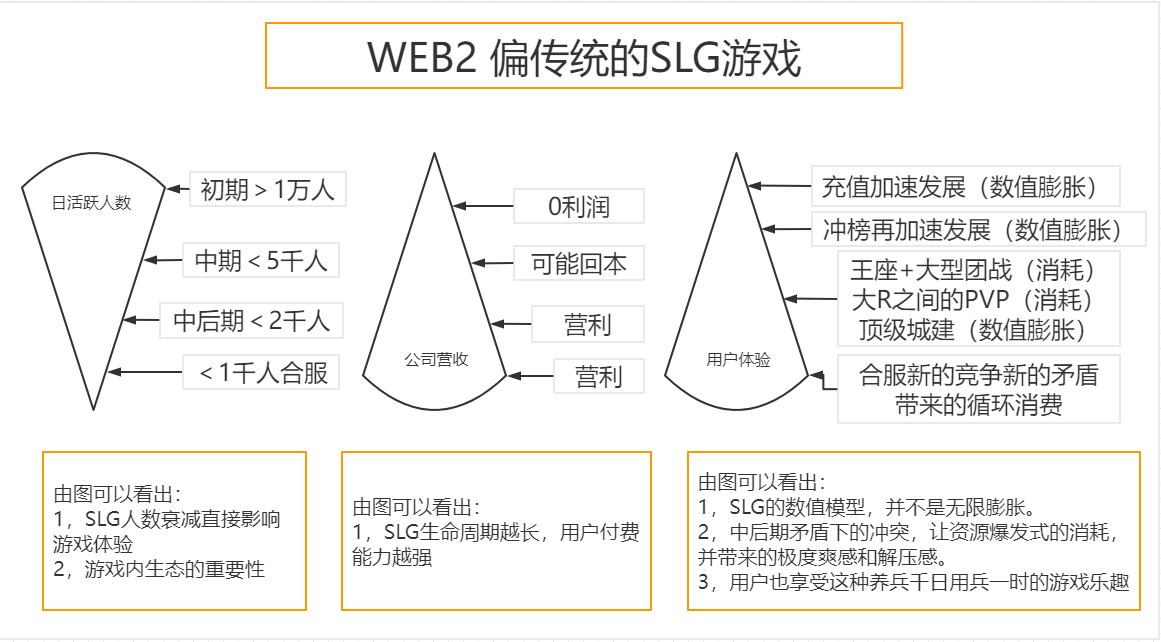
1. SLG games require establishing a game ecosystem first—early user retention needs to be strong, with diverse user tiers and balanced alliances. Conflicts and tensions develop gradually over time. Under such conditions, the game does not generate revenue in the early stages.
2. After about six months, players build social relationships within the game—genuine interactions emerge, such as brotherhood, chivalry, scheming, and betrayal. Conflicts escalate to their peak: fighting for thrones, intense battles, going all-out. This translates into instant troop deployment, instant resource generation, instant speed-ups, instant recovery—all purchased with money. Spending tens or even hundreds of thousands brings pure exhilaration.
3. After each major battle, many alliances disband and users churn. The power gap between alliances becomes too large. Once one dominant alliance emerges, the ecosystem becomes unbalanced. Eventually, there are no more fights to engage in, no outlet for emotions—players lose interest.
4. A server starting with 10,000–20,000 players feels exciting—you can always find someone weaker to dominate. The open world appears vibrant and lively. But when active players drop to 2,000–3,000, server merging becomes necessary.
Therefore:
1. WEB2 SLG games heavily depend on in-game ecosystems. Can blockchain-based SLG games establish such ecosystems?
2. A single server ideally requires at least 1,000 daily active accounts. How many daily active users can a blockchain SLG attract?
3. It typically takes three months to half a year before user spending starts increasing significantly. Can a blockchain SLG sustain a lifecycle beyond three months with continuously growing player expenditures?
All signs indicate that applying WEB2 thinking to SLG game development is extremely challenging.
Despite these challenges, some WEB3 game developers continue exploring the SLG genre—which is truly admirable.
II
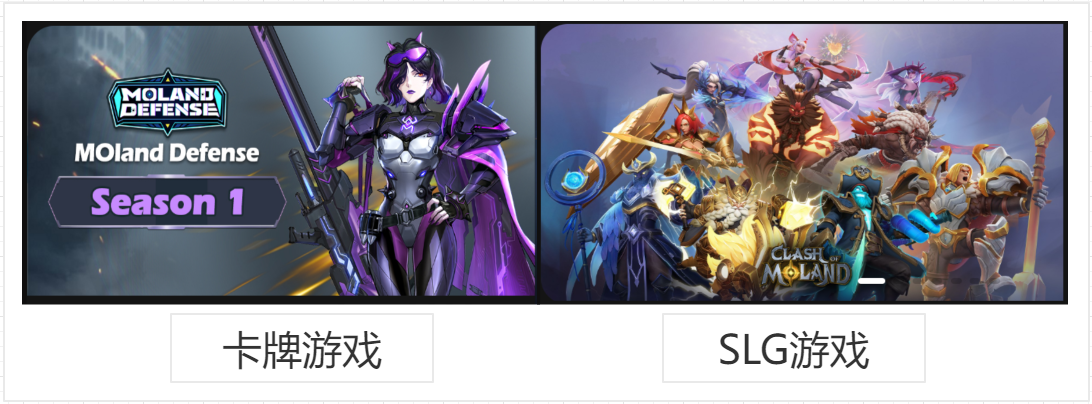
Previously, I played "MOiand Defense," a tower defense (TD) card-building game developed by the MOBOX platform, which pioneered its own distinct blockchain gaming model.
In fact, they are exploring a rapid blockchain integration framework built upon a platform-native token system.
During the National Day holiday, I had ample free time and decided to try out the platform’s latest SLG blockchain game, "Clash of MOland," near the end of its season. This game inherits the proven and mature blockchain mechanics from "MOiand Defense." While not everyone enjoys this model—I personally wasn’t fond of it initially—it remains a viable and sustainable business approach. There are also signs of evolution and innovation, for example:
In the following examples, we exclude return-on-investment calculations related to leaderboard rewards—we’ll explain why later.
In the card game "MOiand Defense," users spend the native token to buy gold for card draws. Card quality has no impact on ROI (yes, ROI is unrelated to card strength—this is important). Originally, the ROI was variable: spending 100 might return anywhere between 20 and 80—the exact numbers are fuzzy now. Currently, spending 100 returns a fixed 50. The rest comes from daily dungeon runs (akin to mining), where sub-token rewards are fixed based on spending tier. In summary: excluding leaderboard rewards, ROI is fixed. Earning model: dungeon mining for sub-tokens + cashback in native tokens from gacha.
In contrast, in the SLG game "Clash of MOland," users directly spend the native token to draw cards, and card quality directly affects ROI—a key difference. If you spend 100 and draw several top-tier cards, those cards will release more native and sub-tokens faster. With lower spending and higher returns, your payback period is naturally shorter compared to someone who spends 1,000 to obtain the same number of top cards (monument token releases can also be seen as mining). Summary: excluding leaderboard rewards, ROI is variable. Earning model: monuments mining native and sub-tokens.
More detailed comparisons below:
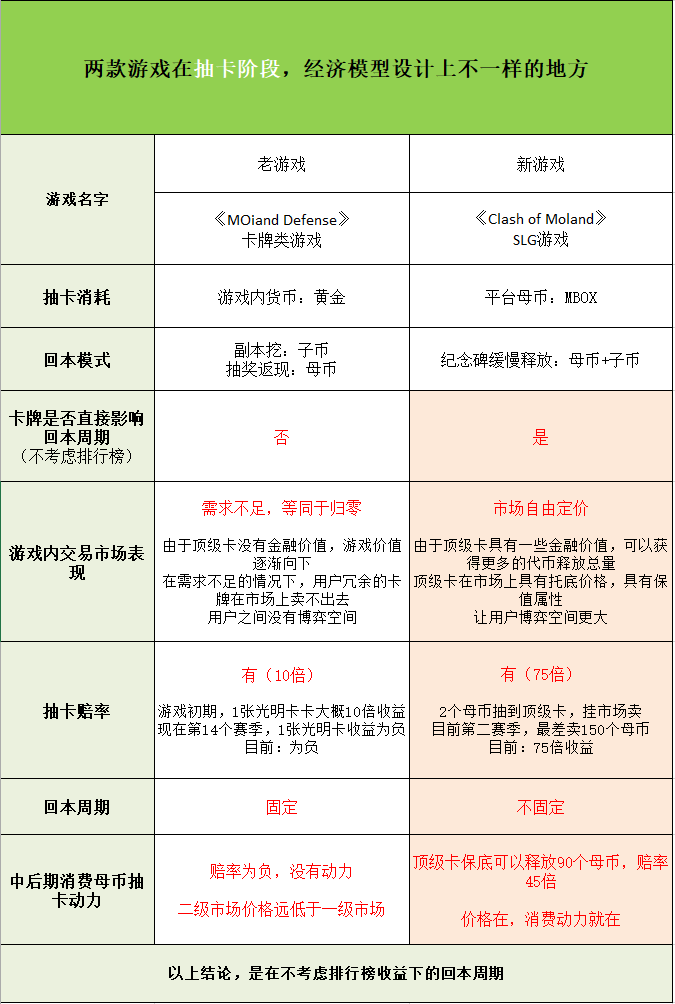
Gacha Comparison
Due to different mining methods and variable ROI, users can clearly perceive these as two games with fundamentally different monetization models.
This explains why we’re excluding leaderboard rewards from our analysis—they create similar user experiences across both games, so we won’t discuss them here.
Another critical difference—one that likely generates significant user feedback—is as follows:
In "MOiand Defense," the in-game marketplace prices for top-tier cards are too low, lacking demand and liquidity. The gacha payout ratio is negative, so users have no incentive to keep spending native tokens on pulls.
In "Clash of MOland," top-tier cards are guaranteed to release 90 native tokens. At 2 native tokens per pull, that’s a 45x payout ratio. With a floor price established, user-driven demand emerges, creating a functioning market. Even in the worst case, after 3–4 seasons, once all native tokens are released along with seasonal sub-token distributions, players can eventually break even—there’s visible hope in the ROI timeline. As a result, users aren’t afraid of losing money on gacha; instead, the high-payout top cards actually stimulate greater spending and engagement.
Based on this comparison, I’d boldly suggest that the MOBOX team approaches blockchain game design with exceptional seriousness—among the best in the crypto space. Their explorations across different models and lessons learned from past failures represent invaluable experience.
Not financial advice—just sharing insights from personal research.
III
What exactly do SLG games offer?
Compared to MMORPGs, SLGs are vastly simpler to understand and play. That’s why early SLG adopters were often older players—they appreciated the straightforward mechanics.
At its core, an SLG revolves around city-building and combat. Combat is central—even a game with minimal city-building can work (e.g., "Liu Shu Zhi Bin" takes city-building to the extreme).
So what do SLG players really engage with? Resources—the production and consumption of resources. City-building involves resource input and output. The open world, PvP, neutral cities, and thrones—all revolve around resource flows.
Resource production and consumption—does that sound familiar? What does an economic model revolve around if not token supply and demand?
Isn’t that strikingly similar?
Both also require an ecosystem: SLGs need a game ecosystem, while economic models need a community ecosystem—the foundation for both is people.
Again, isn’t that very similar?
After rethinking all this, I realize SLG games are actually well-suited for blockchain adaptation.
IV
If you were to design a blockchain-based SLG game, how would you approach it?
Or let’s indulge in some speculation—where could blockchain SLG games truly shine?
1. Based on PvP mechanics, could various tokens, public chains, sectors, and blue-chip NFTs be packaged as factions or heroes, competing together to capture BTC? Could this enable effective cold-start adoption?
2. SLGs rely heavily on in-game ecosystems, which depend on emotional investment from players and alliances. These emotional dynamics align closely with community-building efforts we often emphasize. Game developers could simultaneously cultivate both game and community ecosystems—building them hand-in-hand. If the SLG ecosystem thrives, the community ecosystem will likely succeed too. How good could it get? At minimum, it wouldn’t be bad—and in a blue-ocean market, “not bad” could mean “very good.”
3. A blockchain SLG could evolve into a metaverse project. City-building and expansive worlds naturally align with metaverse concepts. The development path is clear, consensus is easier to build, and grand visions are simple to articulate.
Thematic packaging enables cold starts, community ecosystems follow a clear roadmap, and ambitious narratives come easily.
Boss, this plan guarantees no losses—wanna invest?
Not financial advice.
Reposting is welcome. Original content is hard to produce—please credit "W Labs" as the source.
W Labs Website: http://www.wlabsdao.com/
W Labs Discord: https://discord.gg/wggdao
W Labs Twitter: https://twitter.com/GuaTianGuaTian
W Labs In-depth Research Articles on Mirror: https://mirror.xyz/iamwgg.eth
W Labs Medium: https://guatianwgg.medium.com/
Join TechFlow official community to stay tuned
Telegram:https://t.me/TechFlowDaily
X (Twitter):https://x.com/TechFlowPost
X (Twitter) EN:https://x.com/BlockFlow_News
 瓜田实验室W Labs






