








How should crypto project founders market and drive growth?
TechFlow Selected TechFlow Selected
How should crypto project founders market and drive growth?
What is effective marketing in a bear market?
 Navigating Web3 tides with focused insights
Written by: Matti
Translated by: TechFlow
Recently, we spoke with a founder struggling with how to promote his project. He tried gaining attention on Twitter and spent $20,000/month on a marketing team, yet saw no results.
Founders are essentially builders. He’s a technologist whose product is genuinely useful, has meaningful vision, and solves real problems for other developers. Also, this isn’t a D2C (Direct-to-Consumer) product—it’s B2B (Business-to-Business). So why should he worry about not having enough followers?
Marketing in a bear market is fundamentally different from marketing in a bull market. That’s why I decided to write this short article explaining what I believe works—and what doesn’t—in effective marketing.
Where Is the Heart of the Community?
A community is a Meme.
Few projects have large, loyal, and actively engaged user communities. The diagram below shows a simplified breakdown of a typical cryptocurrency community:
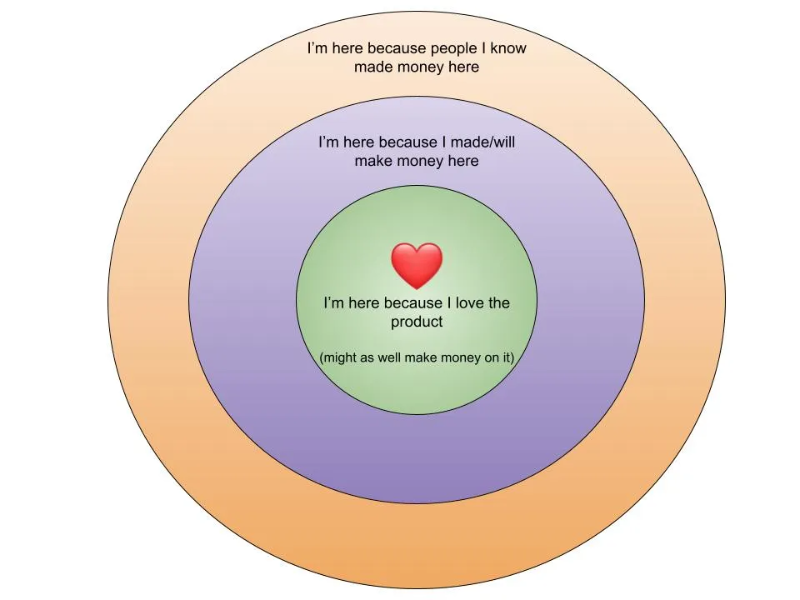
The “heart” of the community is what project teams must focus on.
Ideally, "I'm here because I like this project" equals "I'm here because I enjoy using this product." The rest aren't that important, as their engagement usually depends on whether they can profit from the token.
In a bear market, rallies are fleeting.
That’s why the first priority must be identifying where the heart of your community lies.
This could be just 10 to 100 people—developers and advanced users—who will stick with you as long as there's potential for success in what you're building. If you haven’t found them yet, you’d better start looking immediately.
Many assume that having more Discord members or 100k Twitter followers is crucial. But what really matters is how many people truly care about your product—those who interact with it regularly and enthusiastically tell their friends how cool it is.
Projects with a strong core user base are best positioned during market downturns to iterate toward better Product-Market Fit (PMF).
Getting Started
Suppose you’re a founder who just launched a testnet and new documentation showcasing how great your product is.
Then, here’s where you shouldn’t spend money on promotion:
-
Marketing agencies
-
Marketing teams
-
PR articles
-
Setting up booths at branded events
-
Social media ads
And here’s where you shouldn’t waste energy:
-
Obsessing over likes and follower counts,
-
Worrying about token price (if you have one),
-
Publishing a 50-page whitepaper explaining why your project is amazing, hoping people will actually read it.
What you need to do instead: attend low-budget meetups,and find your core audience. Whether four, ten, or twenty people—even if they’re hackers—these individuals are extremely valuable.
-
For users, nothing replaces hearing directly from the founder.
-
For founders, this can be very time-consuming, but if you haven’t yet found the “heart” of your community, you must commit to it. Talk to everyone you meet. Explain the problem you’re solving and help them understand how their lives will improve tenfold because of what you’ve built.
This is far more valuable than posting a tweet that people will forget in five minutes.
Outbound outreach early on is a responsibility most founders must shoulder for a period, aiming to catalyze the formation of their core community. It’s only once you’ve established the heart of the community that organic growth becomes possible. Only then should community managers and marketers come into play.
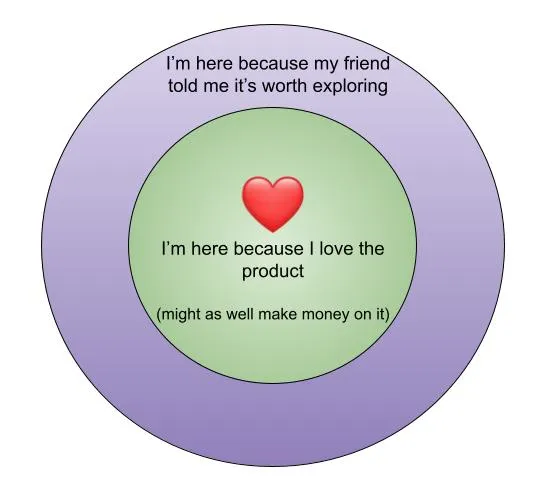
Some founders are lucky—they already have a core community from day one. Others don’t, especially if they aren’t native to the crypto space.
Crucially, a small, loyal community is better than a large, disengaged one. Tight-knit communities communicate better, iterate faster, and provide a solid foundation for future growth.
Scaling Communication
Think of your core community as your innovation. When early adopters join, they act as glue.
But how do you attract the next wave of users?
First, your core community does much of this work for you. If they’re genuinely excited about the product, they’ll tell people around them. Word-of-mouth really works—NPS (Net Promoter Score) is known as a key predictor of user growth for startups. Crypto is no exception.
Whether your existing users/community would recommend your product to friends is critical. Assume you’ve built a great product—once people start using it, they quickly realize its benefits.
If you’ve done your initial outreach well, now it’s time to scale your messaging.
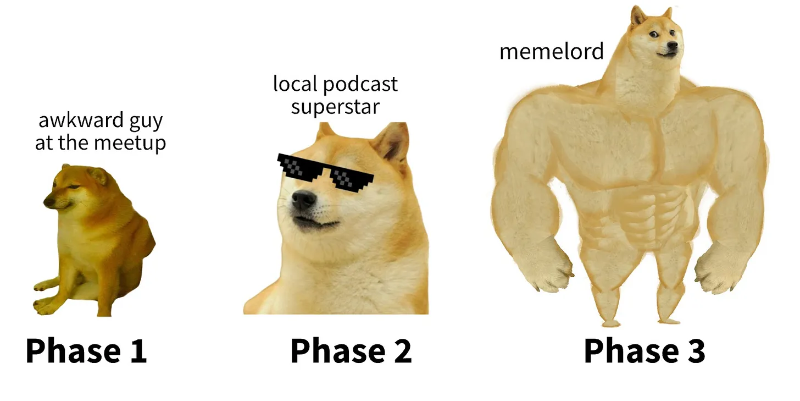
Whitepapers demand too much from users; tweets are efficient but highly competitive.That’s why I recommend podcasts.
There are many crypto-focused podcasts, and people love listening to them. Again, I suggest avoiding major podcasts and instead targeting niche ones.
Choose a niche podcast—even with only 100 or 1,000 dedicated listeners—and you’ll likely see better results. Only when your core community reaches a threshold capable of “absorbing” new members does a Meme emerge.
Meme Meets Product
Chainlink and Synthetix were successful projects during the last bear market.
Both had existing products that attracted users—one succeeded better in incentives; the other achieved ample liquidity through listings on top exchanges.
However, the prerequisite for their success was having both a product and a core community.
Then came the Meme.
LINK and SNX became marketing powerhouses, spreading awareness across crypto Twitter and continuously attracting new users.
A Meme needs virality—a funny image alone won’t cut it. If you have substance (a product), you need a vehicle for the Meme. This is where your early adopters come in. Their presence signals it’s a good time to build or hire a marketing and business development team.
How do you create a good Meme?
I don’t know—there’s no exact formula.
Good Memes rely on simplicity and strong emotional appeal.The best Memes are often collaborative creations—communities organically remix inside jokes and product messages into shareable content. Manufactured, non-organic Memes don’t spread. They’re not true Memes—they’re just images incapable of carrying key messages across forums and social media.
Bribing Users
In bull markets, pay users to use your product. This qualifies as creating decent user experiences. Liquidity mining rewards and airdrops defined 2020/21. But in hindsight, we can conclude that free giveaways are unsustainable in the long run.
Much of the appeal in DeFi, NFTs, and GameFi was pure speculation—Ponzi schemes clearly worked. Yet, once you go down this path, you must eventually correct course: introduce sustainable tokenomics and convert speculators into actual users.
Indeed, Synthetix emerged from the bear market via its liquidity mining incentive program—an arguably revolutionary user acquisition strategy. But today, beyond DeFi, projects should carefully consider early-stage token distribution as a growth tool.
Tokens are a marketing tool—but again, distributing tokens before achieving solid PMF is rarely wise. If you still want to reward early users, consider creating a gamified in-app token that grants eligibility for real tokens later.
Summary
Assume you’re a founder with a great product but lacking an audience. The best way to market during these tough times is:
-
Engage directly with people facing the problem you’re solving—ideally in person—at small gatherings and through direct conversations.
-
Once you’ve built a small group of loyal users/community contributors, expand your reach by targeting niche podcasts, writing concise blog posts, and hiring community staff.
-
Once you’ve identified and integrated your early adopters into the community, the Meme phase begins. Now is the time to build marketing and business development teams.
-
If you have a token and plan to use it for user acquisition, avoid deploying it too early. Design it thoughtfully—free giveaways don’t work.
This advice isn’t limited to bear markets.Generally, this represents healthy marketing practice in the crypto space.
In bull markets, even the dullest narratives can ignite infinite returns—price comes first, everything else second.
In bear markets, founders should focus on turning remaining interested speculators into actual users.
Moreover, the sequence of execution becomes increasingly important. Premature marketing efforts may yield no return. Stay lean, keep building, and grow gradually.
Join TechFlow official community to stay tuned
Telegram:https://t.me/TechFlowDaily
X (Twitter):https://x.com/TechFlowPost
X (Twitter) EN:https://x.com/BlockFlow_News






