








DID and On-Chain Reputation Landscape: 9 Key Sectors and Projects to Watch
TechFlow Selected TechFlow Selected
DID and On-Chain Reputation Landscape: 9 Key Sectors and Projects to Watch
An explanation of 9 on-chain identity application areas and an introduction to related projects.
 Navigating Web3 tides with focused insights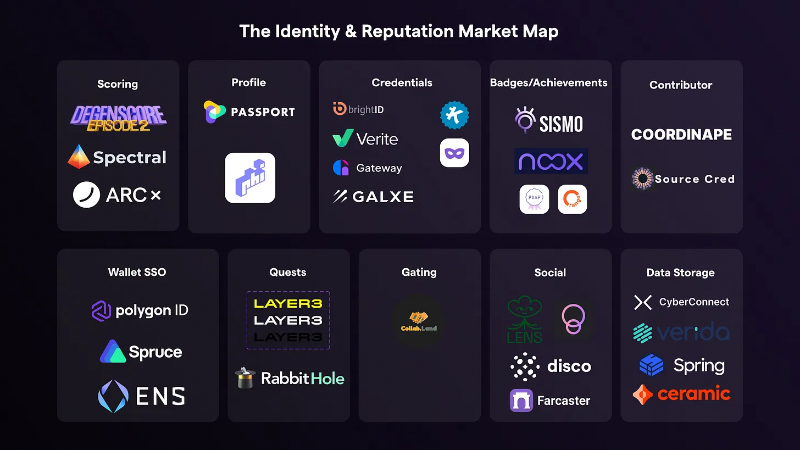
Author: Kerman Kohli, Founder of ARCx
Translation: TechFlow
Over the past two years, I’ve spent nearly every waking moment thinking about on-chain identity and how to make it a reality.
Yet, along the way, I failed to realize that for most people in crypto, on-chain identity remains more of a meme or vision than something tangible.
There’s very little understanding and knowledge about how this space actually works, who the key players are, and what frameworks can be used to think about it conceptually.
Therefore, I believe summarizing the various segments of this field and explaining how they operate will help deepen crypto natives’ understanding of it.
Badges/Achievements
When discussing on-chain identity, one of the most frequently mentioned concepts is badges or achievements. My definition for this category is: tokens/NFTs received after completing on-chain or off-chain activities.
Based on this, I classify the following projects under this category:
-
Sismo —— Sismo is a modular proof protocol deployed on Polygon, focused on decentralization, privacy, and utility. It issues proofs in the form of badges (non-transferable tokens/SBTs). We can mint these badges on their application platform.
-
POAP —— POAP is a protocol that preserves memories as digital records, minted on the blockchain as non-transferable tokens based on the ERC-721 standard.
-
Orange Protocol —— Orange is a reputation and trust minting protocol that aggregates data and Web3 credibility models to generate comprehensive reputation proofs in the form of verifiable credentials and NFTs.
-
Noox —— Noox is a platform where you can mint your on-chain achievements as SBTs.
Credentials/Certifications
Compared to badges/achievements, credentials/certifications typically require third-party entities to verify the claim. This could be any third party, whether verifying your real-world identity via KYC details or confirming you're a certified software engineer. The certification space offers many compelling aspects because it often provides the strongest signals related to an address.
Each startup working in this area approaches the problem from a different angle:
-
Galxe —— Galxe is a Web3 data credential network that enables brands and developers to engage communities and build robust products within Web3.
-
BrightID —— BrightID is a decentralized, open-source social identity network that allows individuals to prove to applications that they aren't operating multiple accounts.
-
Gateway —— Gateway is a Web3 certification network that creates proofs for your work and skills, enabling you to build a Web3-native resume.
-
Zorro —— Zorro is a Web3 citizenship proof protocol. Through it, individuals can prove their real existence and gain voting rights in DAOs and other benefits.
-
Verite —— Verite consists of data models, protocol recipes, and open-source software. It successfully links identity verification with cryptocurrency financial experiences.
-
Krebit—— Krebit is a reputation scoring platform offering fully decentralized, community-verified credentials.
Profiles
The defining feature of the profiles segment is: aggregating all your information and displaying it in one place. The functionality of such interfaces may vary depending on the intended purpose of the profile. Profile products can also act as aggregators, bringing everything together in a single location. Gitcoin Passport is one example.
The following products illustrate the role of different profile systems:
-
Gitcoin Passport —— Gitcoin Passport is a digital ID product that confirms internet-based identities using verifiable credentials without storing personally identifiable information (PII).
-
Phi —— Phi visualizes on-chain identity and creates a metaverse land system built on common Web3 building blocks such as ENS domains and wallet activity.
Social
Social has arguably been one of the most popular sectors over recent months. The social sector refers to creating social media networks/platforms using users' public keys as identity foundations. Creator disenfranchisement with centralized platforms has prompted many to reconsider Web2 social networks.
While still a small category, its future potential is significant:
-
Lens Protocol —— Lens Protocol is a composable and decentralized social graph designed for builders.
-
Farcaster —— Farcaster is a fully decentralized social network—an open protocol like email, supporting multiple clients.
-
Orbis —— Orbis is a suite of social data models integrated with decentralized infrastructure, featuring advanced SDKs and flexible modules to enable fully composable social experiences.
-
Disco —— Disco is a profile system and data backpack. Your profile displays social media accounts and Web3 credentials.
One-Click Login
In terms of transforming the fundamental architecture of the internet, one of crypto’s greatest utilities may be replacing the cumbersome email/password sign-up and login process.
Startups in this segment focus on lowering the barriers to identity verification and infrastructure access:
-
Spruce —— Spruce is a toolkit for decentralized identity, composed of DIDkit, Rabase, Keylink, and Credible, supporting signing, sharing, and verifying trusted information.
-
ENS —— The Ethereum Name Service (ENS) is a distributed, open, and extensible naming system built on the Ethereum blockchain.
-
PolygonID —— PolygonID is a blockchain-native identity system with programmable privacy. It offers on-chain verification and permissionless proofs.
Scoring & Attribution
From my experience, this is a technically challenging segment to execute. However, it may well be opening up new design spaces for novel applications.
The scoring and attribution segment involves running continuous computations over large datasets to assign scores or attributes to users’ wallets. Compared to static badges and achievements, this category is dynamic and holds greater commercial potential.
An example of attribution is identifying where your users come from and assessing their value to you:
-
ARCx —— A reputation-based decentralized credit market in DeFi. Using a DeFi credit score, ARCx allows users to borrow up to 100% LTV against ETH collateral.
-
Degen Score —— Degen Score is a scoring protocol that rates users based on their on-chain behavioral history.
-
Spectral —— Spectral is a credit scoring protocol that calculates your creditworthiness using on-chain transaction data.
Tasks & User Acquisition
If not constrained by Sybil attacks, tasks represent an opportunity for open, crypto-native user acquisition channels. Acquiring users based on certain aspects of their on-chain reputation (badges, credentials, and/or scores). We’ve already seen early signs of success in this area, but the biggest ongoing challenge remains acquiring meaningful users and retaining them. Liquidity mining and airdrops are quite similar to this category—though there are differences, their objectives are largely aligned.
-
Layer3 —— Layer3 is a protocol hosting bounties in the form of tasks, all related to Web3—such as sending tokens on Polygon or using lending protocols.
-
Rabbit Hole —— Rabbit Hole enables users to earn rewards by completing Web3 tasks. Some protocols partner with Rabbit Hole to distribute their tokens to users who have proven their value.
Contributors
DAOs and contributors face the same challenges as traditional organizations: despite diverse backgrounds, how do we find people to hire, ensure they’re capable, and maintain that capability?
Startups focused on identity are optimizing solutions for these problems and their derivatives:
-
Coordinape —— Coordinape is a scalable and permissionless decentralized compensation platform built for DAOs.
-
SourceCred —— SourceCred is a tool for DAOs and open-source communities to measure and reward value creation.
Storage
Due to the complexity of personal identities and the richness of associated information, storage has become a critical component. Self-sovereignty over data and decentralization are the two major themes in storage. This is also highly technically challenging, requiring integration across consensus mechanisms and large-scale datasets.
Several promising solutions are making strong progress in addressing this issue, and I’m personally very excited about them:
-
CyberConnect —— A decentralized social graph protocol that returns data ownership to users and helps developers build Web3 social applications.
-
Spring —— Spring Labs leverages its patented, ultra-secure cryptography and tokenization solutions to help customers store and share sensitive data without exposing any personally identifiable information (PII).
-
Verida —— Verida is a multi-chain protocol for interoperable database storage and messaging. Built on decentralized identity, personal data is owned and controlled by users.
-
Ceramic —— Ceramic is a decentralized data network that brings infinite data composability to Web3 applications.
Conclusion
As you can see, activity in on-chain identity and reputation is extremely vibrant. Today, the crypto world offers numerous solutions to challenges arising during the development of this domain.
This article provides a brief overview of each category and explains what they entail.
In the future, I’ll dive deeper into how these segments interconnect and what value they ultimately deliver to users when combined.
Join TechFlow official community to stay tuned
Telegram:https://t.me/TechFlowDaily
X (Twitter):https://x.com/TechFlowPost
X (Twitter) EN:https://x.com/BlockFlow_News
 @kermankohli






