








Will Cosmos be the ultimate answer for super Dapps?
TechFlow Selected TechFlow Selected
Will Cosmos be the ultimate answer for super Dapps?
Crypto never lacks stories, and Aptos has contributed an incident.
 Navigating Web3 tides with focused insights
Crypto never lacks stories, and Aptos has contributed an incident.
The power of the Move ecosystem should not be underestimated. Following Aptos' mainnet launch are projects like the domain service Aptos Names, wallet Pontem, multisig wallet Momentum Safe, NFT marketplace Souffl3, and lending protocol Argo.
This is the first time so many applications have launched simultaneously with a mainnet—an extraordinary sight where traffic and ecosystem anxiety, which plague other blockchains, seem absent on Aptos.
But is this the end of the story?
R3PO believes otherwise. At least in terms of the overall blockchain landscape, the next era will be the germination and explosion of super Dapps, and the debate between monolithic versus modular architectures is far from over.
Chinese entrepreneurs once again stand at a pivotal moment—will they continue clinging to outdated models hoping for a turnaround, or follow in the footsteps of ancestors who ventured southward, traversed the Silk Road, and eventually spread across the world, stepping into truly expansive global frontiers?
From the gathering of elites at Token 2049 in Singapore emerged collective frustration and discontent, while the scarcity of Chinese developers at DevCon in South America reflects our lingering attachment to home comforts. Yet, the times are offering Chinese builders a new opportunity—the rise of super Dapps.
Such seizing of opportunities amid crisis has repeatedly occurred across generations of Chinese entrepreneurs. R3PO has reviewed history—from dominating up to 90% of Bitcoin's hash rate, to sweeping the globe during the exchange era with HBO (Huobi, Binance, OKX), to making waves in the NFT space with X2Y2 and Element—all witnessing that the synergy between Chinese teams and Web3 lies precisely in application development and operational excellence.
A fundamental current assessment is that the foundational layers of Web3 have been largely built. Escaping futile internal competition, the path forward for survivors inevitably leads toward billion-user-scale super Dapps.
R3PO summarizes the current competitive landscape of Web3 as follows—stripping away irrelevant historical ripples, the historical trend has never been clearer:
High-performance blockchains feature Ethereum’s vertical layering model, Cosmos’ horizontal segmentation model, and the parallel processing model of the Move ecosystem.
DeFi ecosystems see long-standing coexistence among leaders; super Dapps are already taking shape. Uniswap has become the source of depth for other aggregating DEXs, while dYdX prepares to migrate onto a Cosmos app chain.
NFTs are entering a regulatory phase—an initiation ritual previously experienced by Ripple and Binance—where compliance remains the gateway to broader markets.
What remains missing today are truly massive applications with millions or even hundreds of millions of daily active users.
R3PO believes the ultimate breakthrough will emerge either within the Ethereum ecosystem or on Cosmos. The case for Ethereum’s success needs no elaboration, but in the Cosmos 2.0 era, technical features and mechanisms specifically designed for super Dapps will carry another kind of hope.
We hope Chinese entrepreneurs can build genuinely great global Web3 applications atop it, just as they did during mining and exchange eras—only this time targeting a trillion-dollar market serving seven billion people.
Creating Something from Nothing: Cosmos 2.0's Traffic Model
To date, blockchain development has gone through three waves: single-purpose chains represented by Bitcoin, then modular functional chains such as Polkadot and Cosmos starting around 2016, followed by Ethereum’s layered ecosystem approach. History proves that Ethereum’s path has been the most successful—ecosystem vibrancy forms an absolute moat capable of offsetting any disadvantages.
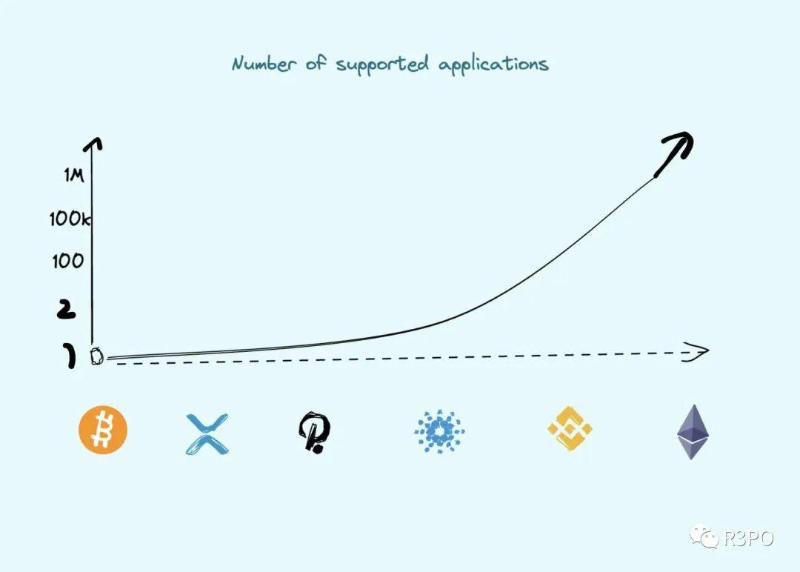
Image caption: Number of Dapps supported by blockchains Image source: R3PO
Currently, only Ethereum can truly run and sustain a million-plus Dapp ecosystem, maintaining high activity and continuous growth, whereas Bitcoin and Ripple represent relics of a past era, conceived as blockchains dedicated to one specific function—such as Ripple for cross-border payments.
Polkadot and Cosmos 1.0 foresaw the future of Dapps, but Polkadot fails to resolve efficiency issues when running multiple Dapps collectively. Its so-called limit of ~100 parachains makes building application layers atop them overly complex and unwieldy, falling short of clear success.
Cosmos’ plan was to directly develop application-specific chains, with Cosmos Hub handling only basic functions and exerting zero control over individual chains—arguably the purest form of decentralization.
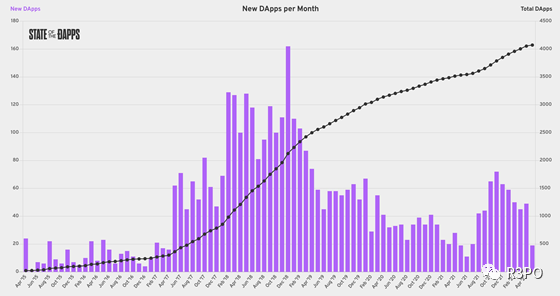
Image caption: Monthly new Dapp count on Ethereum
Ethereum benefits from capital and application accumulation creating a tidal effect. Other blockchains remain unable to escape dependence on Ethereum. Attempts to convert Ethereum’s traffic via EVM compatibility, cross-chain bridges, cheaper fees, and higher efficiency—the classic trio—have consistently failed.
Ethereum stands firm; new blockchains come and go like water.
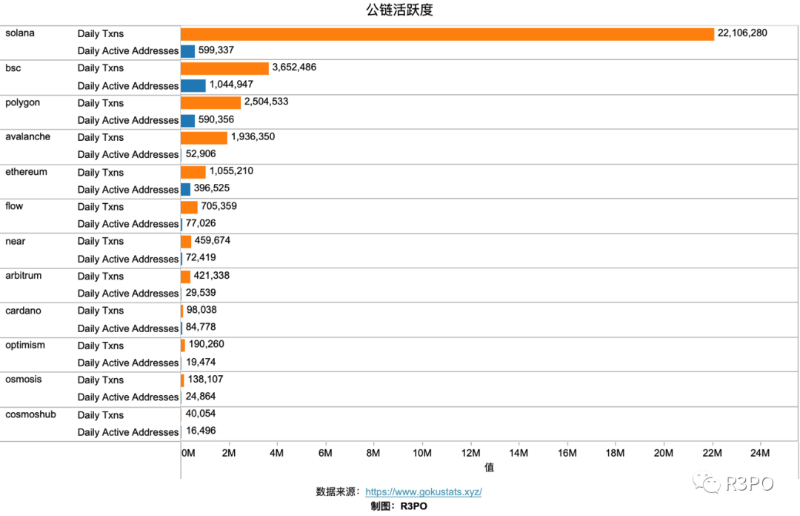
Image caption: Activity levels across major blockchains Source: R3PO
Judging purely by metrics, Ethereum isn’t technically superior—slower than Solana, fewer transaction addresses than BSC—yet all technical advantages ultimately bow before Ethereum’s enduring ecosystem. Only sustained ecosystems retain users and grant chains the strength to survive bull and bear cycles alike.
The latest example is Aptos shutting down its Discord prior to mainnet launch, followed by post-launch TPS reaching merely dozens—far below the heavily promoted claim of over 100,000.
Thus, the core question crystallizes: Where does traffic come from?
R3PO argues that leveraging Ethereum’s traffic is suboptimal; creating super Dapps is the optimal strategy.
Chinese teams excel in application execution. While sometimes lacking in originality, their operational execution surpasses most others. Chains like BNB Chain and OKX Chain are built using Cosmos SDK while remaining EVM-compatible, yet they cannot truly be considered part of the Cosmos ecosystem—they merely exploit Cosmos’ development convenience and Ethereum compatibility.
EVM-compatible chains are essentially sidechains or L2s of Ethereum, ultimately enriching Ethereum’s ecosystem rather than challenging it. However, non-EVM chains aren't doomed to fail.
Take Terra as an example—orchestrated by Delphi, its speed and ecosystem vitality demonstrated Cosmos’ capabilities. Its collapse stemmed from a Ponzi-like economic model, but from a blockchain infrastructure perspective, it still offers valuable lessons. Compared to another prominent non-EVM chain, Solana, Terra had no downtime issues.
Cosmos 1.0 relied on official interchain bridges (IBC) and prioritized application chain tokens over ATOM, attempting cold-start bootstrapping to build organic traffic.
Cosmos 1.0 granted developers maximum freedom—sovereignty meaning full fiscal autonomy. High skies allow birds to fly freely, forming a stark contrast to Ethereum. What kills Ethereum won’t be a better Ethereum, but an entirely new species:
Ethereum’s Problem: Security at a high cost, excluding ordinary users and high-frequency use cases. L2 + ZK + sharding offer short- and long-term solutions, trading time for space.
Cosmos’ Advance: Trading space for time, sacrificing profits to empower individual chains. Hub and ATOM provide security only. Terra, dYdX, and Sei prove viability—past, present, and future.
Cosmos 2.0 focuses on how risks and opportunities for application chains will evolve: Will the future belong to a few dominant super Dapps, or plug-and-play Lego-like components? Will Web3 applications natively become protocols, or mirror traditional Web2 product competition?
R3PO doesn’t have definitive answers, but basic logic applies: First, move beyond platform thinking. Even if super Dapps emerge, they may not capture user-generated profits—as seen with Uniswap, which long kept its fee switch disabled.
Second, protocols and applications aren’t entirely opposed. Fat protocol theory suggests value concentrates at the protocol layer, yet centralized services like Infura (Ethereum API provider) and AWS (node hosting) thrive without undermining ETH prices. User experience hinges on frontends. Competition between protocols and apps centers on frontend traffic—how services are delivered isn’t absolute.
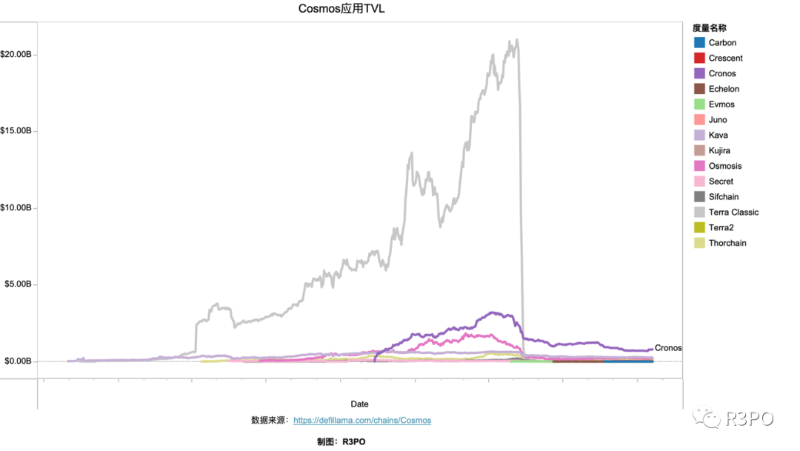
Image caption: TVL of Cosmos-based applications Source: R3PO
Driven by Cosmos’ aggressive “profit-sharing” incentives, applications built on or extending Cosmos have formed a distinctive system—what’s missing is a leading flagship.
The crash of Luna and UST also damaged Cosmos’ previous bull run. A comeback requires a new model system—a complete internal and external reconstruction.
The two key upgrades in Cosmos 2.0 are:
1. Enhancing ATOM’s Value Capture:
Interchain Security (ICS): Cosmos Hub provides security, and application chains "purchase" it using staked ATOM.
Liquid Staking: Expanding the number and types of staking providers—including Quicksilver, Persistence, Stride, and Lido—and enabling liquid staking for both ATOM and application chain tokens.
2. Boosting Network and Interchain Activity:
Interchain Allocator: An on-chain fund allocation mechanism establishing an ecosystem fund managed by the ATOM treasury to promote application growth across Cosmos.
Interchain Scheduler: Enables flexible blockspace arbitrage operations, though practical implementations are still under design.
Taken together, these improvements mean ATOM will become deeply embedded within application chain operations. In exchange for security, app chains cede partial economic sovereignty. As long as the effective tax rate stays below Ethereum’s, the model remains attractive. Meanwhile, proactive distribution mechanisms reinvest ATOM-generated profits back into the ecosystem, creating a flywheel effect to circulate traffic.
Unlike simply attracting top-tier projects like dYdX, the Interchain Allocator can nurture native seed applications such as Osmosis and Keplr—supporting both super Dapps’ demands for security and performance, while also cultivating potential successors to Terra, preventing a single chain’s failure from collapsing the entire ecosystem.
This is no longer passive cold-starting, but emphasizes proactive, intentional operational capability—the very arena where Chinese teams excel. Though Chinese teams didn’t dominate DeFi Summer, in Cosmos 2.0, projects are still in the early land-grab phase—at minimum, the opportunity is abundant.
Cosmos 2.0 lays the foundation for the emergence of super Dapps. Now is the time to step in and prove real capabilities.

From Zero to Infinity: Cosmos’ Economies of Scale
Cosmos’ traffic model is quietly shifting—one that aligns closely with a business model familiar to Chinese entrepreneurs: economies of scale.
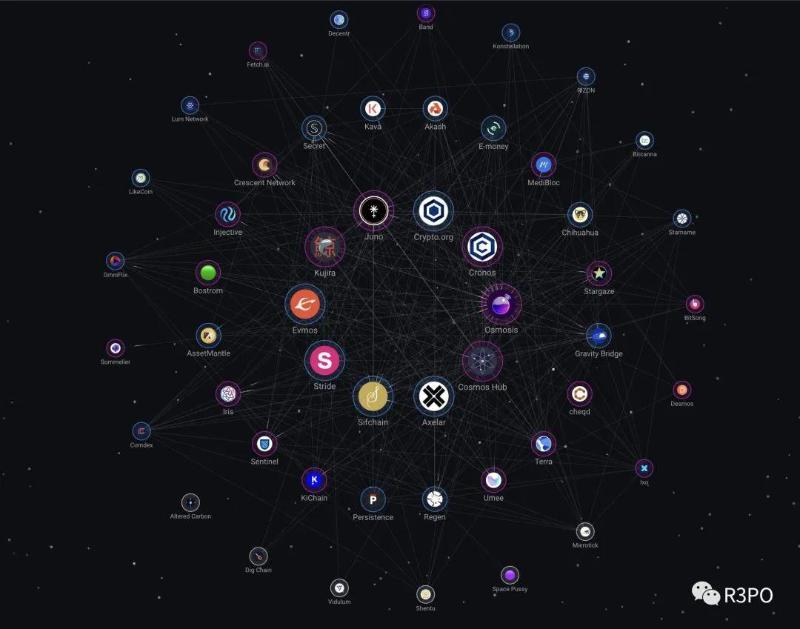
Image caption: Cosmos ecosystem
Western-led applications require localization and adaptation across diverse regions and cultures, making ongoing operations inherently more difficult and costly. However, base protocols are globally universal—this is precisely why the traditional internet saw Western dominance in infrastructure and Chinese strength in applications.
In the Web3 world, East and West now compete on equal footing.
R3PO believes we’re still in the era of early adopters. True super Dapps are still brewing. For instance, Ethereum has about 500,000 active addresses, and MANA sees only around 8,000 active users—meaning Web3 applications currently have almost zero impact on most of the world’s population.
Yet Ethereum’s market cap exceeds tens of billions of dollars, and MANA reached a $1 billion valuation—real numbers nonetheless.
Why do valuations vastly exceed fundamentals despite low user counts? Based on this, what would a billion-daily-active-user Dapp be worth?
For the first question: Current Web3 conditions shouldn’t serve as a baseline. Unsustainable economic models won’t last. Fair value will gradually correct over time toward normalcy.
For the second: The Cosmos 2.0 model is better suited to analyze individual Dapp development. Understand the deeper meaning of protocol revenue—Dapp income comprises transaction fees, service fees, gas fees, and other charges.
ATOM 2.0’s ideal economic model includes Cosmos Hub security leasing fees plus application-level transaction fees. Take dYdX: If it fully migrates to Cosmos 2.0 and chooses to purchase security, users pay only dYdX’s own transaction fees.
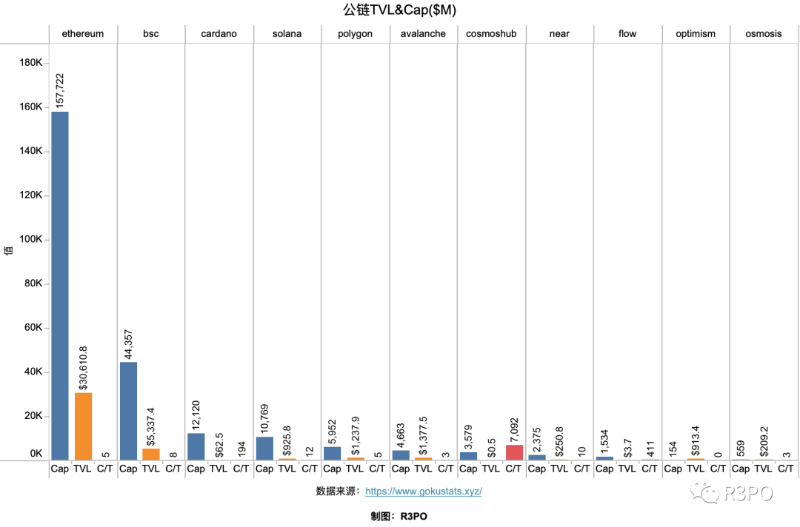
Image caption: Market caps, TVL, and Market Cap / TVL ratios of major blockchains Source: R3PO
Judging from market cap to TVL ratios across major blockchains, Ethereum sets the benchmark Cosmos aims to reach. Yet conversely, the Cosmos ecosystem still holds over a hundredfold room for growth. Further appreciation of ATOM could catalyze coordinated progress across application chains.
Under these conditions, unlike Ethereum’s vertical layering, Cosmos’ horizontal architecture favors scalable expansion. Vertical layering creates strong network effects—later entrants face prohibitively high catch-up costs. On Cosmos, however, early-stage Dapps can “claim territory and grow organically,” enjoying the same level of security as super Dapps while developing unique features. This momentum even influences Polkadot—its community has proposed allocating DOT across chains to create more utility scenarios, enhancing both network security and DOT’s price stability.
In summary, Cosmos 2.0 turns left toward Ethereum, right toward Polkadot.
Cosmos avoids Polkadot’s parachain auction and maintenance overhead, while offering greater horizontal scalability than Ethereum—potentially rolling out large-scale application economies.
Conclusion:Is Cosmos the Final Answer for Super Dapps?
Non-exchangeable goods cannot be accurately valued—such as on-chain security or user habits. Cosmos’ advantage lies in being able to make significant adjustments before a rigid structure solidifies. Every blockchain has its window of opportunity. Overall, the timing still exists for Chinese entrepreneurs to build super Dapps today.
Ethereum’s consensus layer is remarkably stable and robust. Creating a better consensus layer than Ethereum is extremely difficult.
However, another implication of Ethereum’s rich ecosystem is fragmentation—three notable pain points being communication between L2s, interaction across L1-L2-L3 layers, and cross-chain bridge security. Cosmos has targeted improvement opportunities here. But surpassing Ethereum requires landmark super applications. Only by establishing unique, self-sustaining ecosystem gravity can Cosmos truly stand firm.
Secondly, ATOM’s shift—from yielding profits to app chain tokens toward capturing more value—raises questions. Will other applications willingly share profits? If all must redistribute earnings to the base layer, why not just build on Ethereum instead? Tokenomics cannot be solved simply through deflation or enhanced value capture alone.
Markets generate demand; technology fulfills it.
R3PO hopes to uncover opportunities within Cosmos and offer insights to Chinese Web3 founders scattered around the globe—to inspire the creation of super Dapps for all humanity.
Join TechFlow official community to stay tuned
Telegram:https://t.me/TechFlowDaily
X (Twitter):https://x.com/TechFlowPost
X (Twitter) EN:https://x.com/BlockFlow_News
 R3PO
R3PO






