What Does Coinbase's Latest Documentary "Money: The Founder's Story" Cover?
TechFlow Selected TechFlow Selected
What Does Coinbase's Latest Documentary "Money: The Founder's Story" Cover?
This is a documentary about Coinbase's journey to IPO, tracing the history of Coinbase and culminating in its April 14, 2021 Nasdaq listing.
 Navigating Web3 tides with focused insights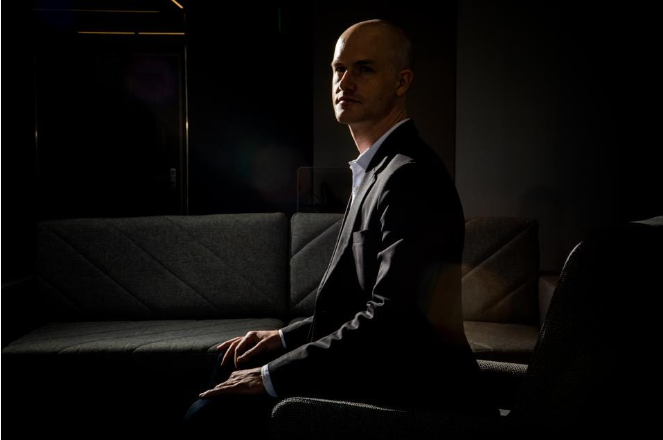
Author: Josh Wilson, Bloomberg
Translation: Guo Qianwen, ChainCatcher
More noteworthy are the unanswered questions raised in the documentary—such as U.S. Senator Elizabeth Warren’s silence on whether cryptocurrency is the ultimate solution to the world’s financial crises.
Coin: A Founder’s Story, directed by 10-time Emmy Award winner Greg Kohs, begins like any origin story—be it hero or villain—with Brian Armstrong’s childhood and his early fascination with computers and the World Wide Web.
This documentary chronicles Coinbase’s journey to its IPO, tracing the company’s history and culminating in its landmark Nasdaq listing on April 14, 2021. The film is rich in content and insight, but what stands out most in its climax are the questions left unaddressed.
Before viewing, it's important to understand who shaped this film and who held editorial control—the right to review, set standards for, or veto aspects such as appearance, text, and usage. Crucially, in filmmaking and television, those holding editorial rights and signing off on the final product should be distinct from the subject of the content.
Editorial Control
Produced by Alldayeveryday, a full-service production company based in New York and Los Angeles, the firm has previously created entertainment content for brands including Nike, Vans, Lyft, Facebook, and Beats. It has also collaborated with actor Michael Pitt for fashion brand Rag & Bone and with Greta Gerwig for DKNY.
Given its track record, Coinbase may have paid a significant sum for this film, naturally raising questions about the extent of its editorial influence and whether the film maintains genuine objectivity.
(Coinbase did not promptly respond to requests for comment regarding the film’s funding.)
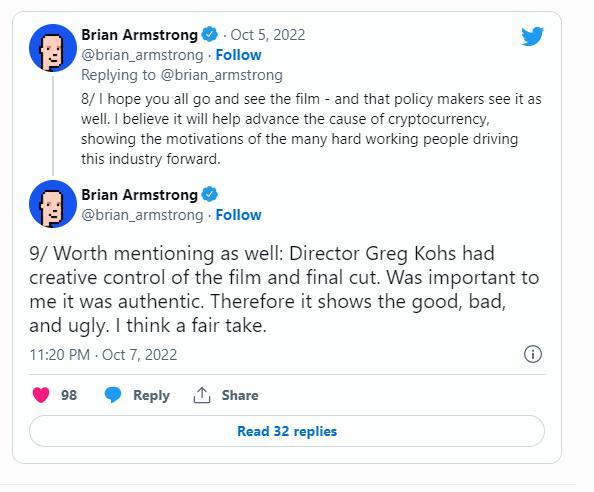
Armstrong stated on Twitter that Kohs retained full editorial control and final cut approval, meaning Armstrong had no say over the finished product. But if Coinbase indeed funded the project, how much real influence did they wield over editorial decisions?
This isn’t to suggest the film offers an uncritical, rose-tinted portrayal of Coinbase. It does address controversies, such as Coinbase’s acquisition of Neutrino and Armstrong’s notably commercialized stance toward the Black Lives Matter (BLM) movement, both of which feature prominently.
Overall, however, the film presents a positive view of the cryptocurrency industry and its potential, while offering insights into Armstrong’s personality.
The documentary primarily focuses on Armstrong’s private business relationships, particularly his dynamic with co-founder Fred Ehrsam.

Director Greg Kohs
In contrast to the infamous fallout between Mark Zuckerberg and his co-founder, Ehrsam and Armstrong aim to resolve their differences amicably. When disagreements arise, Ehrsam departs to pursue his own path but remains on Coinbase’s board. There’s even an anecdote—after Ehrsam’s departure, Armstrong gifted him additional Coinbase shares, a move one investor described as “unprecedented.”
Decentralization and the State
Regulatory issues have long been an area where Coinbase seeks public engagement and aims to foster open dialogue.
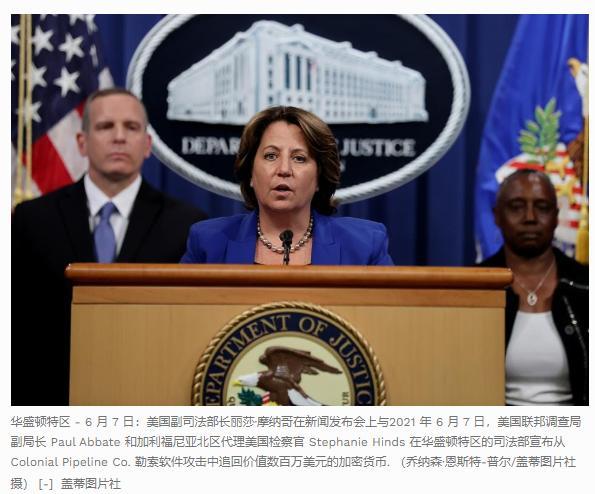
Katie Haun, a former federal prosecutor at the U.S. Department of Justice who led the government’s first cryptocurrency task force investigating Bitcoin, appears in the film. Now a member of Coinbase’s board, she speaks on behalf of the company. Her insights into cryptocurrency investigations reflect a valuable openness—the realization that crypto is a technology that shouldn’t be simplistically equated with illegal activity. Haun emphasizes that blockchain can actually be used to track criminal behavior.
John Kothanek, senior director of Coinbase’s Global Intelligence Unit, also argues in the film that cryptocurrencies make illicit transactions easier to trace than fiat currencies. SEC Commissioner Hester Pierce also appears, expressing continued optimism about the potential of new technologies and cryptocurrencies.
The idea of cryptocurrency as a “revolutionary human rights tool” surfaces in case studies involving Nigeria and Belarus, illustrating how entrenched financial systems enable state dominance and suppress freedom. Harvard economics professor Kenneth Rogoff comments in the film: “Bitcoin makes me think about the balance between freedom and power.”
The film references the 2008 financial crisis and traces how human greed and error have historically led to systemic financial oppression. Decentralizing finance may offer solutions, but it must be acknowledged that governments ultimately retain decisive power. Regulation should be encouraged, not resisted. Footage shows Armstrong meeting with senators in Washington—a step toward constructive regulation, though progress remains slow.
The Neutrino acquisition offers viewers insight into Armstrong’s leadership mindset—calm, willing to admit mistakes, and more importantly, committed to learning from them.
Coinbase acquired Neutrino in March 2019, an algorithmic stablecoin pegged to the U.S. dollar but backed by another algorithmic protocol.
Shortly after the acquisition, users quickly pointed out that Neutrino was operated by a notorious hacker group known for selling spyware in Saudi Arabia, Sudan, and Venezuela.
Black Lives Matter (BLM)
The film also examines Armstrong’s position on BLM—an especially compelling segment.
On one hand, he consistently promotes his mission of democratizing finance and creating equity worldwide. Yet he insists that Coinbase, as a company, will not support political movements like BLM—despite the fact that the movement stems from historical injustices faced by African Americans, particularly within the U.S. financial and monetary system.
Some might argue that this history—including denial of loans to Black communities and policies that devalued and undermined them—should compel Armstrong to align his company more actively with the movement, especially since its vision closely mirrors his own. Instead, he adopted a colder, less empathetic approach, issuing a detached public statement even as some employees went on strike.
Armstrong has signed the Giving Pledge, making his stance on BLM all the more puzzling—and arguably indefensible. Even when discussing BLM, his position seems muddled; he says he agrees with some of the movement’s ideas and goals. There appears to be a serious disconnect between him and the values of anti-racism, equity, and equality that BLM represents. If this were an issue like child trafficking or another less divisive social concern, I suspect he would not take the same stance.
Conclusion
The film concludes with Coinbase’s historic IPO in 2021, capturing Armstrong’s composure throughout, mirrored by co-founder Ehrsam. The final moments focus on their friendship and how they managed to preserve it despite building a company together.
The film is worth watching—it offers a thoughtful examination of cryptocurrency and is clearly educational.
Though it includes interviews with former employees, especially following the BLM controversy, it largely avoids significant criticism and remains overwhelmingly positive, failing to mention or examine any other exchanges beyond Coinbase.
It also lacks substantial opposing or negative perspectives, aside from Senator Elizabeth Warren’s silence on whether cryptocurrency is the ultimate answer to global financial challenges. Given the setbacks crypto has faced in 2022, this positivity feels odd—but the film’s narrative peaks during the second quarter of 2021.
Ultimately, Armstrong emerges as a mild-mannered, pragmatic, and deeply introverted figure—someone who cares about people, his company, and financial history, and who hopes to improve as a CEO.
Original title: ‘Coin: A Founder’s Story’ Offers A Meticulous Look At Crypto And The Ups And Downs Involved In The Origins Of Brian Armstrong’s Coinbase
Join TechFlow official community to stay tuned
Telegram:https://t.me/TechFlowDaily
X (Twitter):https://x.com/TechFlowPost
X (Twitter) EN:https://x.com/BlockFlow_News