








Chainge Finance: Cross-chain Security Solutions for the New Public Chain Era
TechFlow Selected TechFlow Selected
Chainge Finance: Cross-chain Security Solutions for the New Public Chain Era
On October 2, 2022, the cross-chain exchange aggregator Transit Swap was hacked, resulting in the theft of over $21 million worth of assets. The team stated that the breach was due to a vulnerability in authorization.
 Navigating Web3 tides with focused insights
On October 2, 2022, the cross-chain trading platform aggregator Transit Swap was hacked. An estimated $21 million in assets were stolen, with officials citing a vulnerability in authorization as the cause.
Starting from August, DeFi security incidents have been frequent. On August 2, the cross-chain interoperability protocol Nomad Bridge was attacked, resulting in over $11 million in stolen funds; on August 3, Solana wallet Phantom suffered a hack with more than $5 million stolen. Previously, Harmony and Axie Infinity had also fallen victim to attacks.
With cross-chain bridge security incidents occurring so frequently, is there any absolutely secure cross-chain application?
Launched in 2021, Chainge Finance is undoubtedly the safest DEX platform available today!
So let’s take a look at why Chainge Finance stands out as the most secure DEX platform!
Unlike centralized exchanges (CEX) or other cross-chain bridges, Chainge Finance is built on the Fusion public chain and leverages its patented DCRM technology to seamlessly connect to any blockchain. The Fusion public chain is interoperable and compatible with both EVM and non-EVM chains.
How does Chainge Finance use DCRM technology to protect user assets?
To better manage users' digital assets on-chain and prevent single-point failures among nodes, private key management is crucial—after all, private keys control access to on-chain public addresses and their associated assets. Currently, there are three mainstream approaches to distributing private key risks (i.e., decentralized control):
-
1. Multi-signature (Multiple Signatures)
-
2. Secret Sharing (Shamir-Secret Sharing)
-
3. Threshold Signatures (Threshold Signatures)
Fusion's DCRM adopts one of the current mainstream solutions—using a threshold signature scheme (TSS) based on the threshold elliptic curve digital signature algorithm (ECDSA) to provide distributed key generation and transaction signing algorithms, enabling control over accounts and assets across blockchains utilizing this algorithm.
Simply put, DCRM splits a complete private key into multiple parts. These shards never need to be reassembled—from creation to storage and usage. Each shard is then securely held by different nodes, with each node only having access to one or a few fragments of the full key.
Through the threshold signature protocol, signers on Chainge Finance create a unique address. This ensures that no individual signer can abscond with funds—every operation requires signatures from all selected participants.
The DCRM technology was developed by four of the most authoritative and innovative professors in cryptography: Rosario Gennaro — Professor of Computer Science at City University of New York; Dr. Steven Goldfeder — Department of Computer Science at Cornell University; Louis Goubin — Professor of Computer Science at University of Versailles; Dr. Pascal Paillier — CEO and Senior Security Expert at CryptoExperts.
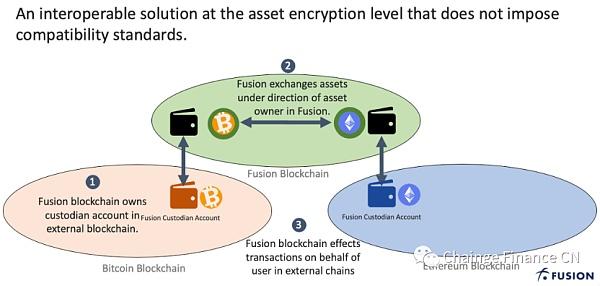
These four experts jointly verified, certified, and enhanced the DCRM architecture, which was specifically designed for token portability and exchange across all networks. It functions similarly to how centralized exchanges operate—they hold custodial wallets on blockchains and transfer assets accordingly. In essence, the protocol hosts various external assets (BTC, ETH, AVAX, etc.) on external blockchains. When users wish to move their assets, the Fusion chain uses these external wallets to distribute funds to them. Fusion is the only public chain capable of seamless integration with every existing chain, making it the sole chain enabling DEXs to draw liquidity from any network.
To date, there has not been a single reported hacking incident on the Fusion chain. Moreover, even in an extreme scenario where the Chainge server itself is compromised, attackers would not be able to transfer assets via TSS, because TSS is controlled by consensus nodes, with a total of 117 DCRM nodes. The TSS mechanism used in DCRM was developed by the Fusion team and audited by top-tier cryptographers and security experts.
Chainge Finance pushes Fusion DCRM technology to its limits, elevating cross-chain bridges to a new level of cross-chain roaming while launching its proprietary multi-chain cross-chain aggregation DEX!
By leveraging FUSION's DCRM technology and its own innovative cross-chain algorithms, Chainge Finance secures cross-chain swap orders. Essentially, Chainge automatically aggregates data from multiple DEXs using cutting-edge technology, finds the best exchange rates for users, and intelligently splits transactions across multiple chains to maximize user benefits.
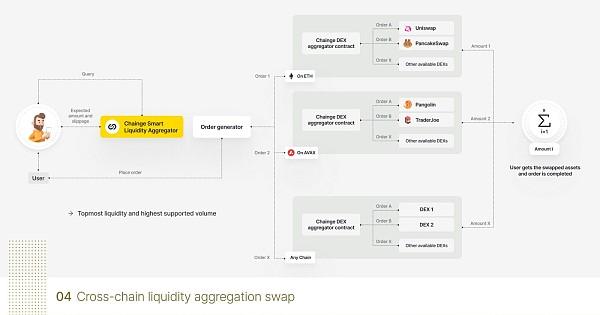
In the second half of the year, Chainge Finance will integrate DEXs on non-EVM compatible chains such as Near, Elrond, Algorand, Cosmos, or Polkadot. Additionally, Chainge’s token listing program has already begun (any token with liquidity exceeding 100,000 U and approved through community voting can be listed), and nearly 100 new tokens have already been added. This ultimately means users will no longer need to switch between different chains or DEXs, as everything will be integrated directly within Chainge.
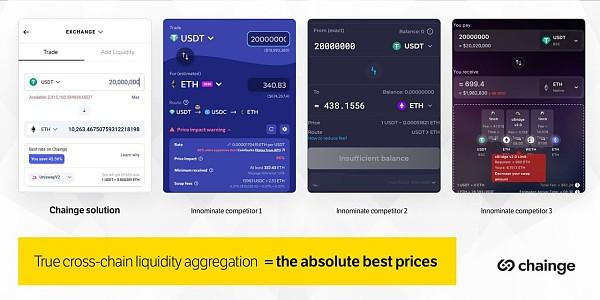
In summary, Chainge Finance is poised to become the most liquid trading platform in the DeFi market, remaining committed to protecting user interests and transaction security, building the safest and most liquid DEX platform!
Join TechFlow official community to stay tuned
Telegram:https://t.me/TechFlowDaily
X (Twitter):https://x.com/TechFlowPost
X (Twitter) EN:https://x.com/BlockFlow_News






