








A Comprehensive Interpretation of Cosmos 2.0: From a Loose Alliance to an Economic Community
TechFlow Selected TechFlow Selected
A Comprehensive Interpretation of Cosmos 2.0: From a Loose Alliance to an Economic Community
The Cosmos ecosystem may no longer be a "loose alliance," but instead is moving toward an economic community.
 Navigating Web3 tides with focused insights
Author: Morty, TechFlow
Editor: Miko
From September 26 to 28, the Cosmoverse conference was successfully held in Medellín, Colombia, aiming to increase awareness of the Cosmos ecosystem within the South American crypto community. The most anticipated highlight of the event was the release of Cosmos’ new 2.0 whitepaper.
TechFlow brings you the latest analysis of this whitepaper.
The whitepaper begins by reviewing Cosmos' past achievements through Tendermint, IBC, and the SDK. Recognizing low adoption of the Cosmos Hub and underutilization of staked ATOM tokens, contributors aim to transform this situation with Cosmos 2.0.
As Zaki, a core developer of the IBC protocol, stated during his talk: "Today’s ATOM is just a meme in the Cosmos ecosystem—it can do so much more."
In my view, the biggest issue for the Cosmos ecosystem—and particularly for ATOM—lies in the Cosmos Hub itself. Marketed as the “economic center of the Cosmos ecosystem,” it aims to serve as the glue connecting all blockchains and providing valuable services. ATOM is the token securing the Cosmos Hub, but unfortunately, the Hub has not developed as expected.
On one hand, many leaders in the Cosmos space have chosen to exit the Hub, instead using the Cosmos SDK to build their own independent chains. On the other hand, they can operate smoothly without relying on the Hub at all. In effect, the Cosmos Hub has become a casualty of Cosmos' overall success.
How can this be changed? The Interchain Scheduler and Interchain Allocator will now become key components of the Cosmos ecosystem, working alongside newly introduced features such as expanded interchain security, chain scheduling, a redesigned ATOM tokenomics model, and liquid staking derivatives. Together, these innovations act as catalysts to accelerate the ecosystem's flywheel, strengthen connections between chains, and ultimately evolve Cosmos into a resilient multi-chain economy.
Capturing Value from MEV
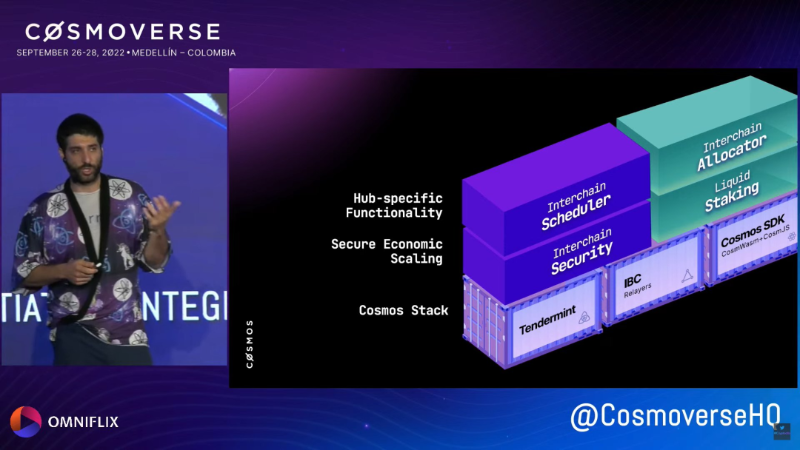
In the public Cosmos stack, two new modules appear: Interchain Scheduler and Interchain Allocator.
The Interchain Scheduler is a cross-chain blockspace market within Cosmos that generates revenue from cross-chain MEV (Maximal Extractable Value).
According to Ethereum.org, MEV can be understood as "the maximum value extractable from block production beyond standard block rewards and gas fees by including, excluding, or changing the order of transactions in a block." Frequent cross-chain activity in the Cosmos ecosystem creates significant opportunities for MEV.
Here’s how it works: willing Cosmos blockchains can sell portions of their blockspace to the Interchain Scheduler. The Scheduler then issues NFTs representing "bookings" of this blockspace, which are auctioned off periodically—and may even trade on secondary markets. A share of the proceeds goes back to the original blockchain. According to the whitepaper, the Interchain Scheduler will complement (not replace) off-chain MEV relays, fostering competition.
The Interchain Allocator is designed to streamline economic coordination across the entire Cosmos network, accelerating user and liquidity acquisition for new projects while ensuring ATOM’s role as the network’s reserve currency.
For example, revenues generated by the Scheduler will be distributed via the Interchain Allocator to support promising new projects and long-term ecosystem development—fueling further growth and generating even more revenue in return.
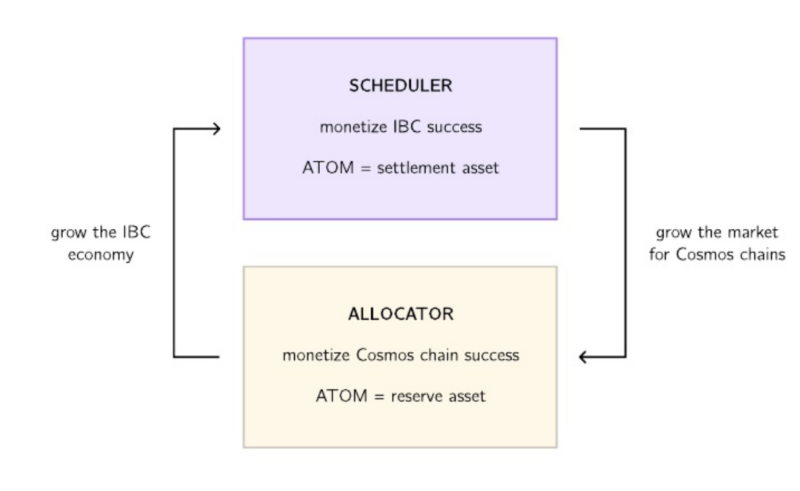
To summarize: The Scheduler monetizes IBC-related economic activity; revenue flows to the Allocator; the Allocator funds new projects in the Cosmos ecosystem, expanding the potential market size for the Scheduler.
The greatest significance lies in the fact that the Cosmos Hub will now earn revenue from cross-chain activities by creating a blockspace market and collecting matching fees—something the current Hub lacks entirely.
Capturing ATOM Value Through Interchain Security
Interchain Security is one of the most anticipated upgrades.
Security remains a fundamental concern for applications built using the Cosmos-SDK. For large app-chains with substantial user bases—like Terra before its collapse—this wasn’t a major issue.
However, smaller app-chains face real risks: if a new application chain is secured by validators whose staked token market cap is lower than the chain’s TVL, it becomes vulnerable to attacks.
Therefore, Interchain Security allows these app-chains to rent security from the Cosmos Hub, paying only a portion of transaction fees in return. These chains will benefit from the protection provided by the Cosmos Hub’s validators. Given that the total ATOM market cap is around $4 billion, the cost of malicious behavior would be approximately $3 billion (roughly 2/3 of the ATOM market cap), making such an attack extremely difficult to execute due to limited supply availability on secondary markets.
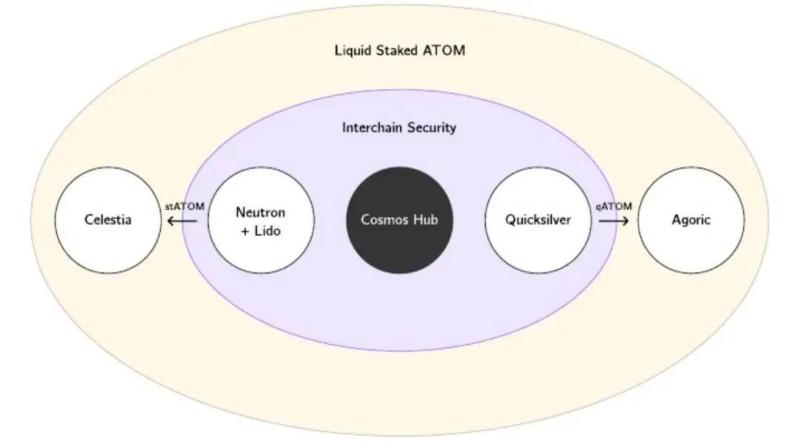
Interchain Security can apply to several use cases: Rollup Settlement (a standardized system for rollups to settle when fraud proofs are published by external data availability providers), IBC multi-chain routing, Chain Name Service (a Cosmos version of ENS), Multiverse (essentially a testnet environment), and more.
The launch of Interchain Security transforms the Cosmos Hub into a central security hub, enabling ATOM to capture value from the security demands of other application chains.
Another way ATOM can accumulate additional value is through Liquid Staking.
Currently, ATOM holders can earn interest by staking their tokens with validators, but this locks up their tokens on-chain for a period of time, rendering them illiquid. While third-party applications offer "Liquid Staking" solutions allowing users to trade derivative tokens representing their stake, Cosmos plans to integrate this natively.
At the conference, core developer Buchman said, “The Cosmos Hub will soon incorporate Liquid Staking directly into the network’s core code. With a native Liquid Staking module, we’ll deliver a far better user experience. Now, ATOM can begin to gain liquidity even while providing security. We can also start building new ways to connect ATOM’s security and liquidity with other tokens launched across the ecosystem.”
New ATOM Tokenomics
A somewhat subjective observation is that while people often praise the Cosmos SDK and various ecosystem projects, they frequently criticize ATOM.
First, there’s high and unstable inflation. Currently, ATOM’s inflation rate fluctuates between 7% and 20%, depending on what percentage of the total supply is staked. In March 2019, the total ATOM supply was about 214 million; today, over 292.5 million ATOM are in circulation—an increase of roughly 36.68%.
Second, there’s a lack of value capture mechanisms, in stark contrast to Polkadot. Although Polkadot’s ecosystem is generally less vibrant than Cosmos’, DOT effectively captures value across the ecosystem through mechanisms like parachain auctions.
To draw an analogy: If Polkadot is a centralized federation, then Cosmos is a loose confederation.
The new ATOM tokenomics model will reform both issuance and value capture. ATOM issuance will shift into two phases: a transition phase and a stable phase.
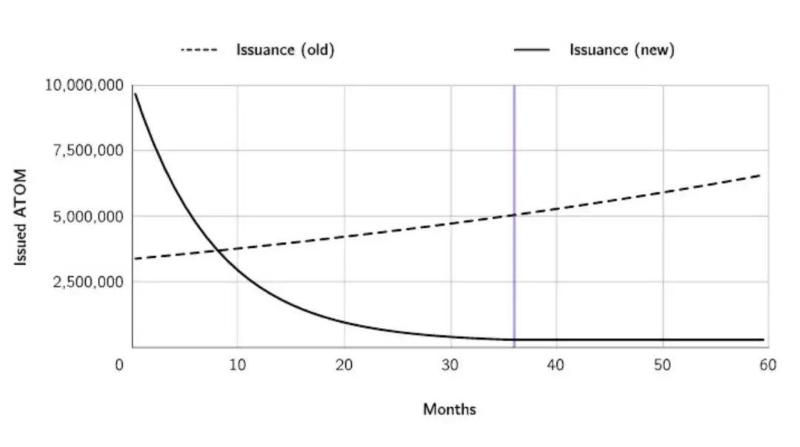
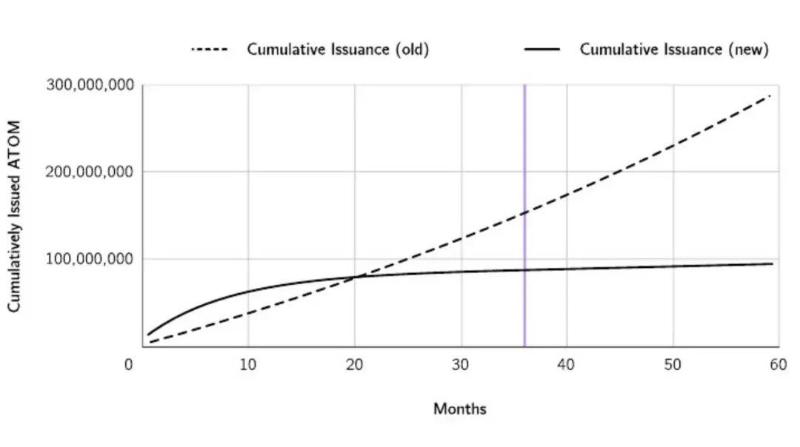
The transition phase lasts 36 months, starting with 10 million ATOM issued per month. If implemented immediately, this would cause short-term inflation to spike rapidly—briefly reaching 40%—before steadily declining until monthly issuance reaches 300,000 ATOM, effectively reducing ATOM’s inflation rate to 0.1%.
As shown in the chart below, ATOM issuance will become linear rather than exponential.
Once the stable phase begins, a portion of transaction fees and inflation from each app-chain enabled by Interchain Security will be sent to the Cosmos Hub’s issuance module, funding security costs across all chains and replacing the current inflation subsidy.
In simple terms, Whitepaper 2.0 replaces token inflation used to incentivize validators and stakers with security fees generated from Interchain Security to reward them instead.
At first glance, validator and staker rewards might seem lower. However, to enhance capital efficiency for ATOM, Cosmos is introducing a liquid staking derivative protocol. This means users can gain liquidity through staking derivatives and participate in more on-chain activities, such as DeFi applications.
The economic restructuring driven by Interchain Security will be realized through the Interchain Scheduler and Interchain Allocator, establishing a completely new distribution model, as illustrated below:
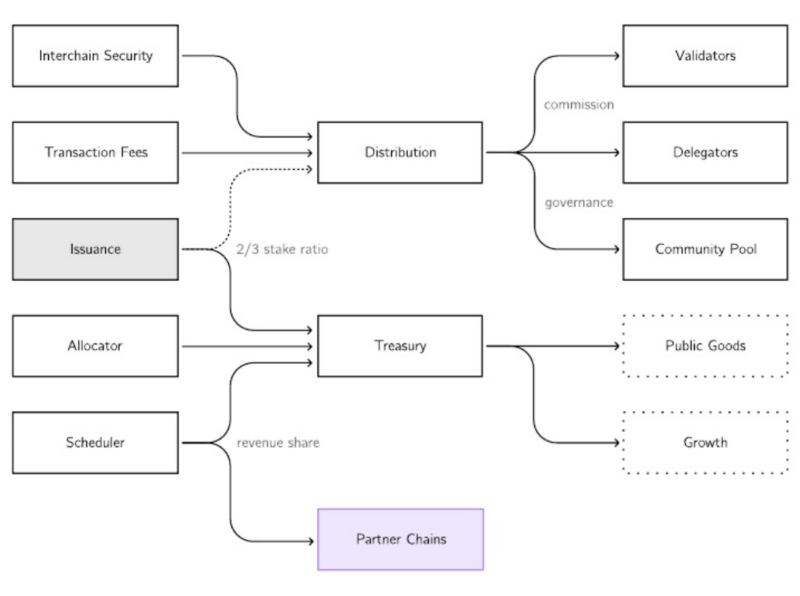
Inflation rewards and value distribution via the Interchain Allocator will flow directly into the Cosmos Hub Treasury—a fund dedicated to supporting new projects and long-term ecosystem growth, aiming to establish a resilient economic system within Cosmos.
Overall, the Cosmos ecosystem may no longer remain a “loose alliance,” but is evolving toward becoming a true economic community.
Conclusion
In their closing remarks at Cosmoverse, core developers Buchman and Zaki emphasized that the future development of the Cosmos Hub depends on ATOM holders, who will vote on any proposed changes to the blockchain. Based on discussions in forums and on Twitter, most reactions have been optimistic.
Zaki was especially bullish, claiming "The new features of the Cosmos Hub will make EIP-1559 look like a joke," and titled his presentation "$1K ATOM LFG."
That said, some skepticism remains—particularly regarding the 36-month transition period. Critics argue that this phase essentially functions as a new fundraising round for the Cosmos Hub. Assuming constant staking ratios, it could generate over 37 million additional tokens (worth approximately $525 million at current prices), diluting existing ATOM holders.
Nevertheless, we now see a clear path for the Cosmos Hub to generate actual revenue and for ATOM to capture real value. No longer merely a loose confederation, Cosmos is increasingly resembling an economic union. As Mindao put it in his assessment of the Cosmos 2.0 whitepaper: Cosmos 2.0 is attempting to turn ATOM into a permissionless euro for the “Cosmos Union”—providing shared economic security and decentralization as a service, while member chains retain full sovereignty.
Join TechFlow official community to stay tuned
Telegram:https://t.me/TechFlowDaily
X (Twitter):https://x.com/TechFlowPost
X (Twitter) EN:https://x.com/BlockFlow_News






