








Web3 Social and Gaming Convergence: A New Mass Craze?
TechFlow Selected TechFlow Selected
Web3 Social and Gaming Convergence: A New Mass Craze?
The integration of gaming and social features will be a key scenario for overcoming current traffic bottlenecks in the Web3 environment. Let's wait together for the day when a truly groundbreaking application emerges.
 Navigating Web3 tides with focused insights
By: Kaspar
I. What Are We Talking About When We Talk About Decentralized Social?
1.1) Understanding Social Interaction
Socializing is an instinctual trait of humans as social beings. Through the exchange of information, interaction, and material or emotional communication, we attempt to connect with others and build social relationships. In this process, a single individual alone cannot complete a social act.
This inevitably requires some form of medium to carry these interactions. The most direct and simple method is face-to-face conversation, where our voices and facial expressions serve as carriers. However, this basic form of socializing is heavily constrained by space and time, limiting us to small-scale, localized interactions.
1.2) Today's Social Environment
To some extent, the development of information technology reflects the evolution of human social behavior—from carrier pigeons to pagers, then to the internet and today’s mobile internet. We’ve built a highly efficient social system, largely powered by social tools and platforms managed by major tech giants.
Initially, we used these platforms primarily as tools for transmitting information—ways to transcend spatial and temporal limitations and efficiently map out our social networks. But as our connections multiplied, they gradually wove into a vast web. Suddenly, we realized that nearly everyone around us was already enmeshed within it. At this point, we became aware that our use of these tools had shifted from active choice to forced synchronization. We can no longer disengage.
Each massive platform functions like a walled city. All our data and behaviors are captured and exploited. The authority to interpret our words and messages no longer belongs to us. Ironically, every brick in this wall was laid by ourselves—yet in the end, we can take nothing with us when we leave, neither the tangible nor the intangible.
Few could have predicted that after contributing to such a vast field, what awaits us isn’t a utopia of blue skies and white clouds, but endless exploitation. We ourselves become the fertilizer for this vibrant garden. Our assets, data, traces, relationships, and bonds now block our exit, while the garden, nourished by us, easily attracts a constant stream of new visitors.
1.3) Hopes for Decentralization
What we desire isn’t much—but it is profoundly valuable at every level of life: autonomy and control, often referred to as “freedom.” We want to truly own what we “own,” freely disclose what we wish to share, and choose whom we want to give access to. The absurdity is that we once assumed all of this belonged to us by default.
Yet these aspirations are nearly impossible under centralized networks. When the profit from user behavior far exceeds costs, profit-driven institutions will inevitably act—because from the beginning, control has never been in our hands.
Blockchain, as a mechanism, enables true ownership of identity. It operates independently of any central authority. Across this vast network, we gain the ability to traverse various independent tools, apps, and platforms with a single identity—without sacrificing any assets. Time, in this context, becomes a blessing rather than a curse.
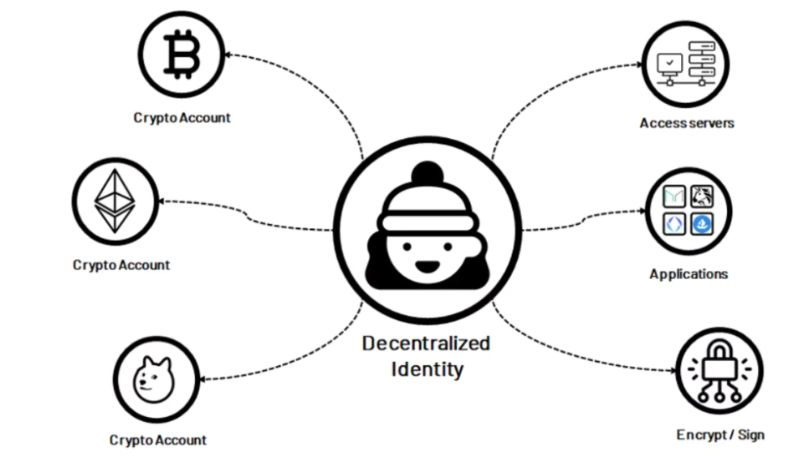
Decentralized social is a new social system built upon decentralized identities (DID). Here, users possess sovereignty over their assets, an open credit system, controllable data privacy, and richly dimensional identity profiles. We can freely choose where to speak, what to say, and what permissions to grant. And crucially, no one can alter or interfere with these choices.
1.4) Current Challenges and Bottlenecks
Despite how promising and exciting this all sounds, we cannot yet call it the utopia we dream of. The overall decentralized environment and ecosystem remain in early construction stages. Decentralized social faces two primary bottlenecks: “traffic” and “use cases.”
a. "Traffic"
Years of operation have given centralized social apps powerful user habits and stickiness. This stickiness translates into high migration costs. As previously mentioned, moving involves not only potential loss of assets, but also renders individual migration meaningless on a social level. Therefore, transitioning existing social relationships forms the first barrier to traffic acquisition.
Moreover, almost all social systems rely on network effects. Especially in decentralized social, where underlying identities are unified and upper-layer applications are infinite, network effects could exponentially amplify adoption. However, the current Web3 user base is still small, and entry barriers remain high, making early-stage accumulation of network effects extremely difficult—the second major traffic bottleneck.
b. "Use Cases"
Beyond traffic issues, the lack of clear application scenarios is another pain point for decentralized social. While many of us long for freedom, in reality we’re not acutely aware of being “chained.” When most social needs are already met by traditional apps, there’s little motivation to migrate proactively. Past failures of numerous X-to-Earn models have shown that financial incentives alone cannot sustain a viable use case.
Looking back at the growth of Web2 social platforms, social games played a crucial role in driving user acquisition. Thus, we believe in the Web3 world, games will similarly act as growth engines, bringing significant traffic to social ecosystems.
II. The Convergence of Decentralized Social and Gaming
Games attract users by constructing entirely new worlds, allowing players to experience lives and adventures that differ drastically—or even break free—from reality. In gaming, social interaction isn’t always essential; many excellent console and indie games are designed for solo immersion.
But it’s undeniable that social elements naturally fit within gaming contexts. Games inherently possess the ability—like social tools—to connect people across time and space. Additionally, life and activities in these alternate worlds create ideal settings for forming bonds.
In traditional online games, we see countless proven examples. Take World of Warcraft, with its grand narrative and faction rivalries—over time, the game itself evolved into a social medium. Players formed friendships, brotherhoods, mentorships, and even romantic relationships through in-game events. These relationships then fueled further in-game interactions: dungeon groups, PvP battles, guild wars, and more.
We also observe younger titles like Fortnite, which downplays competitive gameplay in favor of social entertainment, amplifying social events by hosting real-world artists like Marshmello and Travis Scott in virtual concerts. These experiences—virtual yet deeply real—leave lasting impressions. Thus, the fusion of “social” and “gaming” promises to be one of the most exciting frontiers ahead.
2.1) GameFi Aims for the Metaverse: The Core Is Interoperability
However, as centrally operated entities, traditional games face inherent issues like asset ownership and data silos—problems that negatively impact both player experience and social dynamics. Hence, decentralized games have emerged, leveraging NFTs and tokens to address these challenges, ensuring players fully own their in-game assets—even if a game shuts down, their achievements and possessions persist.
In practice, however, even if a player holds NFT assets in an isolated game, those assets lose all value once the game ceases operation due to lack of utility elsewhere. Therefore, most mainstream GameFi projects ultimately aim toward the “metaverse”—where all in-game outputs exhibit strong interoperability. Assets and data can freely move across different “universes,” because only under such conditions do game assets hold long-term value.
2.2) GameFi + DID = GameID
Achieving this requires players to have a universal identity format—a gaming version of DID—that records their experiences, reputation, assets, and achievements across multiple games. Thanks to the universality of decentralized identities, associated social relationships can also be seamlessly carried across different games. We refer to this form of DID as GameID, which contributes to a user’s complete DID profile.
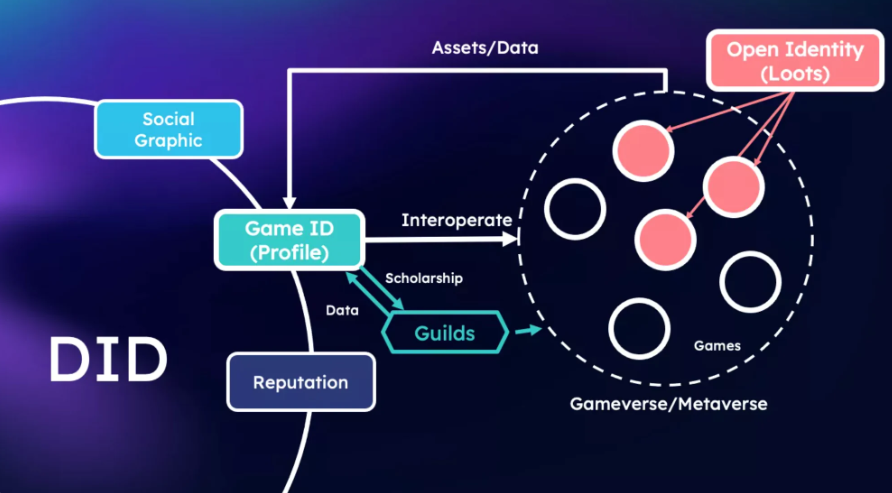
If the concept of GameID remains abstract, consider the once-popular Loot project. Loot functions as a special type of GameID—each Loot represents an identity that allows traversal across various games and apps within the Loot ecosystem. The same identity may manifest differently in different contexts, enabling diverse experiences. The limitation, however, is that this only works within the Loot ecosystem. GameID, by contrast, is like an open version of Loot—spanning the entire GameFi landscape.
Furthermore, GameID/DID enables socializing beyond the game. In traditional gaming, once a player logs off, connection is lost—prompting the rise of external tools like Discord, allowing players to maintain social ties even offline or across different games. In a decentralized context, we believe this need can be fulfilled by general decentralized social tools. Users can interact socially with both work colleagues and gaming friends without switching accounts or platforms.
III. Current Products of This Fusion and Future Possibilities
Earlier, we discussed decentralized social and its natural alignment with gaming. Within today’s Web3 landscape, the intersection of “social” and “gaming” has already sparked numerous innovative ideas. Below are three representative approaches, along with notable projects:
3.1) Identity and Behavior-Centric: Gamer Profile
Projects in this category focus precisely on the pivotal GameID component.
The model typically aggregates and processes a player’s on-chain/off-chain game interaction data, in-game assets, and contributions, visualizing them to enrich DID dimensions. Within the GameFi ecosystem, these profiles serve roles in asset claims, value accumulation, and verifying reputation and skills.
However, although identity data originates from users, early-stage profiles offer limited immediate value to players themselves. Thus, the initial adopters of GameID are often B2B game projects and gaming guilds, who leverage GameID for better player screening, analysis, acquisition, and incentive design.
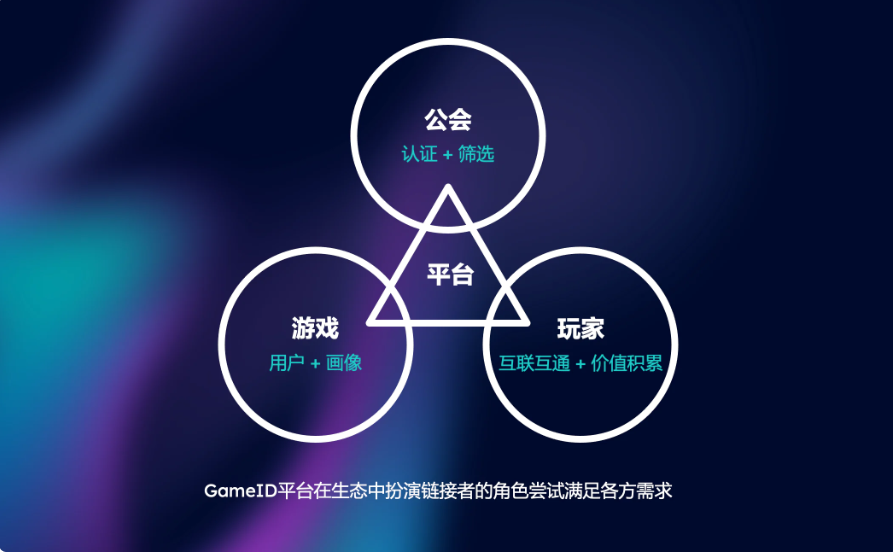
As such, current GameID projects usually appear as platforms—similar to a GameFi version of Project Galaxy. They deliver value to users through content while continuously partnering with more game studios and guilds to expand data integrations, creating a positive feedback loop.
Notable examples include:
a. Carv
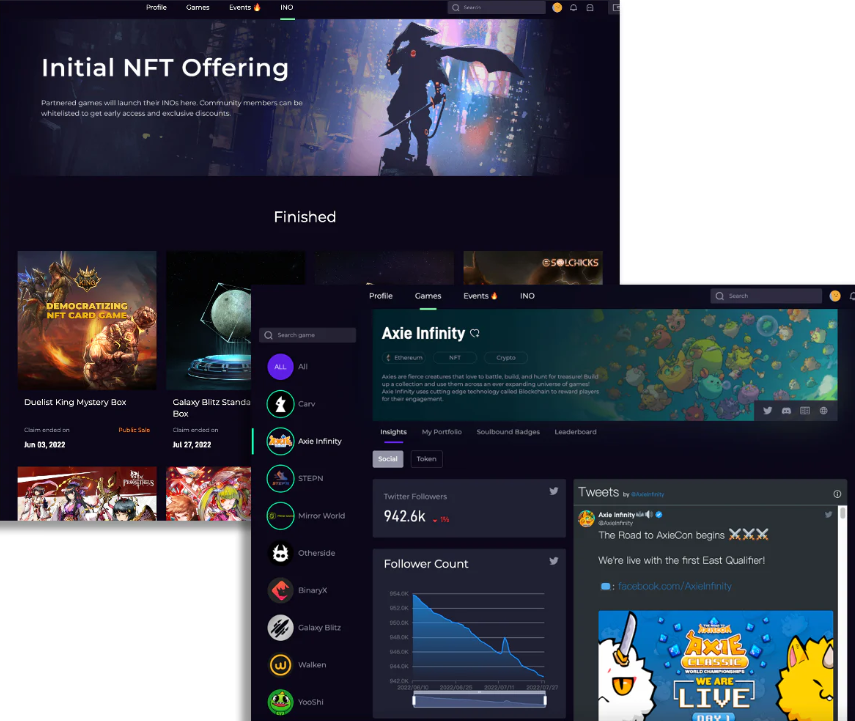
Carv is a GameID platform entering via achievement systems. Interestingly, it calculates a user’s reputation score based on past on-chain activity. The entire GameID is presented as this reputation score plus earned Soulbound Tokens (SBTs). The platform verifies achievements using on-chain data and issues corresponding SBTs upon completion.
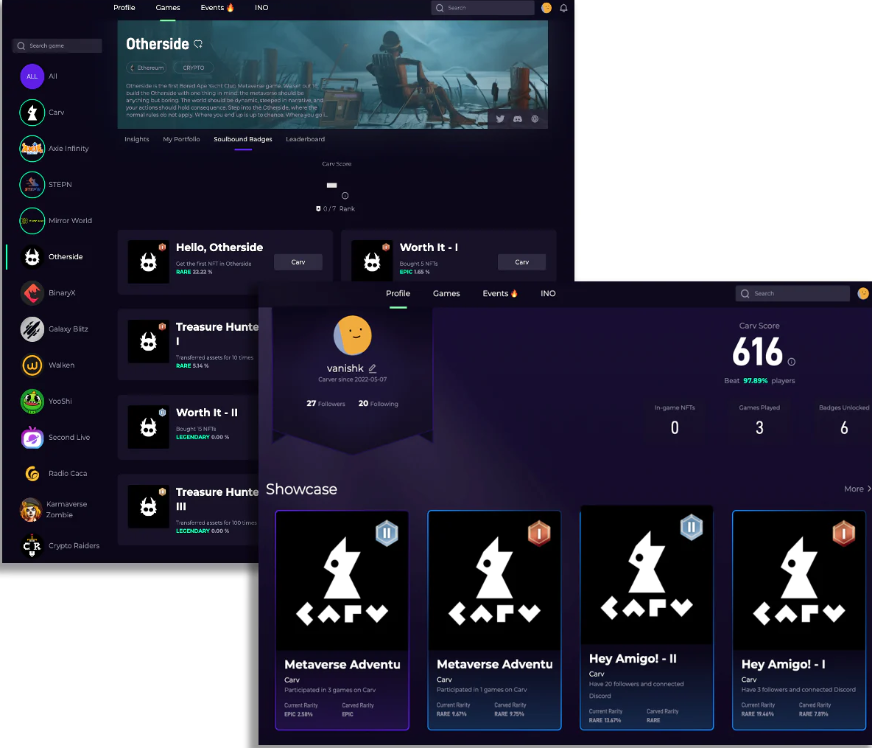
For listed projects, Carv provides social data analytics, helping players quickly identify promising, trending games and track latest social updates—valuable features for gamers. The platform also includes an INO section for game NFT launches, though this relies heavily on business development and has seen only 10 launches so far.
DeQuest enters via a quest system. It features gamified design, presenting users’ GameID as avatars (which may later enter Sandbox). Completing quests unlocks gear and skills.
User experience is smooth and well-designed. Quests lean toward beginner tutorials, larger in scope than Carv’s achievements, and crafted with care—effectively lowering the learning curve for complex games.
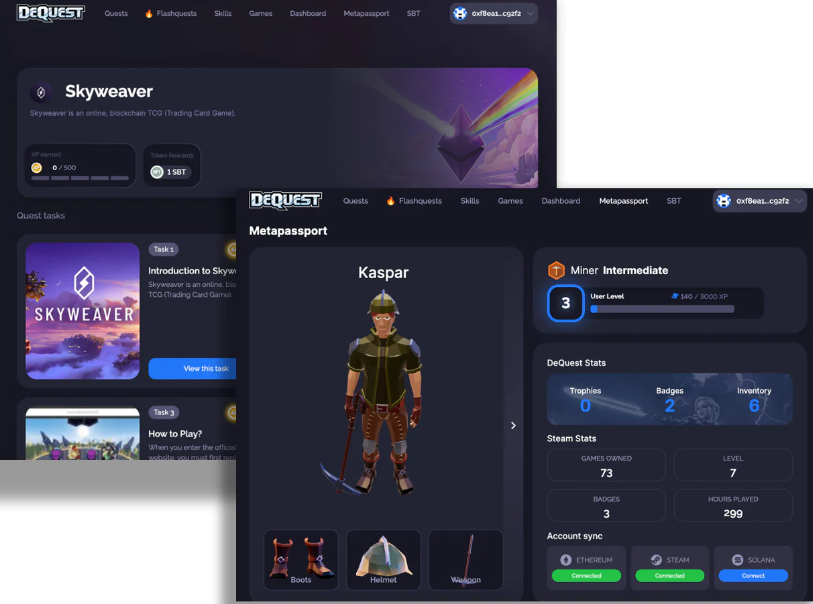
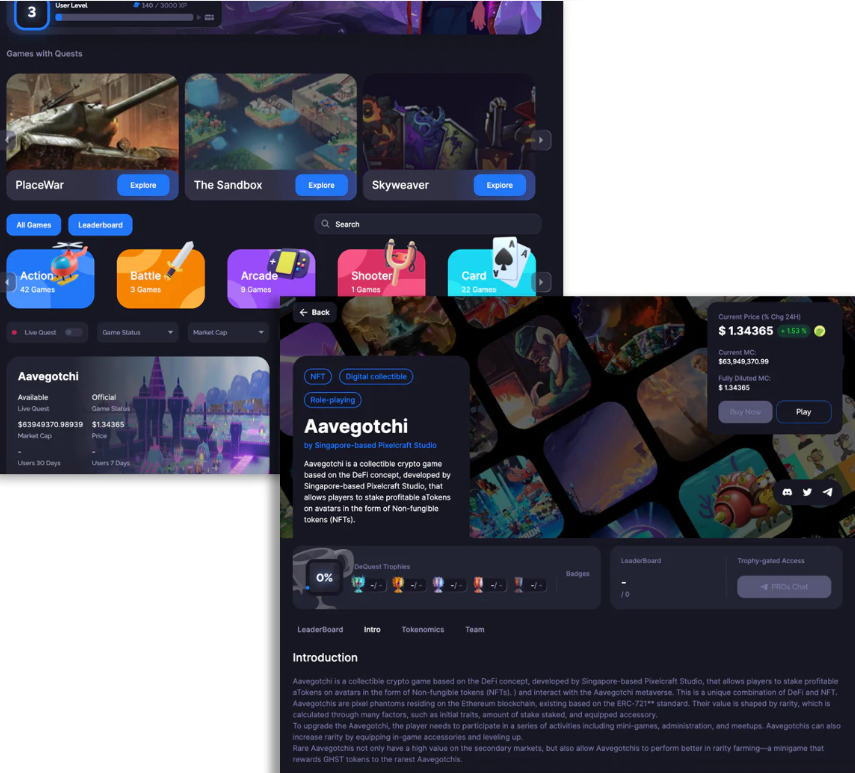
Highlights include seamless UX and broad data coverage—spanning Web2 (via Steam integration), on-chain data, and in-game data (Trophies module, sharing partner in-game data to award achievements). As of early August, DeQuest listed 122 games (though most recently hidden), with 10 offering systematic questlines.
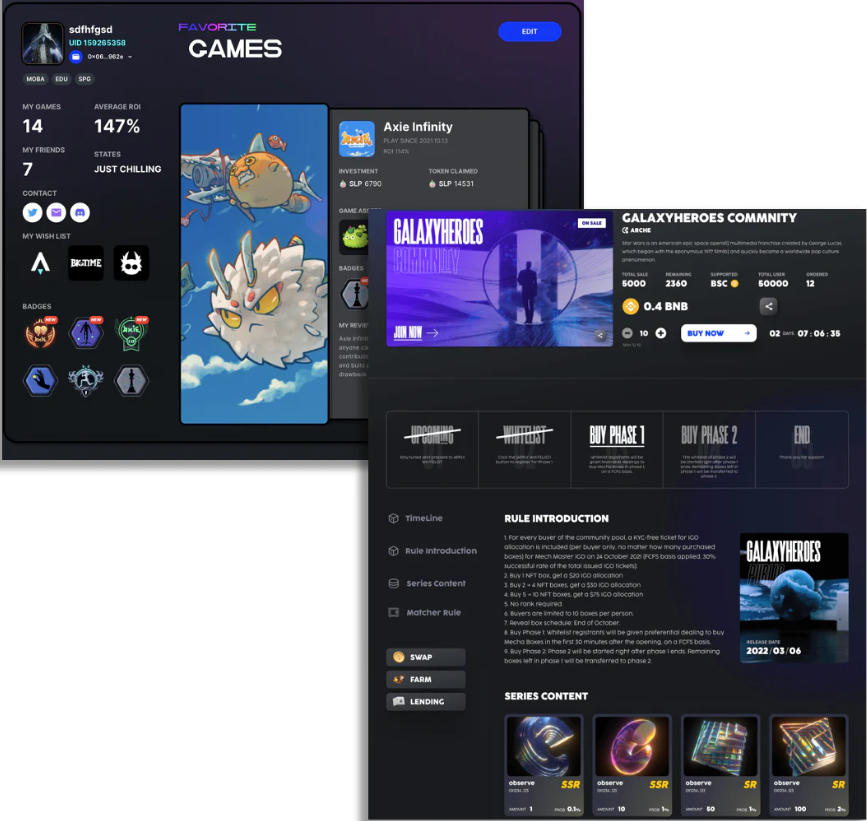
While the previous two focus more on end-users, Arche leans toward B2B game studios and guilds. No public demo exists yet, so final product form remains unclear. But according to its website, it offers an SDK enabling game studios to quickly launch marketplaces—similar to Steam’s store model—where players can buy and trade in-game assets.
In terms of GameID, Arche focuses on aggregating on-chain data and displaying game assets, including historical GameFi ROI—useful for identifying top-tier players.
Another highlight is Arche’s collaboration with major gaming guilds like YGG, Avacado, and GoodGame to form a Guild Alliance. With impressive backing, this alliance will unlock future functionalities and privileges—an exciting prospect.
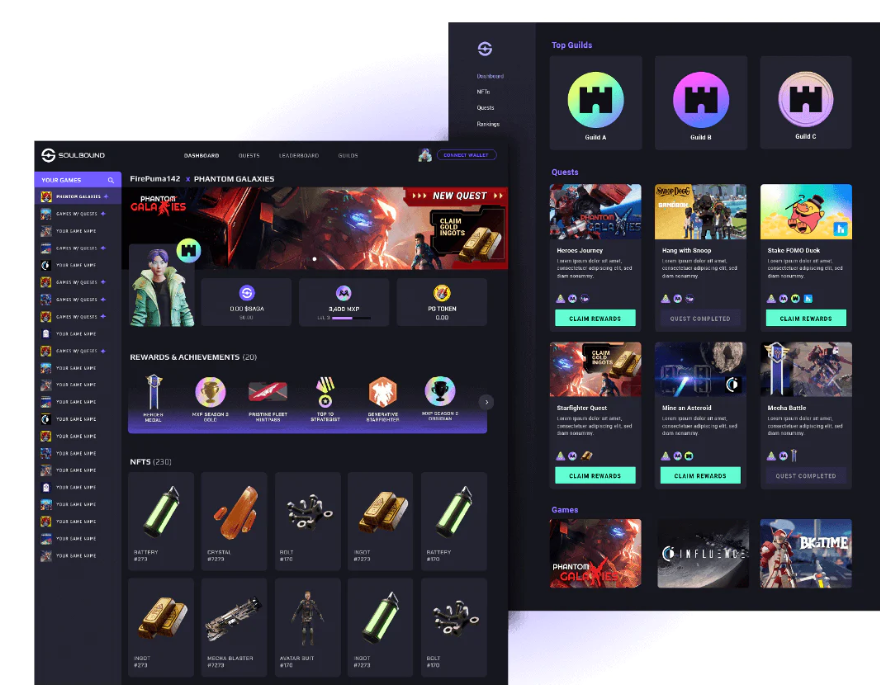
d. Soulbound
Soulbound is another achievement-based GameID platform. No demo is available yet, but based on website info, it appears to have solid in-game data integration. Players upgrade reputation tiers by completing specific in-game achievements and earn token rewards. It also maintains deep ties with gaming guilds.
An interesting feature: anyone can post quests on the platform and attach any NFT/token as reward. The project raised a $3.6M seed round led by Animoca earlier this year.
e. Lysto
Lysto is a GameID protocol focused on player data, helping gamers obtain on-chain digital credentials to showcase skills when finding teammates or joining competitions. Notably, the team claims traditional gamers can also verify credentials via the protocol, indicating strong Web2 game data aggregation.
Currently testing on Polygon, Lysto plans to expand first to Solana, ImmutableX, and Flow, eventually covering nearly all blockchains. In August, it closed a $12M Series A round co-led by Tiger Global.
= Summary =
GameID is currently a hot space, with both projects and investors actively engaged. Leading projects typically focus on 1–2 of these directions: players, developers, or guilds. Carv, DeQuest, and Soulbound lean toward players; P12, which once gained traction, focuses on one-click blockchain integration for game studios; Arche and Tavern target guilds. Despite differing emphases, all aim to effectively integrate Web2, on-chain, and in-game data—an increasingly convergent vision.
I’m excited to see standout projects emerge. Imagine being able to display your Steam marketplace, a blockchain game leaderboard, and a rare NFT weapon directly on Twitter—and having these achievements unlock special perks in new games. As a gamer, I find this incredibly compelling.
3.2) Social Supplements for Games: Cross-Platform Communication
Compared to GameID’s focus on game data and identity formation, this category emphasizes identity-based socialization. Though not limited to gaming, these tools serve as effective social supplements—akin to Web2’s Discord, YY, QQ, or WeChat—but with stronger cross-platform capabilities.
Notable projects include:
a. XMTP
XMTP is an early project building a Web3 messaging protocol, aiming to create a unified, decentralized inbox system usable by all dApps—think of it as a decentralized XMPP. Users can send and receive encrypted XMTP messages via apps with embedded clients, authenticating with wallet signatures. The protocol enables effective message encryption and spam prevention, though currently supports only peer-to-peer messaging.
b. Web3MQ
Web3MQ is an open-source, decentralized secure messaging protocol aiming to become native crypto communication infrastructure. Building on XMTP, it offers a comprehensive solution integrating push notifications, chat, and community features.
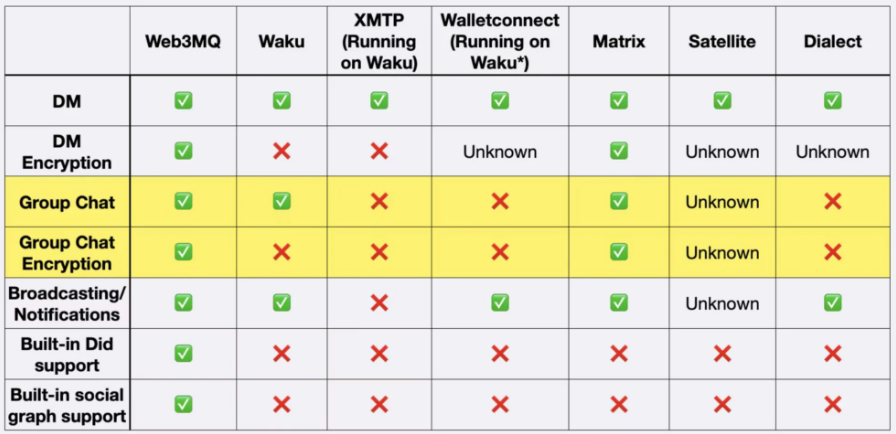
Additionally, Web3MQ supports a wide range of social identities and social graph protocols, using communication as a bridge to unlock relationship potential. It integrates existing Web3 ecosystems—including storage (e.g., IPFS) and computing (e.g., Internet Computer)—to enhance the messaging ecosystem. Users can customize privacy settings and other advanced features. Overall, Web3MQ stands out as one of the most mature and fully-featured Web3 messaging protocols.
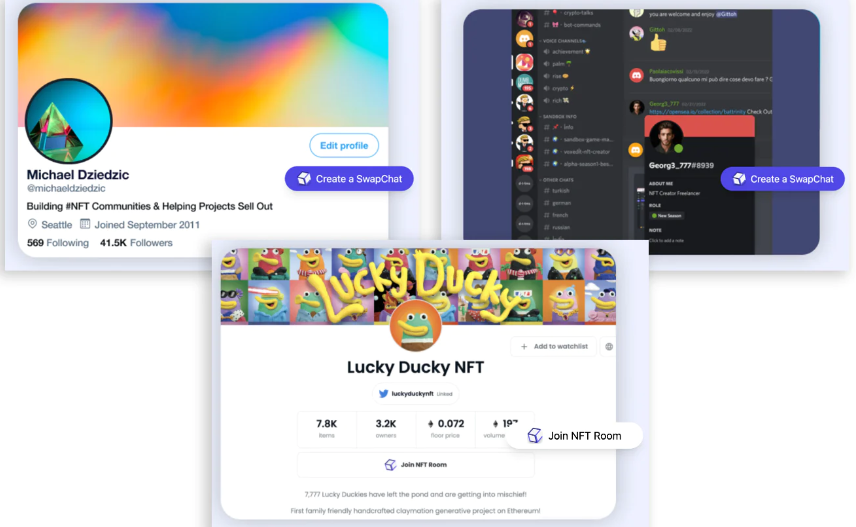
c. Swapchat https://www.web3messaging.online/SwapChat/
Swapchat is an instant messaging plugin based on wallet addresses, enabling cross-platform chat. As a plugin, it supports real-time messaging across OpenSea, Twitter, Discord, etc. For example, if you spot a desired NFT game item on OpenSea, you can instantly initiate 1-on-1 or group chat via Swapchat—and continue the conversation across Web2 platforms. This is highly practical for frequent NFT trades and impromptu strategy discussions.
d. Beoble
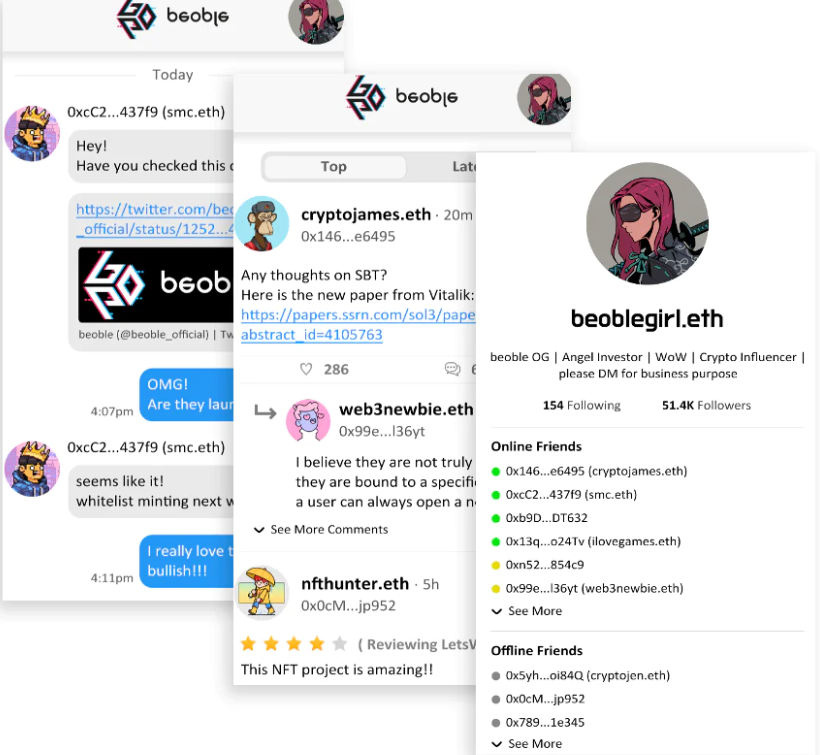
Unlike Swapchat’s focus on cross-platform functionality, Beoble delivers social features as APIs and SDKs, enabling any project to quickly integrate and enhance their own social environments. It offers modular features including personal profiles, feed streams, and private messaging—ideal for game studios or platforms building their own social ecosystems.
e. MetaForo
MetaForo is a forum-style project with its own platform and embeddable components for decentralized forums/discussion boards. The integration of games and forums is a proven model—seen in platforms like Gamersky, TapTap, and Steam’s discussion sections—all of which enjoy strong user followings. Unlike real-time chat requiring online presence, forums enable longer-cycle group discussions, fulfilling deeper gaming discourse needs. Yet this sector remains relatively underdeveloped.
3.3) Asset-Centric: NFT-Integrated Games
NFTs inherently possess strong social attributes—especially PFP projects, where holders use their NFTs to express identity. While project teams build communities early on, these connections often lack meaningful use cases and remain fragile. Hence, games that allow integration of various NFTs have emerged.
These projects present full-fledged game worlds where players import their NFTs as playable characters. By cleverly leveraging the community networks built by NFT projects, they help strengthen and energize those communities. For players, this enhances NFT utility and expands social contexts.
Notable examples include:
a. Arcade
Arcade is the most iconic project in this niche. Though launched as a land-based NFT project, it emphasized social features from day one. Holders gain their own space to invite friends for chats and mini-games. Its core innovation: letting players import their NFTs into gameplay for cross-NFT interaction and battles—expanding on early concepts like BAYC vs. MAYC.
Early partnerships with top communities like BAYC, Azuki, and Punk generated massive buzz and traffic—a smart move, as quality collaborations greatly boost visibility.
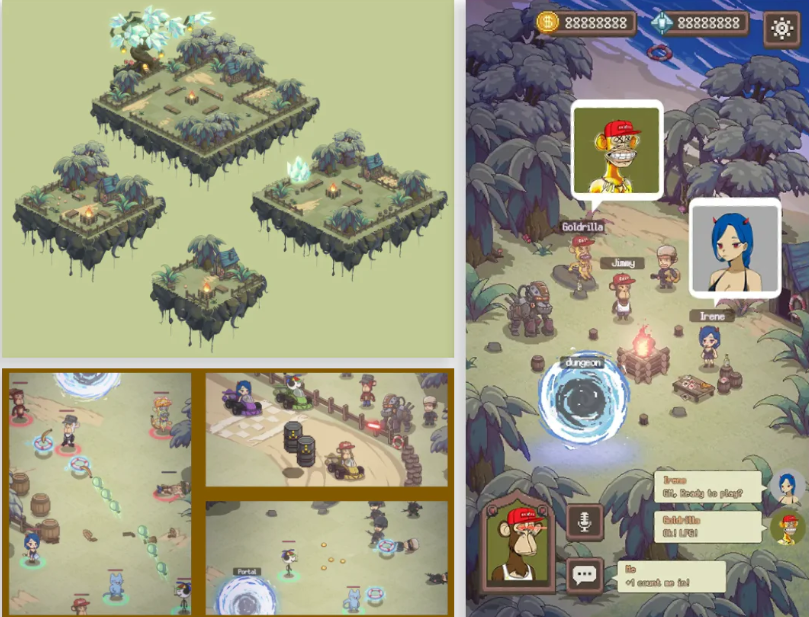
Its public sale on April 2nd saw 10,000 plots sell out in half an hour, leaving only 2,000 available. Gas fees spiked above 2,000 gwei. In the following week, it topped OpenSea’s weekly volume charts. Plots priced at 0.25 ETH initially sold for up to 1.04 ETH.
However, for land-NFT-based social projects like Arcade, NFTs act as amplifiers: during bull markets, they drive traffic; during downturns, they exacerbate decline. As of August 27, Arcade’s floor price dropped to just 0.17 ETH. While the largest plot holds near 11 ETH, daily trading volume is dismal.
Still, Arcade remains a noteworthy project—one of the few social games supporting true NFT interoperability.
b. Worldwide Webb
Worldwide Webb is a more foundational project compared to Arcade, envisioning a broader ecosystem. It uses NFTs to represent characters, pets, items, and quests. Put simply, it positions itself as an MMORPG—but like Arcade, allows importing external NFTs as avatars into its world.
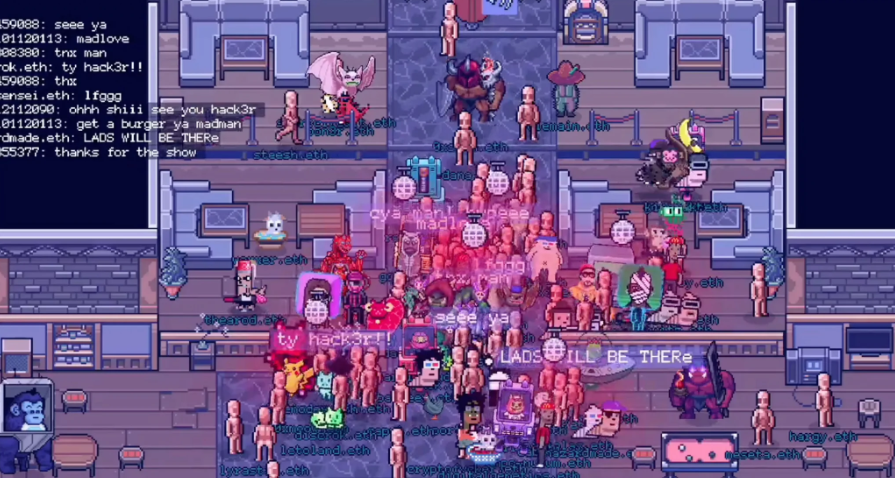
Worldwide Webb’s land NFTs launched on November 29, 2021, totaling 9,508 plots, priced at 0.069E, 0.12E, 0.24E, and 1E respectively. Though less hyped at launch than Arcade, consistent delivery and growing interest in land/social projects pushed its floor price to a peak of 2.84 ETH by late February.
Even amid current market chill, its floor holds around 0.35 ETH—thanks to steady team execution. In Q1 2022, it released friend lists (supporting wallet addresses/ENS) and chat, plus an Alpha version of a Pokémon-style battle system, building solid community confidence. In Q2, it launched a Mario Kart-inspired PvP Alpha, further strengthening engagement.
c. Big Brawl
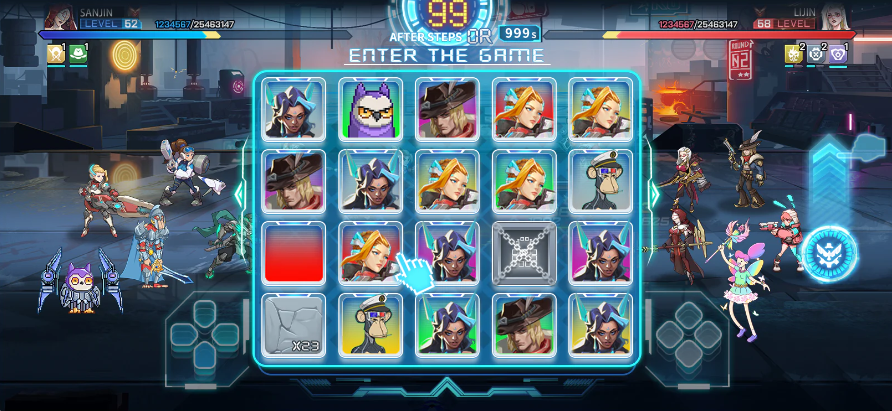
Big Brawl adds utility to PFP NFTs, turning BAYC, Azuki, Moonbird, Mimic, and others into battle-ready heroes. Players can tackle PvE dungeons or challenge friends—essentially an NFT-powered Tamagotchi-style brawl.
This model adds a “combat” layer atop NFT ownership’s existing “display” and “investment” aspects. If the game gains enough traction, Big Brawl could become a promotional platform for new NFT projects seeking exposure.
Its social nature lies in strong NFT interoperability, providing a concrete foundation for NFT-based communities. Additionally, its lightweight, fun gameplay makes it easy to integrate into social platforms, potentially becoming a viral side effect. However, as the game hasn’t officially launched, we must wait to assess its final form.
= Summary =
Overall, the idea of connecting existing NFT projects through shared game scenes is highly appealing. While no breakout game format has emerged yet, relatively mature projects like Worldwide Webb are still in the phase of iteratively building small-scale experiences. Given NFTs’ inherent flexibility, we expect more combinatory, engaging projects to emerge as NFT and GameFi evolve—making this a promising path for NFT utility and social expansion.
3.4) Relationship-Centric: Social Mini-Games
This category builds around users’ existing social relationships, using lightweight, competitive mini-games to spark viral spread—classic examples being QQ Farm, Parking Wars, and Ant Forest.
Given the lack of large-scale traffic hubs in today’s Web3 landscape, these efforts still rely heavily on Web2 social platforms. But as DID-based social graphs develop, new formats may emerge.
Notable projects include:
a. Mask Extension (built-in game module)
Mask is a middleware bridging Web2 and Web3, centered on social. As a browser extension for Twitter, it efficiently leverages users’ existing Web2 networks to expand use cases. The model echoes classic QQ Zone add-ons—mini-games among them—with QQ Farm being the undisputed king. Mask’s plugin contains similar elements.
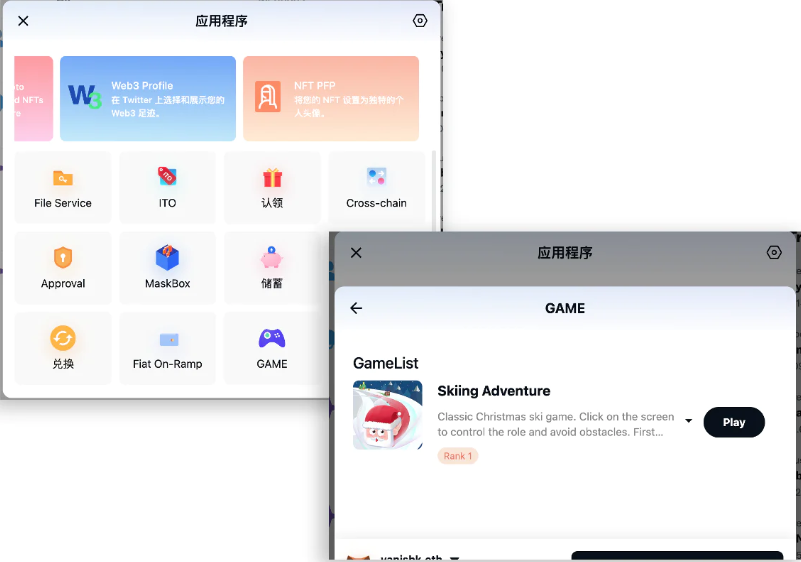
However, despite having a game module, Mask currently hosts only one low-quality game with weak social mechanics. We hope future development and partnerships bring more engaging, viral mini-games—potentially triggering a Web3-native social phenomenon powered by Twitter’s reach.
b. Non-Fungible Friend
Another Mask plugin component, currently simple but conceptually intriguing. It extends the NFT avatar idea—letting users deploy an NFT as a greeter on their Twitter profile, akin to old desktop assistants.
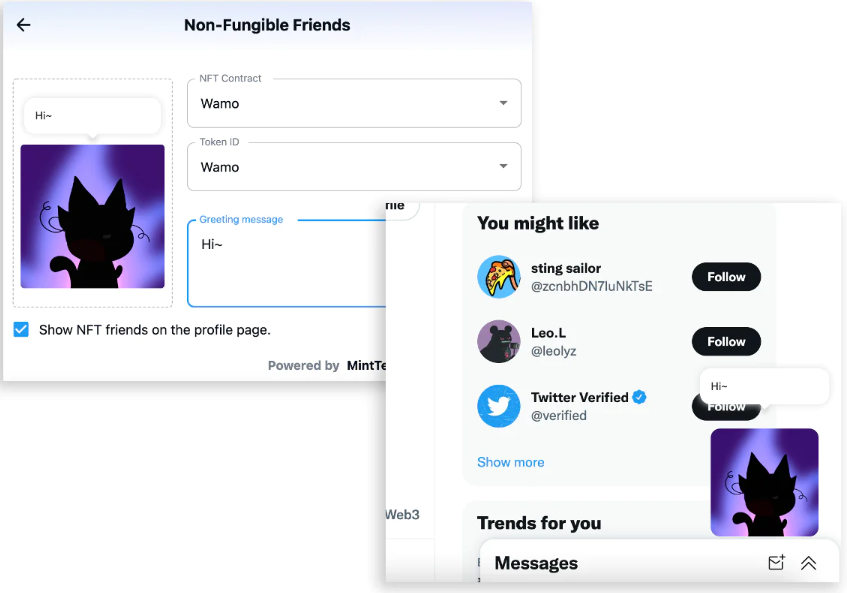
The potential lies in combining this with other concepts—virtual pets, AI, or motion-captured 3D avatars like Anata. Paired with JS scripts, this could yield stunning interactive effects.
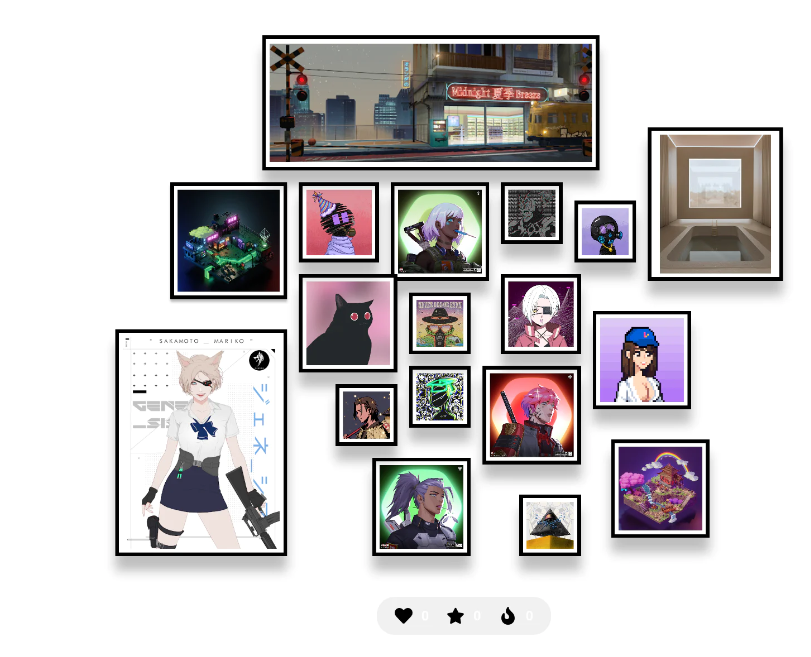
c. Shil.me
Shil.me is an NFT display platform, reminiscent of QQ Space. While gameplay is minimal, NFTs themselves carry strong exhibition and social value, synergizing well with social networks—just as QQ and QQ Space once did—potentially forming a unique ecosystem.
= Summary =
I believe this relationship-centric approach has vast potential. We’ll likely see more innovative formats inspired by classics like FarmVille, Pokémon, and QQ Pet. If NFTs, social, and gaming can be organically fused, the result could be explosively viral.
3.5) Others: AI-Driven Virtual Relationships
Relationships remain central to socializing, but in virtual spaces, these can extend beyond human-to-human connections—enabling unique 1-on-1 bonds with NPCs or AI-powered virtual pets that facilitate new social links.
One of DID’s most fascinating aspects is that it doesn’t restrict identity to human agents—allowing AI entities to exist as full-fledged digital beings. While most people may not yet accept or imagine fully virtual relationships, what if AI achieves—or surpasses—human-level social intelligence? Would we still need to distinguish the “real” entity behind a DID?
Promising projects include:
a. rct AI
rct AI provides end-to-end AI solutions for the gaming industry, using generative AI to create authentic metaverses. It’s a true R&D-driven tech company integrating development, product, and marketing. Leveraging AI computing power—especially deep and reinforcement learning—rct AI delivers dynamic, intelligent user experiences for both consumers and creators.
Core technologies like Chaos Box algorithm and Morpheus Cloud platform are widely adopted by top global games and Web3 projects. They enable real-time generation of dynamic, personalized interactive content across diverse scenarios—intelligently transforming gameplay, storylines, NPC behaviors, and dialogues—building truly dynamic, intelligent Web3 virtual worlds.
Through deep AI research, rct AI has established a unique ecosystem centered on “virtual humans.” It doesn’t just create them technologically—it grants them life, abilities, freedom, and equal rights. Strong technical moats and forward-looking ecosystem planning have enabled rct AI to accumulate extensive experience across tech, gaming, entertainment, and metaverse sectors globally, reaching over 200 million users. Overall, rct AI has built a full-stack architecture spanning core tech → NFT representation → interactive games → deep ecosystem.
b. Mirror World
Mirror World is a virtual universe composed of a matrix of games. Each game features AI-driven virtual beings called Mirrors, whose assets are fully interoperable across all games—ensuring holders retain permanent access to every new game release. After self-publishing three diverse game titles, Mirror World will finalize a universal economic framework, inviting more developers to join the ecosystem. By embracing openness, compatibility, and decentralization, Mirror World aims to become a collectively owned, richly entertaining virtual playground that generates real-world value.
Mirror World is building a multiverse of interconnected games, where players traverse different worlds using their Mirror NFTs, experiencing varied genres and gameplay. Existing designs include an ARPG with roguelike elements (Mirrama), a casual PvP arena fighter (Brawl of Mirrors), and an SLG title.
c. GiroGiro
GiroGiro.AI aims to become Web3’s AI infrastructure, providing content and social AI solutions for games and metaverse projects. It enhances scene diversity and playability by introducing interactive AI. The technology assigns each NFT a chain-based AI identity, linking it to a specific AI model that enables interactivity and autonomous creation. Moreover, the AI model is tightly bound to the NFT, allowing it to learn from user interactions and evolve into a unique on-chain intelligent agent.
To ensure composability and interoperability, NFTs’ on-chain AI identities will be usable across games and metaverse projects. For instance, an NFT could participate in artistic performances within a metaverse using its AIGC capabilities, showcasing and auctioning its creations. Successful NFT-artists might collaborate with renowned artists or platforms, evolving from PFPs into AI-powered “virtual idols,” enhancing commercial value. In gaming, NPCs gain more human-like, emotionally responsive dialogue. Combined with communication channels like Swapchat, this enables novel AI interactions, blurring game and real-life boundaries.
Beyond B2B partnerships, GiroGiro plans to launch its own PFP NFT series to experiment with advanced features.
d. Soularis

Soularis leverages cutting-edge AI and top-tier virtual human systems to build a Web3 society where users coexist with AI avatars, and digital identities and assets interconnect. Co-founded by rct AI and China’s leading virtual human company Ci Shi Culture, Soularis targets Gen Z through entertainment and film, bridging users with the metaverse and ushering in a true era of Web3 interactive experiences.
Soularis combines rct AI’s core solutions in deep reinforcement learning and content generation with Ci Shi’s Virtual Beings System (VBS)—China’s first universal system for generating user digital identities. Together, they form China’s first truly autonomous digital twin framework, revolutionizing appearance, will, and interoperability.
For Soularis, a key goal—beyond adhering to the metaverse’s core principles of persistence, self-evolution, and scalability—is achieving interoperability, especially of virtual identities. Such identities apply not only to real users’ digital avatars but also to native beings born in virtual worlds. This means both users and AI avatars can traverse different virtual scenes, engaging in diverse lifestyles with the same identity and soul—discovering their true selves and exploring the meaning of life.
This advanced technology enables full personalization, intelligence, and interoperability—both externally and internally—for virtual beings, pushing the industry from raw data production into an era of AI-driven personalized interaction and multi-scene data integration.
IV. Conclusion
Both decentralized social and GameFi have spawned numerous innovative ideas. Where they intersect, even more breakout-potential projects emerge—from GameID, now drawing heavy investment, to philosophically rich explorations of virtual relationships. This article merely scratches the surface, aiming to inspire further thinking.
We believe the fusion of gaming and social will be a key scenario to overcome current Web3 traffic bottlenecks. Let us await together the arrival of truly transformative, phenomenon-level applications.
Join TechFlow official community to stay tuned
Telegram:https://t.me/TechFlowDaily
X (Twitter):https://x.com/TechFlowPost
X (Twitter) EN:https://x.com/BlockFlow_News






