









Analyzing the Cosmos Hub 2.0 Upgrade: How ICS & ICA Drive the Thriving of the Cosmos Ecosystem?
TechFlow Selected TechFlow Selected
Analyzing the Cosmos Hub 2.0 Upgrade: How ICS & ICA Drive the Thriving of the Cosmos Ecosystem?
Cosmos Hub seems stuck, with many governance proposals being rejected, and it remains unclear what Cosmos's value proposition truly is.
 Navigating Web3 tides with focused insights
Author: Xave Meegan
Compile: TechFlow
Cosmos Hub is undergoing a major upgrade, and the entire crypto space has underestimated it. My view is that the Cosmos Hub 2.0 upgrade, along with ICS & ICA, will usher in a sustained bull market for the Cosmos ecosystem in 2023.
Cosmos Hub is the first Hub built using the Cosmos SDK. At its core, it was designed to demonstrate how the technology works. However, there was no clear roadmap for what it should become in the future, largely because the founding team disbanded early on.
In many ways, Cosmos wasn't so different from Ethereum in its creation and the early departure of its founders. But unlike Ethereum’s founder, many Cosmos leaders chose to leave the Hub and instead use the Cosmos SDK to build their own chains. Given Cosmos' flexibility and the ease of launching independent chains and communities, in some sense, Cosmos became a victim of its own success. Yet, all the application-specific chains launched by these Cosmos Hub pioneers have brought tremendous value to the broader Cosmos ecosystem.
Over the past two and a half years, as other app-chains flourished, the importance of Cosmos Hub has somewhat diminished. Public blockchains like Terra, a Cosmos-based chain, once gained significant influence, while Cosmos Hub itself seemed to fall behind.
Cosmos Hub felt stuck—many governance proposals were rejected, and it remained unclear what exactly constituted the value pillar of Cosmos.
I believe the true value of Cosmos Hub has always been that most stakeholders across the ecosystem genuinely want it to succeed. Nearly every founder within the Cosmos networks wants to see Cosmos Hub thrive and is willing to work toward that goal.
Against this backdrop, over the past two and a half years, multiple teams have been quietly enhancing the capabilities of Cosmos Hub. Thyborg recently mapped out the ecosystem on the Hub:
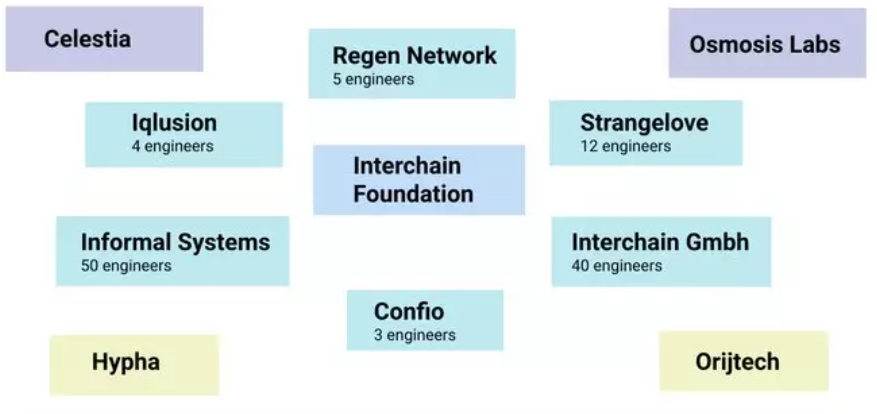
There are many unsung heroes working full-time on Cosmos Hub. These individuals have become the ultimate catalysts, driving Cosmos Hub forward through ICS, ICA, and the Cosmos Hub 2.0 upgrade to lead the entire ecosystem in 2023.
ICS
ICS stands for Interchain Security. ICS makes launching new projects more secure by allowing them to leverage the validators of the Hub. ICS could position Cosmos as the primary launchpad for most future projects. ATOM stakers will benefit from the success of early-stage projects, as a portion of rewards will flow back to ATOM stakers.
If a project grows through ICS and accumulates sufficient value, it may eventually spin out to create its own independent network beyond the Hub. At that point, many stakeholders within the Hub would likely support the new network and hope for its success. The project might also reward ATOM stakers before departing.
Essentially, ICS brings business development to the Hub for the first time. Dedicated teams are now working full-time to attract top-tier projects to the Hub, where they can be actively guided and nurtured.
The end goal is to incubate projects within the Hub and then spin them off into independent Cosmos networks. Cosmos will bring in projects, grow them, spin them out—and repeat. Meanwhile, ATOM stakers continue to benefit (earning staking rewards from projects using ICS).
ICA
ICA stands for Interchain Accounts. While not limited to Cosmos Hub alone, ICA has the potential to multiply the value that ICS brings to the Hub. ICA enables one blockchain to securely control accounts on another blockchain via IBC.
This functionality is powerful because core functions impacting the Hub can now be built directly on the Hub rather than elsewhere. For example, liquid staking (LS) could be established on the Hub for all Cosmos assets. Users could interact with other chains via ICA while paying fees in ATOM on the Hub.
Cosmos Hub 2.0 is expected to launch at Cosmoverse in September. Hub 2.0 development represents a niche breakthrough for Cosmos Hub—it will increase the fees collected by the Hub from ICS and establish connections with networks spun out from ICS, creating a powerful flywheel for value extraction.
In summary, Cosmos Hub is poised for a full revitalization. I believe the Hub's new products, technologies, economic model, community momentum, and roadmap will serve as the catalyst for a bullish cycle across the Cosmos ecosystem in 2023.
Join TechFlow official community to stay tuned
Telegram:https://t.me/TechFlowDaily
X (Twitter):https://x.com/TechFlowPost
X (Twitter) EN:https://x.com/BlockFlow_News






