From Infrastructure to Middleware: A Comprehensive Look at the Present and Future of Web3 Social
TechFlow Selected TechFlow Selected
From Infrastructure to Middleware: A Comprehensive Look at the Present and Future of Web3 Social
Social networks allow users to interact with the network, not just consume its content.
 Navigating Web3 tides with focused insights
Written by: lingchenjaneliu, Fundamental Labs
Translated by: TechFlow
Disclosure: Members of Fundamental Labs and our team have invested in and may hold positions in tokens mentioned in this report. This statement is intended to disclose potential conflicts of interest and should not be construed as a recommendation to buy any token. The content is for informational purposes only, and you should not make decisions based solely on this information. It does not constitute investment advice.
What Is Web3?
Web3 is an umbrella term without a fixed definition, encompassing decentralized ideas and visions driven by community and user ownership. As Him Gajria put it best in his article on Web3.0:
- Web1 was read-only: websites hosted content that people could consume but not share.
- Web2 is read-write: users can actively participate in the network.
- Web3 will be read, write, own: built on peer-to-peer networks enabling interoperability—different applications can connect and communicate in a coordinated way.
In the Web2 world, dominant categories are social networks like Facebook and YouTube. Social networks allow users to interact with the network, not just consume its content. In the Web3 social ecosystem, we’ve seen a surge of funding into Web3 social startups. While no Web3 equivalent of Twitter or Facebook has emerged yet, many believe that narratives around data ownership, network incentives, NFTs, and tokens will solve the cold-start problem and eventually attract enough creators and audiences to platforms.
The Need for Web3 Social
Web3 presents a fundamentally different value proposition from Web2. Web2 is dominated by centralized platforms that follow a model where, once a platform reaches a tipping point—high adoption by users and creators generating strong network effects—participants sacrifice their interests for the platform’s growth.
Post-tipping-point growth is typically fueled by extracting user data for ad revenue, leading to data and security breaches. Beyond these issues, social platforms also contribute to psychological and societal problems, including addiction, mental health issues, opinion manipulation, and misinformation spread.
Recent criticism of social platforms doesn’t come only from regulators and users—developers who once worked at major platforms have also spoken out. In the documentary "The Social Dilemma," developers revealed how social platforms use user data to design products that intermittently reinforce online engagement in users’ minds.
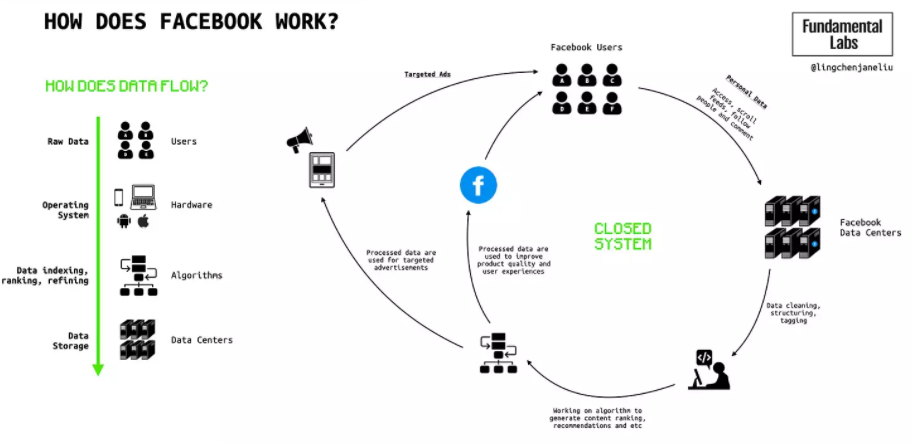
Against this backdrop, Web3 social aims to build open platforms where users own their content, digital assets, and even their social layers—going beyond monetizing user data and locking them into sticky platforms. Digital assets created according to interoperable standards on public blockchains are portable and transferable, so users aren’t trapped on specific platforms.
Dominant internet platforms today aggregate users and their data. As these platforms grow, their ability to deliver value increases. Network effects give dominant platforms a lasting edge. User behavior data from major social platforms helps them optimize algorithms, making their content and ad targeting significantly better than competitors’. For example, Amazon uses comprehensive data to understand customer needs, optimizing delivery logistics and analyzing profit margins and consumer demand to develop its own product lines.
In traditional internet business models, users and their data are key sources of competitive advantage. Therefore, platforms rarely share data; if users leave, they struggle to take their social graph or content with them.
In Web3, users access a public network operated by thousands of independent nodes adhering to strict rules defined by network code—not a closed network owned and run by centralized infrastructure-as-a-service (IaaS) providers.
Users and businesses can build Web3 applications (dApps), communities (DAOs), infrastructure powering these apps (node infrastructure), or make other contributions. No single entity controls data access on the network—any attempt to do so would be rejected by other nodes.
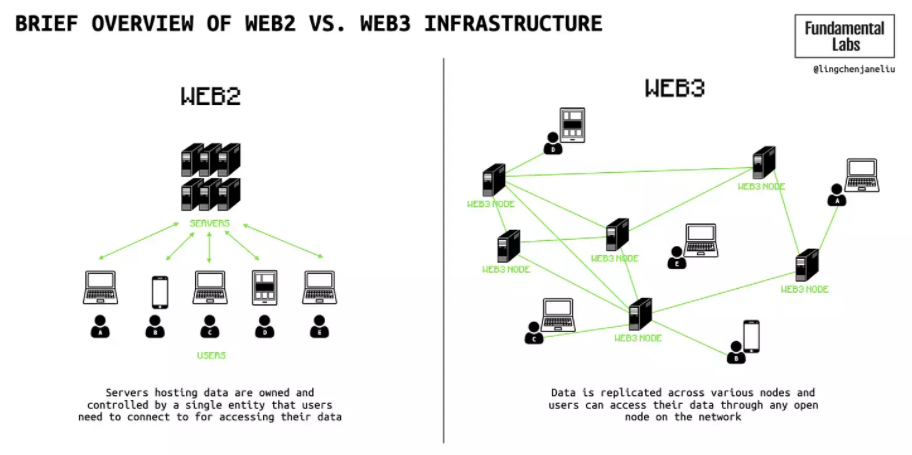
Essentially, data is stored across a network of independent nodes, all ensuring only the data owner decides what happens to it—sharply contrasting with Web2 cloud providers controlling centralized servers.
A core philosophical principle of Web3 is that value creation in ecosystems extends beyond capital—and that value should be earned, not just bought. This marks a fundamental shift from current structures where capital owners earn more from investments than workers do from labor, exacerbating wealth inequality over time. Distributing ownership to participants is another major shift: existing platforms are built by employees and investors, with meaningful ownership held by them. In this traditional Web2 model, users who provide content and contributions don’t own the platforms they help make valuable.
Open Social Stack: Current Market Landscape
After reviewing existing projects building the open social stack in Web3, I’ve mapped out a market landscape with multiple components and layers. Beyond the base layer—including data infrastructure and decentralized storage—there are middleware components such as decentralized identity, social graphs, and authentication protocols, which form the critical foundation of the entire open social stack. Any application can permissionlessly build on top of them, leveraging existing user networks instead of starting from scratch.
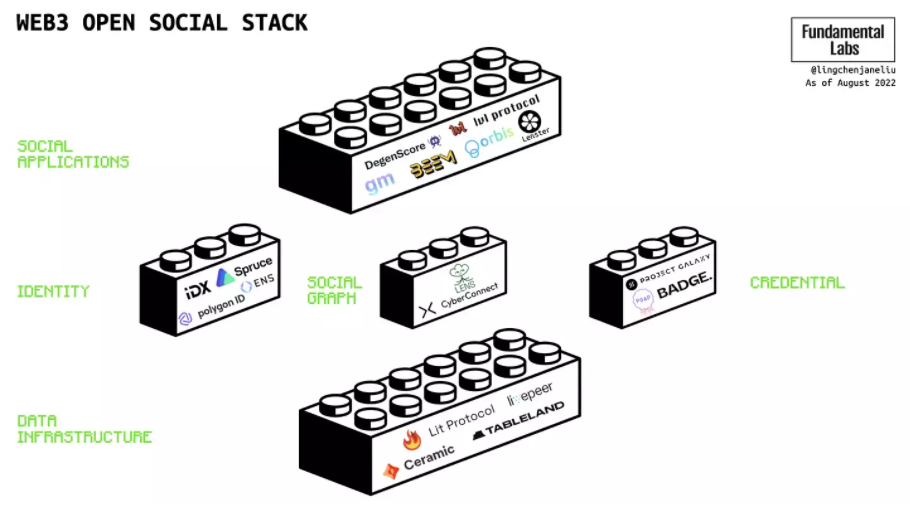
The open social stack enables a powerful paradigm shift—portable and pluggable identities residing in users’ crypto wallets. Consider how our Web2 online activities form aspects of our identity: photos posted on Facebook and Instagram, profiles created on Twitter and LinkedIn—all part of who we are. The challenge is that these identities exist only within the platforms where our actions occur, isolated from one another. Inside the walled gardens built by Web2 giants, we can’t simply integrate our Instagram identity and plug it into YouTube to align with our interests.
Social platforms typically face the so-called cold-start problem: new platforms struggle to acquire users, which is why growth teams play such crucial roles in traditional internet industries. With Web3’s open social stack, new platforms can leverage middleware like social graphs and credentials to develop products and quickly test product-market fit. Since data is transparent, competitors can analyze dominant platforms’ data and target high-network-value users with relevant incentives to join their platforms. Because users can easily port their digital assets across platforms at near-zero switching cost, platforms must compete through superior user experience and deeper community alignment with shared missions and values.
Now, let’s examine each layer of the open social stack in detail.
Data Infrastructure
The most important issue decentralized social needs to solve is decentralized storage of dynamic data. Protocols need to support dynamic data storage before enabling streaming, social media, and related applications.
Since social network apps often generate numerous low-value transactions—such as shares, likes, or follows—executing these on Ethereum is economically unfeasible. Therefore, finding a scalable solution for transaction settlement is critical.
Due to the immutability of on-chain data, building social applications atop the data layer is challenging. However, several protocols aim to address this, including Ceramic, Livepeer, Lit Protocol, and Tableland. These protocols focus on managing and storing dynamic data such as images, videos, and text.
Ceramic Network
Web2 applications run on code, with features, content, and product recommendations driven by complex algorithms fueled by user data. Information populating websites—whether user or app data—is typically determined by platform-designed algorithms. In contrast, Web3 stacks and dApps seen so far lack these data-driven capabilities, primarily due to the immutability of on-chain data. Ceramic Network attempts to solve this by providing a data layer on top of IPFS to manage and track state transitions, linking data to data structures for easier reading and writing. The protocol supports mutable data tables tied to users, enabling the development of data-driven applications on top.
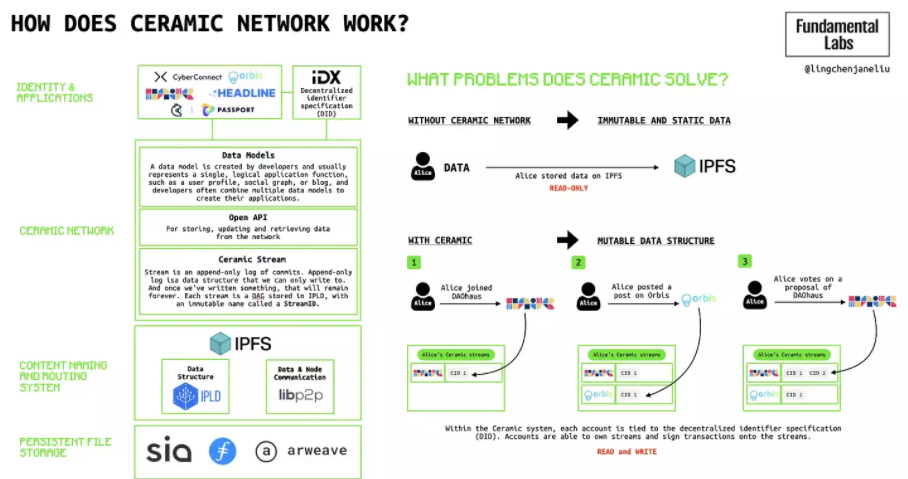
Advantages of Ceramic Network:
- Users: When data is stored on IPFS, users struggle to track it over time. With Ceramic, data is tied to keys associated with users and the identities they bring via blockchain wallets. Each time a user visits an app, data is recorded in Ceramic on IPFS. This data corresponds to data models created by app developers, allowing users to carry their data when moving to another app.
- Developers: Ceramic provides a shared database for structuring data to build data-driven features. It includes a marketplace of data models where developers can create models tailored to specific functionalities.
Tableland
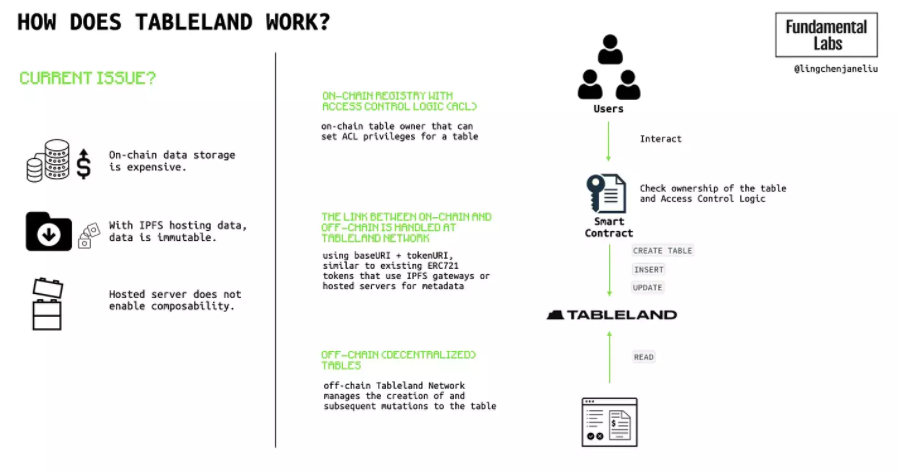
Like Ceramic Network, Tableland aims to overcome limitations of the Ethereum Virtual Machine (EVM), where smart contracts have limited storage capacity and updating, writing, and storing data on-chain is expensive.
Existing Web3 applications often use hybrid methods to store app data. Take NFT projects as an example: an NFT has two parts—the smart contract and metadata for the artwork. The smart contract exists on a blockchain, usually Ethereum, containing rules for transactions. It also includes a link pointing to a server hosting the digital artwork. That means the artwork itself may not reside on the blockchain and could be stored off-chain. NFT projects typically rely on centralized databases like AWS or Google Cloud to store structured data. However, using decentralized storage providers to host metadata is relatively safer—if a centralized server goes offline, the artwork could be lost. With decentralized storage, if one node fails, the artwork might still be retrievable from another location. Current drawbacks of decentralized storage include immutable metadata that’s hard to query or compose. In contrast, centralized providers enable dynamic metadata and support querying. But data stored with centralized providers isn’t open or composable.
Tableland offers a technical solution addressing on-chain data immutability, high storage costs, and poor composability and queryability. It builds a data layer that allows cheaper data storage, reading, and writing compared to pure EVM environments, with greater storage capacity. Tableland achieves this through two components: an on-chain registry with access control logic (ACL) and off-chain tables. Each table in Tableland is minted as an ERC721 token on an EVM-compatible layer. That is, write-access permissions exist on the EVM, and users own these rights via NFTs stored in their Ethereum wallets. The protocol has two main parts: on-chain table owners and the off-chain Tableland network. The connection between on-chain and off-chain components is handled at the smart contract level, preserving immutability.
- On-chain owners: Set ACL permissions for tables
- Off-chain (decentralized) Tableland Network: Manages the creation and subsequent mutations of the tables themselves.
In short, Tableland is like IPFS with an SQL layer on top, offering greater flexibility and adaptability.
Middleware Layer: Social Graphs
Every social network relies on a social graph. Social graphs are essential for all communication—from posts and likes to direct messages. Without a company or entity responsible for data storage, a shared public social graph cannot exist. Some protocols aim to achieve exactly this.
Lens Protocol
Lens Protocol is a composable and decentralized social graph. Social applications include user profiles, followers, posts, comments, shares, and likes. These components define the basic data layout and relationships—like who follows whom or who published what content.
On Lens Protocol, fundamental and critical social media functions are powered by NFTs and owned by users. User profiles are NFTs, followers own follower NFTs, and each post represents a post NFT.
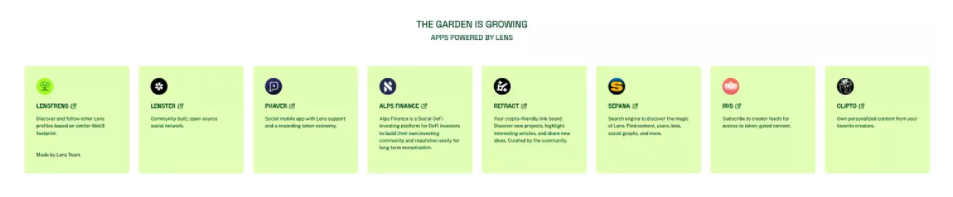
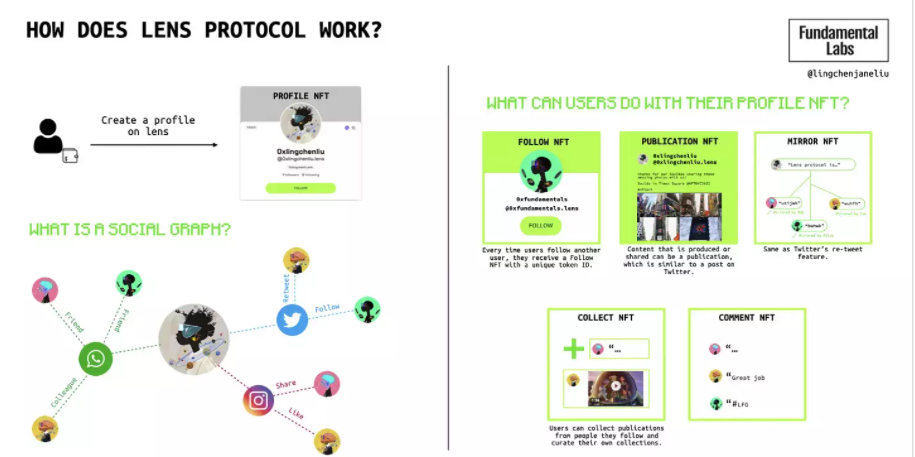
The social graph designed by Lens Protocol cannot be easily forked because all data is stored as NFTs in users’ wallets. Lens Protocol boasts a robust ecosystem with various applications built on top. This ecosystem gives Lens a strong advantage over competitors—as its user base grows alongside the ecosystem, more data flows back into the social graph protocol.
CyberConnect
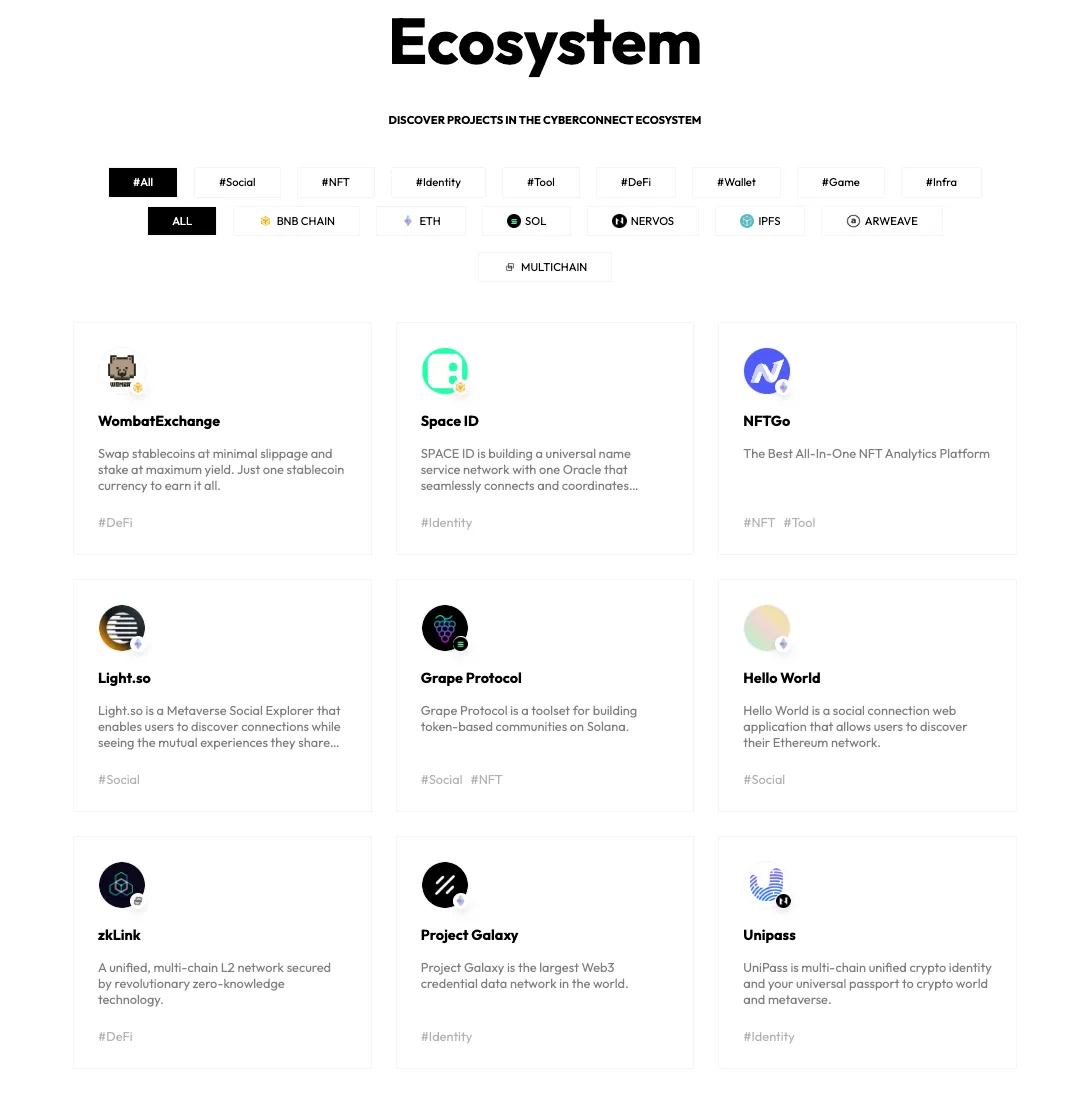
CyberConnect is a social graph protocol allowing dApps to access and use user-provided social graph data. CyberConnect has a strong ecosystem, integrating many Web3 applications including Project Galaxy, Mask Network, Light.so, Grape.art, NFTGo, Metaforo, zklink, and others.
CyberConnect’s social graph consists of two parts: 1) Follow button; 2) Follow and follower lists. Web3 applications can directly plug into CyberConnect’s social graph module to build their own apps, helping solve cold-start problems while returning data ownership to users. Thus, users can move their social graphs seamlessly across different applications. CyberConnect’s solution enables users to maintain a more comprehensive identity across all apps.
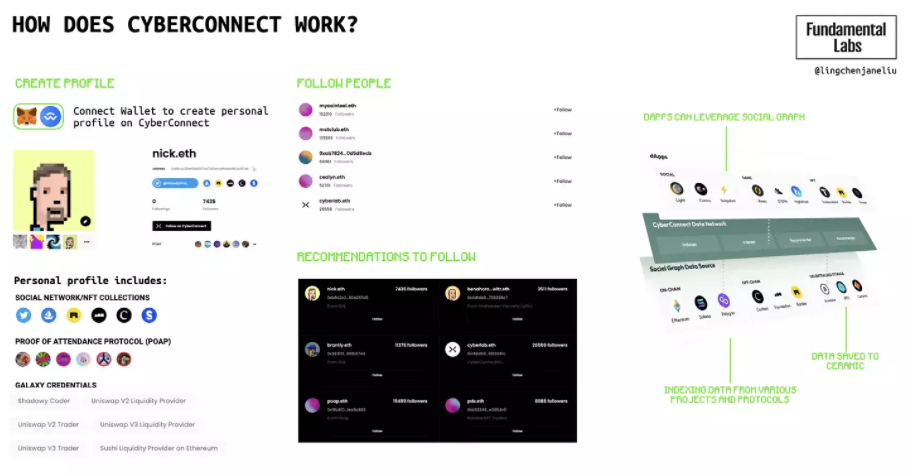
In traditional platforms, a social app builds moats not only through good product design and UX but also through data-driven network effects. Hence, newcomers struggle to challenge dominant platforms because users can’t simply migrate their data and enjoy the same experience without rebuilding profiles, establishing connections, and generating sufficient data for better recommendations and content curation. The cold-start problem remains one of the biggest hurdles for social platforms. Without initial data, launching a new social network is extremely difficult.
Authentication
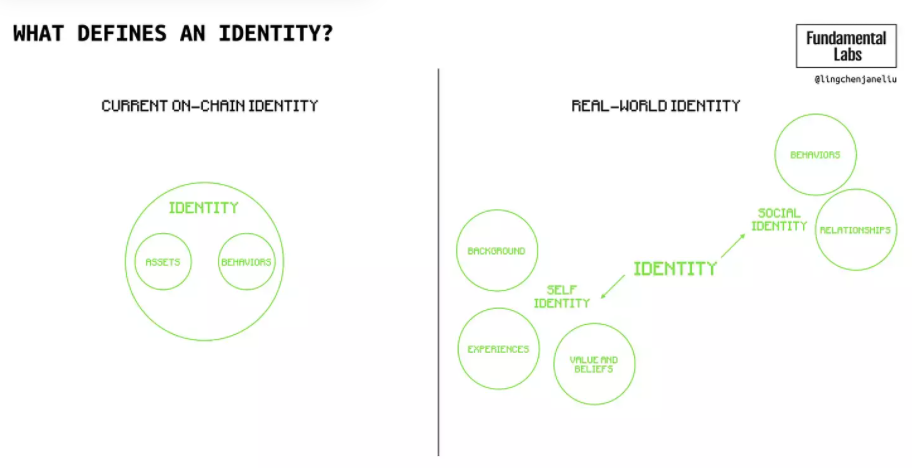
Identity is a person's self-awareness formed by unique traits, affiliations, and social roles. Moreover, identity has continuity—despite environmental changes, a person feels like the same individual over time. So far, Web3 identities consist of low-dimensional data, emphasizing decentralization; thus, decentralized identifiers (DIDs) are the most common solution for Web3 identity.
Why Do We Need DIDs?
- DIDs allow unique, private, and secure peer-to-peer connections between parties.
- Their decentralized nature ensures credentials remain verifiable at all times.
- Each party—individual or organization—can create different DIDs as desired, using separate DIDs for different digital relationships and contexts to prevent data correlation.
- DIDs are fully controlled by the identity owner. They operate independently of centralized registries, authorities, or identity providers.
Transition from Password-Based to Passwordless Authentication
Early Web2 apps mostly used username + password for authentication. Users often reused the same credentials across sites—a highly insecure practice.
When mobile devices and apps emerged and captured most user time, apps began adopting new authentication methods—phone numbers and verification codes. For convenience, many adopted one-click login via Google/Apple/WeChat/Alipay. Apps supporting only ID+password declined.
With advances in biometrics, devices shifted toward fingerprint or facial recognition. Web2 authentication is evolving toward secure, convenient passwordless methods.
Account Separation and Identity Aggregation
In China, internet giants like Tencent and Alibaba offer diverse services spanning finance, social, entertainment, and e-commerce. Based on users’ historical transaction data, social behaviors, and identity verification, they developed robust credit systems. Most Chinese apps support one-click login using WeChat (China’s instant messaging, social media, and mobile payment app) or Alipay (Ant Group’s payment app and digital wallet), both with established credit scores. For instance, users can scan a QR code on a shared bike via WeChat or Alipay to unlock it—no registration or account creation needed. The experience becomes seamless with a single authorization—an ideal example of account separation and identity aggregation. These credit systems/scores represent aggregated digital identities combining identity data and trust levels. Apps integrating such systems can request permission to read user identity and create temporary accounts. Similar identity and account experiences are needed in Web3, allowing users to easily engage in DeFi, gaming, and social apps across different accounts with interoperable identities.
Social Applications
Frontend applications form the user-facing layer, with use cases including social media, video streaming, and community tools. Social apps can leverage middleware projects—open algorithms, public social graphs, and open digital identities—to customize and optimize their products. With middleware in the open social stack, multiple apps can coexist on the same user data and infrastructure components, changing the competitive landscape. Apps will find it harder to defend against competition and build sustainable advantages since users can frictionlessly move between apps. Therefore, Web3 apps must experiment with user acquisition, retention, and monetization models.
Web3 Social: All Hype, No Protocol?
The Web3 social space is booming, attracting developers and capital—but no protocol has yet dominated the market. Why? We’ll explain these challenges below and explore areas for innovation to accelerate progress in this field.
Challenges Facing Web3 Social
From Economically Incentivized Socializing to Relationship-Driven Socializing
Real social interaction happens when users share interests, topics, and backgrounds—current on-chain socializing remains far from real-world interactions. Key reasons include:
- Speculative and incentive-driven behavior: On-chain social activity is currently driven by speculation and economic incentives. On-chain social data doesn’t reflect users naturally forming genuine, effective connections.
- Are counterparts real people?: Social interaction is inherently human-to-human. In Web3, users interact with addresses. Today’s technical reality is that addresses only contain transaction history and asset holdings. Since this data doesn’t help identify authentic target users, connection efficiency is very low and outcomes poor.
Data Composability Isn’t as Easy as We Think
Despite Web3’s promise of composability and expectations that apps should reuse data models from various protocols, the reality is that different protocols define their own data and business metrics based on unique logic and operational needs. It’s unrealistic and impractical for an app to simply scrape and use arbitrary data models and algorithms from other protocols.
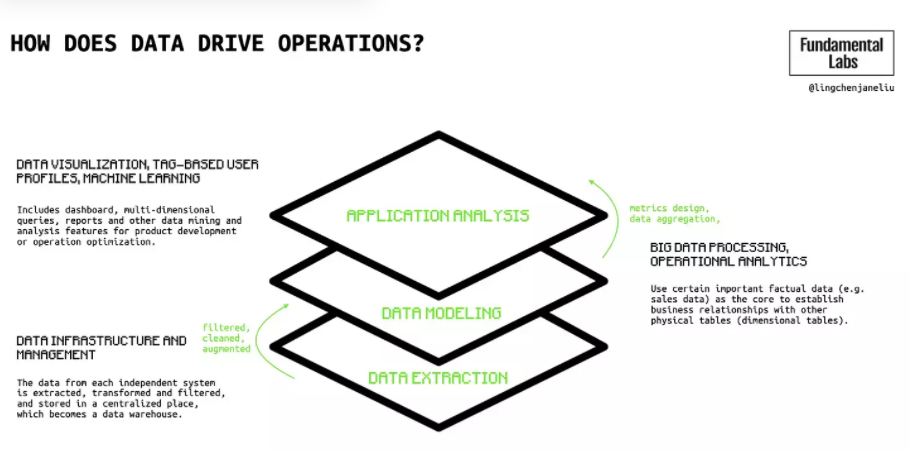
Moving from raw data (e.g., session duration, ticket size, purchased items) to business-level analytics (e.g., retention, conversion) involves multiple steps. Data models and business metrics used to profile users and design social recommendations, content feeds, and targeted marketing algorithms are truly valuable—they help optimize products and operations, driving business and user growth.
Better UX accelerates adoption; poor UX limits user base:
- Too much industry jargon: Terms like airdrop, cold wallet, DeFi, diamond hands, fiat, hard fork, gas, hash rate, private key, proof-of-stake, seed phrase, stablecoin, and smart contract flood research, content, and apps—making onboarding extremely difficult for new users.
- Poor UX is the main barrier to mass adoption: UX encompasses not just appearance, but functionality, ease of onboarding, usability, scalability, gas prices, and transaction speed. New users struggle to add networks to MetaMask or understand differences between chains and how to transfer tokens across networks. When traditional web has spent decades developing user-friendly solutions enabling even older generations to intuitively use the web, it’s hard to convince users to switch to Web3 when its UX generally lags behind Web2.
Web3 must solve real user pain points and deliver unprecedented value. Decentralizing data and giving users ownership of data and content is a compelling narrative, but decentralization comes with higher costs. When users must pay fees to use protocols, decentralization itself holds little immediate practical significance for most. In contrast, centralized platforms absorb transaction and operational costs—including storage, bandwidth, computing power, product development, and maintenance—and monetize collected data to fund platform development and upkeep. Web3 still needs time to discover its native business model—one distinct from existing Web2 patterns. So far, we haven’t seen meaningful innovation in business models.
Where Can We Explore?
Before social applications can flourish, digital identity remains a critical unresolved cryptographic challenge.
Web2 digital identities are siloed and not fully user-defined:
Existing Web2 digital identities are isolated and confined within individual platforms. Furthermore, due to the business models pursued by traditional social platforms, platforms create user tags based on behavior and design algorithms using these tags to recommend content, increase retention, and optimize paid ad revenue. As a result, users’ digital identities are fragmented across multiple platforms and partially defined by the platforms themselves (via user tags). Under this model, users don’t truly own their online accounts—they rent them from companies and centralized organizations. Consequently, users risk having their digital identities hacked, manipulated, regulated, or lost.
Web3 identities should be linked to individuals, not addresses:
Markets based on scarcity, reputation, or authenticity require identities tied to real individuals. Identity carries multiple meanings: one denotes subjectivity—what distinguishes one person from another, akin to legal identification; the other denotes status—describing relationships between people, such as social standing. So far, address-based identities focus only on status, particularly contract state showing assets held by an address. To build richer social applications, relational identities reflecting human-to-human social relationships are essential—relational states only emerge through human interaction.
Though the space hosts many projects, it remains in early stages. Developers are experimenting with integrating building blocks into the open social stack and sustainable business models without compromising UX or the Web3 vision. With Vitalik’s proposal of Soulbound Tokens, mapping real-world relational states onto the chain becomes possible. Only then can deep, human-centric on-chain social ecosystems emerge.
Join TechFlow official community to stay tuned
Telegram:https://t.me/TechFlowDaily
X (Twitter):https://x.com/TechFlowPost
X (Twitter) EN:https://x.com/BlockFlow_News


![Axe Compute [NASDAQ: AGPU] completes corporate restructuring (formerly POAI), enterprise-grade decentralized GPU computing power Aethir officially enters the mainstream market](https://upload.techflowpost.com//upload/images/20251212/2025121221124297058230.png)