Base ecosystem welcomes another powerhouse? In-depth look at the AI infrastructure project Sapien
TechFlow Selected TechFlow Selected
Base ecosystem welcomes another powerhouse? In-depth look at the AI infrastructure project Sapien
Sapien is dedicated to addressing the scarcity of high-quality materials currently used for AI training.
 Navigating Web3 tides with focused insights
Author: San, TechFlow
Recently, Sapien, a decentralized AI data project on Base, has demonstrated strong growth momentum.
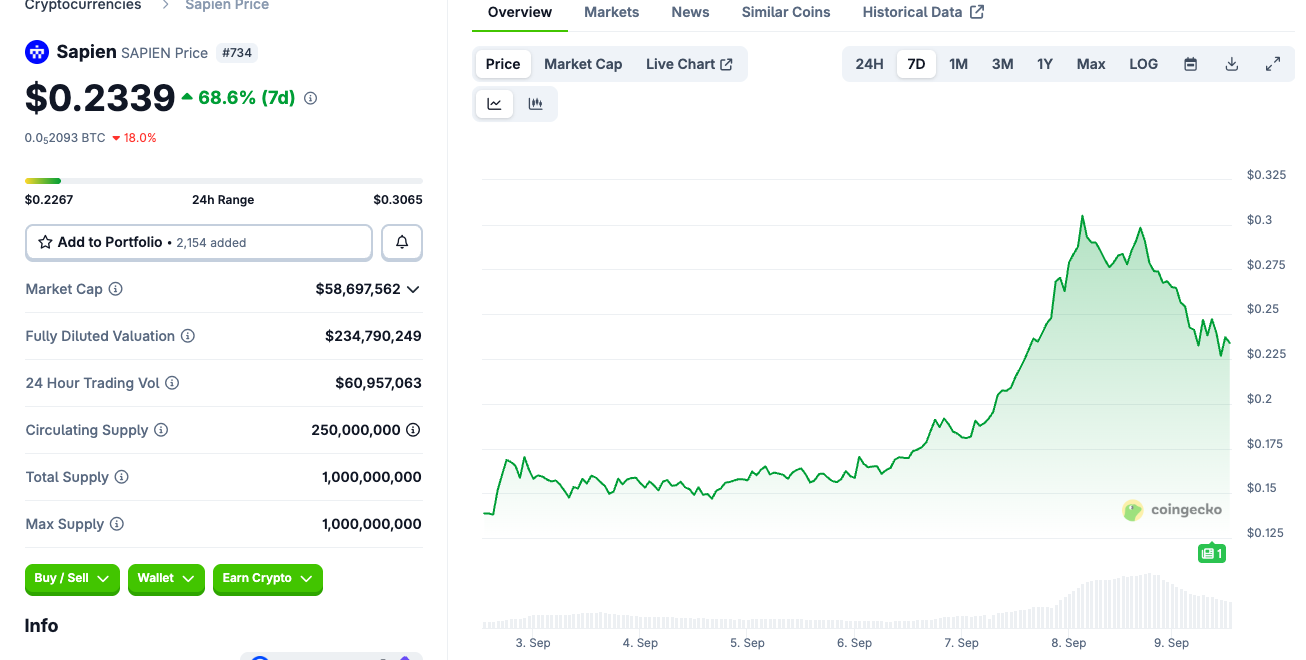
Since its listing on Binance Alpha on August 20, Sapien initially experienced a continuous decline, but began a strong rebound starting September 1. Since then, it has doubled in value, while its 24-hour trading volume has quadrupled from around $5 million at the beginning of the month to surpass the $20 million mark.
As prices and trading volumes rise, discussions about Sapien in the market have gradually increased. On Sapien’s publicly displayed client list, several well-known traditional industry giants appear: Alibaba, Baidu, Toyota, Lenovo, as well as Midjourney, the AI image-generation unicorn.

Clearly, using more data to train AI and serve traditional Web2 enterprises remains an overlooked gem from the previous AI hype cycle; although the current crypto market's enthusiasm for AI narratives is far less FOMO-inducing than before, this still represents a relatively attractive story—especially when most AI-related crypto tokens are more meme-driven.
Project Background
In current crypto community commentary on Sapien, "star team" has become a key term.
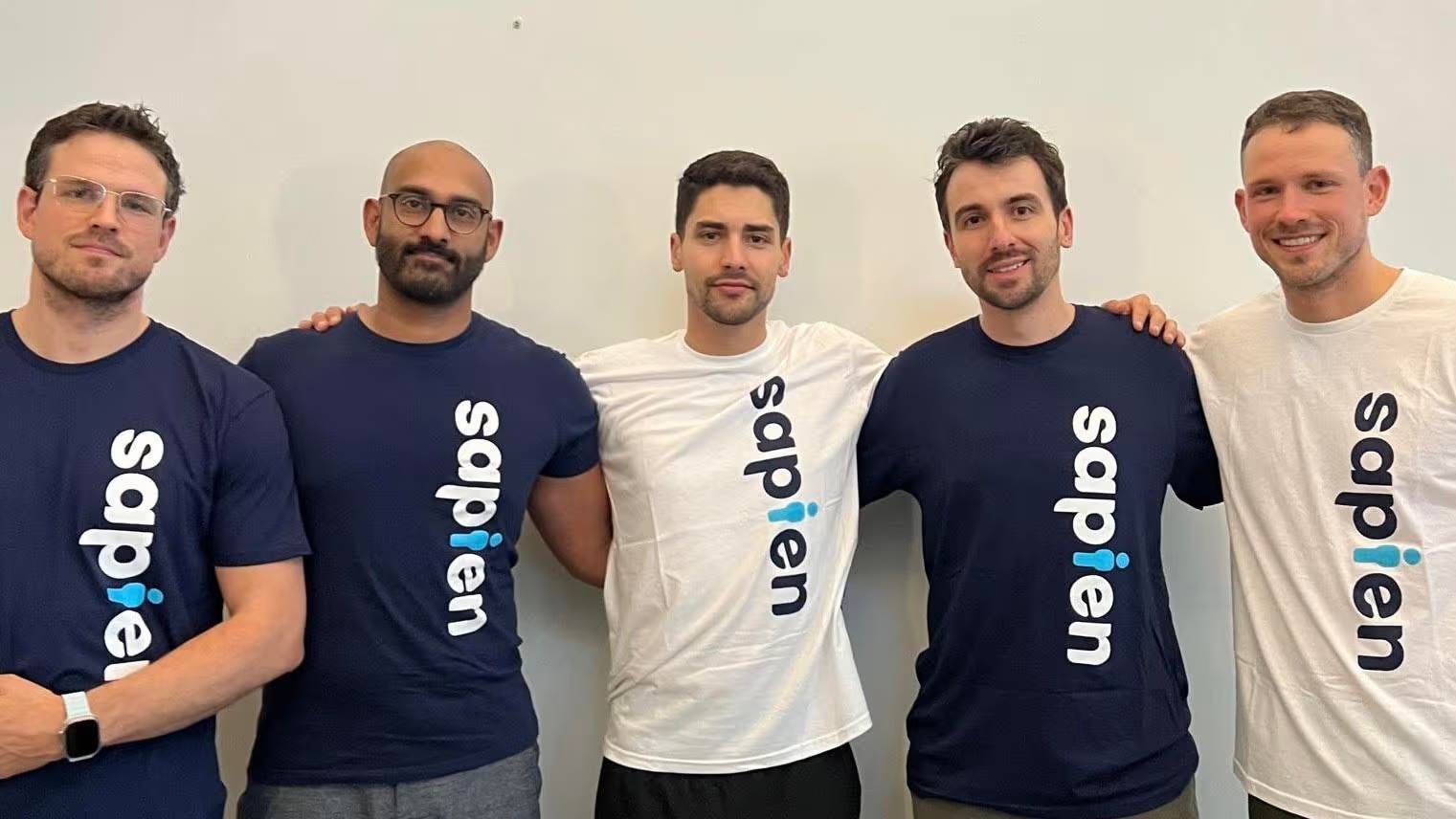
Rowan Stone, CEO of the Sapien project, was previously co-founder of Coinbase’s L2 network Base. This background gives Sapien a natural advantage within the Base ecosystem.
Its Chief Strategy Officer, Trevor Koverko, is the founder of Polymath, an early securities digitization project, and one of the creators of the ERC-1400 RWA standard. His extensive experience in asset tokenization provides crucial support for the Sapien project.
In terms of fundraising, Sapien disclosed two seed rounds in April and October 2024, raising $5 million and $10.5 million respectively. The October seed round included prominent investors such as Primitive Ventures, Animoca Brands, and Yield Guild Games.
This funding not only provided ample operational capital but, more importantly, validated long-term market demand for decentralized AI data infrastructure and signaled VCs’ confidence in this narrative.
Notably, Sapien’s token launch via Binance Alpha also reflects its market热度 (heat), enhancing the project’s visibility with Alpha’s backing.
Technological Innovation
Sapien aims to address the scarcity of high-quality content resources for AI training—an idea that isn’t new, but Sapien offers a novel solution.
The traditional AI data field suffers from opaque data sources, inconsistent quality, and lack of effective incentive mechanisms. To solve these issues, Sapien introduced the Proof-of-Quality (PoQ) mechanism, which leverages token staking, peer validation, reputation scoring, and token-based rewards and penalties.
Specifically, contributors submitting data to Sapien must stake their Sapien tokens as collateral. After multi-party verification, successful submissions earn stablecoin and token rewards, while low-quality submissions face slashing penalties ranging from 25% to 100% of their stake.
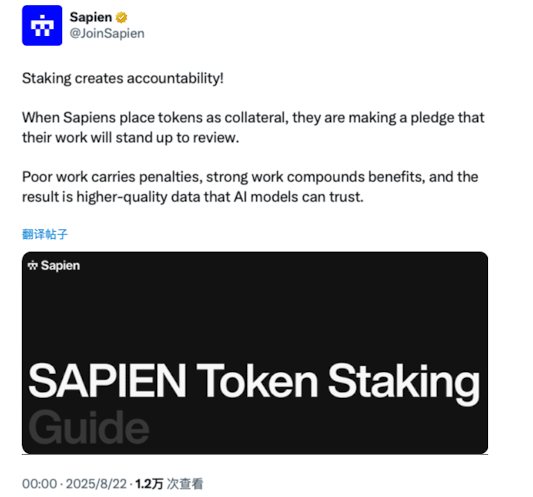
This reward-and-penalty system effectively prevents bot spam and the flooding of low-quality data, ensuring that only high-value, high-quality data is ultimately used.
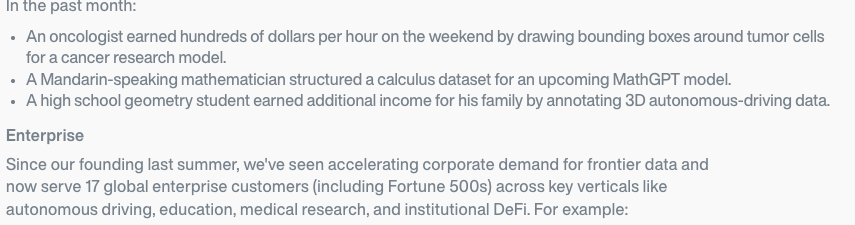
In practical applications, Sapien has already proven its value in high-precision fields like autonomous driving and medical diagnostics. According to disclosed case studies, an oncologist earned hundreds of dollars per hour by annotating cancer data. This example highlights both the immense value of high-quality professional data and the effectiveness of Sapien’s PoQ mechanism in incentivizing expert contributors.
(Image source: Sapien official website)
Market Scale
In terms of commercial progress, Sapien is far ahead of other projects in its category, having built a vast contributor network spanning over 110 countries globally.
According to the latest data from its official website, Sapien has over 1.8 million registered contributors and has completed 187 million data annotation tasks cumulatively.

More significant than the current scale is its growth rate: in 2024, the number of contributors on the Sapien platform grew by an average of 50% month-over-month. This sustained rapid expansion indicates strong market recognition of Sapien’s mechanism and brand.
What draws market attention isn’t just the fast-growing user base, but also its roster of enterprise clients. Sapien currently serves 29 corporate clients, including Toyota, Alibaba, Baidu, Midjourney, and the United Nations—covering sectors such as autonomous driving, e-commerce, AI imaging, and international organizations.
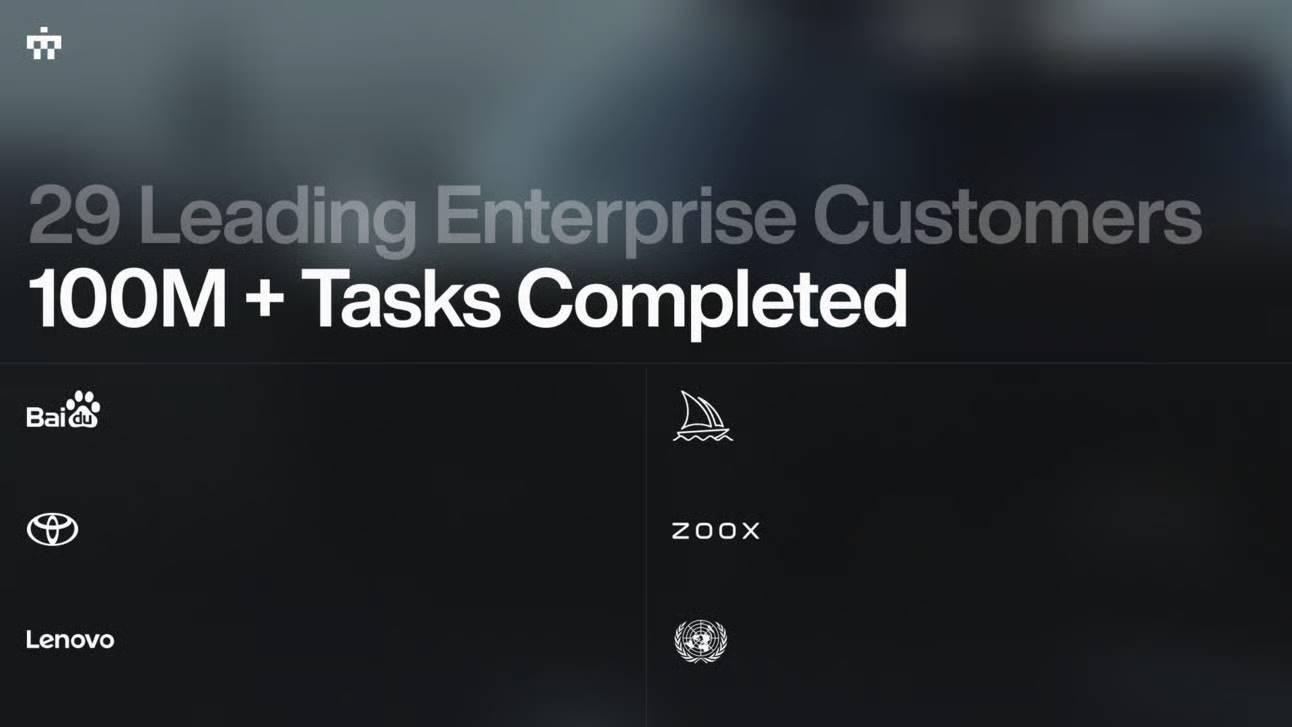
Particularly noteworthy is Sapien’s collaboration with Midjourney. As a leading project in AI image generation, Midjourney is renowned for producing high-quality AI images—indicating extremely high standards for training data quality. Only through massive amounts of high-quality data can reliable AI image generation be achieved. Its selection of Sapien as a data supplier fully validates the feasibility of Sapien’s high-quality data acquisition mechanism.
Meanwhile, the participation of traditional giants like Toyota and Alibaba signals that decentralized data services are gaining acceptance among mainstream enterprises.
Support from the Base Ecosystem
Sapien’s current success is inseparable from Base’s aggressive reforms this year, forming a positive growth loop between the two.
Base chain’s TVL has now surpassed $6.8 billion, overtaking Tron to become the fifth-largest DeFi network. AI-related protocols on Base account for over $2 billion in TVL. Information disclosed through Base App further shows Base’s heavy investment in the AI sector, solidifying Sapien’s leadership position in AI infrastructure.
Moreover, Sapien is highly likely to form complementary relationships with other AI projects within the Base ecosystem. For instance, Venice’s DIEM focuses on tokenized AI compute power, while Sapien provides verifiable human-generated data. Together, they can offer AI developers a complete infrastructure stack. This specialization and ecosystem synergy represent Base’s core competitive advantage over other L2 networks.
Coinbase’s current strategy appears to reinforce this trend. Coinbase CEO Brian Armstrong revealed that 40% of Coinbase’s code is now generated by AI, with a goal to exceed 50% by October 2025.

This dual engine of internal adoption and external trends provides powerful strategic and resource support for AI projects in the Base ecosystem.
Market Discussion and Sentiment
Current social media and community discussions reflect overall optimistic sentiment toward Sapien.
Main narratives focus on the potential value of AI data infrastructure amid the global AI and crypto wave, the unique advantage of its global contributor network, and the strategic significance of partnerships with world-renowned enterprises.
Although its listing method via Binance Alpha and the subsequent days of price decline sparked minor controversy, recent price increases have led the market to increasingly recognize Sapien’s unique appeal and solid fundamentals.
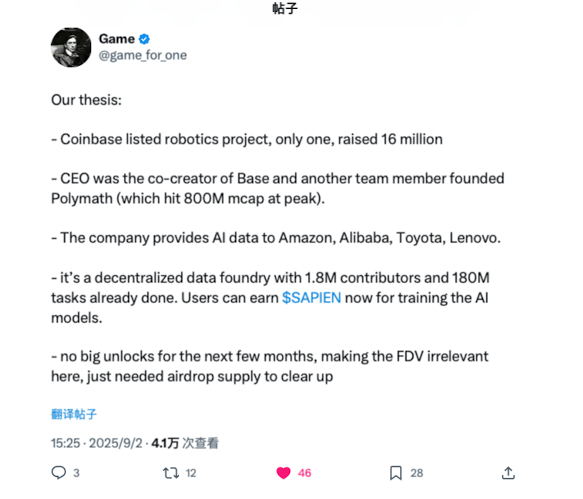
At the beginning of this month, just before Sapien’s price surge, an overseas analyst named Game shared an optimistic outlook based on Sapien’s background and data—coincidentally, Sapien’s price began rising sharply the very next day.
The Two Sides of Sapien
Sapien’s current performance is indeed impressive, but from an investment perspective,冷静 analysis is necessary.
On the positive side, Sapien addresses a genuine need: high-quality AI training data is essential across both traditional and crypto industries. Partnerships with major players like Alibaba and Toyota confirm the effectiveness of its model.
Within the niche field of AI training data, Sapien holds an earlier-mover advantage and a large existing scale compared to peers. More contributors lead to better data, creating a virtuous cycle that builds competitive moats. Backed by the Base ecosystem, it also enjoys advantages in resource access and business expansion.
However, the risks facing Sapien are also evident.
First is the sustainability of the PoQ mechanism. A logically sound model doesn’t guarantee long-term data growth. Once most AI models are trained, will the demand for continuous data input drop significantly? Additionally, as Sapien scales up, the marginal cost of maintaining data quality from contributors may rise sharply—managing such a vast user base is no easy task.
Finally, there’s the common challenge faced by many crypto projects—regulatory risk. Cross-border data flows, privacy protection, and compliance in AI training: any regulatory issue in these areas could cripple the entire operation.
Overall, as a key component of AI infrastructure in the Base ecosystem, Sapien has undoubtedly attracted significant market attention, both as a project and in terms of its token price.
Given the current context of rapidly advancing AI technology, growing data demands, and strong support from the Base ecosystem, Sapien’s future performance may well be worth watching.
Join TechFlow official community to stay tuned
Telegram:https://t.me/TechFlowDaily
X (Twitter):https://x.com/TechFlowPost
X (Twitter) EN:https://x.com/BlockFlow_News
 深潮TechFlow