








When network effects are absent, what serves as the competitive moat for Web3 projects?
TechFlow Selected TechFlow Selected
When network effects are absent, what serves as the competitive moat for Web3 projects?
How can Coinvise fully leverage data interoperability? What kind of moat can we build to retain our users in the long term?
 Navigating Web3 tides with focused insights
Produced by: WEB3 MKT
Author: Eliot Couvat
Translation: TechFlow
As we know it today, Web3 is reshaping every aspect of business. Data portability in Web3 may represent the most significant social shift in years, transferring power from platforms to users.
This new paradigm creates enormous opportunities for newcomers to more easily challenge established enterprises, but also brings new challenges for large companies—namely, creating new moats beyond data lock-in and network effects.
As Community Lead at Coinvise, this is a paradigm I often reflect on. How can Coinvise fully leverage data interoperability? What kind of moats can we build to retain our users long-term?
Because these questions will only grow more critical for thousands of Web3 startups, I’d like to share my thoughts here and explore how we’re overcoming these challenges.
Without further ado, let’s begin.
1 - The Three Pillars of Competitiveness in the Cooperative Economy
Before we begin, since we’ll be using this term frequently, what exactly is a “moat”?
A moat is defined as:
"A company's ability to maintain a competitive advantage, expected to help it resist competition and sustain profitability into the future."
Let me tell you, building moats in Web3 is far more complex than in Web2.
In Web2, the world’s most successful companies all possess competitive advantages. The most famous among them is the concept of "network effects," where data is kept behind walled gardens—meaning the more users join a platform, the more valuable it becomes.
But as Jad Esber and Scott Kominers explain in Why Build in Web3, network effects no longer work in Web3:
The ability of users to move their data between platforms introduces new sources of competitive pressure and may require companies to update their business strategies.
Some might argue that with the rise of Web3 comes tokens—a new variable that could generate network effects by driving new users to reach a point where application utility surpasses economic incentives. Still, I remain skeptical about whether tokens allow newcomers to build true, lasting moats through network effects.
Token-driven network effects can help overcome cold-start problems, but they don’t change the inherently interoperable and composable structure of Web3.
Building moats in Web3 is harder than in Web2 because we’ve never before had digital currencies, digital property rights, or digitally-native organizations built specifically for the internet. Everything must be rethought, with more (and new) dimensions and possibilities—it’s hard to know where to start.
So is there anything that can replace the beloved Web2 network effects by leveraging Web3’s new capabilities?
Well, I’m not smart enough to answer that alone—but luckily, we have Twitter, and some brilliant minds have already explored possible answers.
In one tweet, David Phelps shared his take on how Web3 companies differ when building moats:
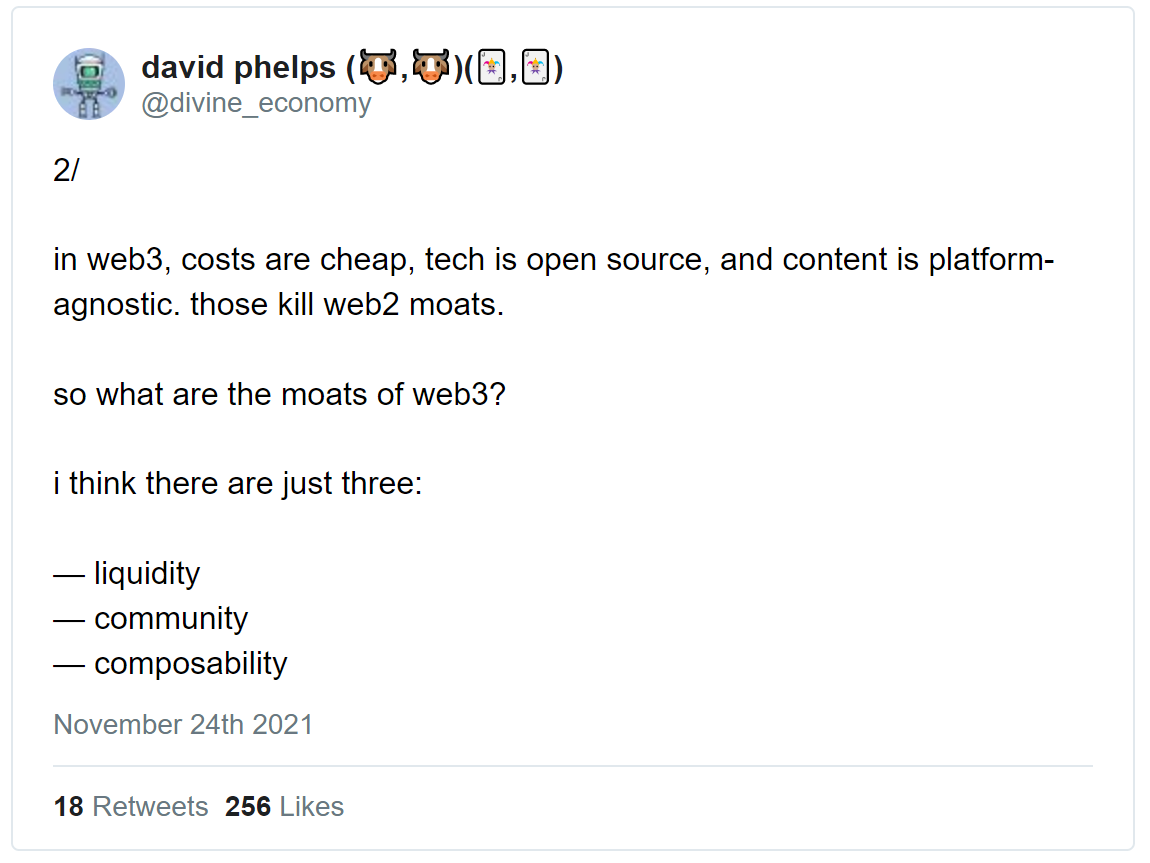
In Web3, costs are low, technology is open-source, and content is independent of platforms. These factors destroy Web2 moats. So what are Web3 moats? I think only three:liquidity;community;composability.
For him, there are mainly three options:
- Liquidity – Abundant liquidity enables faster transactions and more balanced pricing. Liquidity acts as a flywheel: it attracts users, which increases liquidity, which in turn attracts more users.
- Community – As some say, “Technology isn’t a moat; community is.” They’re right—you can copy technology, but you can’t copy people.
- Composability – If you create a module that can easily plug into 1,000 products, you gain attention, validation, and audit-proof credibility, attracting even greater demand.
I've long admired David’s thinking (he’s highly respected in the space), so we’ll dive deeper into these three principles as guides for boosting competitiveness in a space defined by openness and collaboration.
2 - Liquidity as a Pillar of Competitiveness
While in theory, having abundant liquidity seems like a strong competitive advantage, in practice, history shows that liquidity alone is insufficient to retain users over the long term.
DeFi exchanges like Uniswap continuously incentivize users to concentrate liquidity (i.e., deposit funds) on their exchange by offering high APYs (annual percentage yields—high returns on investment).
But once better yields appear elsewhere, users leave...
Don’t get me wrong—I fully understand that deep liquidity means price stability and lower user risk, and DEXs (decentralized exchanges) have an interest in retaining liquidity providers. Unfortunately, however, the incentives aren’t aligned—this isn’t what liquidity providers seek.
As Ian Lee put it, liquidity providers are “emotionless, yield-hungry barbarians who allocate capital to wherever returns are highest.”
For these reasons, I strongly doubt whether any new company can build a sustainable moat based solely on liquidity.
Fortunately, David offers other insights—we still have two potential competitive advantages to explore: community and composability.
3 - Community as a Pillar of Competitiveness
In a recent tweet, Alex Masmej said, “Liquidity is indifferent, but social experience is not.”
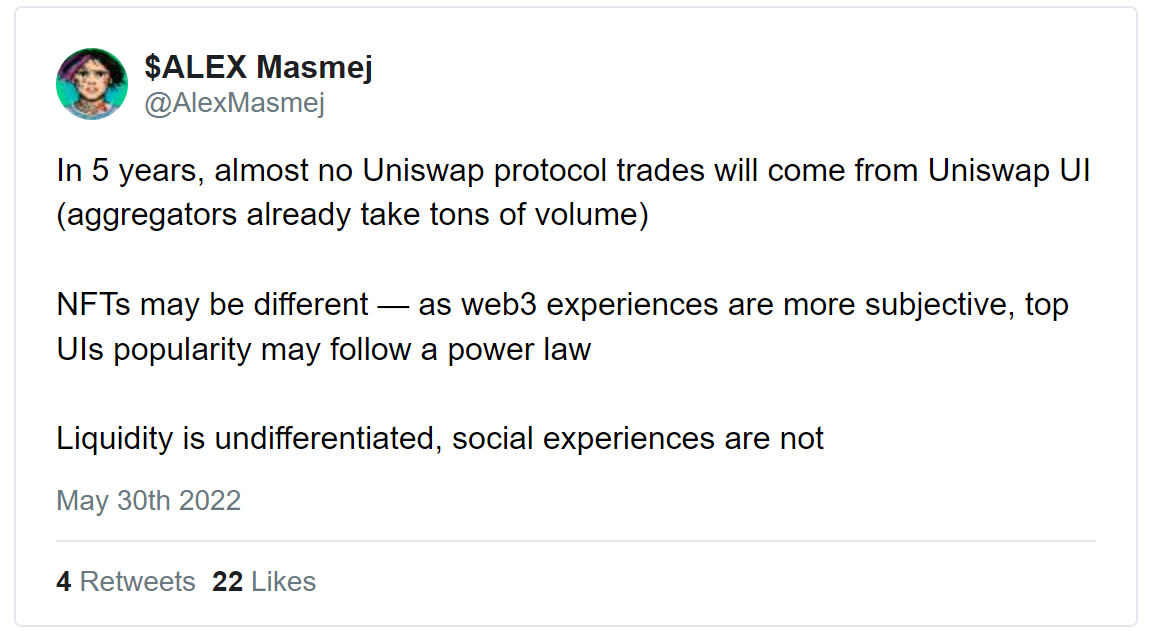
Within five years, almost no Uniswap protocol trades will come directly from the Uniswap UI (aggregators are already capturing much of the volume). NFTs might be different—because Web3 experiences are more subjective, top-tier UIs may follow an exponential popularity curve. Liquidity is indifferent, but social experience is not.
I must admit, I completely agree. “Social experience”—which we can translate as “community”—is everything in Web3.
3.1 - You Can Copy Technology
Since Web3 data resides on open ledgers, newcomers can examine competitors’ held NFTs or social token holdings to gauge engagement levels and identify key participants, making coordinated attacks on new networks significantly harder.
Due to this principle of composability—where data is interoperable and allows any app to interoperate and run—new projects can easily execute “vampire attacks” by incentivizing specific users to switch. Essentially, by accessing data to identify power users of competing projects and launching a slightly similar project with strong enough incentives to “suck” your top users away.
This is exactly what LooksRare did to Opensea (NFT marketplace) and SushiSwap to Uniswap (crypto exchange)—and we’ll see many more such vampire attacks in the future, it’s inevitable.
3.2 - But You Can’t Copy People
For these reasons, new Web3 startups must double down on community-building.
Community and culture are the real differentiators—and what can truly form a moat. Without a strong social experience, your existing user base may abandon you for a more exciting protocol, taking their tokens and patronage with them.
Although Web3 facilitates newcomers copying established companies, it also gives those companies new powers.
Indeed, users enjoy economic rewards from participating in Web3 networks. They are richly compensated for the time they invest in building the ecosystem. As a platform’s utility grows over time, more people want to participate in its economy, and tokens capture value, rewarding early contributors for their efforts. Web3 is about profit-sharing and revenue tokenization.
New entrants must leverage these tools to share ownership and build trust at scale, attracting passionate members eager to help achieve ambitious goals. In this new Web3 world where community is everything, retaining active members will become one of the most crucial skills.
4 - Composability as a Pillar of Competitiveness
Finally, while composability may be the root of vampire attacks, it is also the best way to build a moat. In Web3, it’s far easier for users to migrate from one platform to another.
In Web2, two concepts allowed companies to create network effects:
- Switching cost — describes the difficulty or cost for users to move from one product to another.
- Multi-homing cost — describes how easy (or feasible) it is to use multiple competing networks simultaneously.
The problem is, in Web3, these costs are nearly zero. All-in-one DAO tools like Meta haven't really worked because we don’t live in an “all-or-nothing” space. Web3 users can freely transfer their data between platforms, effectively encouraging the use of multiple platforms.
Web3 is a modular space where users have specific purposes and needs, and can find tools to fulfill them and piece them together. Everything in Web3 is already interconnected—moving data from one platform to another poses no issue.
Therefore, Web3 startups shouldn’t fear composability—they should embrace it.
The ability for communities to carry their tokens across platforms is a feature, not a bug. It forces platform builders to design bridges between protocols and platforms to incentivize a circular economy. If users continue transacting with you through their chosen new platform, they’re not lost users. If you meet them there regardless of where they go, they’re never truly lost.
Final Thoughts
As shown in this article, community and composability are key to creating moats.
But the very concept of a moat implies restriction of movement. Similarly, a moat is defined as a company’s ability to maintain competitive advantages that help it resist competition. Yet if we’re building an industry proud of its interoperability, we should shift our mindset from gatekeeping to bridge-building.
We should focus on enabling users to navigate Web3 freely by building bridges, while establishing sustainable data flows between platforms to encourage a circular economy. Web3 is an open-source positive-sum game—companies simply cannot fight against it.
As Jad Esber and Scott Kominers quote:
Web3 is based on the premise that there is an alternative to monetizing user data—building open platforms that directly share value with users will create more value for everyone, including the platforms themselves.
For these reasons, building Web3 moats will require companies to fundamentally rethink their structures and business models from the ground up. They must focus on building bridges (composability), and embrace this—not resist it—as the path to creating more value.
About WEB3 MKT
WEB3 MKT is a Web3 growth strategy learning group initiated by TechFlow, aiming to dissect case studies, research and learn Web3 marketing and growth strategies, and transform them into "practical productivity" to help projects achieve better global market growth.
We welcome more friends interested in exploring Web3 marketing and growth to join us in learning. You can add WeChat zolohands to connect and share.
Join TechFlow official community to stay tuned
Telegram:https://t.me/TechFlowDaily
X (Twitter):https://x.com/TechFlowPost
X (Twitter) EN:https://x.com/BlockFlow_News






