Reviewing Four Mainstream Cross-Chain DEX Categories: Growing Cross-Chain Demand and Generally Low Valuations
TechFlow Selected TechFlow Selected
Reviewing Four Mainstream Cross-Chain DEX Categories: Growing Cross-Chain Demand and Generally Low Valuations
The crypto industry has entered the cross-chain era.
 Navigating Web3 tides with focused insights
Compiled by: Maxlion
I. Background
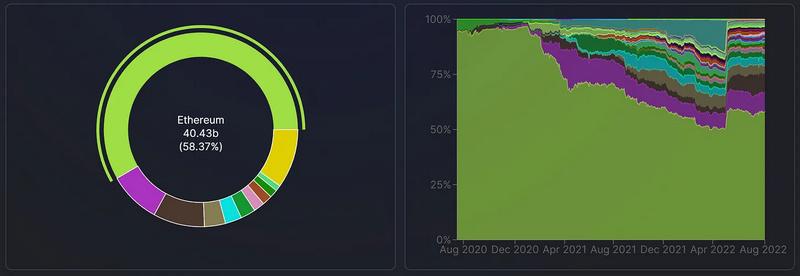
The crypto industry has entered the cross-chain era. According to Defillama data, Ethereum's share of total value locked (TVL) has been declining since the beginning of last year, dropping from over 95% to just 58.37%.
As public chains and rollups continue to grow in Web3, many applications are being built on different isolated ecosystems. Although some apps deploy across multiple blockchains and rollup layers, their liquidity inevitably becomes fragmented, causing inconvenience for users. Moreover, it is cumbersome for users to transfer assets across different ecosystems via centralized exchanges or clunky cross-chain bridges. To solve this problem, decentralized exchanges may have to embrace the shift toward a cross-chain ecosystem. Starting last year, numerous cross-chain exchanges have launched. Even SushiSwap and Ren Project have released their own cross-chain exchange applications.
Cross-chain exchange applications are highly complex products that integrate DEXs, cross-chain bridges, and routing into one application. In this article, we will closely examine various cross-chain DEX products.
II. Projects
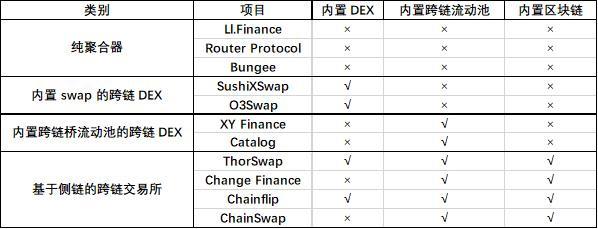
Some cross-chain bridges only support swaps between stablecoins. For example, Stargate Finance helps users transfer USDT on Ethereum mainnet to USDC on Polygon. These types of cross-chain bridges are not the focus of this article. Instead, this article focuses on those enabling seamless movement of assets across different blockchains and tokens. Based on whether the project builds its own DEX, bridge, or blockchain, we classify these products into four categories:
2.1 Pure Aggregators
A pure aggregator is a cross-chain DEX without its own blockchain, bridge, or swap functionality. Unlike 1inch, this product aggregates not only DEXs like Uniswap, PancakeSwap, or SushiSwap but also cross-chain liquidity pools such as Connext, Hop, and ThorChain. It searches for the optimal path using its routing algorithm and executes transactions by calling protocols along the route.
2.1.1 Li.Finance
Li.Finance is a cross-chain bridge and DEX aggregator. It provides a "bridge & DEX" SDK and Widget to help developers build their own cross-chain applications based on Li.Fi. It also launched its own cross-chain DEX: TransferTo.xyz. The product aggregates 10 bridges, 18 exchanges, and 16 EVM chains or rollups.
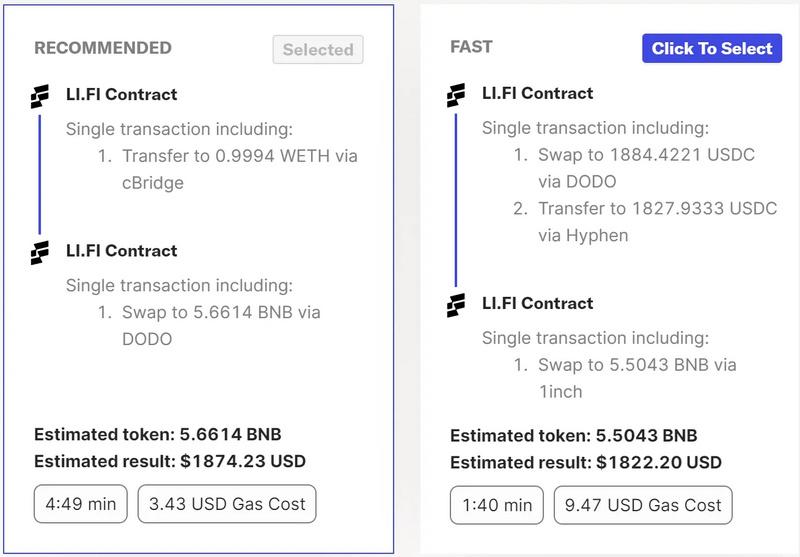
The trading feature allows users to exchange any token from any blockchain or rollup to another. All details about routing paths are displayed to users, including the cross-chain bridge and swap routes used, estimated time and gas cost, and expected outcome. Additionally, the protocol offers multiple path options for users to choose from. More advanced users can even exclude protocols they consider risky.
The dashboard clearly shows users’ portfolios across all EVM blockchains and rollups supported by Li.Fi. This feature is very convenient because users sometimes forget about assets held across various blockchain networks.
Li.Fi launched at the end of last year, received funding from Gitcoin, and attracted investments from Coinbase, Dragonfly Capital, 1k(x), and others. As of writing, the tool is free to use and has achieved $250 million in transaction volume. Although the Li.Fi team has published the token contract on GitHub, no token has been issued yet.
2.1.2 Bungee
Bungee (formerly FundMovr) is very similar to Li.Fi. Bungee is powered by Socket, an interoperability protocol for secure and efficient cross-chain data and asset transfers. Socket is neither a cross-chain bridge nor a cross-chain app. It is an infrastructure tool allowing developers to easily build interoperable applications. Developers can use Socket to build interoperability as a core part of their application architecture. SocketLL and SocketDL are Socket’s main products.
SocketLL enables efficient cross-chain asset transfers. It unifies liquidity across bridges and DEXs and routes funds through them based on user preferences such as fees, speed, or security. SocketDL supports cross-chain data transmission. As of last month, SocketLL had processed over 400,000 transactions and more than $400 million in volume. Data transfer via SocketDL will launch later.
Bungee moves assets between chains by plugging into Socket Liquidity Meta-Layer. It allows users to seamlessly exchange and transfer funds on any chain through its routes.
Like Li.Fi, Bungee gives users multiple choices and displays all details. Bungee is also free to use. However, unlike Li.Fi, users cannot select which bridge or DEX to use—they can only pick a full routing path to execute. Additionally, Bungee allows users to receive assets on a different address than the one initiating the swap. Refuel is a handy tool included with Bungee. When users set up a new address with no tokens to pay gas fees, they can easily purchase required tokens using assets held on other blockchains via Bungee.
Socket has raised funding from Framework Capital, Nascent, and Lightspeed. According to DappRader, Bungee has processed only $5.65 million in volume. As of writing (August 16), neither Bungee nor Socket has launched a token.
2.1.3 Router Protocol
Router Protocol is a cross-chain bridge significantly different from Li.Fi and Bungee. It is a scalable bidirectional bridge connecting current and emerging Layer 1 and Layer 2 blockchains to allow contract-level data or tokens to flow between them. Router’s XCLP (Cross-Chain Liquidity Protocol) provides seamless cross-chain liquidity migration, combined with smart order routing that efficiently executes based on customizable parameters.
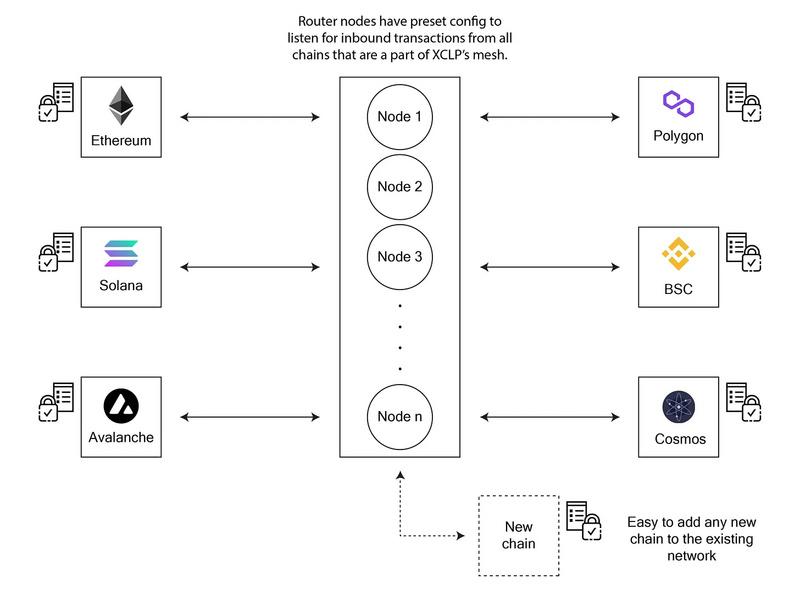
Voyager is a cross-chain DEX powered by Router Protocol. Router Protocol does not build its own cross-chain liquidity pool, which is why Voyager can only use Router Protocol to transmit messages and must integrate with external cross-chain pools to execute trades.
Voyager’s UI differs greatly from Li.Fi and Bungee: it does not display any information about routing paths and instead resembles Uniswap’s swap interface.
Router Protocol has received investments from Coinbase Ventures, QCP Capital, and Alameda Research. It connects nine blockchains and has accumulated over $300 million in transaction volume since launch. It has issued the ROUTE token, with a market cap of approximately $30 million and an FDV of $78 million.
2.2 Cross-Chain DEXs with Built-in Swap
Unlike pure aggregators, cross-chain DEXs with internal swap functionality have their own exchange applications. They first establish exchanges on multiple chains and then integrate with external cross-chain liquidity pools to process transactions.
2.2.1 SushiXSwap
SushiSwap is one of the most well-known forks of Uniswap. Today, SushiSwap is much more than just a Uniswap fork. While Uniswap dives deep into AMM features, SushiSwap actively deploys across different blockchains and rollups and expands its business. It is now deployed on 14 blockchains, accumulating around $750 million in TVL across these chains as of writing. Although SushiSwap’s TVL has dropped 90% from its peak, it remains among the top 10 DEXs by TVL.
Based on liquidity across these blockchains, SushiSwap launched its cross-chain product SushiXSwap. SushiXSwap integrates with Stargate Finance as the cross-chain bridge. However, Stargate Finance only supports cross-chain trading of stablecoins. Therefore, SushiXSwap first converts users’ assets into stablecoins, transfers them to the target chain, then converts them back into the desired target asset.
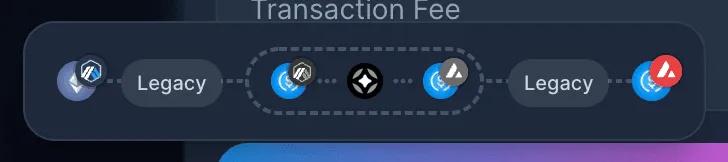
SushiXSwap launched on July 21 and reached $500,000 in trading volume by August 8—an underwhelming figure, but within a short timeframe. We can expect better performance over time.
2.2.2 O3Swap
Although O3Swap and SushiXSwap are both DEXs with internal swap capabilities, they differ significantly at the foundational level. Generally, the internal swap in O3Swap functions more like a cross-chain liquidity pool rather than a traditional swap pool.
O3Swap integrates Poly Network as its cross-chain bridge. Poly Network, a leading cross-chain bridge, locks users’ assets on the source chain and issues corresponding wrapped pTokens on the target chain. To ensure users receive native tokens instead of pTokens, O3Swap established stable swaps (O3 Hubs) on each blockchain to facilitate exchange between pTokens and native tokens. However, stable swaps do not necessarily support conversion into the user’s desired target asset. This means O3Swap needs to integrate with at least one external exchange platform to handle the final leg of the trade that the O3 Hub cannot cover.
For instance, when a user wants to convert USDC on Polygon into ETH on Ethereum mainnet, the protocol first mints an equivalent amount of pUSDC, bridges pUSDC to Ethereum mainnet, swaps it back to USDC, and finally integrates with Uniswap or 1inch to convert USDC into ETH.
According to DefiLlama, O3Swap’s TVL is only around $10 million, insufficient to support large trading volumes. O3Swap built a routing algorithm to integrate with other DEXs and boost liquidity. O3Swap V1 supports source-chain routing swaps, while V2 supports routing swaps on both source and target chains, giving users more options to reduce transaction costs.
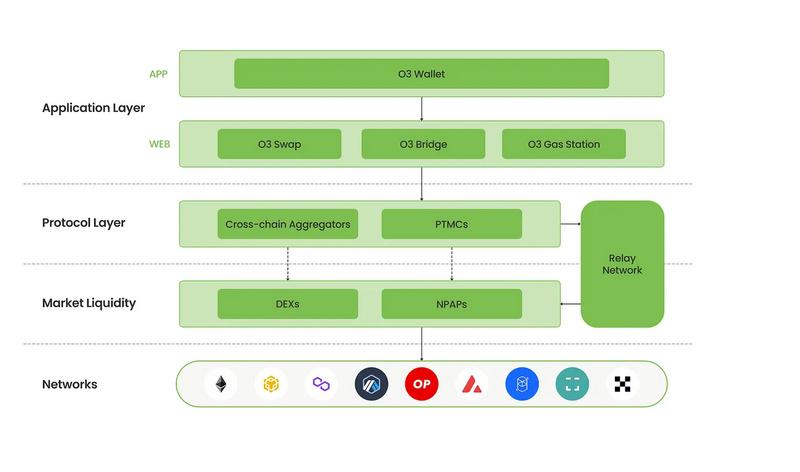
Both O3Swap and Poly Network teams originate from the Ontology ecosystem. They have solid business experience in the crypto industry. O3Swap has partnered with many blockchains and rollups to boost its TVL. However, the major hack on Poly Network severely damaged O3Swap. Its TVL plummeted from around $700 million to $200 million within a month and continued to decline. Current TVL is only $10 million.
The project issued the O3 token, with a market cap of about $5 million and an FDV of approximately $13.8 million.
2.3 Cross-Chain DEXs with Built-in Cross-Chain Liquidity Pools
If a cross-chain DEX relies on external cross-chain liquidity pools to execute trades, it must pay for that service. Some projects decide to build their own liquidity pools to eliminate this cost. Furthermore, a large internal liquidity pool can help maintain an economic moat for the protocol, preserving competitive advantage over rivals.
2.3.1 XY Finance
XY Finance is a one-stop cross-chain aggregator for DeFi and the metaverse. XY Finance consists of two parts—X Swap and Y Pool—to facilitate cross-chain swaps and incentivize liquidity provision.
X Swap is a DEX aggregator, while Y Pool incentivizes all liquidity providers across chains through swap fees. The issued XY governance token rewards liquidity providers who deploy liquidity in specific pools. In Y Pool, situations may arise where tokens supported by a pool are continuously swapped out and depleted, leading to an “unbalanced pool” on that chain. The following flowchart illustrates an unbalanced pool scenario due to cryptocurrency shortage. A rebalancing algorithm rewards XY tokens to users who restore balance via X Swap.
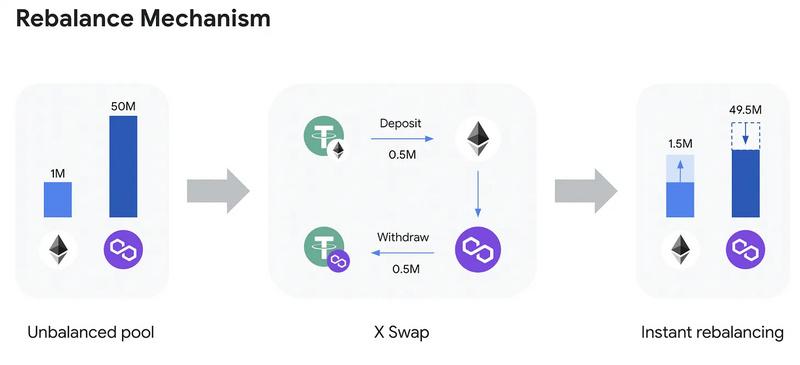
XY Finance has received investments from Animoca Brands, YGG, and Circle. The XY token has been issued, with a market cap of $2.5 million and an FDV of $28 million. Y Pool’s TVL is only around $3.3 million, meaning XY Finance must rely heavily on external bridge pools to settle most transactions. Since launch, XY Finance has processed $152 million in transaction volume, with a 24-hour volume of approximately $558,000.
2.3.2 Catalog
Catalog is a decentralized gateway for users to discover and trade crypto assets across multiple chains. Built on Ren—one of the most secure cross-chain protocols—it uses the world’s first infinite liquidity mechanism, allowing users to simply trade assets in the DeFi metaverse. It is the first consumer-facing application developed by Ren Labs based on the Ren protocol.
Ren is one of the most successful cross-chain bridges in the industry. Since launch, it has processed around $12 billion in volume, providing strong liquidity support for Catalog.
Catalog differs greatly from the projects mentioned above. In Catalog, users must deposit assets into their account before trading and withdraw afterward. This works similarly to centralized exchanges. The benefit is instant trading after deposit, though deposit and withdrawal processes still take time.
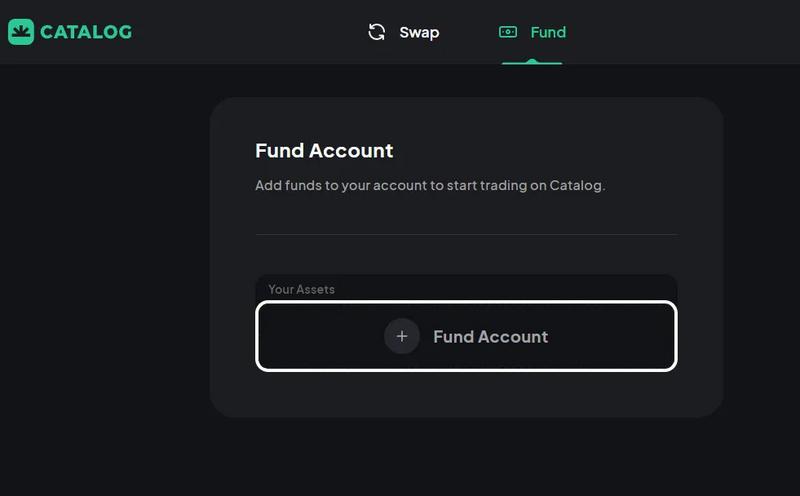
The product is still in testing, and technical details have not been disclosed. We’ll need to wait until the official launch to learn more. However, the biggest difference between Catalog and SushiXSwap is that Catalog will have its own token. Catalog announced a $7.5 million fundraising round in February, with participants including Amber Group, Multicoin Capital, and Cumberland DRW.
2.4 Sidechain-Based Cross-Chain DEXs
Similar to DEX aggregator 1inch, most current cross-chain DEXs are free to use, making it difficult to support intrinsic token value. Given low bridging fees and high risk, even internal liquidity pools struggle to generate good profits. In such cases, some projects build their own sidechains to enhance product security and token value.
2.4.1 ThorSwap
ThorChain is a decentralized cross-chain liquidity protocol based on Tendermint and Cosmos-SDK, utilizing Threshold Signature Scheme (TSS) technology to secure assets. It doesn’t peg or wrap assets; it simply determines how to move them in response to user actions. ThorChain observes user deposits entering vaults, executes business logic (swaps, add/remove liquidity), and handles related outgoing transactions.
Many interfaces are built on ThorChain. ThorSwap is the most widely used and requires no KYC.
Thanks to Tendermint, ThorChain supports interactions not only between EVM chains but also non-EVM chains. For optimal UX, users should use omnichain wallets like xDEFI instead of EVM-only wallets like Metamask.
ThorSwap does not aggregate liquidity from external DEXs but instead builds its own exchange atop ThorChain. Its liquidity TVL is around $171 million. Like Bancor, all liquidity pools in ThorSwap are structured as trading pairs between RUNE (ThorChain’s native token) and other tokens. This mechanism increases demand and intrinsic value for RUNE but limits overall TVL scalability.
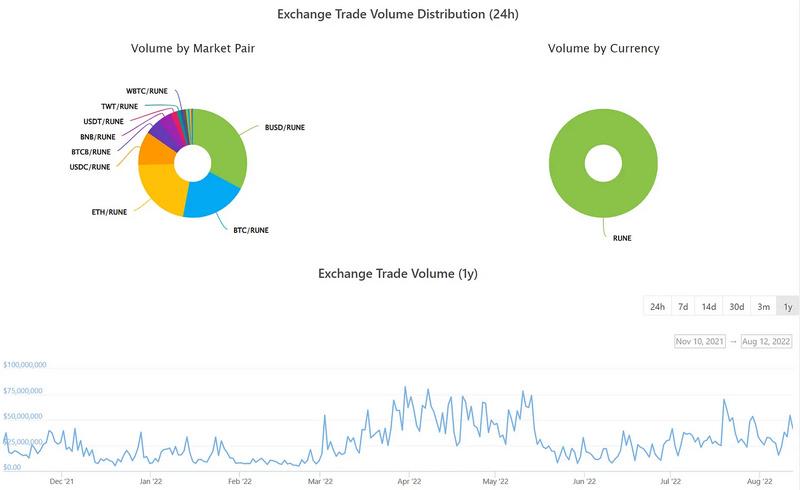
ThorChain’s RUNE token has a market cap of $873 million and an FDV of $1.45 billion. Since launch, ThorSwap has processed over $6.8 billion in transaction volume, with a current daily volume of about $51 million.
2.4.2 Chainflip
Chainflip is a decentralized, trustless protocol enabling cross-chain swaps between different blockchains, very similar to ThorSwap. The difference lies in Chainflip being built on Substrate within the Polkadot ecosystem, whereas ThorSwap is built on Tendermint within the Cosmos ecosystem. According to its whitepaper, Chainflip is establishing its own liquidity pools on every major blockchain ecosystem and building its own AMM-based swap. The whitepaper indicates that Chainflip’s AMM will be designed based on Uniswap V3.
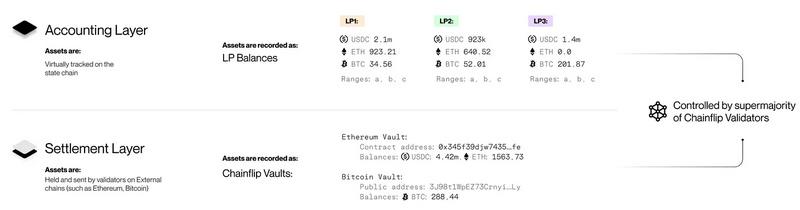
Chainflip has raised funding from Coinbase Ventures, Mechanism Capital, and ParaFi. The FLIP token is staked by validators to provide economic security for the network. The protocol charges 0.10% to 0.20% per swap. These fees are used to directly buy and burn FLIP tokens from the Chainflip AMM.
Like Catalog, Chainflip’s UX appears similar to centralized exchanges, requiring users to deposit assets before trading and withdraw afterward. However, Chainflip has not launched its public testnet yet, so we lack sufficient information to comment further.
2.4.3 Chainge Finance
Chainge Finance is an interesting project founded by DJ Qian, co-founder of Anyswap and Fusion. Similar to Anyswap, Chainge Finance is built on the Fusion blockchain, but uses a mechanism entirely different from other cross-chain DEXs with their own sidechains.
First, Chainge Finance itself is a mobile wallet. Users must use the Chainge Finance app directly, rather than connecting via other blockchain wallets like Metamask.
Second, when centralized exchanges or projects like Osmosis receive user deposits, they lock the assets and issue wrapped tokens in user accounts—or simply add numbers without actual custody. Users then trade using these numbers. Thus, ETH from Polygon and ETH from Ethereum mainnet appear identical in such systems. But in Chainge Finance, tokens clearly indicate which chain they belong to. Moreover, users can one-click trade tokens from multiple chains into a single target chain, which is very convenient.
Third, Chainge Finance does not have an internal swap on the Fusion blockchain, but it establishes liquidity pools on each connected blockchain. When users trade, the project pulls liquidity from DEXs on the target chain to complete the transaction—similar to a DEX aggregator.
2.4.4 ChainSwap
ChainSwap launched in March 2021 with big ambitions. ChainSwap is very similar to Li.Fi: it has no internal liquidity pool or bridge. Instead, it integrates with AnySwap, PolyNetwork, and cBridge to execute cross-chain swaps for users. However, the product only shows a single non-adjustable routing path. As of writing, supported assets are limited—for example, there is no ETH trading pair on ChainSwap. Nevertheless, ChainSwap enables users to move NFTs across chains.
According to its Gitbook, the ChainSwap team aims to build a cross-chain bridge and application hub allowing projects to seamlessly bridge between blockchains. They plan to build an internal sidechain and a cross-chain bridge liquidity pool on top. With this infrastructure, it could support not only cross-chain DEXs but also lending, NFT markets, and real-time analytics.
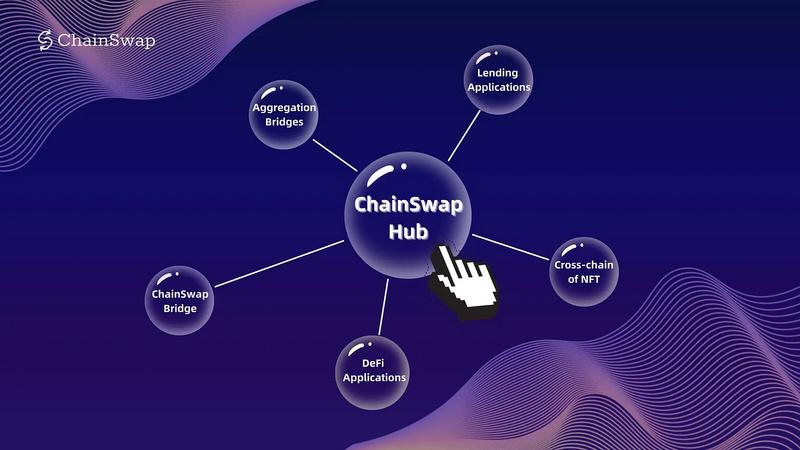
ChainSwap has received investments from Alameda Research, CMS, and NGC. It issued the $ASAP token, currently with a market cap of $554,000 and an FDV of $2.7 million. The protocol has accumulated $185 million in transaction volume. However, it was hacked in July, resulting in approximately $800,000 in user losses, severely damaging user confidence in the platform.
III. Market Landscape
Cross-chain DEXs typically build upon existing DeFi and multi-chain ecosystems. Since these ecosystems have only recently matured, the latest cross-chain DEXs are still young. Most web3 users remain accustomed to using centralized exchanges or cross-chain bridges to transfer assets. However, as more users enter Web3 and more crypto assets become distributed across multi-chain ecosystems, demand for cross-chain DEXs will grow.
3.1 Market Data
Judging from the market cap data below, RUNE performs exceptionally well, with a market cap around $860 million. As one of the leading DEXs, SUSHI has a market cap of about $270 million. All other protocol tokens have market caps below $30 million.
In terms of volume, ThorSwap dominates the cross-chain DEX space. It has processed over $6.8 billion in volume, with a daily volume of approximately $51 million. Router Protocol, Li.Finance, ChainSwap, and XY Finance have cumulatively reached $150 million to $300 million in total volume. Bungee’s total volume is only about $5.65 million. SushiXSwap went live on July 21 and had only $500,000 in volume by August 8. Finally, O3Swap and Chainge Finance have not disclosed this data.
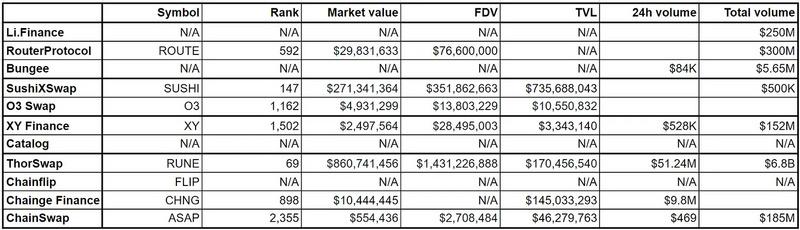
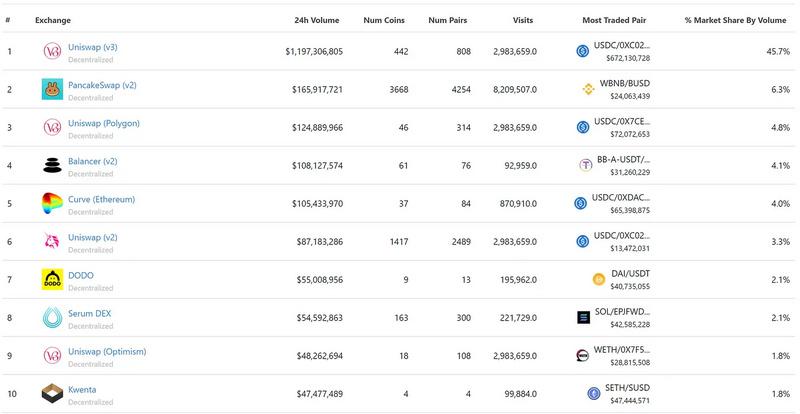
However, the transaction volume of the cross-chain DEX industry remains small compared to other DEX protocols: Uniswap processes around $1.2 billion in daily volume—about 10 times the combined daily volume of all cross-chain DEXs.
IV. Conclusion
Cross-chain DEXs represent an emerging sector in the DeFi crypto space. Since mid-2022, multi-chain ecosystems have grown increasingly popular. Most cross-chain DEXs launched in 2021 or 2022 and have very short development histories, so their transaction volumes remain small and token valuations have not performed strongly. Nonetheless, as new networks and ecosystems emerge, demand for cross-chain functionality grows, creating a valid and powerful demand case for cross-chain DEXs. Currently, cross-chain DEX valuations remain low, but upside potential is substantial.
Summary of the Four Types of Cross-Chain DEXs:
1. Pure aggregator projects are designed to be extremely lightweight. They don't own their own swap or bridge, reducing risk. Additionally, these protocols aren't limited by integrated swaps and bridges, offering maximum flexibility to search optimal routing paths for users and sharing all path information. However, these protocols struggle to charge fees. Adding fees increases user transaction costs and may drive users away.
2. Cross-chain DEXs with built-in swaps have their own trading liquidity on each connected blockchain, forming a strong business moat. However, establishing trading pools is extremely difficult, and liquidity fragmentation may lead to high slippage. This type of DEX suits existing multi-chain DEXs (like SushiSwap) looking to expand into cross-chain trading.
3. Cross-chain DEXs with built-in cross-chain liquidity pools represent a promising business model, as the bridge is the most critical component of the product, and the DEX retains full control over fund flows. Besides the protocols mentioned, other cross-chain bridges like Swim Protocol and Stargate Finance are also exploring this model. They aren't covered in detail here as they currently only support stablecoin-to-stablecoin cross-chain swaps. With mature cross-chain bridges and liquidity pools, such protocols can easily assist users in swapping tokens across multi-chain ecosystems. However, the biggest challenge is that cross-chain bridges remain among the most vulnerable components in the blockchain industry. Security of cross-chain liquidity pools is hard to guarantee.
4. Sidechain-based cross-chain DEXs also represent a strong business model. Tokens can serve multiple functions—such as Layer 1 gas fees, MEV extraction, trading fees, and bridging fees. The challenge is that building a Layer 1 blockchain is far more difficult than building an application—not only technically, but also in developing ecosystems, communities, and developer adoption.
Join TechFlow official community to stay tuned
Telegram:https://t.me/TechFlowDaily
X (Twitter):https://x.com/TechFlowPost
X (Twitter) EN:https://x.com/BlockFlow_News