Founder's Account: How I Built an Investment DAO from Scratch
TechFlow Selected TechFlow Selected
Founder's Account: How I Built an Investment DAO from Scratch
Some cold start problems, and clarify some nuances in launching and operating a DAO.
 Navigating Web3 tides with focused insights
Author: rahul iyer.eth
TechFlow authorized translation and publication
Introduction
Five months ago, I dove headfirst into the world of NFTs.
One month ago, I co-founded Spicy Duck—a DAO built with 14 other super-smart friends.
Today, we’re learning and building—figuring out where this might all lead…
By writing this, I hope to unpack some cold-start challenges and clarify certain nuances involved in launching and running a DAO. This isn’t a how-to guide, but rather a knowledge dump of everything I’ve learned and experienced over the past few months. As always, this is not investment, tax, or legal advice.
Origins
I started trading crypto in 2017, watching my portfolio crash and recover over time. After letting it sit untouched for a year or two, my interest in crypto peaked again during the pandemic. By mid-2020, I was back to trading, absorbing new information—but for some reason, I stayed away from NFTs.
That changed quickly. By September 2021, I had convinced family and friends to form a fantasy team and get into crypto. In December, I bought my first NFT and joined several communities I still actively participate in today (Floor & Shiny). By February 2022, I felt like I’d been in the space for a year, yet still had so much to learn.
But this was still surface-level—I wanted to build more.
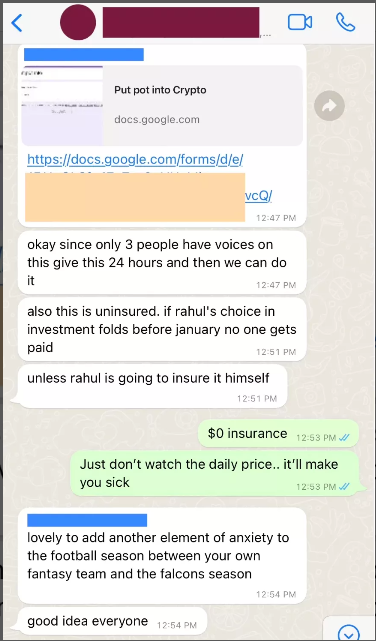
Anxiety-inducing—that phrase alone describes our situation last year.
Fast forward to March 2022: our fantasy team was doing well. The market kept rising, and I enjoyed advising curious, intelligent friends working in Web2 about crypto and NFTs.
But what next? I thought about pushing further by launching my own NFT community. However, as some of you know, expectations were high while project delivery fell short, and motivation began to wane. WGMInterface’s farewell letter hit me hard—I didn’t want the experience of creating projects to shift from joyful to stressful.
What would be a low-risk, high-learning opportunity that still offered meaningful impact?
Friends had already approached me asking to learn about crypto, NFTs, and Web3 together—people who were successful in their careers and lives. What if we formed a small group among ourselves to learn, invest, and eventually build together? What if we launched a DAO?
This wasn’t a novel idea, but the key was building on what I was already doing—keeping things small and only expanding our circle when necessary (a minimal viable community). I was already researching NFTs and explaining them to friends and family. I looked at my Web2 friends’ businesses and explored whether there were compelling Web3 applications worth building.
Launching a DAO seemed like the perfect way to involve friends more deeply in Web3, understand product management in Web3, and make money along the way. I wanted to create something great with 14 other sharp-minded friends. And so it began…
How does the DAO work? What are the rules?
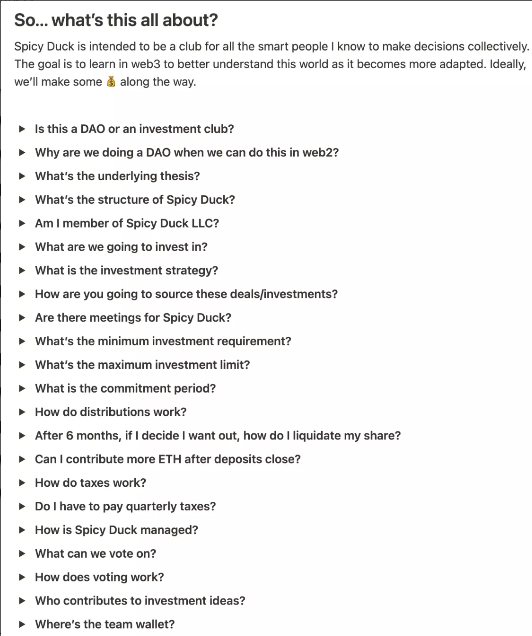
Before building anything, every project/DAO needs clarity on its goals. For us, we wanted to become a Web3 learning and investment community—ready to act on our knowledge and seize opportunities when they arise. With that vision, we created a basic DAO charter. We opted for simplicity and iterative optimization, knowing perfection wasn’t required upfront. We already had strong mutual trust, which helped us avoid paralysis or overcomplication.
Deposits
● Everyone has roughly one month to deposit
● Minimum = 1 ETH, maximum = 10 ETH (to prevent any single person from controlling the DAO)
● 1 ETH = 10,000 DUCK tokens
● No withdrawals for 6 months after deposit deadline (to ensure DAO stability)
Governance
● Token-based voting: 1 token = 1 vote
● Proposals pass with majority vote (<50% or =50% fails)
● Polls/proposals last 24 hours
● If >50% approval is reached, execution can proceed—even within the 24-hour window—to allow swift action when needed
● Voting topics: new members, investments, operational changes, administrative updates
Meetings
We chose weekly meetings. The goal was to create a space to review developments in the NFT space, ask questions, discuss current and future investments, and share important updates.
It's hard to beat face-to-face interaction (via video or in-person). For us, establishing a trusted, safe environment was critical.
Random Tidbits
Many newcomers hesitate to deposit large amounts of ETH—which is understandable. So after our first investment, I allowed new members just 7 days to deposit, purely to help us gain momentum (typically, re-opening deposits after fundraising is taboo, but we're treating this as an experiment).
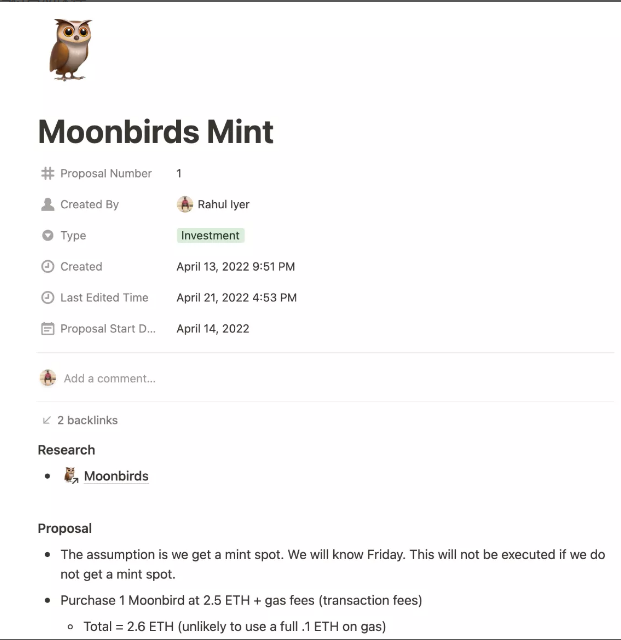
Although this caused token dilution, I accepted the trade-off because it helped accelerate growth. Our first investment was minting Moonbirds for 2.5 ETH (now priced around 25 ETH floor). You can imagine how exciting that was—and how attractive it made the DAO!
Practice
Many members come from Web2 with little knowledge of Web3, so we realized we needed to start from a place of minimal cognitive friction. While I hoped everything could be on-chain and fully decentralized from day one, I recognized that could hinder participation. Gradual decentralization made the most sense.
Our core requirements:
● Use a single point of contact (one app) whenever possible
● Mobile-friendly
● Independent—no competition with other communities
● Low cost to upgrade/switch apps
● Legally compliant
With these principles in mind, we began exploring DAO tools and architectures designed for long-term scalability.
We focused on:
● Communication
● DAO creation
● DAO governance
● Documentation
● Treasury management
● Contributor payments and reimbursements
● Accounting and taxation
● And diving deeper into details…
Communication
We immediately ruled out iMessage and WhatsApp. The former has limited functionality and isn't Android-friendly; the latter lacks robust bot integrations. The real debate was between Discord and Telegram—both excellent in their own right. Discord is widely adopted in the Web3 world with extensive integrations. Telegram offers a smoother UX and better group chat experience.
Pros of Discord
● Heavily used by Web3 communities—our Web3-savvy friends joining Spicy Duck wouldn’t need to change habits.
● Rich integrations. Most communities are built here, so we can leverage many ready-made bots for essential functions.
● Easier channel organization. Native support for channel segmentation.
Cons of Discord
● Competes for user attention across many other servers.
● Feels overkill for 15 members—do we really have enough activity to justify all of Discord’s features?
● More frequent crashes (though perhaps not often enough to matter).
Pros of Telegram
● No competing attention. You know it’s a Spicy Duck message—and likely only open Telegram for DAO chats.
● Native polling. Lightweight voting is crucial for a lean DAO.
● Feels more active and conversational. The right vibe—without being excessive.
● Perceived as more secure. More Web3 scams happen on Discord simply because more people use it.
Cons of Telegram
● Fewer Web3 integrations/bots compared to Discord.
● May become unwieldy beyond 15 members. Channel segmentation isn’t native to Telegram.
● Building custom tooling for Telegram may prove costly to scale.
Ultimately, we prioritized low friction and a tighter community feel. While fewer integrations and scaling limitations may pose issues later, Discord felt unnecessarily heavy for 15 people. We all remember our first time using Discord—so much going on.
Telegram gives us 80%-90% of the functionality, plus the intimate group-chat feel we wanted. For members already active in Web3—or becoming more so—it’s vital we don’t compete for attention across hundreds of other communities. When we open Telegram, we know exactly why we’re there—high focus, high intent.
We believe the potential cost of relocating 15 people from Telegram is high, but manageable if needed.
DAO Launchers
This space is nascent and evolving rapidly—rules change constantly. Speed in processing information is critical. While DAO platforms vary in maturity, we evaluated Upstream Collective, Colony, and Syndicate. For brevity, I’ll focus on these three since they consumed most of our attention.
Though Upstream and Colony offer more powerful features, we ultimately launched our DAO with Syndicate for three main reasons:
1. Customer service/responsiveness
2. Legal support offerings
3. Ability to legally include non-accredited investors
In a fast-moving field where rules are frequently rewritten and markets volatile, we wanted a responsive partner. Frankly, Syndicate excels here—their Discord is well-managed, and multiple team members promptly address questions, concerns, and bugs. A huge advantage.
Moreover, Syndicate enables regular people to legally establish a DAO. Other services requiring full legal counsel are prohibitively expensive. We need more tools like Syndicate that consider legal implications for ordinary users to achieve mass adoption. It’s absurd to assume everyone can afford large legal fees to structure a DAO.
Syndicate lets you create a legal entity with just a few clicks via Doola. They provide excellent templates for operating agreements and documents like subscription agreements.
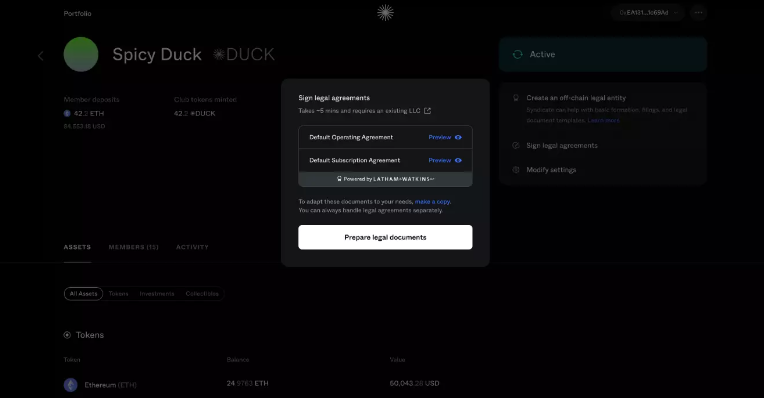
Once everyone is part of a legal entity, the key benefit is that Syndicate structures your DAO as an “investment club” under SEC guidelines. This matters if you plan long-term and want to operate legally under increasing regulatory scrutiny.
Four things to remember as an investment club:
1. You cannot invest in securities (as non-accredited investors), meaning only crypto and NFTs (with rare exceptions).
2. Membership capped at 99.
3. Every member must participate in decision-making in some capacity.
4. You cannot publicly advertise membership—only private invite links.
This is fantastic. It provides legal protection and a legitimate path for unaccredited investors to join. For DAOs to go mainstream, either regulations must evolve, or services must build around clear legal frameworks. Like most of the world, our DAO consists largely of non-accredited investors. Syndicate handles this well.
Note: Colony came onto our radar later, but looks like a solid product. We didn’t do a deep comparison with Syndicate or Upstream Collective.
DAO Governance
This area of DAOs can quickly get complex. We evaluated several on-chain options but narrowed down to two off-chain tools: Snapshot and Telegram Polls.
While I wanted governance and voting on-chain, I prioritized participation—making it as simple as possible. Many mobile voting options are poor, requiring complex steps or multiple clicks to connect wallets. I knew most of our members would use phones primarily due to busy schedules. I wanted quick discussions and easy voting.
Unfortunately, we found Snapshot too cumbersome. Hence, we chose Telegram Polls. It’s native to our messaging app and allows fast, transparent voting.
But let’s be honest—Telegram voting is about as un-Web3 as it gets…
I know—again, we chose ease of participation and learning Web3 concepts gradually. As members grow more comfortable, we’ll slowly move on-chain.
Documentation
We needed a shared app to access and store research, proposals, data, meeting notes, and links.
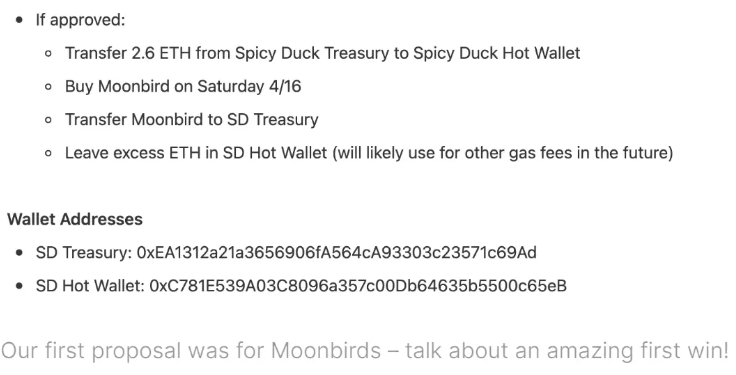
Simple choice—we went with Notion. We found it superior to Google Docs and ideal for collaborative research and proposal drafting.
Treasury, Vault, and Hot Wallet
Another straightforward decision. We needed a multi-sig wallet to secure our treasury and a hot wallet for daily transactions like minting, buying, and selling assets. This setup is proven across other DAOs, so we adopted it:
● Gnosis Safe for treasury/vault—secure and reliable
● Individual MetaMask hot wallets—for DAO use only, not personal (more on this below)
Contributor Payments and Rewards
Three tools stood out for contributor compensation:
1. Utopia Labs
2. Parcel
3. Coinshift
We liked all three for different reasons. All support fund/expense management with similar core features—the deciding factors were customer support and product direction.
We wanted a solution that could track across multiple wallets, handle contributor payouts, and offer decent customer support—financial chaos demands someone to call when things go wrong.
While we loved Parcel and Coinshift’s UX, neither supported accounting across multiple wallets. That wasn’t ideal—we didn’t want manual transaction tracking.
It started with a tweet, ended with a demo scheduled with Pryce.
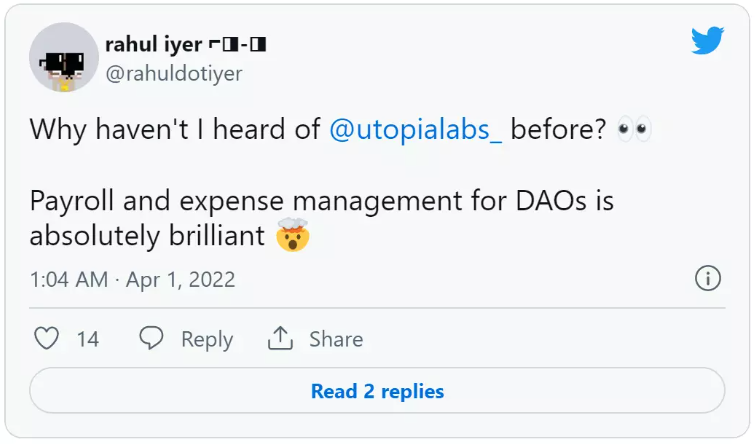
To be clear, we chose Utopia Labs because the team responded quickly, aligned with our roadmap, and is trusted by major DAOs (FWB, PleasrDAO, SquiggleDAO). Big fan of the team—excited to see what they build next.
Bookkeeping, Accounting, and Taxes
While many personal Web3 accounting tools exist, there are no truly robust solutions for businesses or DAOs. Most are early-stage and cost more than their functionality justifies.
That said, our operations aren’t overly complex yet, nor are we executing numerous trades. So we opted for Koinly (with manual transaction notes when needed), while awaiting Utopia Lab’s bookkeeping solution launching in June.
We evaluated Coinbooks and liked their vision, but ultimately preferred keeping all expenses, payments, and bookkeeping under one service to reduce overhead. Coinbooks’ pricing didn’t make sense for us at this stage. The short-term pain of using Koinly and later migrating to Utopia Labs seemed a fair trade-off.
We also have an accountant helping us, which simplifies decision-making.
What Are We Doing Today?
Spicy Duck has been live for just over a month. We’ve made several investments and developed coherent theories about the future (more on that another time).
Notable investments include:
● Moonbirds
● Moonbirds Oddities
● Chromie Squiggles
● Floor NFTs
● Tokenproof
Total asset value grew from 42.2 ETH to 66.63 ETH (57.89%). This was driven largely by Moonbirds, reinforcing our confidence in continued learning and investing in the space.
What Challenges Remain?
As we continue gradual decentralization and development of Spicy Duck, new questions keep emerging. Below are top priorities we need to tackle soon.
Exit Strategy
Current issue: How can we enable liquidity exits without violating rules for non-accredited investors?
Currently, there’s no clean way to exit quickly when invested in illiquid assets like NFTs. Requiring asset sales to facilitate entry/exit destabilizes the DAO. Fractionalizing assets creates problems for non-accredited investors. Syndicate handles this well and has it on their roadmap (another reason we chose them).
Scaling the DAO Treasury
Current issue: How can we grow the treasury without diluting existing members?
We have 15 members and started with 42.2 ETH. Great start, though modest compared to larger DAOs. While we’d love to scale up, inviting more members isn’t our preferred path.
Some ideas I’ve considered:
● Create art/generative mints, sharing profits with artists (or ourselves)
● Offer consulting in our areas of expertise (similar to CPG)
● Build tools we can monetize for other DAOs
● Launch POP to CPG (though this requires clear deliverables and established branding)
Increase/Incentivize Participation
Current issue: How can we boost and incentivize participation?
Though all 15 members are involved, encouraging even deeper engagement is always valuable. We’re exploring ways for individuals to contribute in ways most meaningful to them.
Learning Together as a DAO
Current issue: How can we ensure everyone learns using the same tools and collectively?
We launched this DAO to learn together. It enables us to invest, access diverse communities, and apply insights to future investments and builds. In theory, it makes sense. In practice, we’ve hit snags.
Not everyone has equal access to the same Discords/communities. This leads to information bottlenecks—only a few consume content and relay it secondhand (not the same as firsthand experience).
Dilution of Early Supporters
Current issue: How do we avoid diluting early believers/investors? Or should we allow dilution?
We’re exploring models to bring in new members without diluting existing ones. What’s the best approach? How can we do this legally? Or should dilution be accepted?
Business Wallets and Expense Management
Current issue: How can we empower members to make purchases on behalf of the DAO while maintaining proper accounting and tax compliance?
Current Web3 wallet architecture isn’t friendly for real-world use. Each member must maintain a separate hot wallet or meticulously tag business transactions in personal wallets—otherwise, accounting and tax headaches follow.
Rain is one of the few Web3-native startups tackling this. Excited to see what they build.
FAQ
This section addresses common questions and doubts you might have while reading.
● This isn’t a DAO, it’s just an investment club.
You’re right. The purpose of this DAO is to learn about Web3, NFTs, crypto, and DAOs. For a group of beginners, achieving full decentralization overnight isn’t realistic or necessary. The goal is to gradually grow familiar, decentralize step-by-step, and eventually move operations on-chain.
● You missed many DAO tools—the list isn’t complete.
I know. I wish I had time to explore everything, but sometimes building and iterating the big picture beats obsessing over fine details. We’ll decentralize gradually—time will tell if this was the right call.
● Why a DAO? If you’re just investing, collecting, and learning, it’s inefficient.
We’re working to improve efficiency, but that’s not our primary goal. We want to learn and genuinely believe DAOs represent a meaningful future. I rarely take advice from those who haven’t lived through it—learning by doing > learning by reading, watching, or listening.
You didn’t mention token-gated access—does your community/DAO have token-based permissions?
Not yet. But membership is closed—no one can join without approval. So in practice, it’s gated via Telegram and Syndicate. As we scale, we do plan to implement token-based access control.
DAO Tools
Below are all the tools mentioned in this article, plus others we discovered later. Not exhaustive, but helpful for anyone getting started.
Communication
Telegram: https ://telegram.org/
Discord: https ://discord.com/
DAO Creation
Syndicate: https ://syndicate.io/
Upstream: https ://upstreamapp.com/
Colony: https ://colony.io/
Prysm: https ://www.prysm.xyz/
Gardens: https ://gardens.1hive.org/
DAO Governance
Snapshot: https ://snapshot.org
Tally: https ://www.tally.xyz/
Boardroom: https ://www.boardroom.info/
Documentation
Notion: https ://notion.so/
Google Docs: http ://docs.google.com/
Mirror: https ://mirror.xyz/
Clarity: https ://www.clarity.so/
Treasury Management
Gnosis Safe: https ://gnosis-safe.io/
Parcel: https ://parcel.money/
Coinshift: https ://coinshift.xyz/
Contributor Compensation, Spending, and Reimbursements
Utopia Labs: https ://www.utopialabs.com/
Parcel: https ://parcel.money/
Coinshift: https ://coinshift.xyz/
Coordinape: https ://coordinape.com/
Bookkeeping, Accounting, and Taxes
Coinbooks: https ://www.coinbooks.xyz/
Koinly: https ://koinly.io/
Token-Gated Access
Collab.Land: https ://collab.land/
Guild: https ://guild.xyz/
Vulcan: https ://www.vulcanbot.io/
Join TechFlow official community to stay tuned
Telegram:https://t.me/TechFlowDaily
X (Twitter):https://x.com/TechFlowPost
X (Twitter) EN:https://x.com/BlockFlow_News