








Understanding the Era Value of ZK Rollup
TechFlow Selected TechFlow Selected
Understanding the Era Value of ZK Rollup
How to Capture the Value of the ZK Rollup Era?
 Navigating Web3 tides with focused insights
Author: Lewis Liao
Introduction: Ethereum is about to enter its Layer 2 era, and among all L2 scaling technologies, ZK Rollup stands out as one of the best solutions. What kind of synergy can emerge from combining zero-knowledge proof technology with rollup-based scaling? How does ZK Rollup surpass other scaling approaches? How can it be rapidly adopted? From an investment perspective, how can we capture the value of the ZK Rollup era, and what innovative applications might emerge? We hope this article provides some insights.
Table of Contents
1. Why Focus on Zero-Knowledge (ZK) Rollup?
-
Comparison Between Optimistic and ZK Solutions
2. What Is the Landscape of ZK Rollup Scaling Solutions?
-
Comparison of Major ZK Rollup Players
-
Advantages of ZK Rollup
-
Pain Points of ZK Rollup
3. What Does the Future of Scaling Look Like?
-
Technical Challenges
-
Go-to-Market Challenges
-
Go-to-Community Challenges
4. How to Invest in the Scaling Ecosystem
1. Why Focus on Zero-Knowledge (ZK) Rollup?
Zero-knowledge cryptography is considered one of the most underappreciated technologies of our generation. Unlike artificial intelligence and big data, which receive widespread media attention, zero-knowledge technology has attracted little public notice. Nevertheless, it represents a major breakthrough—providing crucial privacy protection in an age where personal information is increasingly exposed through big data.
Zero-knowledge cryptography is a broad topic, but in this article, we focus on the area most relevant to blockchain: zero-knowledge proofs. A zero-knowledge proof is a non-interactive, zero-knowledge argument of knowledge involving two parties: a prover and a verifier. The prover wants to convince the verifier that they know certain information without revealing what that information is. Meanwhile, the verifier checks the proof and either accepts or rejects it.
Such schemes have three key properties:
-
Completeness: Any valid result can be proven for a given program
-
Soundness: No dishonest actor can create a valid proof
-
Zero-knowledge: The verifier learns nothing about the input of the proof, only the outcome
In the blockchain world, where all data is publicly visible, the ability to prove a statement without revealing its content is a powerful primitive. This technology can address critical real-world challenges for individuals, enterprises, and governments—such as protecting user data, designing sensitive systems or contracts, proving fair distribution of public goods, and enabling more efficient and economical government operations.
Beyond privacy, the most prominent application of zero-knowledge technology in blockchain is Ethereum’s scaling solution: ZK Rollup. Ethereum is now embracing a rollup-centric roadmap, offering optimal trade-offs in decentralization, security, and scalability. In essence, Ethereum upgrades will make the network more scalable, sustainable, and secure.
Ethereum's scaling strategies are divided into on-chain and off-chain scaling.
On-chain scaling involves upgrading the base layer of the blockchain to improve scalability. Ethereum's long-term on-chain scaling solution is called sharding, which splits the base layer into 64 chains secured by a beacon chain.
Off-chain scaling refers to solutions that use external execution layers instead of the base layer. These second-layer, or "L2," solutions are auxiliary layers built atop the base layer, providing greater transaction capacity for the entire blockchain.
Ethereum's adopted L2 approach is Rollup, which offers the following benefits:
-
With Rollup, Ethereum can scale from approximately 25 TPS to 3,000 TPS without sacrificing security;
-
With Rollup, users' funds cannot be stolen or censored (unlike some sidechains);
-
Users always have access to data on L1, and no one can prevent their funds from securely exiting the Rollup at any time;
Currently, there are two (main) types of Rollups:
ZK Rollup (ZKRU) and Optimistic Rollup (OR)
Optimistic vs. ZK Solutions Comparison
Optimistic Rollup is currently a more mature solution compared to ZKRU. Products from Optimism and Arbitrum are already available for Ethereum developers. However, due to their fraud-proof mechanism, withdrawal times and security remain questionable. Additionally, cost optimization lags behind ZK Rollup. While ZK Rollup faces mainly technical hurdles, many talented developers—including Vitalik—believe ZK Rollup will ultimately become the superior scaling solution.
Comparing both solutions in terms of gas fees and TPS:
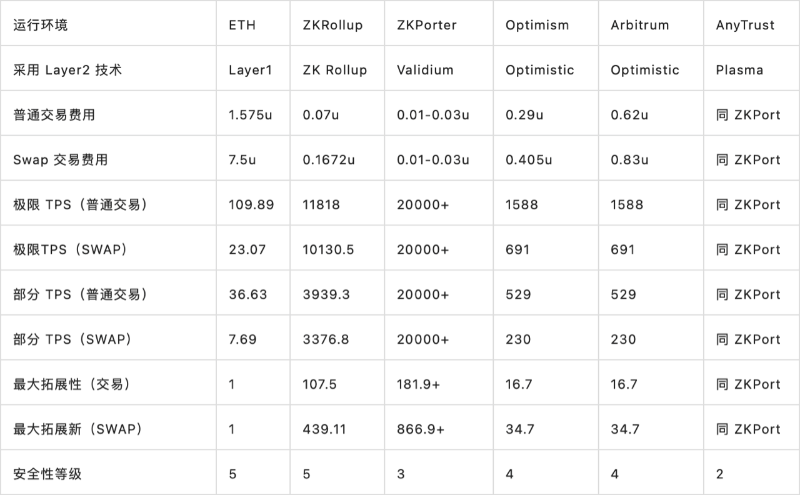
Gas fees across four major solutions
Source: Xiang|W3.Hitchhiker. Calculations assume ETH price at $2,500, block gas limit at 30,000,000, gas fee at 30 Gwei, and average block time of 13 seconds. Maximum TPS assumes the environment occupies all Ethereum block space (spending 500,000 gas on proof verification), while normal TPS assumes 1/3 of block space usage.
-
In terms of efficiency and cost, ZK solutions are more efficient than OR, offering higher TPS and lower fees.
-
In terms of time cost, due to the fraud-proof mechanism, withdrawals on Optimistic Rollup require a 7–14 day challenge period to allow others to disprove potential malicious activity. Although some solutions like Boba Network have introduced liquidity pools to shorten withdrawal times.
-
In terms of compatibility, both Optimistic and ZK face challenges adapting to complex EVM contract calls. However, Optimistic implementations are easier—solutions like Arbitrum and Optimism feature EVM-compatible virtual machines, allowing them to process all transactions occurring on the Ethereum mainnet.
One of the biggest limitations hindering ZK Rollup development is EVM compatibility. When EVM was first designed, developers never anticipated using ZK technology. Generating usable zero-knowledge proofs from EVM operations is nearly impossible, leading to the need for ZK-EVM. Many previously believed achieving ZKSync 2.0 would take years, but ZKSync 2.0's public testnet officially launched at the end of February—it's the first EVM-compatible ZK Rollup on the Ethereum testnet. The large-scale adoption of ZK Rollup may arrive sooner than expected.
Why is EVM compatibility so challenging for ZK?
Most existing ZK Rollup solutions only support simple payments and swaps. The reason is that ZKEVM must not only execute smart contract bytecode normally but also generate a proof showing correct state updates after transactions. Due to EVM design and ZK proof algorithm principles, achieving compatibility between the two is extremely difficult.
From a security standpoint, OR relies on economic incentives—requiring well-designed mechanisms to incentivize validators on the main chain to monitor submitters and prepare fraud proofs. Submitters must also stake assets to ensure accountability for malicious behavior. In contrast, ZK’s security is based on mathematics or cryptography, enabling trustlessness. Mathematical and cryptographic guarantees are far more reliable than optimistically trusting human honesty.
Below are the pros and cons of ZK Rollups in comparison.
Advantages
-
Each transaction contains less data, increasing Layer 2 throughput and scalability—greater scalability and lower transaction costs compared to Optimistic Rollups;
-
No need for anyone to monitor ZKR;
-
No fraud dispute window required as in Optimistic Rollups, reducing withdrawal time from ~2 weeks to minutes;
-
Privacy enabled by default;
Disadvantages
-
The computational difficulty of generating zero-knowledge proofs requires data optimization for maximum throughput;
-
Initially harder to build and integrate into the Ethereum network compared to Optimistic Rollups;
Overall, ZK Rollup's weaknesses are primarily technical issues. With many talented developers working on these problems, they are likely to be resolved. Most experts, including Vitalik, agree that ZK Rollup will become the superior scaling solution in the future.
2. What Is the Landscape of ZK Rollup Scaling Solutions?
Comparison of Major ZK Rollup Players
There are two dominant players in the ZK Rollup space: zkSync and StarkWare
The table below visually highlights key differences between the two in terms of team, technology, data availability, funding and supporters, and current products and roadmaps.
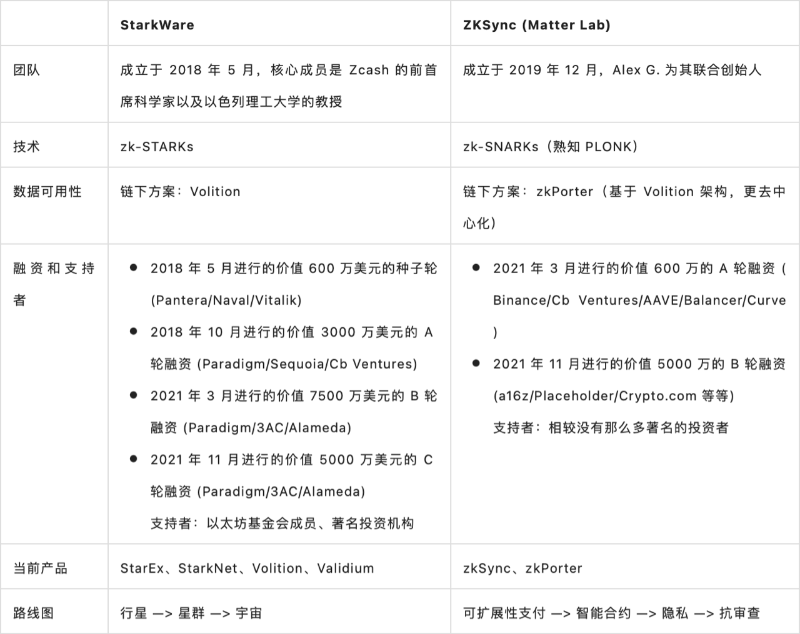
In terms of teams, StarkWare is more academic, composed of world-class cryptographers and scientists who have pioneered innovation in zero-knowledge research, published numerous academic papers, and turned them into real-world products. Less information is available about zkSync’s team, but judging from product releases, they exhibit cross-industry traits and high operational efficiency.
In terms of technology, StarkWare generally offers superior technology, providing blockchain finality—which means optimal capital efficiency. Key advantages of STARK include:
-
They invented and built their own ZK-STARK system, whereas zkSync uses PLONK built by Aztec. This gives StarkWare stronger control over and ability to improve their technology;
-
Multiple systems are already running in production, using Cairo—a Turing-complete programming language ready for use. Matter Labs (zkSync) only has a simple payment system in production, with no Turing-complete language available;
-
Faster, more secure (cryptographically), transparent (no trusted setup), and quantum-resistant, while Matter Labs’ core technology (built by another team) is slower, requires trusted setup, and is vulnerable to quantum computing attacks;
In terms of data availability, StarkWare pioneered the Volition system to solve DA issues. Volition allows end-users to choose per transaction between rollup (on-chain DA) and validium (off-chain DA). zkSync uses zkPorter, a technology based on Volition. The main difference is: with Volition, users choose storage method per transaction; with zkPorter, users choose settlement method per account (zkPorter accounts can only generate transactions via off-chain DA). Moreover, zkPorter’s off-chain DA system is more decentralized because its security is provided by a Guardian network incentivized by zkSync’s native token, rather than a centralized DAC.
In terms of funding and supporters, StarkWare is valued at $2 billion and raising a Series D round at a $6 billion valuation—an elite level attracting many renowned investors. Supporters include industry titans and members of the Ethereum Foundation. Vitalik himself has reviewed most of StarkWare’s publications. Compared to StarkWare, zkSync has fewer high-profile investors, resembling a consortium-backed Defi/CEX crypto family. While each project is well-known and together forms a strong ecosystem, this is crucial: the success of ZK Rollup will heavily depend on DeFi protocol adoption and direct CEX integration.
In terms of current products and roadmap, in June 2020, StarkWare launched StarEx—their "Planets" phase—enabling permissioned, application-specific ZK Rollups powered by Cairo and STARKs, such as dYdX, Immutable, DeversiFi, and Sorare. As of March 2022, StarkEx had processed 134 million transactions, with cumulative volume reaching $49 billion and $1.1 billion in TVL.
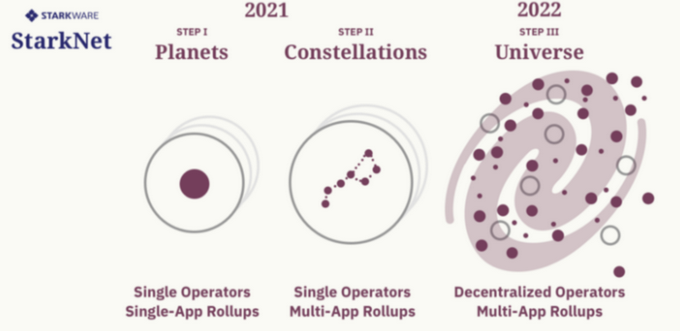
StarkWare Roadmap
On November 29, 2021, they launched the mainnet alpha of StarkNet, advancing toward the "Constellations" phase. StarkNet is the permissionless, multi-application general-purpose ZK Rollup we’ve been waiting for. As of March 2022, StarkNet’s Goerli testnet had recorded 1.4 million transactions, and the mainnet 45,000. In terms of contract deployment, there were 26,000 contracts on Goerli and 1,600 on mainnet.
Initially, StarkNet will be driven by a centralized prover, with applications requiring whitelist approval for sequential deployment—similar to Optimism. Their plan is to grow the ecosystem and gradually decentralize StarkNet to reach the "Universe" phase.
zkSync’s roadmap can be summarized in four steps. Phase one corresponds to zkSync 1.0 launched in June 2020—a ZK Rollup without smart contract integration. Users could send and receive tokens but lacked composability. Many promising projects have already deployed on version 1.0.
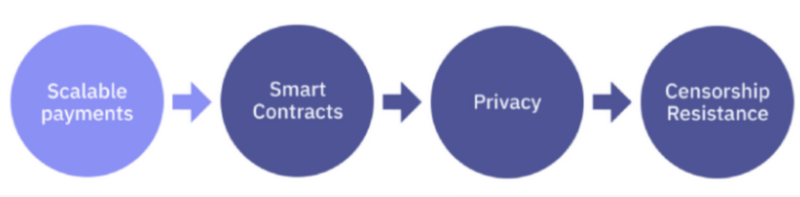
zkSync Roadmap
Phase two begins with zkSync 2.0 going live on mainnet, delivering everything we expect: a fully EVM-compatible ZK Rollup with smart contract composability. zkSync 2.0 was initially scheduled to launch on mainnet in August but was delayed due to technical challenges. These are now being tested and progressively resolved on the testnet. In October, zkSync announced recent technical milestones and deployed an AMM-like testnet (Uniswap) to verify EVM compatibility. Delaying release to ensure LLVM/Solidity compatibility may have been frustrating initially, but it will enable seamless native integration of every Ethereum tool and dependency on zkSync 2.0.
Advantages of ZK Rollup
ZK Rollup solutions offer unique advantages such as privacy protection, retained scalability, and cross-chain application capabilities.
-
Privacy is one of ZK Rollup’s strengths and features
Permissionless blockchains achieve computational integrity without trusting third parties, but at the cost of scalability and privacy. Since the 1980s, theoretical work on proof systems such as zero-knowledge proofs, interactive proofs, and probabilistically checkable proofs has paved the way to solving these issues, now reflected in practical applications.
-
Retained scalability grants developers theoretically near-infinite computing power
This makes it possible to migrate internet ecosystems onto blockchains—for example, competitive gaming, previously impractical on Ethereum, becomes feasible with ZK Rollup. Furthermore, combining immense computing power with blockchain characteristics enables many new applications.
-
Cross-chain applications—one of ZK Rollup’s representatives, StarkNet, offers diverse bridging capabilities
Developers can send any payload (not just transfers) from L1 to L2—deploying dApp front-ends on L2 for low-cost governance or gameplay, while sending instructions for liquidity back to L1. Think of L2 as the brain and L1 as the muscle.
Pain Points of ZK Rollup
Although ZK Rollup is an excellent Ethereum scaling solution, its adoption still faces risks such as fragmented liquidity, communication difficulties, reduced composability due to technical barriers, and centralization risks.
-
Liquidity fragmentation is increasingly evident in today’s multi-chain landscape—not unique to ZK Rollup
With multiple technical solutions coexisting, the number of rollup networks will increase, worsening liquidity fragmentation. Fortunately, several cross-chain communication solutions are addressing this—LayerZero launched Stargate in March 2022 (note: Stargate currently doesn’t support ZK Rollup). LayerZero is paving the way toward a “full-chain future” with shared states, unified bridge liquidity, cross-chain lending, swaps, and multi-chain yield aggregators—all while maintaining security.
-
Composability issues mainly arise from interactions between mainchain dApps and sidechain dApps
Every new protocol built on Ethereum acts like a Lego brick, easily combinable with others—partly why DeFi grew so fast. Without solving communication and standardization, sidechain dApps must rebuild their own ecosystems, leading to massive resource waste. Communication mechanisms and standardized contracts are needed not only between mainchain and sidechain, but also between different sidechains.
-
Centralization risk stems from current rollup solutions
The sequencer responsible for executing, ordering, compressing, and packaging transactions remains relatively centralized. To further enhance security, rollups must address this centralization issue.
3. What Does the Future of Scaling Look Like?
Ethereum’s scaling roadmap outlines a short-term dominance of Optimistic Rollups, followed by a medium- to long-term shift toward a “sharding + ZK Rollup” model.
Overall, Rollup is undoubtedly the best choice for Ethereum scaling, offering exceptional security and scalability. Despite programmability requiring ongoing technical efforts, it remains a highly ideal scaling technology in the medium to long term. Combining Ethereum sharding with ZK Rollup will crack the so-called “impossible triangle,” while zkEVM ensures programmability, easing developers’ migration to Layer 2.
In the medium to long term, as ZK-SNARK technology improves, ZK rollups will dominate across all use cases. —Vitalik Buterin
Nonetheless, ZK Rollup still faces many challenges before achieving mass adoption—technical, GTM (Go-to-Market), and GTC (Go-to-Community) issues.
Technical Issues
We’ve briefly covered ZK Rollup’s technical challenges earlier—here we add more detail.
Regarding compatibility, ZK Rollup’s main technical hurdle is developer unfriendliness, limiting functionality. Two reasons made building general-purpose dApps difficult:
-
First, developing dApps on ZK Rollup required writing all smart contract logic in a special language (R1CS). Not only is the syntax complex, but it demands deep expertise in zero-knowledge proofs;
-
Second, ZK Rollup lacked composability—different ZK Rollup apps couldn't interact within Layer 2. This severely undermined DeFi composability;
There are two ways to build general-purpose dApps on ZK Rollup: one is building dedicated circuits ("ASICs") for different dApps—this was the early path taken by ZK Rollups, corresponding to StarkWare’s Planets phase, where apps couldn’t interact. The other is building a general-purpose "EVM" circuit for smart contract execution. Both StarkWare and zkSync have made significant progress here.
Currently, StarkWare is in the "Constellations" phase. In September 2021, StarkWare launched a permissionless, multi-application general-purpose ZK Rollup supporting smart contracts via Cairo. zkSync is also in phase two: in February 2022, zkSync 2.0 testnet went live, continuously testing LLVM/Solidity compatibility to achieve full EVM compatibility and smart contract composability.
Notably, StarkWare and zkSync adopt completely different technical approaches.
StarkWare uses a brand-new Turing-complete programming language, Cairo, and collaborates with OpenZeppelin to develop standardized contracts—just as they did with Ethereum—meaning they're creating new contract standards for composability. This is a bold move, significantly increasing developer onboarding costs. Currently, Nethermind’s Warp team is helping developers convert ERC-20 contracts from EVM bytecode to StarkNet contracts. Progress is rapid, with the next goal being conversion of arbitrary smart contracts from Yul to Cairo.
zkSync adopts the zkEVM approach for EVM compatibility. There are currently two main zkEVM implementation strategies:
-
Direct support for EVM’s existing instruction set, fully compatible with Solidity—used by Hermez and the Ethereum Foundation zkEVM;
-
Redesigning a virtual machine friendly to zero-knowledge proofs while adapting EVM development tools to maintain Solidity compatibility—primarily used by zkSync;
Overall, the first strategy offers better compatibility and higher security but requires more work—Hermez uses this. The second is more flexible with less workload but requires extra adaptation effort—this is zkSync’s approach. zkSync developed two compiler frontends for zkEVM: Yul and Zinc. Choosing LLVM for their compiler caused delays in zkSync 2.0’s original August 2021 launch due to LLVM/Solidity compatibility issues—now a key focus during testnet rollout.
Using Cairo may seem worse in terms of compatibility—is this a weakness of StarkWare? Not really.
While adopting a new language increases developer onboarding costs, Cairo brings several advantages that allow ZK to integrate more elegantly into the blockchain ecosystem. For instance, Cairo comes with AIR (Algebraic Intermediate Representation) visualization tools for inspecting proof details, enables secure and trustworthy generation of zk-STARK proofs to ensure computational integrity, aligns better with mathematical proof logic, and features a complete toolchain.
Moreover, it enhances security. Cairo’s AIR is relatively simple, resulting in lower efficiency and amortized costs for on-chain verifiers and off-chain proof services. Auditing one simple AIR is safer than auditing multiple complex, app-specific AIRs. With Cairo, we rely on a single Verifier smart contract—no need to deploy separate verifiers for each application.
Note the security implication: a single audit of this contract protects any application from proof system risks, allowing them to focus solely on auditing business logic. Regarding business logic, verifying code correctness is much easier than understanding application-specific AIRs. Cairo doesn’t solve EVM’s vulnerability issues, but some are actively working on it.
Go-to-Market Challenges
The go-to-market model for ZK Rollup closely resembles that of so-called “Ethereum killers.” StarkWare is currently centralized but moving toward decentralization. zkSync is open-source and somewhat decentralized—but not fully—and neither has a token yet. Similarly, the two major players in the other Rollup camp—Optimism and Arbitrum—also lack tokens.
zkSync will issue a token—confirmed by their source code. Starkware and Arbitrum haven’t publicly commented. Optimism recently hinted at launching a token.
However, for L2s to drive decentralization and win markets, issuing a token is essential. Tokens aren’t just effective incentive tools—they also help govern communities better. Current obstacles to token issuance include immature cross-chain bridges and unresolved EVM compatibility.
A16Z defines the GTM matrix for Web3 based on organizational structure and economic incentives:
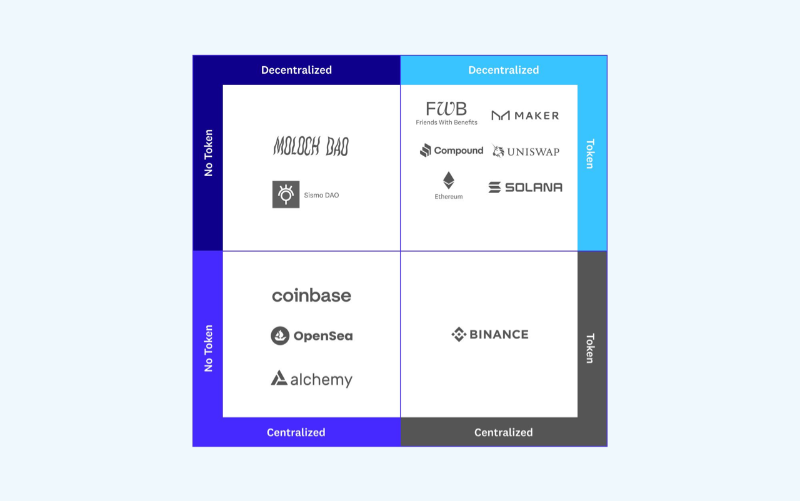
Web3 Go-to-Market Matrix, Source: a16z
They argue that Web3’s go-to-market (GTM) model differs significantly from Web2, primarily due to the introduction of tokens and new organizational forms like DAOs. Each quadrant represents different GTM strategies—from traditional Web2-style approaches to emerging experimental ones.
Factors indicating whether a Layer 1/Layer 2 has won the market include GitHub stars, number of protocol developers, number of integrated projects, number of protocol forks, and TVL.
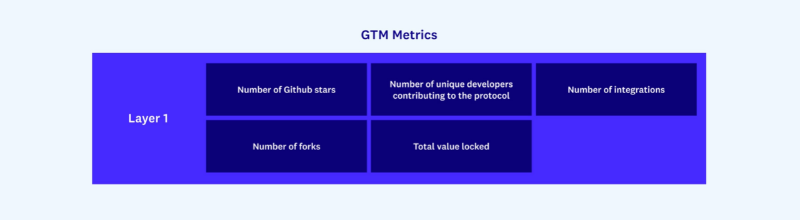
L1 Public Chain Go-to-Market Matrix, Source: a16z
Due to StarkWare’s closed-source nature, direct comparison isn't possible. Based on March 2022 data, here’s how zkSync, Optimism, and Arbitrum compare:
-
In GitHub stars, zkSync leads with 1.3K, slightly ahead of Optimism’s 0.9K and Arbitrum’s 0.7K;
-
In number of protocol developers on GitHub, Optimism leads. zkSync has 43, Optimism 66, Arbitrum 36;
-
In protocol forks on GitHub, Arbitrum edges ahead with 355. zkSync and Optimism are close at 292 and 303 respectively;
-
In TVL, Arbitrum leads significantly at $3.41B, while zkSync and Optimism stand at $148M and $562M respectively;
Compared to the successful Ethereum alternative chain Solana, Solana has 7.7K GitHub stars, 1.8K forks, 305 contributors, and a TVL of $7.46B.
Clearly, current Rollups are far from having "won the market." Much work remains—especially gaining more project integrations. Greater adoption attracts more developers, leading to better ecosystem projects, wider user adoption, and increased capital inflow. Achieving this requires proactive engagement with the community (Go-to-Community, GTC).
Go-to-Community Challenges
Some believe the key difference between go-to-market and go-to-community strategies lies in value capture versus value creation. For a product, the community consists of its users; for a blockchain or protocol, the community comprises its adopters—applications. Hence, using “ecosystem” instead of “community” may be more accurate.
Currently, with the launch of StarkNet Alpha and zkSync 2.0 testnet, ZK Rollup technology is seeing rapid adoption, and both ecosystems are expanding. Below is a summary of both ecosystems:
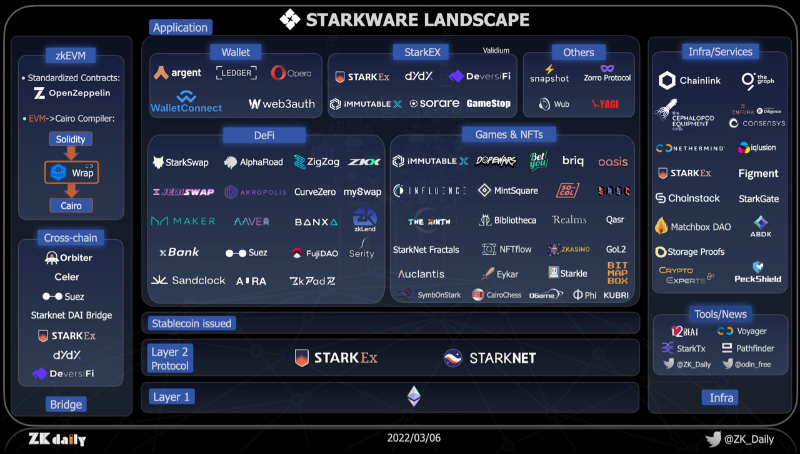
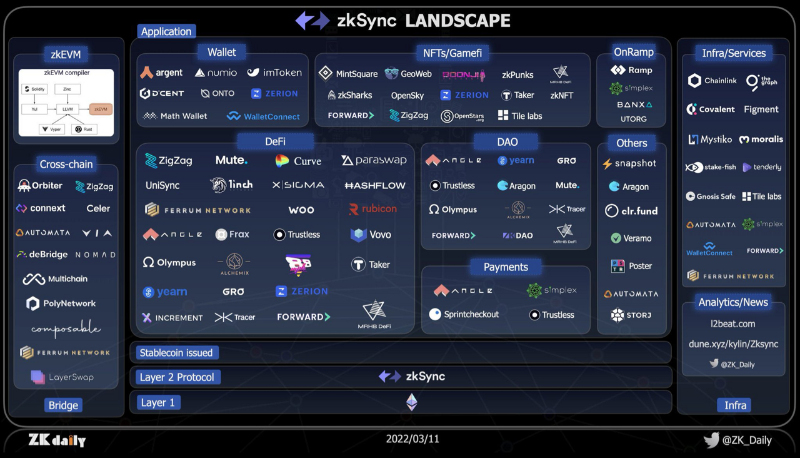
StarkWare Landscape, Source: ZK_Daily
Both ecosystems show comparable vibrancy. zkSync enjoys broader support from cross-chain, DeFi, and wallet applications, while StarkWare boasts a more vibrant Games & NFTs ecosystem.
For an L1/L2 ecosystem, liquidity functions like bandwidth—connecting different application scenarios into a larger network: the value internet. Here, liquidity refers to value exchange across applications. High liquidity minimizes value loss; poor liquidity increases it. If applications cannot exchange value, liquidity simply doesn’t exist. An ecosystem only functions properly when liquidity flows throughout—just like the Ethereum ecosystem, where any Ethereum-based application can be priced and exchanged via ETH.
I divide ecosystem liquidity into horizontal and vertical liquidity. Bridges in L2s serve to horizontally connect liquidity across different Rollups. Recently, innovative approaches like LayerZero have emerged, improving upon traditional bridge designs with enhanced security and trustlessness. Vertical liquidity focuses on different applications: end users connect to the ecosystem via wallets, sometimes using payment methods to buy crypto, exchanging value across apps, and occasionally using marketplace apps for intermediary swaps.
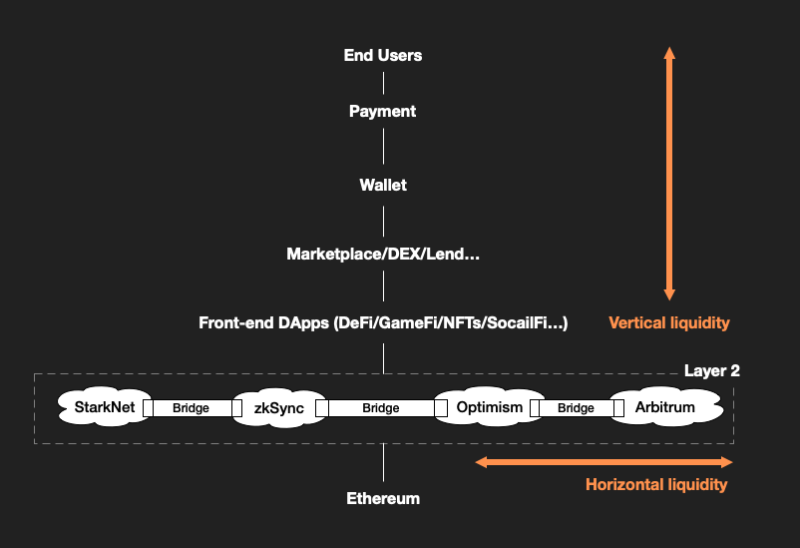
L2 Ecosystem Value Flow Diagram
Currently, both StarkWare and zkSync have deployed applications at various liquidity nodes—most still in testing. Their ecosystem comparison is shown below:
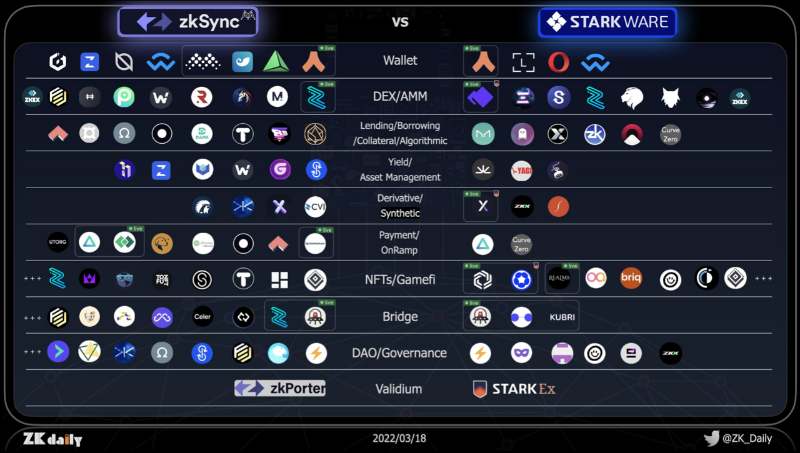
zkSync vs. StarkWare Ecosystem Comparison
To achieve internal vertical liquidity, composability must be supported—requiring unified standards for permissionless integration between protocols, like Lego bricks. This is easy on Ethereum, but due to zero-knowledge proof complexities, both StarkWare and zkSync are making great efforts to solve it—progress is being made.
An ecosystem thrives only with strong horizontal liquidity—requiring robust bridges to cheaply extend Ethereum’s liquidity. More importantly, they must enable seamless communication with other L2s or even L1s. For both users and applications, a fast (high TPS), low-cost (low fees), and secure blockchain is inherently attractive. The lower the migration cost, the stronger the ecosystem’s appeal.
The necessary condition for ecosystem takeoff is the emergence of killer applications that attract massive user and capital inflows. This cannot be achieved merely through high APYs, token airdrops, subsidies, or closed “play-to-earn” models.
How to Invest in the Scaling Ecosystem
Blockchain is the value internet; traditional internet is the information internet. Information travels via bandwidth; value transfer relies on liquidity. First, a public chain ecosystem must enable value flow, then efficient value flow. On top of that, by building applications meeting user needs, we can truly boost productivity and eventually establish an efficient, permissionless, censorship-resistant, democratic, anti-corruption, inclusive, open, and transparent blockchain world.
Thanks to smart contracts, blockchain applications go beyond being decentralized ledgers. They've spawned innovations like NFTs for digital ownership and fungible tokens forming DAOs as novel governance structures. These innovations, combined with existing internet applications, spawn even more use cases. Yet current blockchain infrastructure struggles to support these applications effectively.
First is the scaling problem. Whether TPS or data availability, scaling is essential. ZK Rollup and Validium have made meaningful progress. Other Layer 2/Layer 1 solutions like Optimistic Rollup, Plasma, Solana, and Celestia also contribute. Scaling technology itself is a prime investment target. At this stage, we should pay closer attention to on-chain storage technologies. After scaling, high TPS and reliable data availability will greatly enhance blockchain performance, enabling more complex applications—divided into internet blockchain transformation and blockchain-native categories.
-
Internet blockchain transformation: Most visibly in GameFi—real-time on-chain combat settlement, real-time communication, and large-scale payments become feasible;
-
Blockchain-native: High-performance blockchain infrastructure enables more frequent and dense value exchanges, drastically lowering value transfer costs. Innovative applications should genuinely improve capital utilization efficiency, thereby boosting productivity. Additionally, high-performance blockchains make liquid data capital markets possible—a revolutionary innovation. Data, as a production factor in the information age, can now flow freely, be applied widely, and enable fair and rational profit distribution;
Second is the liquidity problem, split into horizontal and vertical liquidity.
-
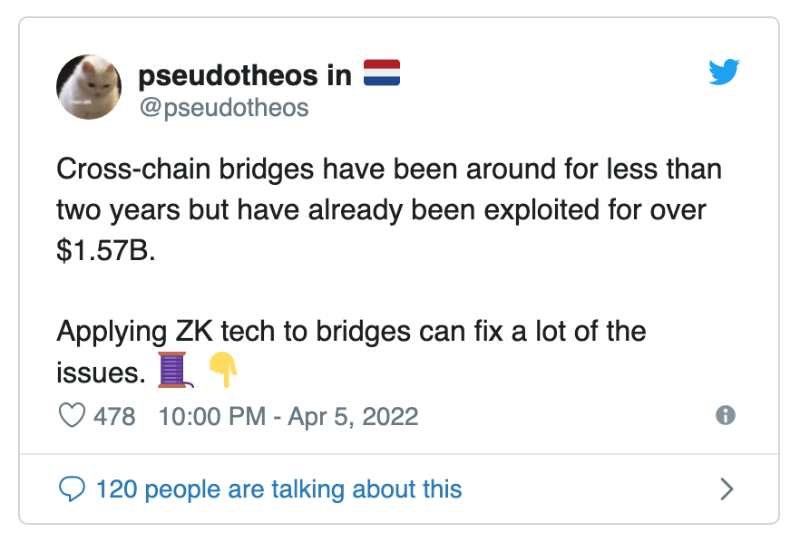
Horizontal liquidity refers to value transfer across different public chains/L2 ecosystems. When a new chain/L2 ecosystem emerges, users migrating from existing ones need reliable value exchange tools—often called bridges. Traditional bridges have security flaws, risking fund losses and even cascading failures. Fortunately, newer bridge technologies like LayerZero are emerging. We expect even better solutions—such as zk bridges under active research—to resolve many current bridge issues. As gateways to ecosystem liquidity, bridges can spawn more DeFi applications and capture greater value;
-
Vertical liquidity refers to value movement within the same public chain/L2 ecosystem. Optimizing vertical liquidity contributes more to efficient value flow, thanks to innovative DeFi applications like AMMs, yield farming, and lending. Efficient applications minimize value loss during exchanges. This segment captures enormous value, but current solutions aren’t good enough—most lock liquidity, resulting in low capital efficiency. Novel solutions include Tokemak and dAMM—we should watch for more L2 applications in this space;
Then comes data privacy. No company wants all financial data publicly exposed, letting everyone audit every transaction. On-chain blockchain data is stuck in the HTTP era of the internet—all information transmitted in plain text. The advent of ZK technology ushers blockchain into the HTTPS era. Soon, nearly every blockchain transaction could be protected by zero-knowledge technology. Only then can blockchain permeate every corner of society—preserving trustlessness, tamper-resistance, openness, and transparency, while adding transaction privacy. The best way to implement privacy should be protocol-based—modular, composable, configurable, ownable, and censorship-resistant. In the foreseeable future, privacy protocols will become mandatory components in every application.
Finally, wallets. As gateways to the blockchain world, wallets are critically important. By analogy to the internet, wallets are like browsers—information interacts with people through browsers, value through wallets. Some say we’re in the Netscape era of blockchain, and MetaMask might be today’s Netscape. Despite potentially different fates, current wallets are far from user-friendly. Most importantly, value doesn’t flow efficiently between wallets. While compatibility issues affect interoperability, clearly we need universal standards defining this value interface.
The above covers infrastructure—the domain where value is generated and begins to be captured. Only by resolving these issues (though possibly not exhaustively) can blockchain technology achieve true breakout, connecting everyone through the value internet.
In past public chain ecosystems, value was mainly captured by protocols—first the chains themselves, then DeFi, especially exchanges and trading platforms. Refer to the famous "fat protocol" theory. While controversial, it largely holds true today. I believe this is because the blockchain infrastructure era is far from over.
Infrastructure development is long, hard, and resource-intensive—but it’s where moats form. Applications built atop infrastructure that deliver massive benefits are called kinetic applications. Kinetic applications will create the most value. Infrastructure vs. kinetic isn’t static—Taobao was once the kinetic force of the internet, but now serves as infrastructure for Ant Group. The core purpose of infrastructure is to pave the way for kinetic applications, reducing their adoption costs.
The kinetic era of blockchain hasn’t arrived yet. But with the gradual adoption of ZK Rollup in the L2 era—and the coming of L3 and L4 eras—the kinetic era becomes foreseeable. Who will lead it? Likely sectors capable of producing killer applications: gaming, entertainment, social networks, and virtual reality.
Early bets on these fields are viable investment strategies. But considering difficulty and ROI, they’re not highly cost-effective at this stage. When investing in these areas, consider whether they fully leverage new infrastructure or retain full extensibility for it—giving them sufficient speed, high-value cost control, and efficiency gains in the fast-evolving blockchain infrastructure era, greatly enhancing competitiveness.
Join TechFlow official community to stay tuned
Telegram:https://t.me/TechFlowDaily
X (Twitter):https://x.com/TechFlowPost
X (Twitter) EN:https://x.com/BlockFlow_News






