
How to conduct economic development within a DAO like a nation?
TechFlow Selected TechFlow Selected
How to conduct economic development within a DAO like a nation?
DAOs are like nation-states—they should strive to build thriving internal economies that serve their mission.
 Navigating Web3 tides with focused insights
Author: Llama
Translated by: TechFlow

This article is based on my talk at Crypto, Culture, & Society—a learning DAO building a liberal arts education for the crypto space.
Today, while increasingly complex activities have moved from the physical world into digital spaces, tools for digital-native coordination haven't evolved at the same pace. DAOs are emerging as a definitive coordination mechanism, but they're still in their infancy. To reach their full potential, DAOs—like nation-states—should strive to build thriving internal economies that serve their mission.
This article explores how DAOs can build internal economies, how to use native tokens and treasuries in service of their goals, and how models from economics, history, and anthropology can be applied for effective operation.
I. How to Build an Economy?
Why Have Japan, South Korea, and China Succeeded?
In his book *How Asia Works*, Joe Studwell details the economic models implemented by Asian governments to build successful economies—including those of Japan, South Korea, China, and others.
These successes contradict traditional economic ideas promoted by Western universities and institutions like the IMF and WTO. Unrestricted free markets can harm underdeveloped economies. Successful Asian economies were strategic about which parts of their economies to open and when.
Strategies cited in the book include:
Land reform: Distributing land from inefficient feudal landlords to smallholder farmers;
Immigration policy: Allowing specific skilled workers to immigrate while restricting foreign ownership of land;
Import/export policy: Subsidizing exports and taxing strategically important imports;
Protecting domestic industries: Shielding local farmers and manufacturers from foreign competition;
Currency protection: Devaluing currency to make exports more competitive;
Economic zones: Designating regions with greater economic autonomy, such as Shenzhen;
Tax incentives: Offering tax subsidies to domestic industries;
Countries like South Korea and China began with abundant land and relatively uneducated labor forces. Training citizens for high-skill fields like IT or financial services would have been too costly. Instead, governments implemented land reform, allocating land to agricultural laborers who worked it directly.
As a result, economically incentivized small farms operated by farmers saw increased productivity and crop yields. This raised household incomes. Agricultural success then fueled local manufacturing growth. Since manufacturers couldn’t get rich through domestic consumption (due to low local purchasing power), they focused on exporting to wealthier economies like the U.S. and Europe.
Export stimulation didn’t come from fully opening the economy, but through selectively establishing special economic zones and offering tax subsidies to strategic industries. Governments selectively revalued currencies—China, famously, kept its currency devalued to maintain export competitiveness globally.
While these strategies aren't sustainable long-term, they were crucial during early development stages. Economic construction requires building a strong foundation before fully opening up to foreign competition.
Applying Government Economic Models to DAOs
What happens when we apply these Asian economic development models to building DAOs?
Let’s take FWB as an example.
Land Reform: Broad Token Distribution
Just as East Asian governments distributed land from feudal landlords to laborers, DAOs must distribute tokens widely to participants, allowing contributors to earn tokens. This may cause inflation but also dilutes old, inactive members while attracting new, active ones.
FWB does this by forming working groups where members earn tokens through contributions to the DAO.
Immigration Policy: Token Threshold (75 FWB) and Scholarships
FWB grants membership to anyone holding 75 FWB tokens and approved by the FWB team. They also run a scholarship program for selected applicants.
Unlike open-border policies, this manages DAO membership early on.
Currency Protection: Liquidity Reserves and Treasury Diversification
A large portion of FWB’s token supply is held in treasury, limiting circulating supply. The treasury is selectively used by responsible community members.
FWB manages its liquidity programs. Most major liquidity providers are trusted FWB members who don’t arbitrarily sell their FWB holdings.
Economic Zones: FWB Cities, FWB Gatekeeper, FWB Radio
Sub-DAOs can be thought of as loosely defined economic zones. They’re empowered and funded to produce specific products or services.
Tax Incentives: Funding from DAO Treasury
FWB acts like a nation that must provide public goods for people to operate within it. Just as governments offer tax subsidies to industries beneficial to the nation, FWB allocates treasury funds to activities that further its mission.
FWB’s treasury has funded a token-gated product (granting access to communities or content exclusively to token holders), an editorial covering weekly FWB news, and events in various cities.
Designing Tokens and Treasuries as a Decentralized, Programmable Game
A DAO is an internet-native organization whose core rules are governed by smart contracts rather than legal agreements.You can encode critical aspects like membership, ownership, key assets, or community-owned property on-chain. At the edges, real people manage key components such as shared bank accounts or treasuries, protocol upgrades, and changes to the DAO charter.
Today, most protocol DAOs allocate 40–60% of their native tokens to the community treasury, then redistribute them via on-chain governance. The challenge is that on-chain governance is slow and ineffective, meaning almost no native tokens actually get allocated.
However, over time, the rules for distributing native tokens can be encoded at the DAO’s formation. By setting these rules, DAOs create a game that builders, users, market participants, and other stakeholders can play to earn native tokens.
Bitcoin Block Rewards: A Transparently Governed Game—The Birth of Economic Activity
Bitcoin provides a great example of this principle in action. Bitcoins are generated as mining rewards, where mining serves the vital function of using computing power to verify and record new Bitcoin transactions. The incentives designed by Bitcoin’s creator, Satoshi Nakamoto, have spurred an entire ecosystem of participants—from mining companies like Bitmain, to hydroelectric plants in Italy and Costa Rica, to ASIC miners dedicated to mining Bitcoin, and many more.
While the Bitcoin model has faced criticism, it successfully established a transparent way for market participants to earn Bitcoin.
Curve: An Open, Attack-Resistant Mechanism Leading to Complex Economic Behavior
Curve is another example of a protocol with a highly transparent system for distributing native tokens to reward participants and create utility. On Curve, you can lock your tokens in a voting escrow, subjecting them to Curve’s vesting schedule. By locking tokens, you not only accumulate more tokens but also gain voting rights over token reward distributions and adding new Gauges to the protocol.
Based on the rules Curve created for utilizing and distributing its tokens, an entire ecosystem has emerged with extensive activity both inside and outside the DAO.
For instance, Convex emerged as a protocol that unlocks governance and economic rights for Curve holders. As Kydo explained, a group within Curve Finance wanted to maximize yield on their CRV, but individually lacked sufficient influence. So they pooled their voting power (forming a coalition) via Convex Finance. Holders can delegate their Curve governance rights to Convex while retaining veCRV’s economic benefits—such as trading fees, yield, and CVX rewards. Additionally, holders can bribe veCRV holders via Votium to vote for directing rewards to specific pools.
Alliances Between DAOs
Corporate-to-corporate relationships are rigid, whereas DAO-to-DAO relationships are fluid.B2B relationships are defined by legal contracts, proprietary software, and private negotiations with company executives. D2D relationships are defined by smart contracts, forum governance posts, open-source software, and public negotiations with DAO communities, token holders, and core teams.
D2D collaborations resemble alliances between nation-states more than corporate mergers and acquisitions. A significant D2D token exchange functions similarly to a NATO agreement—partly to protect each other and avoid stepping on toes. Yearn serves as a strong case study—they assisted several protocols like Pickle, Rari Capital, and Alchemix when they were exploited. This helped Yearn build trust with other DAOs.
When code is open-source and forkable, you want community and ecosystem development to organically form around protocols. This cannot be forced through pressure.
Successful collaborations involve product integration, resource sharing, support during attacks, and mutual increases in economic value. Collaboration may also include participation in each other’s governance. Such cooperation exists as long as both communities agree. If token exchanges are implemented via Sablier streams, either DAO can cancel the stream or sell tokens at any time.
II. Barter and Gift Economies
Financializing Everything
Crypto enables the financialization of nearly anything—from open-source protocols to memos to future income streams. Combined with the ability to exchange anything via decentralized exchanges like Uniswap and Sushiswap, we’re entering a loose barter economy.
Anything can compete to become money. Creating assets from anything is easier than ever, and exchanging assets with one another has never been simpler.
Liquidity Impacts Web3 Like Bandwidth Impacted the Internet
As exchange becomes more prevalent (and thus more economically significant), liquidity becomes increasingly important.
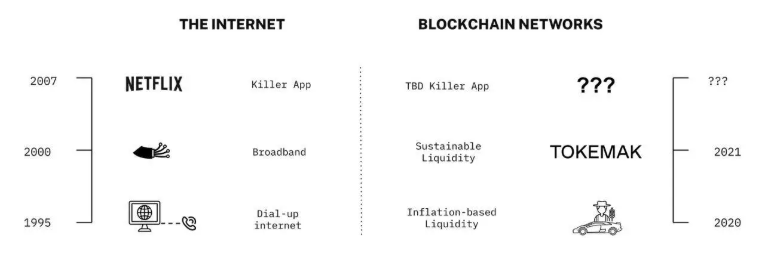
An interesting analogy is that what bandwidth was to the internet age, liquidity is to the blockchain era. Bandwidth measures how fast data moves across networks, while liquidity measures how easily you can exchange your assets for others. Abundant availability of both is foundational for DAO economies to thrive.
Gift Economies Within DAOs
Many anthropologists disagree with the commonly held belief that barter economies evolved before credit- or money-based systems—a view popularized largely by 18th-century economist and philosopher Adam Smith. In reality, many anthropologists believe early economies were based on generosity and reciprocal gift-giving (e.g., I give you something you need, and at some point, you reciprocate in kind).
This pattern appears in DAO interactions as well. As trust builds within a DAO, members develop confidence that their efforts advancing the DAO’s mission will eventually be rewarded.
However, there's concern in Web3 that every interaction could become transactional. DAOs must guard against making this part of their culture, as it undermines members’ intrinsic and social motivations. The best DAOs will operate gift economies internally, even if their interactions with other DAOs are more transactional.
Inexhaustible Treasuries and Infinite Time Horizons
Sustainable capital is valuable because some projects require long time horizons and perpetual funding. Endowments for Chinese temples and universities were built on this understanding—that funding should last indefinitely.
DAO treasuries should regularly fund long-term, open-source projects.This means funds need to persist as long as possible.
But as with anything, exceptions exist depending on project goals—whether for DAOs or traditional institutions. For example, the Gates Foundation plans to spend all its resources within twenty years of Bill and Melinda’s passing, so they can focus on today’s most urgent problems.
Socialists Meet Capitalists in DAOs
DAOs are fascinating because they contain elements of both socialist and capitalist ideologies.A hybrid model is emerging—one that combines libertarian ideals (everything can be financialized, money shouldn’t be controlled by any central entity) with left-wing views (labor should own more of the means of production, not just receive wages). This is why Web3 embraces diverse political perspectives—people are drawn for different reasons, and both sides can be right.
In many ways, DAOs offer a better model for coordination and ownership distribution than some existing structures. Successful DAOs will build thriving internal economies that advance their missions.
Join TechFlow official community to stay tuned
Telegram:https://t.me/TechFlowDaily
X (Twitter):https://x.com/TechFlowPost
X (Twitter) EN:https://x.com/BlockFlow_News