








Finding Potential Investment Opportunities: A Comprehensive Overview of the ZK Solution All-Star Projects
TechFlow Selected TechFlow Selected
Finding Potential Investment Opportunities: A Comprehensive Overview of the ZK Solution All-Star Projects
This article does not involve professional cryptographic knowledge, but rather provides a theoretical explanation of zero-knowledge proofs, helping readers roughly reconstruct the overall picture of zero-knowledge proof systems and understand their current development status.
 Navigating Web3 tides with focused insights
Author: LD CAPITAL
Privacy has always been considered one of the most valuable features in the cryptocurrency community, as most holders of crypto assets do not wish for their holdings and transaction history to be fully public. Among various privacy-preserving cryptographic technologies, zero-knowledge proof (Zero-Knowledge Proof) stands out as a particularly important one. This article does not delve into professional cryptography knowledge but instead offers a theoretical overview of zero-knowledge proofs, helping readers roughly reconstruct the full picture and current development status of zero-knowledge proof systems.
1 Zero-Knowledge Proof Technology Development
1.1 Concept of Zero-Knowledge Proof
Zero-knowledge proof (ZKP) is a key component of modern cryptography, referring to a method by which a prover can convince a verifier that a certain statement is true without revealing any useful information to the verifier.In essence, a zero-knowledge proof is a protocol involving two or more parties—a series of steps required for multiple parties to accomplish a task. The prover demonstrates to the verifier that they know or possess certain information, yet no details about this information are leaked during the process. In simple terms: proving what you want to prove while disclosing "zero" information to the verifier.
While zero-knowledge proofs involve complex cryptographic algorithms, we use a "find the panda" example below to provide a theoretical understanding:
A group of people are searching for a panda in this image. Alice finds it first, but she cannot immediately point it out, as doing so would ruin others' gaming experience.
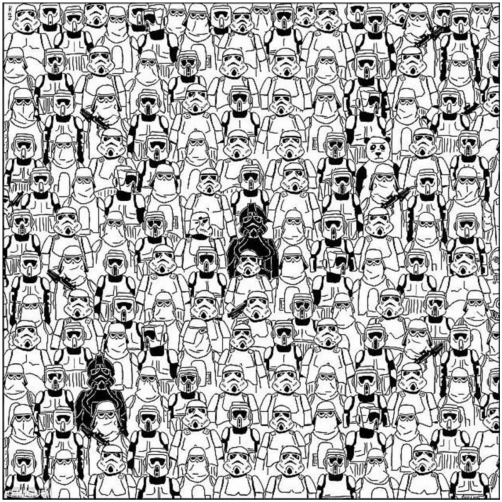
Is there a way for Alice to prove she knows where the panda is, without revealing the answer to anyone else?
Alice takes a very large sheet of white paper and randomly covers the image. Then, she cuts a small hole in the paper, just large enough to reveal the panda.

Thus, the panda's location—the critical piece of information—remains protected, yet Alice still proves she found it without revealing its position. This is zero-knowledge proof.
The verification method of zero-knowledge proof emphasizes completeness and soundness.Completeness means that a valid statement can be proven to the verifier; soundness means that the prover cannot convince the verifier of a false statement. However, soundness remains probabilistic—the chance of successful cheating is extremely low.
The credibility of zero-knowledge proofs depends on two factors: proof difficulty and interaction level.Proof difficulty increases via mathematical complexity; interaction level refers to repeated challenges from the verifier to the prover. As interactions increase, the statistical probability of successfully deceiving the verifier decreases significantly.
1.2 Evolution of Zero-Knowledge Proof Theory
The concept of zero-knowledge proofs was first proposed in 1985 by S. Goldwasser, S. Micali, and C. Rackoff, who introduced “interaction” and “randomness” to construct early interactive proof systems. An interactive proof requires the verifier to repeatedly challenge the prover’s claimed “knowledge.” By answering a series of questions, the prover convinces the verifier they indeed possess such “knowledge.” More questions mean more interactions, but this method doesn't guarantee both parties are honest—they could collude beforehand, allowing the prover to pass verification even without knowing the correct answer.
Over the following decades, legendary cryptographers made significant contributions. For instance, M. Blum, P. Feldman, and S. Micali showed that “interaction” and “hidden randomness” were not essential, leading to non-interactive zero-knowledge proof systems based on the Common Reference String (CRS) model. In non-interactive proofs, the prover doesn’t need to interact with the verifier. A set of public parameters is pre-established, and transactions are built and verified using these parameters. This allows independent proof generation, eliminating collusion risks between prover and verifier.
In 2010, Jens Groth proposed the controversial Knowledge of Exponent Assumption, embedding secret random values into the CRS to reduce proof size to constant levels. This process creates a secret known only to the system. Anyone aware of how the public parameters were generated could forge proofs—a process called trusted setup. While drastically reducing proof length, this approach introduced security risks. Nevertheless, it laid the foundation for the most influential branch of zero-knowledge proof technology over the next decade.
As zero-knowledge proof theory evolved, cryptographers began focusing on engineering applications. In 2013, Rosario Gennaro, Craig Gentry, and others improved upon Jens Groth’s 2010 work, significantly shortening proof times and reducing proof sizes further. Subsequently, Parno et al. implemented the Pinocchio verifiable computation protocol, later optimizing it.
In 2014, the privacy-focused cryptocurrency ZeroCash emerged. Eli Ben-Sasson, Alessandro Chiesa, and others slightly improved the Pinocchio protocol, marking the first successful implementation of zero-knowledge proofs in blockchain. ZeroCash was the predecessor of Zcash, whose team also made major contributions to engineering zero-knowledge proofs.
1.3 Current State of Zero-Knowledge Proof Development
The integration of zero-knowledge proofs with Zcash highlighted their immense potential in blockchain and marked a crucial shift from theory to application.
Currently, several zero-knowledge proof schemes exist, each representing different implementations with varying outcomes, particularly in security, proof size, computational speed, and verification speed.
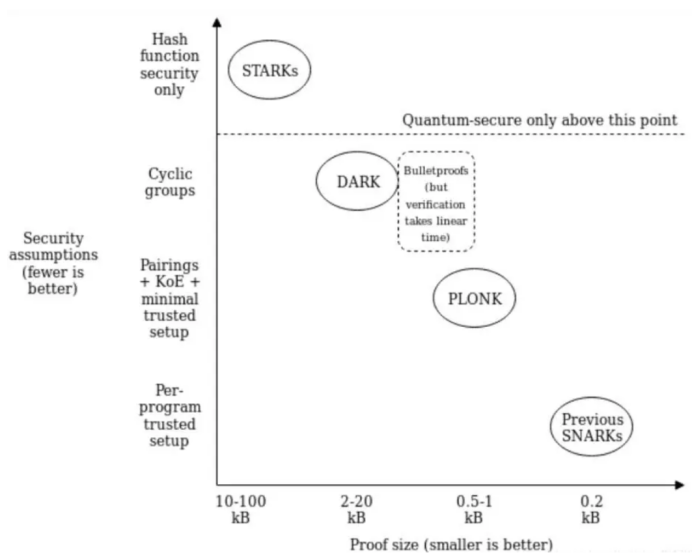
The horizontal axis represents proof size, and the vertical axis represents security assumptions. STARK algorithms offer the highest security, relying on no mathematical hardness assumptions and being quantum-resistant; Groth16 under the SNARK framework yields the smallest proof size; PLONK, another SNARK variant, offers moderate security and proof size. Currently, zk-STARK and zk-SNARK are the most widely adopted.
1.3.1 zk-SNARK
SNARK (Succinct Non-Interactive Argument of Knowledge) is an acronym for succinct non-interactive arguments of knowledge.This scheme is succinct—verification involves minimal data transfer and simple algorithms, meaning verification time doesn’t scale with computational load. Additionally, the single-message nature of non-interactive proofs makes the entire verification process highly efficient.Groth16 is currently the fastest zk-SNARK with the smallest data footprint, first widely implemented in Zcash. Building on the Pinocchio protocol, Groth16 slightly strengthens security assumptions to compress proof size by nearly half.
However, Groth16’s main controversy lies in its trusted setup: the hidden random values in the CRS are typically determined by a small group, raising trust concerns. Theoretically, a prover with sufficient computing power could submit fake proofs, compromising system security—this is why quantum computers are seen as a threat. Thus, overcoming the trusted setup issue remains a core focus for other zero-knowledge proof technologies. PLONK improves upon this, and we’ll detail differences between these algorithms later.
To address this, Stanford cryptographer Benedikt Bünz et al. proposed Bulletproofs—unlike earlier zk-SNARKs, they require no trusted setup. However, their computation and verification times are longer than STARKs, though proof sizes are much smaller. Bulletproofs were quickly adopted by Monero.
1.3.2 zk-STARK
STARK (Scalable Transparent Argument of Knowledge) was created as an alternative to SNARKs.Unlike SNARK’s “S” for Succinct, STARK’s “S” stands for Scalable—meaning proof generation complexity is approximately linear with computation, while verification complexity is far lower. Thus, as scalability increases, proof complexity does not grow proportionally.
More importantly, STARK requires no trusted setup, relying instead on hash function collisions and symmetric encryption. This is the origin of STARK’s “Transparent” label.
A third improvement of STARK over SNARK is quantum resistance, making it immune to quantum attacks. Of course, these benefits come at a cost: compared to SNARKs, STARKs are more complex, with proof sizes growing from 288 bytes to hundreds of KB, and higher Ethereum verification fees.

1.3.3 Zero-Knowledge Proof Schemes with Trusted Setup
Although requiring public parameter generation, trusted-setup zero-knowledge proof systems have proven advantageous in computational cost and proof size, making them preferred tools for many privacy-focused blockchain applications. Their security largely depends on the secure generation of public parameters. Centralized generation is possible but incompatible with decentralization goals. To date, the preferred technique is multi-party computation (MPC).
MPC ensures no single party gains knowledge of the underlying mathematical structure of the parameters. It achieves this by distributing the generation process among as many independent participants as possible—only a minority (or even one honest participant) is needed to ensure security. Clearly, more participants enhance parameter security.
zk-SNARK is a trusted-setup zero-knowledge proof scheme, but has evolved into different algorithms. Groth16 and PLONK are the most widely used today. Their key differences are:
Groth16 offers the fastest verification and smallest data size, but its secret computation is tied to specific problems, requiring a new round of MPC-based trusted setup for each new problem. Since multi-party protocols are cumbersome, this severely impacts Groth16’s performance.
PLONK improves upon Sonic, reducing proof time fivefold. Sonic is an updatable global CRS scheme.“Updatable” means trusted setup can be refreshed if secrets are suspected compromised. “Global” means computations aren’t bound to CRS—one setup enables different zero-knowledge circuits across applications. Thus, trusted setup occurs once, needing only updates, not repeated per-problem MPC. The diagram below compares Groth16 and PLONK:
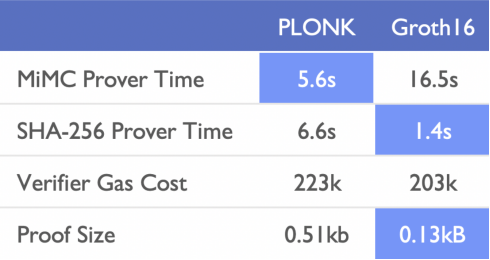
PLONK was developed jointly by Gabizon from Protocol Labs and two researchers from Aztec Protocol. Introduced after Groth16, PLONK lags slightly in proof size and verification speed, but its updatable trusted setup gives it a solid place in the zero-knowledge proof landscape.
2 Applications of Zero-Knowledge Proof Technology
Two key features of zero-knowledge proofs enable their application in blockchain:
1)Zero-knowledge proofs protect data privacy by enabling verification without leaking information;
2)They generate very small proofs to verify large datasets, greatly aiding data compression and performance enhancement.
Therefore, zero-knowledge proofs serve two primary purposes:
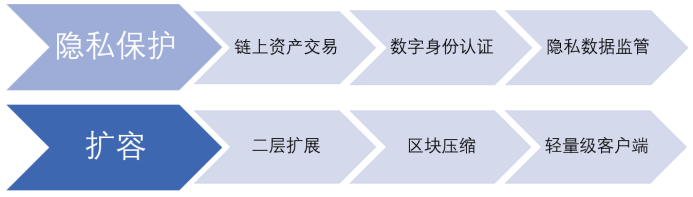
2.1 Privacy Protection
Privacy protection remains a crucial concept in blockchain, representing the ability to safeguard transactions and participants within distributed networks. Although blockchain promotes anonymity, most transactions merely offer pseudonymity—users avoid real names but can still be identified through repeated use of public key hashes as transaction identifiers. By default, all user transactions are public. Once an address is linked to a user, their fund sources, balances, and on-chain activities can be traced.
Zero-knowledge proof technology enables transaction validity confirmation through proofs that reveal no information, achieving complete transaction anonymity.During the rise of crypto privacy, many developers explored privacy-centric public chains. The privacy protection and data compression capabilities of zero-knowledge proofs made them key components. Projects like Zcash and Monero gained prominence during this period.
Take Zcash as an example: it initially used the Pinocchio protocol and switched to Groth16 in 2019. Zcash wallet addresses come in two types: transparent and shielded. Transactions between transparent addresses resemble Bitcoin—sender, receiver, and amount are publicly visible. Shielded address transactions appear on the public blockchain too, but addresses, amounts, and notes are encrypted, with zk-SNARK proofs validating their compliance with network consensus rules. Transactions between shielded and transparent addresses are also supported. Zcash maintains compatibility with auditing and regulation—senders and receivers of shielded transactions can voluntarily disclose details to third parties for compliance, audit, or verification purposes.
2.2 Scaling
The “impossible trinity” remains a persistent challenge for L1 blockchains like Ethereum, which constantly balance decentralization, security, and scalability.Ethereum prioritizes decentralization and security, inevitably facing scalability limitations. High gas fees and long confirmation times significantly impact user experience. Hence, its core team and community continue exploring scaling solutions.
Two approaches exist for blockchain scaling:
1)Scale the L1 blockchain itself—methods include increasing block size or sharding, where nodes are divided into relatively independent shards. Each shard handles a smaller workload or stores partial network state, enabling parallel transaction processing and theoretically boosting overall throughput. However, this often sacrifices decentralization;
2)Move L1 transactions to L2, where transactions are batched and settled on L1. This way, a batch pays one gas fee instead of each transaction paying separately, effectively lowering per-transaction costs. Thus, L1 becomes a settlement layer for all executions on L2. L2 scaling solves scalability issues without sacrificing decentralization or security.
L2 scaling has evolved from state channels to Plasma and then Rollups. Currently, Rollup is the most mainstream and promising L2 solution.Rollup performs complex computation and state maintenance off-chain, then saves state-change-related data on-chain via cheaper CALLDATA, bundling many transactions into one. This increases TPS while ensuring data availability.
All Rollup schemes emphasize on-chain data availability—anyone must be able to reconstruct the full state from on-chain data, mitigating security risks from data unavailability. Zero-knowledge proofs play a key role here—compressing on-chain computation while ensuring correctness.
ZK Rollup emerged in late 2018. Its key feature is ZK: every state transition requires a zero-knowledge proof, validated by a smart contract on the main chain before state changes occur. That is, ZK Rollup state transitions strictly depend on cryptographic proofs. (Note: For detailed explanation of ZK Rollup principles, see Li Hua’s “Understanding Layer and Cross-Chain Methods.”)
Other Rollup schemes exist, such as Optimistic Rollup, developed in late 2019. It assumes state transitions are correct by default and allows challenges within a time window. If challenged successfully, the submission is penalized and rolled back. Thus, Optimistic Rollup relies on economic incentives and game theory.
ZK Rollup’s main challenge is programmability, though zkSync’s virtual machine design aims to solve this. Optimistic Rollup’s biggest concern is withdrawal delays due to challenge periods when moving funds from L2 to L1, though intermediaries can offer bridging services. Therefore, Optimistic Rollup has seen faster adoption.
Performance comparison between the two is shown below:
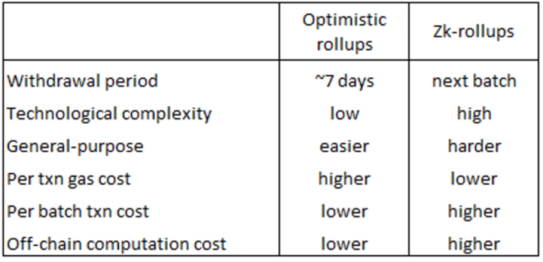
Compared to Optimistic Rollup, ZK Rollup is technically more complex, requires heavy computation, incurs longer transaction latency, and higher operational costs. However, per-transaction fees are lower, and verification is far cheaper than computation—this succinctness enables scalability.
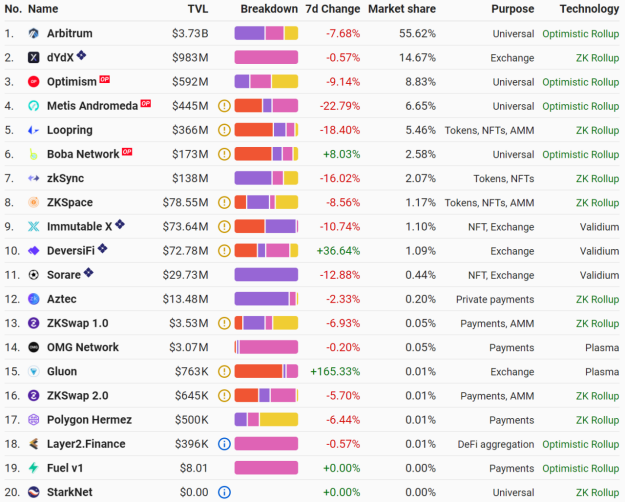
According to recent data from L2beat.com, total value locked (TVL) in L2 solutions is around $6.7 billion. Optimistic Rollup, pioneered by Arbitrum and Optimism, dominates half the market. Zero-knowledge proof solutions hold only about $1.7 billion, primarily due to greater technical difficulty and immature ecosystem development.
3 Star Projects in Zero-Knowledge Proof Ecosystem
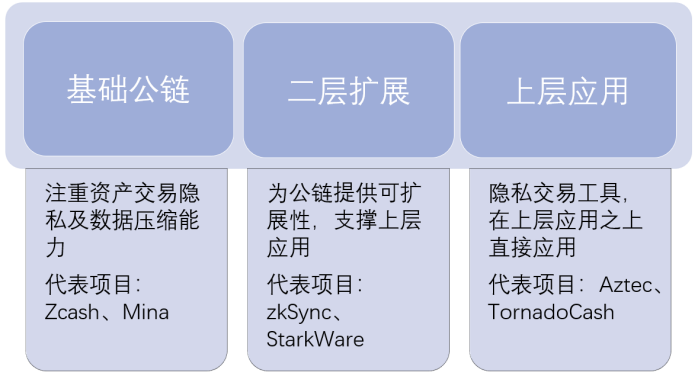
Early zero-knowledge proof projects like Zcash and Monero excelled in privacy protection but served mainly as store-of-value assets, unable to support broader applications. With ongoing developer efforts, integrating zero-knowledge proofs with smart contracts is unlocking greater potential. Current applications fall into three broad categories. This section introduces some highly promising zero-knowledge proof projects, most of which haven’t issued tokens yet.
3.1 Mina
Founded in 2017 as Coda Protocol, Mina is developed by O(1) Labs, a team composed of world-class cryptographers, engineers, PhDs, and entrepreneurs.
Mina focuses on building a lightweight blockchain. Unlike Ethereum or Bitcoin, which require hundreds of GB of storage, Mina maintains a constant block size of 22 KB, enabling widespread node participation.Low-barrier node deployment promotes wider user access and enhances network decentralization and security.
Mina achieves constant block size using recursive zero-knowledge proofs—each new block uses zk-SNARK to compress into a single proof, with each new SNARK proof including previous ones. Nodes only need to verify this proof, not the entire transaction history.
But this is only the first step. Blockchains require each block to reference the prior one. Simply generating SNARK proofs per block would still lead to linear growth. Thus, Mina applies recursion—creating SNARKs of SNARKs—and iteratively nests them into a recursive structure, maintaining a ~22 KB constant block size.
Additionally, Mina builds a privacy-preserving ecosystem around zero-knowledge proofs. Its dApps, called Snapps (now zkApps), enable specific business logic for targeted scenarios and can interoperate with other public chains via bridges, fostering mutual benefits across the blockchain ecosystem. Mina is currently the only project developing in this lightweight-node space.
Funding Background:
In March 2022, Mina announced a $92 million strategic funding round led by FTX Ventures and Three Arrows Capital, aimed at accelerating Mina’s adoption as a leading Web3 zero-knowledge proof platform by attracting top-tier developers.
Previously, Mina raised four rounds totaling ~$48.15 million from top-tier institutions including Coinbase Ventures, Polychain Capital, Three Arrows Capital, Paradigm, and Multicoin. These high-profile investors typically focus on long-term value and bring strong brand visibility, benefiting Mina’s future market expansion.
3.2 ZkSync
zkSync is developed by Matter Labs, founded in December 2019 with a focus on Ethereum scaling. zkSync 1.0 is a ZK Rollup (zero-knowledge proof) L2 scaling solution for Ethereum, focused on payments, launched on the Ethereum mainnet in June 2020. Initially using the Groth16 SNARK algorithm, zkSync required a trusted setup not only at genesis but also for every new application upgrade. This hindered creating an EVM-compatible environment, limiting zkSync 1.0 to specific applications like payments.
zkSync 2.0 is an EVM-compatible L2 solution built atop Ethereum, also known as zkEVM. It recompiles EVM code and uses zero-knowledge proofs to validate rollup transactions, allowing developers to build and deploy decentralized apps in a low-gas, highly scalable L2 environment using Ethereum’s native programming languages.
In May 2021, zkSync released an Alpha version of zkEVM, initially expecting mainnet launch in August 2021, but delayed due to technical complexity. In February 2022, the zkSync 2.0 public testnet launched. zkEVM is now live—the first EVM-compatible ZK Rollup on Ethereum testnets.
Funding Background:
In March 2021, Matter Labs secured a $6 million Series A round led by Union Square Ventures, with notable investors including Placeholder and Dragonfly. This round notably brought in numerous ecosystem partners, including some of the most prominent companies and founders in crypto.
In November 2021, Matter Labs completed a $50 million Series B round led by a16z, with strategic investors including centralized exchanges (Blockchain.com, Crypto.com, ByBit, OKEx). Shortly after the announcement, these exchanges declared partnerships supporting deposits and withdrawals between exchanges and zkSync L2.
3.3 StarkWare
StarkWare was founded in May 2018 by a team of world-class cryptographers and scientists, including the former chief scientist of Zcash. They pioneered innovations in zero-knowledge proofs, introducing zk-STARK in a 2018 academic paper. The authors later founded StarkWare.
Like zkSync, StarkWare offers zero-knowledge proof scaling solutions—but based on STARK.STARK’s challenge lies in immaturity compared to SNARK and difficulty achieving EVM compatibility if made Turing-complete. StarkWare created a specialized programming language, Cairo, to run autonomous programs powered by STARK. The team is now collaborating with Nethermind to develop Warp, a transpiler converting Solidity smart contracts seamlessly into Cairo for EVM compatibility.
StarkWare launched StarEx, enabling application-specific ZK Rollups powered by Cairo and STARK.dydx, Immutable, and DeversiFi are three major applications built on StarkEx. To date, StarkEx has processed over 5 million transactions worth more than $250 billion.
On November 29, 2021, they launched the mainnet Alpha of StarkNet. StarkNet is a ZK Rollup-based L2 application network aiming to cultivate its own ecosystem.
Funding Background:
StarkWare has completed four funding rounds totaling over $160 million, backed by top institutions like Paradigm, Polychain, Sequoia Capital, and IOSG. Angel investors include Ethereum founder Vitalik Buterin, making it highly favored in the crypto community.
3.4 Aztec
Founded in 2018, Aztec’s team consists mostly of PhDs from top universities, including former Zcash researchers, giving them strong technical expertise. Their self-developed PLONK algorithm has been adopted by multiple industry projects.
Aztec uses ZK Rollup technology to address Ethereum’s scalability issues. From inception to Aztec 2.0 launch, the team deeply researched PLONK, releasing improvements like PLONKUP. Even Vitalik Buterin praised their R&D capabilities.
The Aztec network serves two primary functions: protecting user privacy during interactions, and enabling programmable privacy contracts for fully private applications.
After launching Aztec 2.0, they introduced zk.money, a private transfer app where sending and receiving tokens is anonymous. Transactions are encrypted via recursive zero-knowledge proofs, with no transaction data publicly disclosed. Currently, it only supports deposits and transfers. Aztec Connect, the first privacy-focused cross-chain bridge, is now live on testnet.
Aztec’s development has progressed through three stages:
Stage 1: Aztec 1.0—an Ethereum-based privacy transaction tool;
Stage 2: Aztec 2.0—a privacy-focused L2 for Ethereum using zk-Rollup, bringing scalable privacy;
Stage 3 (future): Aztec 3.0—enabling private smart contracts on Ethereum L2 via Noir, a privacy-focused programming language.
However, most zk-Rollup L2 projects face EVM compatibility challenges. Aztec currently lacks EVM compatibility, increasing difficulty and cost for developers building privacy smart contracts. The team has acknowledged ongoing research to improve this.
Funding Background:
In November 2018, Aztec raised $2.1 million in a seed round led by ConsenSys Labs. In December 2021, Aztec closed a $17 million Series A round led by Paradigm, with participation from IOSG and angel investor Stani Kulechov, founder of lending leader Aave. Funds will support continued ZK system development and refinement of Aztec Connect, which reportedly reduces gas costs by up to 100x during private transactions.
3.5 Aleo
Launched in 2019, Aleo’s team includes world-class cryptographers, engineers, designers, and operators from companies like Google, Amazon, and Facebook, as well as research universities including UC Berkeley, Johns Hopkins, NYU, and Cornell.
Aleo uses its structured zkCloud architecture to hide identities and transactions. Hidden identities can interact directly (e.g., asset transfers) or programmatically (via smart contracts).In typical public blockchains, program execution occurs on-chain within a global “virtual machine” (VM) run by every node. Every node must recompute and collectively agree on each step of a given program—inefficient, slow, and costly. zkCloud overcomes this by separating application runtime from blockchain state (on-chain + off-chain), combining recursive zero-knowledge proofs to achieve full programmability, privacy, and higher throughput.
To improve developer experience, Aleo created Leo—a Rust-inspired, statically-typed programming language designed specifically for writing private applications. Beyond developer-friendliness, they’ve launched developer incentive programs and testnet rewards to boost early ecosystem growth.
Funding Background:
In April 2021, Aleo completed a $28 million Series A round led by a16z, with participation from Placeholder, Galaxy Digital, Variant Capital, and Coinbase Ventures.
In February 2022, Aleo announced a $200 million Series B round—the largest single investment in the zero-knowledge proof sector—led by Kora Management LP and SoftBank Vision Fund 2, with Tiger Global and Sea Capital participating.
Summary
Zero-knowledge proof technology already occupies a vital position in blockchain, yet remains immature. Various schemes still face shortcomings in quantum resistance, performance optimization, and EVM compatibility. However, zero-knowledge proof solutions are rapidly advancing, with projects like zkSync and StarkNet opening new possibilities for blockchain evolution.
References
1. "Zero-Knowledge Proof Technology Development Report," Tuoluo Research Institute, SECBIT Lab
2. "What Are Zero-Knowledge Proofs? | ZK科普系列(一)", ZK Enthusiast
3. "[Public Due Diligence] Deep Dive Report: Mina," Topfund
4. "Layer2 Development and the Rise of zk-Rollup | ZK科普系列(二)", ZK Enthusiast
5. "Understanding Layer and Cross-Chain Methods," Li Hua
6. "[Cryptography Column] Advanced Level: PLONK VS Groth16 (Part 1)", Quchain Technologies
Join TechFlow official community to stay tuned
Telegram:https://t.me/TechFlowDaily
X (Twitter):https://x.com/TechFlowPost
X (Twitter) EN:https://x.com/BlockFlow_News






