








Leaving the Tech Giants, All in WEB3
TechFlow Selected TechFlow Selected
Leaving the Tech Giants, All in WEB3
Saying Goodbye to 996: Big Tech Employees Embrace Entrepreneurship and the Web3 Story
 Navigating Web3 tides with focused insights
Text & Interview: 0x5willows
In early March, Chinese internet stocks plummeted unprecedentedly. Even well-funded tech giants couldn't stay calm, with frequent layoffs sweeping across Web2 behemoths. Of course, as large corporations, they had to maintain decorum—countless once-envied employees were now "graduated" or “redistributed talent to society.”
Once upon a time, landing a job at an internet giant was the ultimate dream for white-collar workers. Now, that golden era has passed. Faced with an increasingly harsh external environment, these giants are no longer growing rapidly—the industry's ceiling is becoming clearly visible.
Employees who rode the wave of Web2 and reached the top of the internet world are now seeking new paths. Many have turned their eyes toward a completely new frontier: Web3.
So we spoke with several friends who transitioned from major Web2 companies into the Web3 world, sharing their experiences and insights. Some have already gone all in—like Zolo, Li Ge, and Jose—who luckily discovered new opportunities in Web3 and left behind the 996 grind of big tech to become entrepreneurs. Others are still balancing both worlds, waiting for the right moment to fully commit to Web3.
Throughout our conversations, one word came up more than any other: “fulfillment.” Despite different personal journeys, every interviewee expressed optimism about Web3’s future and joy in contributing to its development. Here are their stories.
Li Ge — Former Big Tech PM, Now Web3 Tech Team Lead
My journey has been quite diverse. Before joining a big tech firm, I’d already tried entrepreneurship. Back in 2011, I worked on a short video platform but didn’t stick with it—so I missed the chance to build something like TikTok. Then in 2015, I joined a major tech company, focusing on technical roles.
I got into crypto-related topics relatively early—I bought cryptocurrency back in 2013—but just like my first startup, I didn’t hold on. My real dive into this space began with my current entrepreneurial venture.
You could say I’m someone who wanted to start a business for the sake of starting one—but not blindly. In today’s big Web2 companies, technology is no longer the core driver; most are led by operations and resources. I wanted to launch a tech-driven project without taking outside investment.
Given that, the scope wasn’t too broad—crypto-related projects fit perfectly.
In June 2020, a client approached me asking to help develop an IPFS project. After analysis, I realized it was feasible—and that’s when I decided to quit my job.
Another reason was burnout from my previous role. At big tech firms, you spend enormous amounts of time on communication and coordination—adding massive unnecessary overhead. When I worked there, I had meetings nonstop from morning till night, sometimes attending two simultaneously. Many colleagues would spend the entire day in meetings and only start coding after 6 p.m.
Compared to my days at the big company, my current workload might not be much lighter, but it feels far freer and more relaxed because my time isn’t scheduled for me—I actively manage it myself. I think this is one of the appealing aspects of Web3—remote work opportunities abound, teams are small, and inefficiencies are minimized.
Still, the past decade of growth at big internet companies has outpaced most smaller firms—it succeeded for good reasons. The most valuable lesson I learned at a big tech firm was how to view problems from a higher-level perspective. During my first startup, once user numbers hit tens of thousands or even hundreds of thousands, I didn’t know what to do next—I was essentially winging it. Working at a big tech company gave me exposure to managing projects with tens of millions of users—knowledge you simply can’t gain elsewhere.
Looking ahead, Web2 may eventually merge with Web3, just like PC internet merged with mobile internet before it. I don’t believe adoption will face significant barriers. Remember, when smartphones first appeared, people had to jailbreak them just to install apps—seeming extremely complex. Today, we download apps with one tap from an app store.
Many people’s lack of understanding—or even bias—toward Web3 today is simply because the field is still in its infancy. Widespread adoption will take time.
Zolo — Former Big Tech Marketer, Founder of YouTube Channel DiamondHands
Like most people, I entered the crypto world through Bitcoin—buying some BTC back in 2016. After that, I kept a loose eye on the industry, though not deeply, since my main focus remained my corporate job.
By late 2020—around autumn—I sensed many new, practical innovations emerging in the space. That period marked a turning point; I started investing more energy into researching and engaging with the ecosystem.
Starting DiamondHands felt like going with the flow. My background was in marketing and strategy, so alongside holding crypto, I began writing market analyses. Over time, those writings deepened, transitioning from side hustle to full-time work, culminating in launching DiamondHands in June last year. I didn’t go into it with 100% confidence—just a strong sense that opportunity existed.
Back then, talking to friends about this often revealed they didn’t understand what I was doing—or grasp the nature of the industry itself. Even now, when I share our articles or videos with friends, many still struggle to comprehend or see the value. At big tech firms, it’s hard to find common ground—you end up operating largely within your own niche community.
The space remains somewhat insular today. It needs breakthrough projects like NFTs to reach broader audiences. That’s exactly what we aim to do—not just analyze projects, but also explain underlying technologies and intrinsic values. This defines our positioning, though we still have plenty of room to grow.
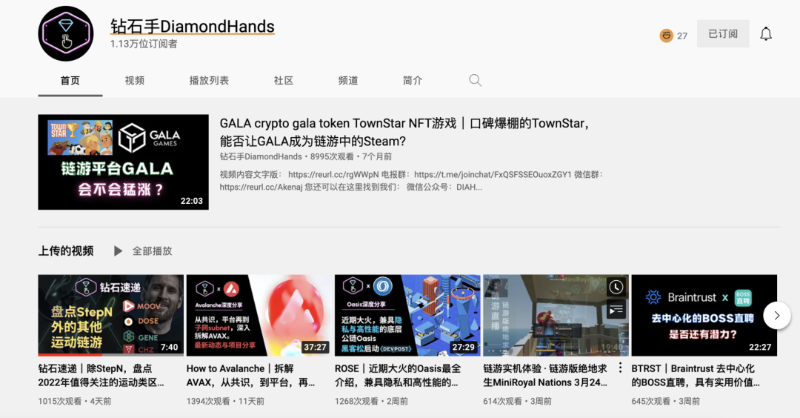
First, content. Our content tends to be relatively in-depth. While many projects remain surface-level, we believe some deserve attention—even if current markets and audiences aren’t mature enough yet. We use compelling narratives to signal which projects merit closer watch.
Second, community. Our actual community turned out larger than expected. Our original vision—a loosely managed space where members casually chat and exchange ideas—no longer suffices. A truly valuable community should offer meaningful content and better operational frameworks.
Third, product. Recently, we’ve been rethinking what DiamondHands should ultimately become—how far we can push value creation. I believe Web3 today resembles early internet days—full of unmet needs. We’ve identified a promising vertical and are currently incubating a product to amplify our impact. So, we welcome fellow Web2 professionals to join us in building products for the Web3 era.
Xiao Y — Big Tech Researcher, Web2-Web3 Middleware
After completing my PhD, I joined my current company as an industry researcher. I wouldn’t classify myself as a typical Web2-to-Web3 migrant. My research focus leans toward Web3, and I’ve led multiple blockchain-related studies within the company—so I often describe myself as a “middleware” between Web2 and Web3.
I entered this space in 2016, during the rise of blockchain and smart contracts. I was drawn to the underlying technology and stayed engaged ever since. The mainstream breakout of the Web3 narrative happened later, in 2021. Initially, crypto was confined to on-chain finance. Only when applications expanded into non-financial domains—via NFTs, GameFi, and Metaverse—did Web3 begin taking shape, reaching more consumer users.
What drives me toward Web3? Primarily, belief—though that may sound abstract. I genuinely believe Web3 aligns with future trends, enabling true ownership of assets and identities, decoupling value layers from the internet—something Web2 fundamentally cannot achieve. Moreover, Web2 has plateaued, becoming a zero-sum game where big tech firms compete solely for user attention.
Our company culture is fairly open and inclusive, partly due to my role. I regularly share Web3 insights and industry updates on social media. Of course, I never neglect my primary responsibilities. Other colleagues may hesitate to reveal their interest in Web3 for fear of professional repercussions.
Despite solid compensation at big tech firms, their massive scale inevitably brings challenges. On one hand, innovative startups evolve into bureaucratic giants, losing agility and creativity. On the other, external pressures intensify—especially regulatory scrutiny facing Web2 giants.
Web3 will transform both business and organizational models, potentially solving issues inherent in Web2’s evolution.
In terms of work experience, even the most humane Web2 giant demands accountability to the corporation, whereas Web3 is protocol-governed—you demonstrate value through proof-of-work. In Web2, you might get stock options; in Web3, builders, users, and investors alike enjoy diverse incentive mechanisms, offering far greater fulfillment.
Also, post-pandemic, I’ve grown accustomed to remote work—which is naturally easier to implement in Web3.
I believe the pandemic’s global impact runs deeper than we realize—it may take years to fully grasp. The biggest shift? The real world has become harsher: slower economic growth, rising disorder (e.g., Russia-Ukraine conflict). Yet people who share common values still need connection—and Web3 provides precisely that bridge.
I firmly believe a new global order will emerge from Web3.
Jose — Former Big Tech Consortium Chain Developer, Now Fully Committed to Web3
I started exploring this space in college—before Web3 was even a term. Back then, I tinkered with mining rigs and cryptocurrencies. After graduation, I joined a big tech firm working on blockchain development—specifically consortium chains.
At the end of last year, I co-founded a startup with friends. Currently, we’re building a DAO—to serve both as a learning hub and a builder community. Our overarching vision is to provide foundational infrastructure for the coming Web3 era.
Our team culture is quite open, perhaps because everyone comes from a technical background. Even while employed, my peers and I frequently discussed blockchain and crypto topics.
We maintain close ties with the Ethereum Foundation. While still at the company, we invited Vitalik Buterin to give a talk, which inspired some colleagues—but most found it too novel to embrace immediately.
Leaving my job felt inevitable—almost natural. I enjoyed my prior role, but it lacked meaning. What I do now feels pioneering, groundbreaking—that’s what excites me.
In terms of workload, it might even exceed my big tech days. Our team spans the globe, and key events are often U.S.-centric, so I routinely wake up at midnight for meetings. But doing something I truly love doesn’t feel exhausting—it feels exhilarating.
Some people, especially older family members, struggle to understand. They see big tech jobs as secure, high-paying, and stable—while Web3 remains a mystery. Their skepticism was expected, and I was mentally prepared.
First, you must prove to your family that entering this new field won’t drastically reduce your quality of life—that’s the most tangible reassurance. Second, patiently educate them about Web3; over time, they’ll come to accept it.
Whether staying in Web2 or moving to Web3—it boils down to personal choice. There’s no universally best path, only what suits you best. I’m someone driven to build things, so I jumped. One final note: Web3 offers immense opportunities, but high rewards come with high risks. Before going all in, honestly ask yourself whether you can bear the risk. Only then consider making the leap.
Lastly, while earning money is great, never lose sight of why you entered this space in the first place.
H Jun — Big Tech Operator, Web2 OG, Leader of a 1,000-Member DAO
I work in operations—pretty much a Web2 veteran. I entered the Web3 space only about half a year ago.
Actually, Web3 isn’t a new concept—the original idea referred to the Semantic Web. What people mean today is Gavin Wood’s version, which gained traction last year. I led a company NFT project last year, during which I systematically studied Web3 concepts and underlying technologies—then decided to dive in and contribute.
Even though I participated in major projects at big tech firms, I always felt like just a cog. After years inside, it starts feeling like a state-owned enterprise—linear career progression, predictable trajectory, everything foreseeable. In contrast, Web3 is still at the stage of building from zero to one. The pie is vast, and the potential for contribution is enormous—that’s what draws me in.
When I first took charge of the company’s NFT project last year, it was tough—the knowledge barrier was real, requiring lots of new learning. At the time, our regular projects were also intense. I’d often leave the office around midnight, then study Web3 topics and handle DAO tasks until 3 or 4 a.m., sleep five or six hours, and head back to work. This went on for months.
Physically, it was demanding—but manageable. I could endure. To me, participating in Web3 feels like entrepreneurship—immensely fulfilling throughout the process.
Another thing: people in the Web3 space tend to be very kind and generous with knowledge-sharing. I received tremendous support during my onboarding. The fact that I now run a 1,000+ member DAO isn’t due to my brilliance—it reflects widespread anxiety among big tech employees. With clear ceilings apparent, some naturally look toward Web3 for exploration. Even if the proportion is small, the absolute number is significant.
I’m cautiously optimistic about Web3’s prospects. For something to succeed, it must be profitable. Web3 will likely replace Web2 in areas where it holds clear advantages, but Web2 will retain its use cases—just as Web1 products still exist online today. They’ll coexist, competing yet occupying distinct niches.
In recent years, countless “get-rich-quick” myths—real or fake—have flooded the space. Many enter cluelessly. The recent viral debate over whether to drop everything and go all in on Web3 is a perfect example.
I may eventually go full-time into Web3. I’m not a technological utopian, but I believe this is the inevitable trend.
Join TechFlow official community to stay tuned
Telegram:https://t.me/TechFlowDaily
X (Twitter):https://x.com/TechFlowPost
X (Twitter) EN:https://x.com/BlockFlow_News






