
What is CULT.DAO, the project fueling community FOMO?
TechFlow Selected TechFlow Selected
What is CULT.DAO, the project fueling community FOMO?
CULT.DAO: Seeks to rapidly accelerate the collapse of the global economic order and funds revolutionaries pursuing the same goal.
 Navigating Web3 tides with focused insights
As understanding of DAOs deepens and driven by events like the OpenDAO airdrop, similar airdrops and new DAO launches have become commonplace.
The downside of this normalization is evident: enthusiasm for such meme DAOs has significantly waned compared to earlier days. The token of OpenDAO, $SOS, has performed poorly—peaking at launch and failing to regain market attention after its initial drop.
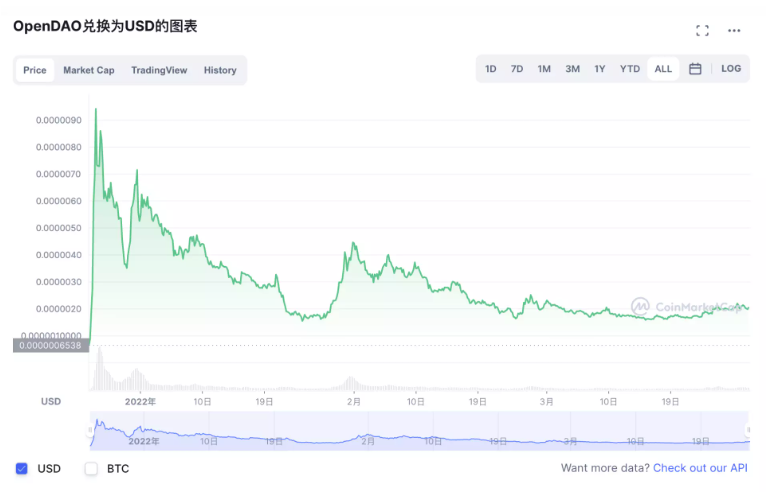
In an otherwise mediocre market, speculative capital gravitates toward trending opportunities rather than what traditional investors call "value investing." Some even joke that people only analyze fundamentals when they're trapped in a position—forced into "value investing." Just as interest in meme DAOs was fading, CULT.DAO emerged, delivering astonishing token performance and reigniting widespread FOMO across the market. When I spoke with others about CULT.DAO, many excitedly shared how much ETH they had invested.
So, what exactly is CULT.DAO?
CULT.DAO: A Decentralized Venture Capital Fund
In its own words, "CULT.DAO seeks to rapidly accelerate the collapse of the global economic order and fund revolutionaries who pursue the same goal."
CULT.DAO primarily consists of two groups—Guardians and voters. Members who stake $CULT receive an equivalent amount of $dCULT, which represents voting power. The top 50 $CULT stakers become Guardians, gaining the right to submit proposals. All other stakers are considered voters.
All Guardian proposals must relate to investments in other decentralized protocols. Each proposal includes details such as the target protocol’s total token supply, the allocation CULT.DAO can acquire, audit reports, burn and distribution plans, and tokenomics.
The treasury funding these investments comes from a 0.4% transaction fee on $CULT trades. For every 15.5 ETH worth of $CULT collected, 2.5 ETH worth is burned, while 13 ETH worth is allocated to invest in the target protocol.
CULT.DAO encourages proposals to fight centralization, advance decentralization, and benefit from this noble cause (according to the official whitepaper).
After a proposal is submitted, DAO members (voters) can cast their votes.
In simple terms, Guardians select projects, and all token-staking members vote.
Once approved, CULT.DAO uses $CULT worth 13 ETH at current market prices to purchase tokens from the target protocol in its current funding round. These tokens are released according to the project’s schedule, then swapped back into $CULT at prevailing market prices. 50% of the profits are distributed to $CULT stakers, while the other 50% of the $CULT received is sent to a black hole address (permanently burned).
Essentially, CULT.DAO aims to function as a decentralized Web3 VC fund. $CULT stakers act as VC shareholders, while the top 50 Guardians serve as project managers, responsible for selecting investments and submitting proposals.
The Narrative Behind CULT.DAO
The widespread appeal of CULT.DAO largely stems from its compelling narrative.
CULT.DAO emphasizes decentralization—decentralization, and nothing but decentralization. According to its official description, its mission is to deepen the implementation of decentralization.
This vision resonates deeply with crypto enthusiasts.
The idea of “investing” itself is inherently exciting—especially for retail investors who normally lack access to early-stage protocol investments. CULT.DAO elevates their status, turning them into actual investors in potentially world-changing protocols.
Staking rewards are entirely funded by investment returns. The treasury is built from token transaction fees—collected from the community, reinvested for the community.
These elements together form the narrative value of CULT.DAO.
Clearly, it's an intriguing protocol. Yet, for many, $CULT remains just another "shitcoin," a meme token akin to SHIBA. People trade it speculatively, chasing trends and hearing stories of massive gains, fueling intense FOMO. I’m no exception.
While writing this article, $CULT was undergoing a sharp decline, nearly halving in market cap. So, this is not investment advice—merely my fundamental analysis of this decentralized protocol. In plain terms: I got rekt.
Update: By the time this article was published on TechFlow, I had turned a profit. Still not financial advice—just information sharing.
Join TechFlow official community to stay tuned
Telegram:https://t.me/TechFlowDaily
X (Twitter):https://x.com/TechFlowPost
X (Twitter) EN:https://x.com/BlockFlow_News