On-Chain Gaming Guild Chronicles: YGG and Its Rivals in the Arena
TechFlow Selected TechFlow Selected
On-Chain Gaming Guild Chronicles: YGG and Its Rivals in the Arena
In this report, we provide a detailed analysis of eight different P2E guilds, comparing various aspects and investment theses.
 Navigating Web3 tides with focused insights
Written by: mcsauceth & 0xSong, Impossible Research
Translated by: Andy, IOSG Ventures
TechFlow is authorized to publish
The recent rise of Play-to-Earn (P2E) games can be attributed to various factors, among which P2E guilds often play the most critical role. Guilds contribute significantly to P2E games through scholarships, social media marketing, or direct financial investment, substantially increasing the daily active users of partnered games.
P2E guilds have achieved remarkable success in expanding Axie Infinity and other games, enabling them to accumulate token assets for reinvestment and further growth.With success comes competition, evident from the growing number of P2E guilds. In response, Impossible Finance aims to educate its community by providing essential knowledge about P2E guilds and their respective products. This report offers a detailed analysis of eight different P2E guilds, comparing various aspects and investment theses.
We engaged with 15 different P2E guilds and compiled data provided to the Impossible Research team to produce this report. If any additional guilds or games wish to be included, we welcome updates. All data was collected and compiled before February 8, 2022, and therefore does not include changes to Axie Infinity's economic balance in Season 20.
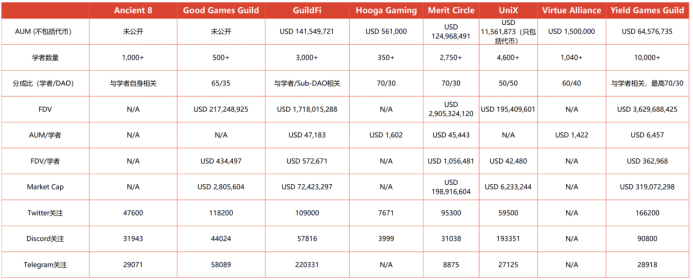
Quantitative Comparison of Guilds
Qualitative Comparison of Guilds

Guild 1: Ancient 8
Ancient8 is Vietnam’s largest blockchain gaming guild, incubated by Coin98 Labs, Kyros Ventures, Coin68 Media, and 3twelve Capital.Ancient8 aims to develop a platform that allows its community to earn monetary rewards while gaining opportunities to play and build in the metaverse. Through investments, scholarships, and education, Ancient8 has grown into one of the most successful gaming guilds. Investments in emerging and top-tier P2E NFT games allow Ancient8 to provide these productive assets to its community, continuously expanding earnings as scholars use scholarships at the forefront of P2E gameplay. Introducing other games during Axie Infinity esports tournaments (such as Thetan Arena), along with teaching blockchain fundamentals to community members, ensures Ancient8’s scholars always stay updated on the latest game metadata and strategies. As a result, Ancient8 is not only a successful traditional gaming guild but also Vietnam’s largest gaming community, giving it a strong player base across Southeast Asia.
1) Assets Under Management (AUM)
Not disclosed
2) Scholarship Data and Revenue Share
Ancient8’s Axie Infinity scholarship program currently supports over 1,000 scholars and plans to expand its scholarship pool in other games such as Thetan Arena and Cyball. The guild intends to add another 1,000 scholars once its Cyball scholarship program officially launches. Ancient8’s scholarship revenue split is not publicly disclosed and may vary per scholar. Ancient8 believes scholars should be rewarded based on multiple quantitative and qualitative factors—such as time spent as a scholar under Ancient8, adherence to guild policies, high rankings in respective games, contributions back to the Ancient8 community, or joining Ancient8 as formal employees.
3) Revenue
Not disclosed
4) Quantitative Data

5) P2E Games
Ancient8’s investments and participation in P2E games primarily revolve around Axie Infinity, Thetan Arena, and Cyball, but its engagement in the P2E space enables further expansion into Sipher, Summoners Arena, and Elpis Battle.
6) DAO/Guild Structure
Ancient8 is currently moving toward a DAO model, aiming for greater decentralization. Currently, its guild structure is relatively simple and flexible, with a single entity owning all assets and investments. As Ancient8 continues to grow, it will be interesting to see whether its DAO structure adopts subDAOs for specialized tasks and operations or maintains its flexible, unified structure.
7) Value Proposition
Compared to other gaming guilds,Ancient8’s main advantage lies in its unique ability to build a strong community and dominate the Vietnamese regional ecosystem.Incubated by Vietnamese crypto-native entities like Coin98, Coin68, and Kyros Ventures, Ancient8 leverages strong support from innovators in the field to capture the majority of Vietnam’s P2E landscape. With exceptional access to insights and resources in the Vietnamese market, Ancient8 has demonstrated significant focus on the country. One might question why Ancient8 primarily focuses on domestic development, as its tutorial videos and scholarship application processes are largely tailored for the Vietnamese community. However, rather than viewing this as a limitation, it should be seen as a competitive advantage relative to other guilds.
Targeting niche markets like Vietnam is particularly beneficial due to macroeconomic factors. According to ChainAnalysis, Vietnam ranks first globally in cryptocurrency ownership and usage—a fact supported by the rapid rise of Vietnamese crypto companies, projects, and protocols. Ancient8 already boasts an impressive 73,000 community members from Twitter and Discord alone, serving as strong evidence of its competitiveness. Building on its success in Vietnam, Ancient8 has laid the foundation for global expansion and is ready to deliver further value to other countries.
Since inception, Ancient8 has prioritized its community above all else. It currently has a diverse membership spanning Southeast Asia, Turkey, South Korea, Japan, and India.The formation of the Ancient8 Community Alliance (ACA) reflects its unique commitment to this vision: partnering with like-minded communities to offer collective community and marketing influence for high-quality GameFi projects.
8) Future Plans
Ancient8 is committed to building more blockchain products to enhance interconnectivity among communities across various GameFi projects and improve metaverse infrastructure.This can be seen in the formation of the Ancient8 Community Alliance (ACA), which includes alliance partners from leading blockchain communities and other P2E guilds. ACA aims to strengthen community capabilities and help leading GameFi projects better reach more gamers, thus promoting themselves within the blockchain gaming community for greater opportunities. Additionally, Ancient8 plans to release more educational content for its community members, including esports match reviews and top-ranked gameplay analyses on its blog to help scholars refine their current Axie Infinity strategies, along with offering financial literacy courses on cryptocurrency. Ancient8 is currently launching its first NFT collection, offering benefits such as scholarship access, future drops, product and event whitelists, and community perks. Finally, Ancient8 aims to build more competitions in the P2E space beyond the Axie Infinity Vietnam Championship, giving players and community members opportunities to represent their regions competitively and showcase local talent.
Guild 2: Good Games Guild
Good Games Guild (GGG) is a P2E guild aiming to help create and nurture the largest virtual economy by optimizing the use of its own and lent P2E assets to ensure maximum returns and rewards.GGG aims to transform managed assets into productive, revenue-generating assets by leveraging each member’s role and function within the guild. Furthermore, this ownership can be traded and rented via GGG’s owned NFT marketplace.
1) Assets Under Management (AUM)
Not disclosed
2) Scholarship Data and Revenue Share
As of January 12, 2022, Good Games Guild offers an average 65/35 revenue split between scholars and the guild. Currently, GGG has 500 active scholars using guild assets to earn daily income in Axie Infinity, averaging around 130 SLP per scholar per day.
3) Revenue
Not disclosed
4) Quantitative Data

5) P2E Games
Good Games Guild is currently involved in over 20 games, aiming for diversification and sustained generation of multiple income streams from game operations. GGG is currently active in Axie Infinity, Elumia, Era7, Elfin, MetaStrike, Wasted Lands, RaceFi, Hero Arena, Age of Tanks, Duelist King, Decimated, and Universe Island.
6) DAO/Guild Structure
GGG’s structure resembles Hooga Gaming’s, with different vaults having dedicated purposes, but GGG distinguishes itself by separating vaults based on specialized revenue streams rather than operations.Currently, GGG’s vaults are primarily divided into three areas: Axie breeding revenue, game scholarship revenue, and NFT marketplace revenue.Revenue from these vaults is then distributed to $GGG holders based on each vault’s percentage contribution to total revenue.
7) Value Proposition
GGG has successfully launched Good Games Labs, an incubator for startup projects selected through a rigorous process to help nurture them into high-quality products capable of competing with top-tier P2E games like Axie Infinity. Good Games Labs provides support in areas such as marketing and user acquisition, where GGG can collaborate by supplying large numbers of scholars and players to new games—areas where initial appeal is often difficult to achieve.
In addition, GGG’s NFT marketplace allows users to buy and sell GameFi-related NFTs on its platform, increasing exposure to game creators, players, and artists, ensuring GGG consistently profits from various ecosystem activities. The marketplace supports payments in both cryptocurrency and fiat, enabling faster onboarding of new users. GGG charges a 1.5% transaction fee, offering competitive pricing compared to industry leaders like OpenSea.
One consideration regarding GGG is that its scholars earn a relatively low average daily SLP compared to other guilds—around 130 SLP per scholar per day. This could be interpreted by GGG scholars as a lack of quality, either in the scholars themselves or in GGG’s Axie Infinity NFT assets, meaningGGG’s scholars may struggle to keep up with Axie Infinity’s evolving meta and strategies.
8) Future Plans
GGG aims to launch its mobile app in the near future to give back to its community, especially its scholars, allowing users to track achievements, rankings, and earned rewards anytime.The mobile app will also allow scholars to instantly withdraw cryptocurrency assets into fiat currency, enabling timely access to funds when needed.
Guild 3: GuildFi
GuildFi is a Web3 infrastructure connecting games, NFTs, guilds, and communities, creating an interoperable system where players’ time and effort can transfer across games and the metaverse.By providing foundational tools, GuildFi aims to solve accessibility issues commonly faced by players in GameFi. More importantly, GuildFi gives players the opportunity to participate in multiple different games, reducing isolation caused by high entry costs and the added complexity of cryptocurrency, ultimately bringing long-term benefits to players. To achieve this, GuildFi’s ecosystem consists of a Gaming Center and multiple Zones, analogous to various operational units within GuildFi. The Gaming Center is typically where players join guilds and access different zones to further their progression and continue adding value to the entire ecosystem.
1) Assets Under Management (AUM)
As of January 16, 2022, GuildFi’s managed assets were valued at $146,020,583.AUM is divided into three main categories: Reserves, Tokens, and NFTs, as shown below:

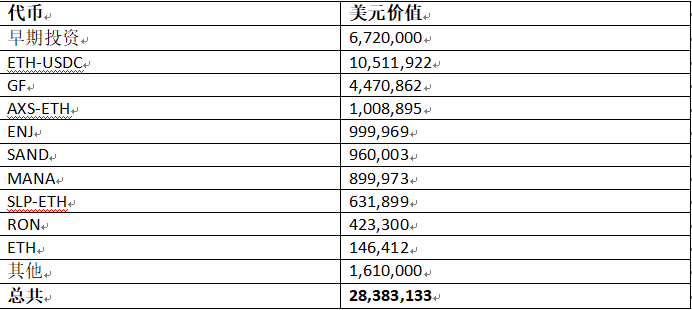
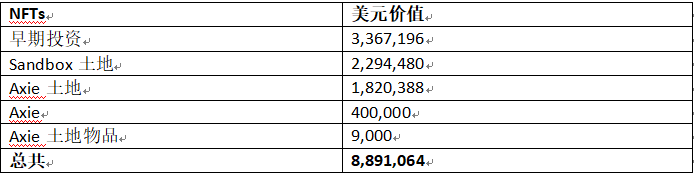
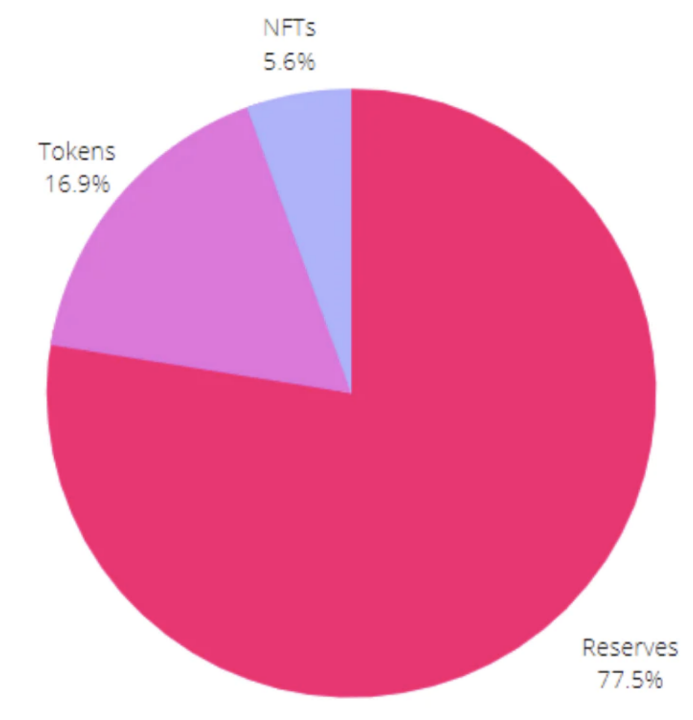
As shown above, the majority of AUM belongs to reserves, accounting for two-thirds of the treasury, attributable to its stablecoin-denominated public fundraising. These funds are primarily used for liquidity mining through loans or liquidity provision.
In terms of tokens, GuildFi holds various game tokens believed to have high potential to add value to the overall GuildFi ecosystem. Their early-stage investment fund began only last October, making it relatively new, yet it has already seen substantial paper gains: starting from an investment size of approximately $2.4 million, it grew nearly threefold to $6.7 million within four months. Notable investments include Pegaxy, Sipher, Elpis Battle, Gunstar, Zodium, and Nitro League, which constitute currently tradable investments on the market. On the other hand, CyBall (whose game tokens and NFTs are now tradable), Syn City, Elumia, and Mavia remain non-tradable for now but have received significant attention. The remaining highlighted tokens align with GuildFi’s vision of future interoperability within metaverses like ENJ, SAND, and MANA. The team has also provided liquidity for pairs such as AXS-ETH and SLP-ETH to mine RON.
Currently, tokens account for about 20% of its total AUM, but this proportion is expected to increase as more games emerge, especially following GuildFi’s recent public fundraising, enabling a significant expansion in the number of invested games.
Finally, in NFTs, early investments make up the largest portion of category investments. NFT investments include Nyan Heroes, Cyball, Pegaxy, Elpis Battle, Thetan Arena, Sipher, and Gunstar, all currently tradable on the market. GuildFi has also invested in NFTs not yet available on public markets, such as Mavia and Big Time. Other NFT holdings follow similar trends to their token portfolio, encompassing both metaverse land and all things Axie Infinity, highlighting continued focus on Axie-related developments.
2) Scholarship Data and Revenue Share
Unsurprisingly, Axie remains home to the majority of GuildFi’s scholars, with over 1,500 scholars, making it the dominant P2E game. Next comes Cyball (1,000+), followed by Thetan Arena (500+), and Pegaxy (100+), totaling over 3,000 scholars. However, with more games launching, even more scholars are expected to join GuildFi, especially given its scholarship waitlist exceeds 20,000, indicating strong market interest. Additionally, GuildFi has over 30 coaches to assist with onboarding and mentoring players in specific games. With solid infrastructure attracting new players and a strong incentive structure allowing players to earn extra income through GuildFi rankings and leaderboards across games, it fosters healthy internal competition, higher yields, and other reward forms.
3) Revenue
Not disclosed
4) Quantitative Data

5) P2E Games
GuildFi has invested in many different games, reflecting a growing need for more investment opportunities and diverse game designs as the play-to-earn space evolves. This is evident in early investments in games like Pegaxy, Sipher, Elpis Battle, Gunstar, Zodium, Nitro League, CyBall, Syn City, Elumia, and Mavia. GuildFi has also expanded operations into games such as Big Time, Thetan Arena, Sandbox, Nyan Heroes, Elpis, Legends of Elumia, Genopets, Summoners Arena, and DarleyGo.
6) DAO/Guild Structure
GuildFi’s DAO structure is fundamentally divided into two main parts:Gaming Center and Zones—composed of tools, guilds, NFTs, and vaults.
The Gaming Center is the core mechanism for onboarding users, consisting of the following elements:
1. GuildFi ID:Similar to a metaverse passport, GuildFi ID enables simple tracking of a player’s achievements and footprint within the metaverse while allowing access to GuildFi’s broader ecosystem.
2. Game Discovery:Enables players to discover games on the platform while helping game creators find suitable player bases for their releases.
3. Guild Discovery:Offers a built-in scholarship program aggregated from GuildFi’s funding, partner guilds, and affiliated NFT funds.
4. Proof-of-Play Rewards:By analyzing all user activities, GuildFi enables earning rewards in any game. Players earn experience points (GXP) and rankings, translating into deserved rewards—either distributed as NFTs or additional token rewards. GXP also contributes to upgrade systems and determines player rankings.
Zones are dedicated engines driving commercial activity, adding value to GuildFi’s entire ecosystem: Guild Zone, NFT Zone, and Tools Zone. Zones act as dedicated engines adding value across GuildFi’s ecosystem:
1. Guild Zone:GuildFi’s guild platform comprises Play-to-Earn related products, GuildFi’s own operations, and value-added offerings for existing guilds and investors, specifically including GuildFi Guild, Guild-as-a-Service (GaaS), and Guild Network.
2. NFT Zone:Metadrop Launchpad is the first product in GuildFi’s NFT Zone. With high-quality game partners, GuildFi’s Metadrop Launchpad will offer many limited NFTs or new game products to community members. More products like marketplaces and lending applications are expected in the GameFi NFT Zone in the future.
3. Tools Zone:GuildFi has developed one of the most advanced Axie tools on the market, serving both individual players and guilds, featuring scholarship management, game stats, leaderboards, card browsers, and PvP simulators.
7) Value Proposition
GuildFi’s long-term vision enables it to attract not just players seeking quick profits, but those who genuinely enjoy gaming.Thus, it accommodates a full suite of games catering to diverse needs, creating a more comprehensive guild. This also benefits games themselves, avoiding scenarios where enjoyable games face frequent dumping akin to Axie Infinity and its in-game token SLP.
Additionally, due to extra incentives within the GuildFi ecosystem, players aren’t restricted solely to mining and dumping Axie Infinity. There must be income mechanisms enabling them to potentially reinvest earned tokens back into games, improving the overall ecosystem and ensuring a healthier economy—ultimately creating games people want to play, not feel forced to play.
Moreover, GuildFi empowers partners to manage their guilds using GuildFi’s established infrastructure. This simplifies the process for aspiring guilds to start operations immediately, allowing others to enjoy efficiency levels comparable to large guilds thanks to GuildFi’s existing infrastructure. It also reduces overreliance on recruiting players as a means of expansion, since GuildFi’s network instantly connects numerous other guilds through its services, enabling continuous growth. It also offers players flexibility to move across different guilds within the ecosystem based on preferred games, essentially creating an echo chamber as diversity among internal guilds retains players.
However, despite this excellent service, certain situations might create unfavorable scenarios. For example, if anyone with funds can create a guild using GuildFi’s services, it might lead to quality degradation. If such guilds don’t adhere to GuildFi’s principles, GuildFi itself might end up being held accountable for issues it doesn’t fully understand, damaging its reputation as a leading guild. A potential solution is thorough vetting of prospective partners wishing to use its services. This creates a way for GuildFi to ensure some form of quality control while expanding the number of guilds under its umbrella—achieving the best of both worlds.
8) Future Plans
As P2E systems evolve, GuildFi will shift focus to P2E infrastructure, aiming to connect more players, guilds, and games within the metaverse.GuildFi aims to achieve this by seamlessly integrating various protocols and projects into a unified alliance—for example, introducing advanced ranking systems to determine player standings within its platform, enabling guilds to find top players and allowing players to essentially build digital resumes for their gaming careers. With the implementation of a guild network and scholarship portal, GuildFi effectively removes boundaries for its community members in the P2E space, ensuring smooth onboarding for scholars and managers into various guilds or games.
Guild 4: Hooga Gaming
Hooga Gaming is a DAO aiming to develop the Web3 GameFi ecosystem by establishing equitable communities and strong esports scenes for each game the DAO participates in.Hooga Gaming aims to achieve this through three distinct aspects: community, tools, and competitive gaming. Hooga Gaming gives back to its community by educating players on deep gameplay mechanics and providing analytics, ensuring scholars possess knowledge surpassing other players, and offering boot camps to foster continuous learning, improvement, and a winning mindset among its scholars. Hooga Gaming uses internally built tools to reduce operational complexity and ensure smooth scholarship management, ultimately building competitive gaming scenes by leveraging opportunities beyond game economies to attract and retain its community. This is already evident in Hooga Gaming’s collaboration with FTX to launch the FTX Galaxie Cup, an Axie Infinity esports tournament.
1) Assets Under Management (AUM)
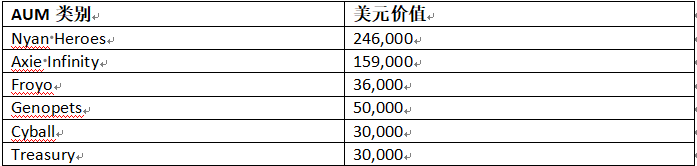
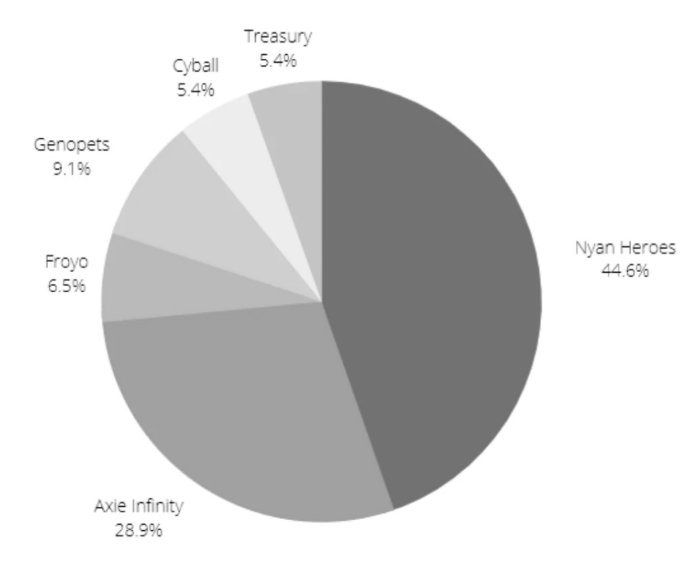
As of February 6, 2022, Hooga Gaming’s managed assets were valued at $561,000. AUM is divided into six main categories: Axie Infinity, Froyo, Genopets, Cyball, and Treasury. Nyan Heroes constitutes the largest portion of Hooga Gaming’s AUM, with Nyan Heroes NFTs accounting for approximately 44.6% of Hooga Gaming’s assets. Axies represent the second-largest portion of AUM, valued at around $159,000, or about 28.9% of total AUM. It should be noted that games like Genopets and Cyball have not yet launched, so these asset valuations are based on investment amounts and may not reflect true market values. These upcoming games account for approximately 14.5% of Hooga Gaming’s AUM.
2) Scholarship Data and Revenue Share
Hooga Gaming offers a highly competitive revenue split between the guild and its scholars, with an average 70/30 distribution between scholars and Hooga Gaming. Currently, Hooga Gaming has 350 scholars, each averaging 160 SLP per day.
3) Revenue
Hooga Gaming’s revenue falls into two main sources: Axie scholarships and tournaments. Axie Scholarships alone generated $350,000 in revenue in 2021, while tournaments contributed an additional $87,500, accounting for about 20% of Hooga Gaming’s total 2021 revenue of $437,000. Hooga Gaming expects revenue from gaming operations to continue growing in 2022 due to new game launches in Q2 and Q3 and rising floor prices of GameFi NFTs, anticipating sustained demand in the GameFi sector. Even if P2E income declines, Hooga Gaming projects gaming operation revenue to reach $400,000 in 2022.
4) Quantitative Data

5) P2E Games
Hooga Gaming continuously seeks new opportunities within the P2E ecosystem, evident in its investments in Axie Infinity, Sipher, Nyan Heroes, and Cyball, aiming to generate returns through P2E gameplay. This is also visible in its investment in Web3 gaming launchpad Froyo. This partnership benefits both parties, as Hooga Gaming gains early access to P2E games launching on Froyo, while simultaneously providing larger player bases for these games through its scholars.
6) DAO/Guild Structure
Hooga Gaming consists of a main guild and four additional sub-guilds (DCG Sub-Guild, Cruxia Sub-Guild, AOC Sub-Guild, Putra Sub-Guild). The main guild accounts for approximately 70% of total scholarships, while the remaining four sub-guilds collectively handle the remaining 30%. Hooga Gaming provides top-tier scholarships through sub-guilds, as each serves a specific, dedicated purpose for Hooga scholarships. DCG exclusively manages breeding of top-tier Axies, Cruxia handles event streaming and casting, AOC manages community affairs, and Putra focuses on content creation. Hooga Gaming collaborates with and acquires these sub-guilds to leverage their expertise for more efficient scholarship operations.
7) Value Proposition
Hooga Gaming’s primary advantage over other gaming guilds lies in its ability to cultivate and retain high-quality scholars, ensuring scholars efficiently utilize guild assets.This is reflected in Hooga Gaming scholars averaging 160 SLP per day, compared to around 130 SLP per day for scholars in guilds like Good Games Guild. Hooga Gaming has developed the capacity to unlock higher potential among its scholars through multiple services, such as offering enhanced incentives when scholars meet quantitative and qualitative KPIs (e.g., MMR, activity, content creation, ideas), implementing mandatory boot camps to instill a winning mindset, and delivering educational content on top-tier game metas and strategies. This community-centric approach enables a 91.24% scholar retention rate, adding 3,961 members to its Discord talent pool.
Additionally, Hooga Gaming partners with leading innovators in the crypto space like FTX, further advancing its ambitions and goals. This is evident in the launch of the FTX Galaxie Cup, where Hooga Gaming and its partners organized a premier Axie Infinity esports tournament reaching 7 million users across platforms. The FTX Galaxie Cup marks just the beginning of Hooga Gaming’s journey in P2E esports, making 2022 an exciting year ahead.
However, one consideration is that Hooga Gaming’s AUM is currently relatively inactive, with games like Nyan Heroes and Cyball yet to launch, accounting for roughly 50% of Hooga Gaming’s total AUM. Currently, Axie Infinity assets are the only actively profitable component of Hooga Gaming’s AUM, generating SLP. Despite most assets being inactive, Hooga Gaming overcomes this by effectively utilizing Axie Infinity assets, evident in scholars averaging 160 SLP per day and the ability to breed top-tier Axie assets for reinvestment. Furthermore, the imminent launch of Cyball and Nyan Heroes in Q4 2022 (along with staking $CTNP) will enable Hooga Gaming to more effectively monetize its assets for itself and its community. As these P2E games roll out full features, Hooga Gaming’s revenue and scalability are expected to significantly increase in 2022.
8) Future Plans
Hooga Gaming has various initiatives in its pipeline, asit aims to further enhance its tooling system (Jungle Book) in the near future.Jungle Book will automate all processes during scholarship operations, ensuring scaling Hooga Gaming becomes effortless—offering income tracking, game registration, scholar performance dashboards, and automated scholar payouts. Additionally, Hooga Gaming seeks to build on its success in P2E esports by relaunching the Galaxy Cup and introducing new tournaments like the Hooga League—an annual league featuring weekly, monthly, and yearly championships. Hooga Gaming is also exploring lateral collaborations, forming partnerships with other guilds in Southeast Asia to build stronger communities and hosting the AxSea SEA Axie tournament, pitting against other SEA guilds.
Guild 5: Merit Circle
Merit Circle was first established in August 2021 with the goal of creating a decentralized autonomous organization that develops and provides opportunities through P2E. Merit Circle aims to create an environment that effectively connects capital, expertise, and participants.This is already evident in Merit Circle’s Axie Infinity operations, providing competitive in-game assets, in-game tactics and strategy education, and competitive revenue splits for potential players. Merit Circle prides itself on being more than just a traditional “gaming guild,” believing that guilds primarily focused on increasing scholar counts under their operations overlook long-term goals. Instead, Merit Circle aims to create value through community building, educational content, and mentorship, ensuring sustained and improved quality of scholars and the guild while staying at the forefront of P2E ecosystem trends.
1) Assets Under Management (AUM)
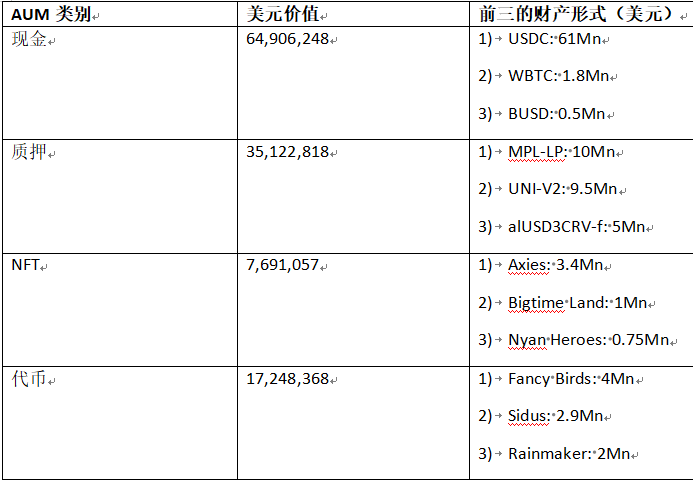
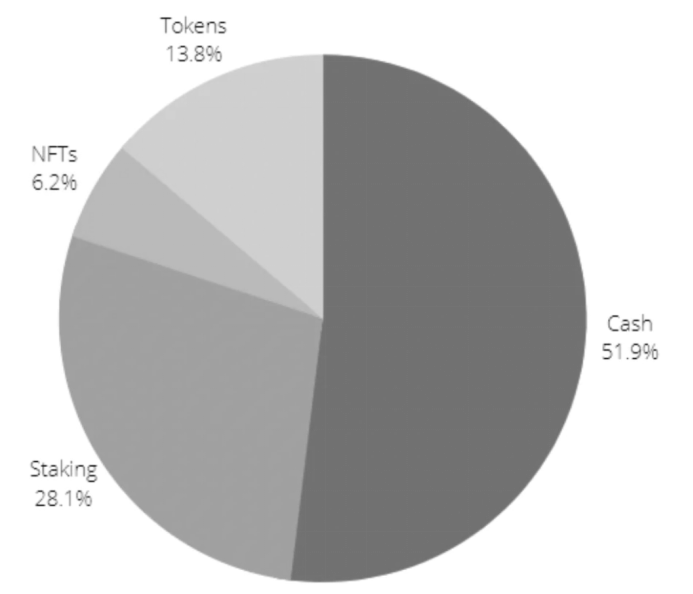
As of December 31, 2021, Merit Circle’s treasury had grown to $124,968,491 (excluding Merit Circle’s native token). Funds are divided into four main categories: Stablecoins, Staking, NFTs, and Tokens. Cash constitutes the largest portion of Merit Circle’s treasury, with stablecoins like USDC accounting for approximately 49.5% of total managed assets. Staked assets represent the second-largest portion, as Merit Circle actively deploys assets to sustain treasury longevity and scalability. Tokens comprise the third-largest portion of AUM, with a significant share allocated to other games such as Genopets, Nyan Heroes, Summoners Arena, Mixmob, and Fancy Birds. Additionally, Axie Infinity NFTs remain the largest portion of Merit Circle’s NFT AUM, representing about 43.6% of NFT treasury value. Merit Circle’s extensive investments in other P2E games through its native token and NFT assets demonstrate its intent to remain at the forefront of the P2E ecosystem as it expands into various other P2E games striving for greater foothold and mindshare. An example is the Epic Cyball NFT (current floor price $168), whose value in Merit Circle’s AUM surged by 1614% within a month. Merit Circle expects game operations to improve and further increase Axie Infinity AUM, as it focuses on maintaining current scholar operations rather than hypergrowth—especially given basic needs challenges among Philippine-based scholars—while Nyan Heroes recently opened its staking pool, allowing Merit Circle to begin staking and earning Nyan Heroes’ native token: $CTNP. Merit Circle’s assets are currently deployed across Ethereum, Binance Smart Chain, Solana, and Ronin.
2) Scholarship Data and Revenue Share
Merit Circle offers a highly competitive revenue split between the DAO and its scholars, averaging 70/30 between scholars and the DAO. Currently, Merit Circle has 2,750 scholars using DAO assets to earn SLP in Axie Infinity.
3) Revenue
Merit Circle generates approximately $1.5 million in monthly revenue, derived from realized gains on token sales and daily income from Merit Circle scholars’ gameplay operations. Since Merit Circle’s DAO is relatively new, past revenue figures have never been disclosed, and projected 2022 revenues may be inaccurate due to various factors including overall cryptocurrency and profit markets. Future investments and opportunities in Merit Circle’s pipeline have not been announced. However, 2022 could be a strong year for Merit Circle, as the displayed revenue streams may become more active across the DAO, and with many games in its portfolio launching, we can expect robust sustained growth.
4) Quantitative Data

5) P2E Games
Merit Circle invests in and operates over 20 games, including Axie Infinity, Vulcan Forged, Cyball, Fancy Birds, Big Time, Genopets, Hash Rush, Illuvium, Nyan Heroes, Heroes of Mavia, Summoners Arena, Mixmob, Rainmaker, Sipher, and UFO Gaming (a complete list of play-to-earn investments can be found here: https://meritcircle.substack.com/p/4-treasury-report-january-2022). As the P2E ecosystem evolves, Merit Circle believes free-to-play games will increasingly target more traditional gamers, where player-owned economies enhance gaming experiences. This is already evident in its investment and operation of Fancy Birds, where users personalize and customize gameplay through accessories, skins, and aesthetics to improve their experience.
6) DAO/Guild Structure
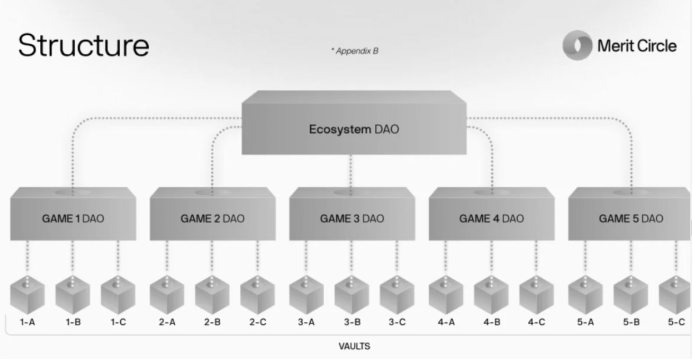
MainDAO:
Merit Circle’s MainDAO, or EcosystemDAO, is a powerful tool functioning across all Merit Circle operations by:
1. Ensuring scalability and continuity of subDAOs
2. Providing a soft floor price for the $MC token
3. Generating yield farming revenue
4. Providing additional funding for subDAOs
5. Enabling future governance of Merit Circle
6. Supporting subDAOs during funding shortfalls
subDAO:
subDAOs are game-specific DAOs that Merit Circle commits to and aims to:
1. Ensure continuity and scalability of in-game strategies
2. Maximize strategic returns
3. Continuously acquire top-tier NFTs with positive expected accruals
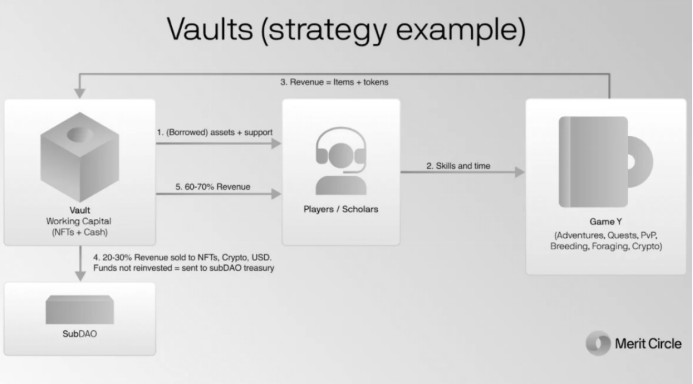
Vaults:Vaults represent strategies deployed by Merit Circle to generate revenue and ensure profits flow back into the ecosystem. The scholarship model used in Axie Infinity is one example (shown below).
7) Value Proposition
Merit Circle’s primary competitive advantage over other P2E guilds lies in its DAO structure, ensuring continuous adaptation to the evolving play-to-earn landscape.Using subDAOs ensures Merit Circle’s treasury and AUM consist of diversified assets spread across multiple games, keeping Merit Circle at the forefront of any major shifts in gaming. This allows Merit Circle to proactively develop and identify strategies, ensuring maximum profitability—whether through scholarship models, purchasing virtual world land, or financial investments—to grow its treasury. subDAOs generate profitable operations by leveraging their internal DAO structures and cultivating skilled local players and scholars across various games, enabling Merit Circle to reinvest these profits through the mainDAO. This gives the mainDAO the capacity and opportunity to enter new games, acquire more NFTs, adopt further yield farming strategies, and explore other profit-generating methods for the treasury.
Another competitive advantage is thatMerit Circle is a gaming DAO, not a traditional scholarship guild,as its activities extend far beyond merely providing scholarships to community members. Instead, Merit Circle takes pride in its ability to build its own products, exemplified by Edenhorde—the first incubated product designed by experts and Emmy Award-winning designers. Merit Circle stands out from other P2E-focused guilds by focusing on creating value beyond traditional guild player metrics, making metrics like AUM per Scholar seem overstated, as value flows into other critical aspects of the guild.
A consideration regarding Merit Circle’s subDAOs is that as Merit Circle continues to grow and engage with increasingly popular games in the GameFi ecosystem, it must constantly establish new subDAOs for each game it enters. Compared to other guilds, this might require more time to fully set up operations and subDAO management. However, Merit Circle has overcome this through careful planning and investment in new games, ensuring the time spent establishing these subDAOs does not exceed the time other guilds take to implement game operations. This is because Merit Circle participates in P2E games through direct SAFT (Simple Agreement for Future Tokens) investments, allowing immediate use of game NFTs post-launch. Without direct SAFT investments, it might take Merit Circle DAO longer to establish operations, but Merit Circle can easily overcome this by efficiently deploying resources to ensure smooth transitions for the Merit Circle DAO, its managers, and scholars, equipping them with the necessary assets, knowledge, and experience to thrive.
8) Future Plans
As mentioned above, Merit Circle is much more than just a “gaming guild.” In fact, Merit Circle views guilds primarily focused on increasing “scholar” counts with skepticism. Merit Circle believes the future will bring more free-to-play games targeting more traditional gamers, where player-owned economies enhance gaming experiences. Users will buy accessories, skins, etc., to improve their experience rather than pay-to-play or rely on guilds lending assets. With this in mind, Merit Circle aims to continuously build infrastructure to support the transition of traditional gamers from games like Fortnite, Call of Duty, and FIFA toward play-to-earn models and economies.Merit Circle aims to become synonymous with Play-to-Earn, positioning itself as a one-stop shop in the Play-to-Earn industry—from community
Join TechFlow official community to stay tuned
Telegram:https://t.me/TechFlowDaily
X (Twitter):https://x.com/TechFlowPost
X (Twitter) EN:https://x.com/BlockFlow_News