Entretien avec le COO de la Wormhole Foundation : Le choix de la multichaîne par Uniswap, les organisations sans fondateur et le jalon des 900 millions de messages
TechFlow SélectionTechFlow Sélection
Entretien avec le COO de la Wormhole Foundation : Le choix de la multichaîne par Uniswap, les organisations sans fondateur et le jalon des 900 millions de messages
Rassembler tout le monde sur un même outil de gestion de projet et l'utiliser de manière cohérente est essentiel pour maintenir les projets en cours.
 Dédié à des analyses Web3 approfondies
Interview : Sunny, TechFlow
Guest : Dan Reecer, COO of Wormhole Foundation
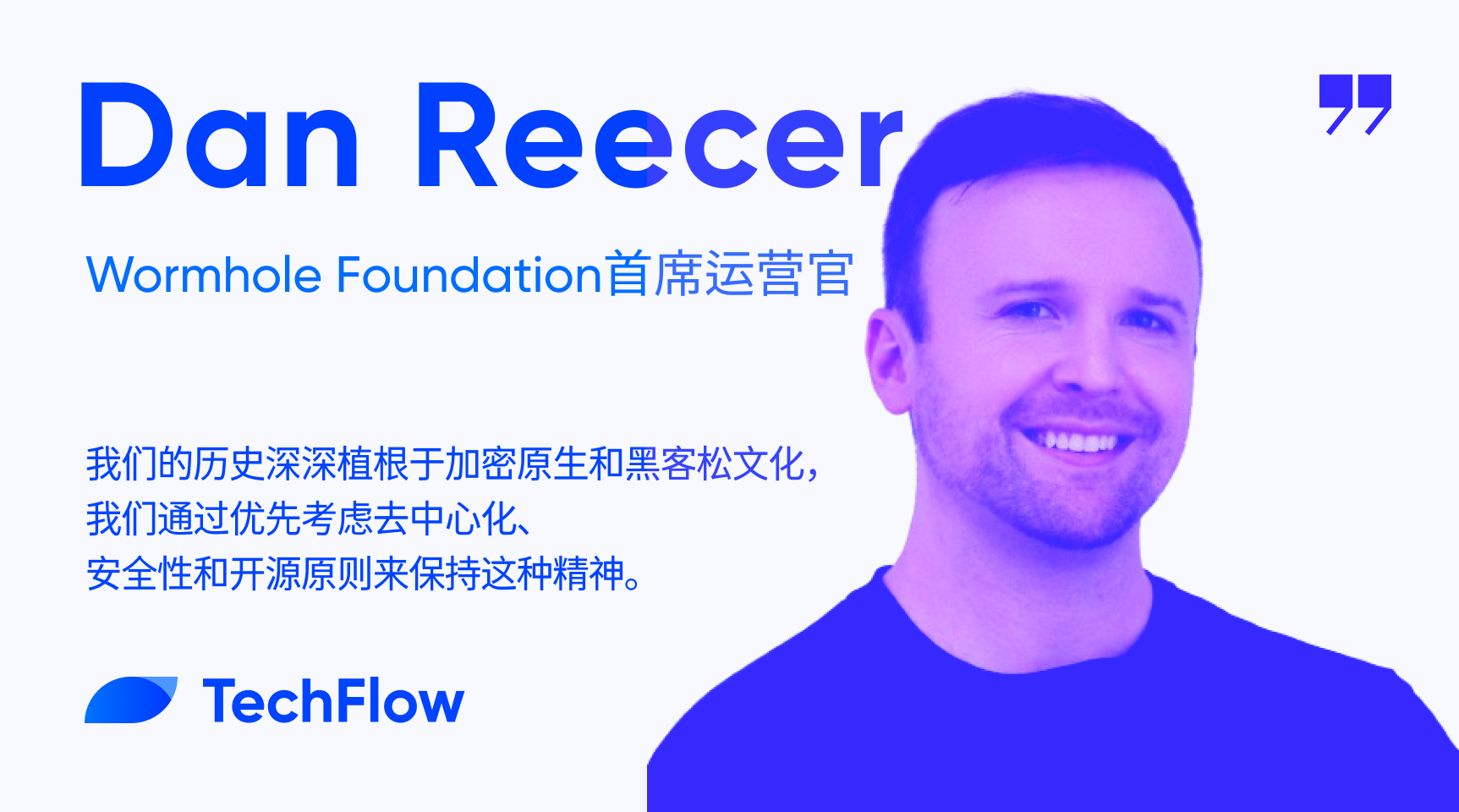
"Our history is deeply rooted in crypto-native and hackathon culture, and we maintain this spirit by prioritizing decentralization, security, and open-source principles."
— Dan Reecer, Chief Operating Officer, Wormhole Foundation
Last year, Uniswap published a major cross-chain bridge evaluation report, in which Wormhole and Axelar Network stood out among the top six cross-chain bridges globally, becoming trusted infrastructure for Uniswap governance. The other bridge providers—LayerZero, Celer, Debridge, and Multichain—are all leading players in the industry.
Why have Wormhole and Axelar been recognized by Uniswap as decentralized cross-chain experts?
How does Uniswap's governance message get bridged across different blockchain networks?
Is LayerZero a Web2-style company?
TechFlow invited Dan Reecer, COO of the Wormhole Foundation, to answer these questions. Interestingly, unlike other Web3 projects, Wormhole is a "headless organization" without founder-led leadership. So within such a structure:
What is Wormhole’s organizational structure? Is it similar to the Web3 triad: DAO, Foundation, and engineer-driven Labs?
Within this architecture, how does Dan formulate operational strategies and run Wormhole into such a successful project today?
With extensive experience in operations and marketing in the traditional pharmaceutical industry, what differences does Dan see between centralized and decentralized organizations in terms of operational direction and tool usage?
Why has Wormhole specifically set up a gateway for the Cosmos ecosystem? What are Dan’s insights on Polkadot and Cosmos ecosystems?
We also thank members of Wormhole’s Chinese community who raised some user experience issues currently facing Wormhole:
Progress of Wormhole’s ZK engineering team?
Low liquidity when using Wormhole to transfer assets to L2s—how will this be resolved?
Factors determining the speed of cross-chain transactions via Wormhole?
Below is our full conversation with Dan, hopefully clarifying some of your questions.
*Note: Wormhole and wormhole will be used interchangeably throughout the article.
History: From Solana Hackathon, Jump Crypto to Wormhole
TechFlow: Today is my first time interviewing a deep infrastructure project like Wormhole. Following others’ advice, I’ve made my questions more specific. To start, could you briefly introduce the history of the Wormhole Foundation?
Dan Reecer:
The origin of the Wormhole project is quite interesting—it emerged from a hackathon about three years ago. We initially conceived it during a Solana hackathon, aiming primarily at bridging the gap between Solana and Ethereum.
It started as a small team effort within the hackathon but quickly gained recognition and attention, gradually evolving into a significant endeavor. Jump Crypto played a pivotal role, bringing Wormhole under its umbrella and incubating the project.
Over time, Wormhole expanded its interoperability scope to cover around 30 different blockchain networks. Currently, personnel originally associated with Jump Crypto and Wormhole have transitioned out, and the project is now entirely managed by teams outside the Jump organization. In recent years, multiple entities have contributed to Wormhole’s development.
-
Wormhole Foundation, established in the Cayman Islands, employs about 15 people and provides grants to various organizations supporting Wormhole.
-
xLabs, operating in Argentina, manages relayer infrastructure and acts as one of the network’s guardians and validators.
-
Wormhole Labs, the third core contributing entity, drives many engineering, product, and business development initiatives.
Additionally, we recently funded two zero-knowledge (ZK) engineering teams, though collaboration details haven’t been officially disclosed yet. These teams focus on developing Wormhole ZK, including light clients and bridges. Moreover, several teams—including security, community, and those within the Cosmos ecosystem—also contribute to the project.
Our history is deeply rooted in crypto-native and hackathon culture, and we maintain this spirit by prioritizing decentralization, security, and open-source principles.
This commitment to decentralization and open source distinguishes us from competitors who opt for centralized and closed-source approaches.
Despite numerous challenges, we firmly believe that proper decentralization and openness at the infrastructure layer are essential for ensuring security and scalability throughout our continued growth.
Operation of a Headless Decentralized Organization
TechFlow: Could you share Wormhole’s organizational structure—typically divided into DAO, Foundation, and Labs?
Dan Reecer:
A DAO hasn't launched yet. We plan to implement both a DAO and an on-chain treasury simultaneously. What makes this project unique is that, in the traditional sense, we lack a conventional founder. Although someone named Hendrick was involved early on, he is no longer part of the project. Now it's a founder-less initiative. About 12 individuals across different team leadership groups collaborate extensively, leading work in product development, engineering, and business expansion. The organizational setup is clearly decentralized.
TechFlow: Given Wormhole’s competitive landscape and its leadership position in a field full of messaging protocols and continuous hackathons, I’m particularly interested in Wormhole’s operational strategy.
Considering your corporate management background and clear expertise in Web2 marketing strategy and operations, how do you conduct operations within a decentralized, headless organization like Wormhole?
Could you share your personal approach and highlight the differences between Web2 and Web3 operations?
Dan Reecer:
That's a great question—the current working dynamics are very different. As mentioned earlier, we regularly collaborate with about five or six teams, creating a dynamic environment unlike traditional structures where fixed hierarchies assign tasks. Coordination resembles working groups—individuals from different teams gather to jointly complete specific projects or launches. This involves active participation through calls, Slack channels, and similar platforms.
Another notable aspect is the importance of goal setting, which isn’t common in crypto compared to traditional companies. Based on my experience at Eli Lilly, companies place strong emphasis on defining annual and quarterly goals, as well as individual objectives. My corporate background gives me deep insight into century-old enterprises, so integrating these practices into a decentralized ecosystem presents challenges.
However, using systems like OKRs (Objectives and Key Results), aligning everyone around shared quarterly goals, is both challenging and rewarding.
Corporate experience proves invaluable in implementing coordinated strategies. This includes collaborating with leaders across teams to define strategy, set goals, motivate team members, and celebrate achievements.
This contrasts sharply with the specific hierarchies in corporations, highlighting that individual coordination and decentralized structures are the key differences.
TechFlow: I understand the challenges of handling user-facing operations, tracking an ever-evolving tech stack, and keeping pace with market trends, especially in the fast-moving crypto space. Considering recent developments like BTC ETFs and crypto regulations, how do you balance these operational aspects internally at the Wormhole Foundation?
Dan Reecer:
Yes, you're referring to the various project management tools we use internally, such as Notion and Slack.
Over time, I've identified the most effective communication tools, with Slack being the clear winner. Although not decentralized, its efficiency surpasses that of decentralized alternatives. While some teams (like Polkadot) prioritize decentralization and choose decentralized tools, this approach can be less efficient, especially regarding mobile functionality. Given Slack’s superior performance, we rely on it for our communication needs.
Ensuring everyone starts from the same page is crucial. For tracking product documentation and strategic files, we use Notion to organize information in an accessible and trackable way.
Project management is another critical aspect, for which we use ClickUp.
Bringing everyone onto the same project management tool and consistently using it is vital to keeping projects on track. To this end, we have a dedicated project manager overseeing all initiatives, conducting weekly status checks, and ensuring project launches and other milestones proceed as scheduled.
This approach forms the foundation of our operational strategy.
Four Products of Wormhole
TechFlow: Wormhole encompasses multiple product lines. Could you briefly introduce each product and explain its function?
Dan Reecer:
Wormhole Messaging is the cornerstone product in our ecosystem, often categorized in the industry as a bridge. However, it is actually a messaging protocol upon which bridges like AllBridge, Mayan, and Portal can be built.
Messaging Protocol
However, it must be emphasized that Wormhole functions as a messaging protocol. Currently, about 10 bridges are built on the Wormhole protocol. Underlying it is a message layer capable of transmitting various forms of data between blockchains. This data can include token-related information or non-token data.
Uniswap’s governance is an example of non-token bridging. Uniswap uses Wormhole across five instances, leveraging the protocol to broadcast governance decisions across chains. They treat Ethereum as their home chain and deploy approximately 15 to 20 units on other chains. When a governance decision is made on Ethereum, Wormhole messaging propagates that decision to all connected chains.
Another case involves Pyth, the second-largest oracle after Chainlink. The entire Pyth oracle network relies on Wormhole messaging, distributing price feeds from its Solana fork to around 40 different chains.
At a higher level, Wormhole messaging serves as a foundational platform for various applications.
Delving deeper into this technology, messages are validated by the Guardian Network—a group of 19 validators responsible for verifying the authenticity and quality of each message.
After validation, at least 13 of the 19 validators must agree on a message’s validity before it is forwarded to the destination chain. This provides further technical insight into Wormhole messaging, establishing it as foundational infrastructure for building diverse applications.
Wormhole Gateway
The Wormhole Gateway you mentioned is a blockchain we developed for dual purposes.
First, it enhances the overall security features of the Wormhole network.
Second, its primary function is serving as a gateway to and from the Cosmos ecosystem.
Integrating new blockchains into Wormhole is challenging because one of the 19 Guardians must run a full node nightly.
Wormhole Gateway allows any new Cosmos chain to seamlessly connect to the Wormhole network via IBC, solving this issue and enabling excellent scalability within the Cosmos ecosystem.
Wormhole Gateway is a component within the broader Wormhole network, distinct from Wormhole’s overall engine.
A notable difference compared to Axelar Network is that their entire bridge network is built on a Cosmos-based chain.
Wormhole Connect
Regarding Wormhole Connect, it's known as an in-app widget that solves historical challenges faced by applications like AAVE. Traditionally, users' bridged funds were redirected to external bridges, causing user attrition and reduced revenue. To overcome this, Wormhole enables developers to embed a bridge directly into their app with just three lines of code. Users can seamlessly bridge funds within the application without leaving it.
Wormhole Queries
Finally, Wormhole Queries launched three weeks ago. This innovative product functions similarly to an oracle, but for on-chain data. Chainlink and Pyth are oracles that bring off-chain data onto blockchains, whereas Wormhole Queries introduces a new primitive for DeFi. It allows other blockchains to efficiently and cost-effectively query data from different blockchains. The product has seen high demand, with over a hundred applications expressing interest within the first few weeks.
Multiple Ecosystems: Cosmos, Ethereum, Solana
TechFlow: I assume you need to interact with various networks like Ethereum, Cosmos, Solana, and Polkadot. You previously worked in the Polkadot ecosystem and now see Wormhole connecting with Cosmos—could you compare Cosmos and Polkadot? I’ve heard there’s bullish sentiment toward Cosmos in 2024 predictions. Could you explain why? Or more precisely, why did Wormhole build a dedicated Gateway for Cosmos?
Dan Reecer:
Yes, we developed Wormhole Gateway for Cosmos because the Cosmos ecosystem is highly active. Notable teams like Osmosis have recently launched, demonstrating significant progress—for example, the WBTC chain team. Launching Wormhole Gateway allows us to scale seamlessly within this ecosystem without incurring additional infrastructure costs when adding new chains—a concept akin to a router chain.
A similar concept has been implemented in the Polkadot ecosystem, where teams like Moonbeam and Acala independently built routers to facilitate information flow in and out of their chains and connect with any other chain in the Polkadot ecosystem. This benefits both sides by increasing network traffic and enhancing our scalability within Polkadot.
Reflecting on my roughly four years in the Polkadot ecosystem, I noticed shortcomings in business development and marketing. The focus on engineering overshadowed the need for effective marketing and sales efforts.
In contrast, Cosmos has made significant strides in these areas, benefiting from a longer launch timeline and leadership changes that enabled recent growth.
As a member of the Wormhole team, I find the advantage of being central and neutral, allowing us to observe and engage with various ecosystems. Currently, Solana and Ethereum are the most active, with Ethereum leading in Layer 2 solutions, followed closely by Cosmos in third place. Recent ecosystem developments are evident on Wormhole Scan, which offers deep visualizations of token flows across networks.
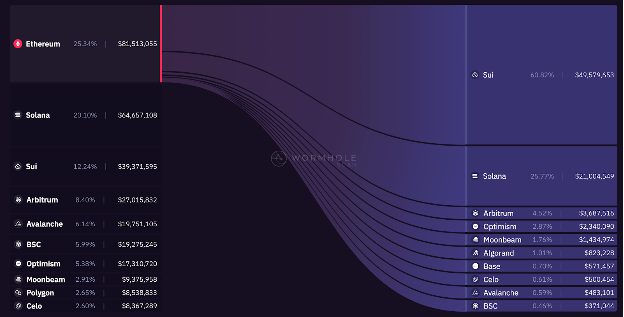
Wormhole Scan's Snapshot of Cross Chain Volume
Wormhole’s unique position allows us to witness trends firsthand. Notably, Ethereum transfers primarily flow to Solana and Sui. Starting with Solana, our initial goal was connecting Solana and Ethereum—a foundation that significantly contributed to our growth within the industry’s most active ecosystems.
Competitors: LayerZero Is a Web2 Company in the Web3 Space
TechFlow: Regarding bridge competitors in the industry, I recall that in your podcast with the Crypto Coin Show, you briefly mentioned LayerZero, emphasizing its centralization resembling a Web2 company rather than a Web3 one. Could you elaborate on the reasoning behind this view?
Dan Reecer:
A notable data point is the Uniswap Bridge Assessment Report. Recognizing the complexity of community voting on bridge selection, the Uniswap Foundation commissioned a group of impartial third-party researchers with deep technical expertise.
Over several months, they studied six different cross-chain protocols, including Wormhole, Axelar Network, and LayerZero. The report focused primarily on decentralization and security, with Wormhole emerging as the highest-rated protocol due to its decentralized operation via 19 guardians and open-source code.
Another protocol, Axelar Network, was also approved by Uniswap, reflecting its open-source and decentralized nature.
However, the other four bridges were denied opportunities to collaborate with Uniswap governance unless substantial changes were made.
A key reason for rejecting LayerZero was its operational structure: controlled by a centralized 2-of-2 multi-sig, posing potential risks of transaction censorship and fund theft.
In contrast, both Wormhole and Axelar Network prioritize decentralization and open-source principles. The report also highlighted a major flaw in LayerZero—its closed-source code, similar to large companies like Twitter, Google, and Apple.
In an industry where decentralization and open source are paramount, relying on a closed-source approach raises concerns about transparency and security.
Therefore, the Uniswap Bridge Assessment Committee remained cautious about LayerZero, viewing it as a risky choice for users due to its lack of transparency and decentralized operations.
Three Questions from Wormhole’s Chinese Community
TechFlow: According to current information, Wormhole plans to integrate ZK technology in 2024 to achieve fully trustless transfers between major networks. How is progress in this area going?
Dan Reecer: We’re about to release announcements soon—I’m working on this today. Several engineering teams have been funded and are focused on zero-knowledge (ZK). We’ll announce a major hardware partner collaborating with us to enhance hardware supporting ZK technology. Additionally, we’re advancing a plan where ZK bridges will utilize light clients. Our Ethereum light client is nearly complete, followed by announcements for light clients on various other chains.
This development will enable us to launch several fully trustless corridors between chains.
We are actively developing light clients for Mantle, Sui, and several other chains, targeting challenging yet impactful industry advancements. These are ongoing initiatives, and in the next two weeks, there will be a flood of new ZK-related information released.
TechFlow: Wormhole assets lack liquidity across different Layer 2 solutions, resulting in poor user experience. How does Wormhole plan to address this, and will the liquidity layer improve the situation?
Dan Reecer:
That's an excellent question—my answer actually emphasizes the liquidity layer. We are currently building this product and striving to release it as soon as possible.
Historically, Wormhole bridges used wrapped assets to facilitate transfers. The new liquidity layer aims to provide users with a native-to-native transfer experience. We recently launched this technology and will formally announce it this Wednesday. It enables native ETH and native-wrapped ETH transfers between six top Ethereum mainnet and Layer 2 chains, including Optimism and Arbitrum.
For users transferring assets between these chains, this marks a significant improvement in user experience. Looking ahead, our goal is to expand the liquidity layer to include virtually any asset with native liquidity on both sides. Our aim is to minimize reliance on token wrapping as much as possible.
While certain assets (like Ethereum and Solana) have immutable contracts preventing burning, we plan to roll out products involving burn-and-mint mechanisms. For assets like WBTC or USDC, burn-and-mint can be used. However, for Ethereum, wrapping will always be required to transfer it to another chain. Nonetheless, our overall strategy is to prioritize native transfers and incorporate burn-and-mint transfers wherever feasible.
TechFlow: In your discussions about transactions and cross-chain corridors, what factors affect the timing or duration of such transactions?
Dan Reecer:
Transaction speed depends on the finality of the source chain. For example, the Layer 2 solution Polygon may encounter prolonged transaction times. Even on Ethereum mainnet, block times can extend up to 20 minutes. To address this, our liquidity layer solution includes developing a “fast transfer” product. This feature aims to offer near-instant transfers by having counterparties assume finality risk, thereby accelerating fund movement. Users opting for fast transfers will pay a small fee for the expedited service.
Lastly, I’d like to share an update on Wormhole messaging activity. If you visit wormhole.com/stats and scroll down to the second chart, you’ll see we’ve just surpassed the milestone of 900 million messages transmitted—an impressive industry record. We expect to reach 1 billion messages within the next one or two months. This statistic offers profound insight into the widespread adoption of our platform. For community members and readers interested in more data, the Wormhole Scan page provides even more compelling figures.
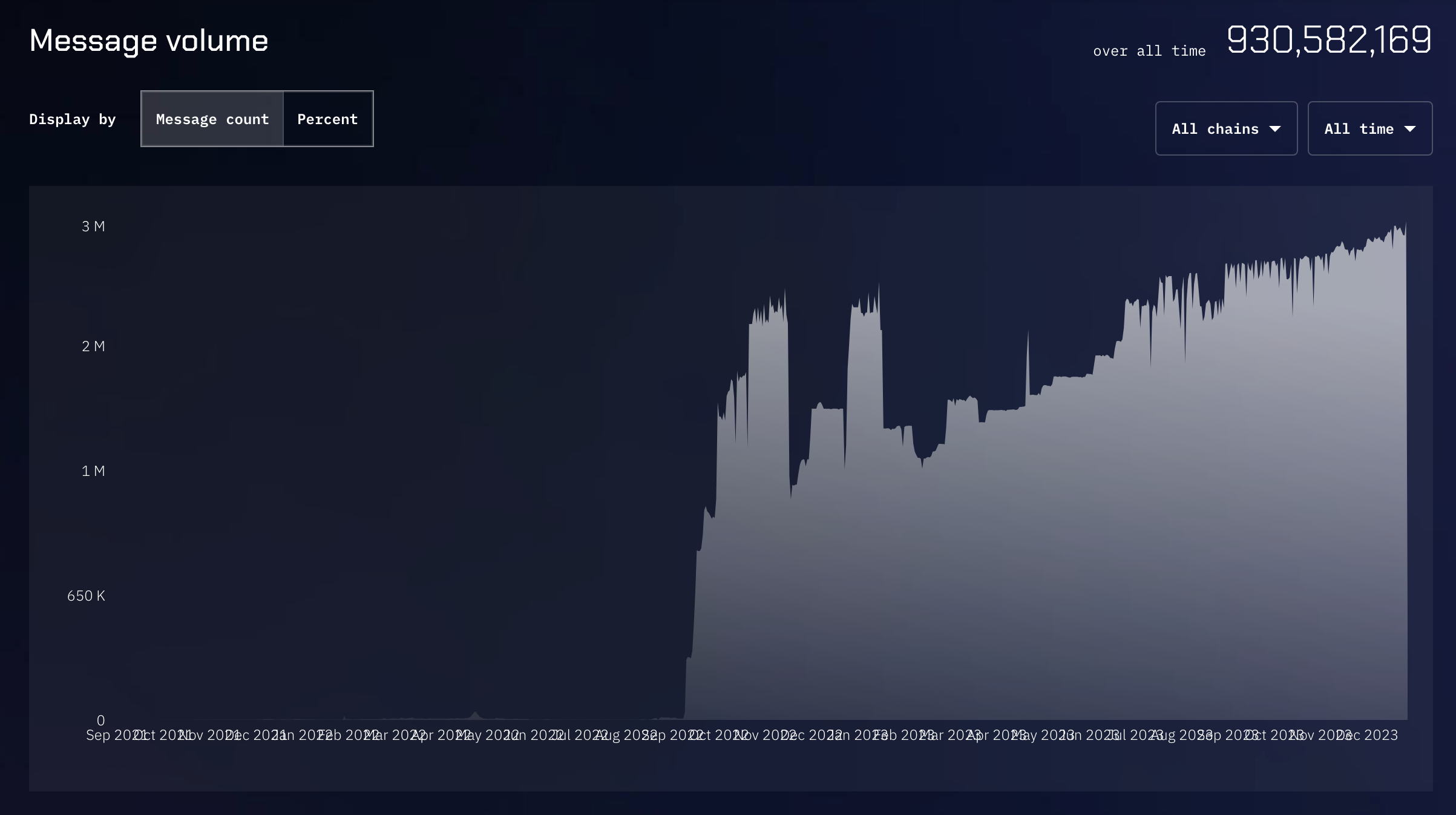
Over 900M messages were transmitted by Wormhole messaging protocol
Further Reading:
Bienvenue dans la communauté officielle TechFlow
Groupe Telegram :https://t.me/TechFlowDaily
Compte Twitter officiel :https://x.com/TechFlowPost
Compte Twitter anglais :https://x.com/BlockFlow_News
 深潮TechFlow