Supra Special Report | How Blockchain and Cryptocurrency Are Revolutionizing the Gaming Economy?
TechFlow Selected TechFlow Selected
Supra Special Report | How Blockchain and Cryptocurrency Are Revolutionizing the Gaming Economy?
Undeniably, the video game industry is one of the largest and most profitable sectors in today's technology and entertainment industries.
 Navigating Web3 tides with focused insights
Author: Suzytu
How Blockchain and Crypto Are Revolutionizing Gaming Economies
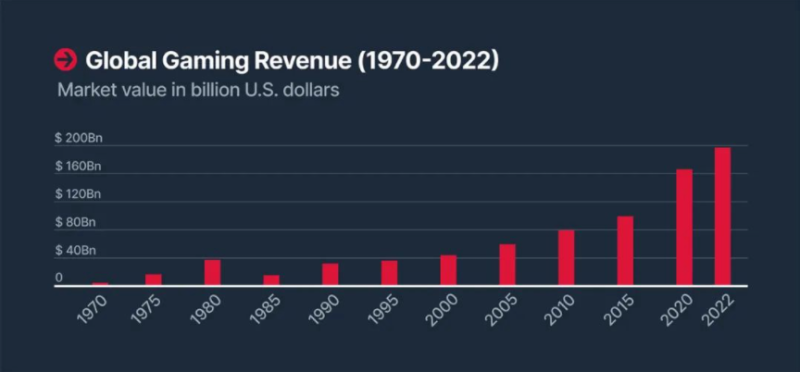
Undeniably, the video game industry is one of the largest and most profitable sectors in today's technology and entertainment landscape. It’s estimated that over a third of the world’s population plays some form of video games. As of the end of 2021, the global video gaming market was valued between $150 billion and $200 billion, with some estimates suggesting it could actually reach as high as $336 billion.
By 2028, the global video game market is projected to grow to an astonishing $545.98 billion, with a compound annual growth rate (CAGR) of approximately 13.20% expected over the next seven years.
Crypto and blockchain gaming may be the fastest-growing and most exciting trend within both the video game and blockchain industries. The crypto gaming sector generated roughly $321 million in revenue in 2020 and exploded in 2021, with the market capitalizations of certain game tokens surging into the billions of dollars. While exact figures for 2021 crypto gaming revenues are hard to pin down, they likely far exceeded $1 billion—especially considering the top five gaming coins currently have a combined market cap of $25 billion, and the total market cap for all crypto gaming tokens approaches $40 billion.
In this article, we’ll explore various aspects of the current state of the crypto and blockchain gaming industry, covering topics such as:
-
How crypto games redistribute profits to players
-
The world’s top gaming tokens
-
The importance of gaming guilds
-
MMORPGs and blockchain gaming
-
Cryptocurrencies and NFTs in traditional games
-
Dynamic NFTs and oracles in crypto gaming
How Crypto Games Redistribute Profits to Players
Video game economics have traditionally been a one-way street. Players purchase games, subscriptions, and in-game items, while all profits and revenues go directly to game creators. However, blockchain and crypto games are attempting to shift this model by enabling players to earn substantial financial returns through consistent gameplay.
With the rise of games like Axie Infinity and the issuance of in-game tokens, currencies, and NFTs, individuals in low-income countries have replaced their full-time incomes by playing crypto games. Some exceptionally fortunate participants have even become millionaires.
Top Gaming Tokens (2021–2022)
As of January 2022, the top gaming tokens by market capitalization were:
-
Decentraland: $6.5 billion
-
Axie: $6.38 billion
-
The Sandbox: $5.56 billion
-
Gala: $3.52 billion
-
Flow (Dapper Labs): $2.95 billion
In the following sections, we will delve deeper into each of these gaming tokens, the platforms they represent, and what makes them so appealing to players and investors alike.
Axie
While this article focuses on broader crypto gaming themes, it would be remiss not to first discuss Axie Infinity—the world’s most popular blockchain-based play-to-earn game.
Inspired by Pokémon, Axie allows players to raise animated pet characters called Axies, which can engage in P2P (peer-to-peer) battles. Axies can generate income through selling, trading, collecting, and staking. The Axie gaming universe features two tokens: Axie Infinity Shard (AXS) and Smooth Love Potion (SLP). AXS is the main governance token of the game, while SLP tokens—earned by winning battles or completing tasks—are required to breed new Axies.
Although Axies are ERC-721 NFTs, they can be sold and traded for AXS, which can easily be converted into Bitcoin, Ethereum, or USD on many major exchanges. In recent months, several Axies have sold for staggering prices. For instance, Axie #643 was sold for nearly £230,000 (approximately $309,000), and is currently listed at an astonishing $623,328. Several other Axies sold for around $230,000 in August and September. Axie also allows users to buy virtual land; a plot was sold for $2.3 million in November 2021, marking one of the largest recorded virtual land sales to date.
Remarkably, the profits earned from Axie have led some players—particularly in developing nations like the Philippines—to quit their full-time jobs to play Axie professionally. Numerous player reports indicate weekly earnings of $300–$350, significantly exceeding average wages in many countries.
However, getting started with Axie can be expensive. It typically costs $1,000 or more to acquire your first team of Axies. As a result, many established members of the Axie community have begun funding new players’ initial Axies through scholarship programs. These sponsors—often lacking the time or interest to play full-time—act more like investors, providing startup capital and taking a predetermined share of the player’s earnings in return.
Decentraland
Operating on the Ethereum blockchain, Decentraland currently holds the title of the highest-market-cap gaming token and hosts one of the largest online virtual land games in existence. The platform enables users to leverage its builder tools to create original art, challenges, and scenes, and participate in events and prize competitions.
However, the core strategy revolves around allowing users to buy and sell virtual land as NFTs on its marketplace. Each landowner controls exactly what content is published on their parcel, and every plot is identified by x and y coordinates, much like real-world property. Beyond land, users can also purchase buildings, wearable avatars, names, and other accessories.
In recent months, prices for Decentraland NFT assets have reached record highs, with one virtual estate selling for a record-breaking $2.4 million in November 2021. Like most secondary market NFT sales on Decentraland, this transaction occurred primarily on OpenSea’s Decentraland Collection, which currently lists nearly 100,000 NFT lands and items for sale.
Unlike many blockchain games, Decentraland is governed via a DAO (decentralized autonomous organization). Additionally, Decentraland controls the MANA token, whose smart contract has been discarded, enabling (in theory) full community governance.
According to Decentraland’s website:
“The Decentraland DAO owns the most important smart contracts and assets that make up Decentraland — land contracts, estate contracts, wearables, content servers, and the marketplace. It also owns a significant MANA wallet, enabling true autonomy and subsidizing various operations and initiatives across Decentraland.”
The Decentraland DAO allows token holders to vote on a wide range of in-game issues, including:
-
Dates and details of land auctions
-
Which new wearable items are permitted or banned
-
What upgrades are allowed for land and estates
-
Which members can join the game’s governing council, known simply as “the Council”
Sandbox
When it comes to virtual land in virtual worlds, The Sandbox ranks second only to Decentraland in popularity. Like Decentraland, players can purchase virtual land. However, The Sandbox differentiates itself in overall gameplay by emphasizing the use of physical elements and materials to create in-game items and experiences. Users can utilize elements such as glass, sand, water, soil, lighting, lava, and even mechanical devices to craft original content.
The Sandbox’s popularity has also been boosted by extensive celebrity endorsements, including The Smurfs, Deadmau5, and Snoop Dogg, who have invested in metaverse land, hosted private metaverse parties, and regularly drop their own original NFTs within the game.
Perhaps most importantly, The Sandbox is more than just its own virtual metaverse—it’s a platform where players can build their own video games without any coding or prior technical experience. Each game creator can monetize their creations through play-to-earn mechanics and market their own digital assets within the game.
Beyond fundraising through its popular SAND token, The Sandbox has attracted significant institutional investment. In November 2021, SoftBank led a $93 million funding round for The Sandbox. Like Decentraland, The Sandbox is built on the Ethereum blockchain.
Gala
Gala is not a game. It’s a platform built on the Ethereum blockchain designed to make it easy for game developers to create advanced blockchain games. Games currently under development on the Gala platform include:
-
The Walking Dead: Empires: A survival-based MMORPG developed by renowned game studio Ember Games, based on the popular TV series.
-
Legacy: A business simulation game built by 22cans for PC and Mac.
-
Echoes of Empire: A 4X space strategy game crafted by gaming giant Ion Games.
-
Mirandus: A fantasy RPG developed in-house by Gala.
Gala currently operates in a semi-decentralized manner, where anyone granted permission by Gala can become an authorized node operator, earning native GALA tokens and limited-edition Gala NFTs. Like The Sandbox, Gala has seen substantial external investment in recent months. In December 2021, Gala announced a $100 million fund in partnership with C2 Ventures to support new game development on the platform, focusing on play-to-earn models.
Although Gala currently runs on the Ethereum blockchain, it is transitioning to its own proprietary blockchain, GalaChain, which promises “nearly free” transactions across the entire Gala gaming ecosystem.
Flow
Similar to Gala, Flow is not a game but a custom blockchain designed specifically for crypto and NFT gaming. Engineered for superior performance, Flow is built to enable games and protocols to attract millions—or even billions—of users to regularly buy, trade, and interact with NFTs.
Unlike traditional blockchains, Flow divides its consensus algorithm into four distinct roles, making participation ideal even for beginners with a reliable internet connection.
According to Flow’s website:
“Validators can join Flow in one of four roles:
-
Collector nodes enhance efficiency
-
Consensus nodes ensure decentralization
-
Execution nodes enable speed and scale
-
Verification nodes guarantee correctness”
Flow currently supports some of the largest NFT marketplaces and products, including the NBA Top Shot Marketplace, CryptoKitties, and digital collectibles from Dr. Seuss and UFC.
Crypto, Blockchain, and MMORPGs
MMORPGs such as World of Warcraft and RuneScape, mentioned at the beginning of this article, represent one of the largest segments of the video game market. For example, as of December 2021, World of Warcraft had an estimated 116 million players, while RuneScape had around 48 million players across its original and classic versions. However, MMORPGs have yet to gain widespread traction in the blockchain and crypto space—but this is slowly changing.
Some of the most popular blockchain-based MMORPGs currently on the market include:
SolChicks
SolChicks is currently the most popular blockchain MMORPG. It functions similarly to Axie Infinity, allowing players to breed, train, and purchase playable NFTs, battle them for rewards, and then sell those rewards. Players can also participate in multiplayer online battles (team vs. team) to maximize potential earnings.
SIDUS
Sidus is a browser-based sci-fi action game that allows players to embark on galactic adventures and loot the galaxy for rewards. Players can train and upgrade NFT-based legions, engage in large-scale team battles on multiplayer battlefields, and participate in one-on-one duels.
Players can also craft new in-game items, trade and sell them, breed and train wild creatures, farm resources, and even take part in an interstellar council.
Worldwide Webb
Worldwide Webb is a pixel-art-based virtual world game. Unlike others, it allows gamers to import their own NFTs and use them as playable character avatars. The game currently supports interoperability with popular projects such as CryptoPunks, Cool Cats, ApeGang, HeadDao, CryptoToads, and CyberKongz. As in Decentraland, players can purchase in-game land on OpenSea. They can also participate in interactive NPC quests.
The Importance of Gaming Guilds
Since the mid-1990s, with the development of MMORPGs like World of Warcraft and RuneScape, gaming guilds and clans have become increasingly popular ways for players to unite, leverage economies of scale, complete team missions, and earn more in-game currency for upgrades.
However, prior to the emergence of crypto and blockchain gaming, gaming guilds were typically limited to a single game and—with rare exceptions—did not generate real-world profits. Yet, over the past year, crypto gaming guilds have exploded in popularity and even secured real-world venture capital funding.
For example, in 2021, major venture funds such as Andreessen Horowitz (a16z), Pantera Capital, and DeFiance Capital led multiple seed rounds for gaming guilds. Yield Guild Games raised an impressive $22.4 million, while GuildFi secured an equally remarkable $6 million seed round.
Like traditional gaming guilds, crypto gaming guilds allow members to improve their in-game economic standing—but now with real money involved. In many cases, guilds fund new players’ activities, enabling them to purchase necessary in-game tools and upgrades in exchange for a percentage of their in-game earnings.
Moreover, a key difference between traditional and crypto gaming guilds is that the latter are not limited to a single game. Instead, they fund and support players across multiple blockchain-based games, diversifying their investments and maximizing potential profits.
As previously mentioned, a prime example is the sponsorship model popularized in Axie Infinity, where guilds help new players access expensive Axies (digital creatures) by renting them out.
Some analysts believe that guilds—not the games themselves—may become the true power players in the new crypto gaming metaverse, as their endorsement (or lack thereof) could make or break a game. This leverage could help ensure that crypto and blockchain games remain fair and profitable for players, especially regarding tokenomics. For instance, if a game’s creators hoard tokens or unfairly manipulate in-game NFT prices, guilds might switch to a different game, potentially taking thousands of loyal players with them.
Beyond impacting the emerging crypto gaming industry, some of the most prominent crypto gaming guilds—including Merit Circle, YGG, and GuildFi—have begun issuing their own tokens. Some have even formed DAOs to decentralize leadership and prevent dominance by wealthy “whale” members, fostering a more inclusive environment for new players.
According to CoinGecko, the largest guild, YGG, currently has a market cap of $461 million. While this is much smaller than the capitalization of top crypto games, this could change as guilds grow larger and more influential.
Cryptocurrencies and NFTs in Traditional Games
Many traditional game companies, witnessing the stunning success and growth rates of crypto and blockchain games, are now seeking to join the trend. Recently, EA (Electronic Arts) CEO told investors that collectible NFTs are “an important part of the future of our industry.” Over $100 billion was spent on in-game virtual goods in 2021 alone, so it makes sense for many video game companies to convert these items into NFTs to increase scarcity and foster secondary markets.
However, integrating NFTs into traditional games is still in its early stages. Recently, gaming giant Ubisoft announced plans to introduce NFTs into its popular game Ghost Recon. These NFTs, dubbed “Digits,” will initially be released as in-game items, including gear, weapons, and vehicles. Each item has a unique serial number, and only one copy per player is allowed, increasing rarity over time.
Ghost Recon’s NFTs will be built on Tezos, a proof-of-stake blockchain, which Ubisoft hopes will alleviate concerns about the environmental impact of minting and transferring NFTs on blockchains like Ethereum, which has not yet fully transitioned from proof-of-work to its planned proof-of-stake model. While these NFTs can be resold, they are not dynamic and do not affect gameplay, which may limit their appeal, as NFTs in many (if not most) blockchain-native games directly influence gameplay.
Zynga, creator of the popular social game FarmVille, also plans to enter the NFT market and has announced intentions to sell thousands of NFTs in 2022.
While some traditional game companies are embracing the trend, others remain cautious. Valve recently banned blockchain games from running on Steam, while Xbox and Epic Games (creator of Fortnite) have stated they have no plans to include NFTs or cryptocurrencies in future products, citing concerns over player exploitation.
These concerns are not entirely unfounded. For example, fans of the popular online game Neopets began protesting the game’s NFT launch in October, urging players to boycott until the project was canceled.
Whether NFT launches excite users or provoke strong backlash will largely depend on how they function within the game ecosystem. If NFTs, tokens, and cryptocurrencies are perceived as enhancing financial incentives for users—as in play-to-earn models like Axie Infinity—they may be seen as a net benefit. But if NFTs are launched at excessively high floor prices and offer little opportunity for players to profit, they may be viewed as greedy cash grabs by video game developers solely interested in boosting profits.
Dynamic NFTs and Oracles in Crypto and Blockchain Gaming
If there’s one thing nearly all blockchain and crypto games have in common, it’s NFTs. Most of these NFTs are static, meaning they remain unchanged over time. However, dynamic NFTs—those that evolve over time or in response to external conditions—are likely to grow in popularity. For example, Ubisoft’s Digits NFTs mentioned above are actually dynamic NFTs, changing in nature each time they are transferred or sold to a new user.
Beyond in-game influences, dynamic NFTs within games may also respond to real-world external events—such as news, token prices, weather data, political developments, or other factors. For instance, an NFT in a military strategy game might change based on the real-world strength of armed forces or similar metrics. Since blockchains are typically closed systems with limited access to external data, these dynamic NFTs often rely on oracles—third-party software providers that bring off-chain, real-world data onto the blockchain. Oracles can be centralized or decentralized.
However, oracles won’t be the only software products used in the rapidly growing crypto and blockchain gaming industry. Just as blockchain and crypto have influenced the gaming market, games within the blockchain and crypto world may inspire new blockchains, protocols, and software solutions to meet the fast-evolving needs of this dynamic sector.
Join TechFlow official community to stay tuned
Telegram:https://t.me/TechFlowDaily
X (Twitter):https://x.com/TechFlowPost
X (Twitter) EN:https://x.com/BlockFlow_News