








mfers: The "Sang" Culture — A New Web 3.0 Tribe in the Post-Subculture Era
TechFlow Selected TechFlow Selected
mfers: The "Sang" Culture — A New Web 3.0 Tribe in the Post-Subculture Era
The conceptual design of the NFT PFP project mfers and its highly self-driven community resonate with the global rise of "cynical youth culture."
 Navigating Web3 tides with focused insights
Author: Mingzin
Editor: Yusheng
This article is an entry for the DeFieye Web3 Essay Contest, republished by TechFlow with authorization.
In my previous article "Azuki: Japanese Animation and Post-National Identity in Web3.0," I discussed how Azuki, as a continuation of Japanese anime aesthetics, reflects the resonance between Web3.0's decentralized ideals and the virtual worlds depicted in Japanese sci-fi animation—alongside global aspirations toward an idealized "post-national identity." However, within this complex global cultural landscape, such hybrid stylistic elements and their diversified models have not achieved dominant influence. It seems that the general public resonates more strongly with something else—something that better mirrors our current collective mindset.
If we were to describe the spirit of the times (zeitgeist) in one word, people from different regions might use varying terms, yet their core values share universal qualities. In June 2021, mainland China witnessed a massive social movement known as "lying flat" ("tang ping"). This was a form of "passive resistance," reflecting young people’s attitudes toward unavoidable societal issues such as the 996 work culture, cutthroat competition ("involution"), and ineffective labor laws. As New York Times journalist Cassady Rosenblum pointed out, similar phenomena exist beyond China—even in Western countries like the United States, the sacredness of work has already been demystified.
Thus, people worldwide are re-evaluating so-called "positive energy," the glorification of relentless struggle, and grand narratives like the American Dream. The collapse of these beliefs inevitably triggers counter-movements and behaviors. The NFT PFP project mfers, with its conceptual model and highly organic community, directly responds to the globally emerging "culture of despair." This article will explore the Web3.0 cultural phenomenon sparked by mfers through two lenses: the culture of despair and new tribes under post-subcultures.
Note: I consider the "culture of despair" under post-subcultures as a branch of postmodernist culture; its core values include resistance to grand narratives, nihilism, fragmentation, etc.—all fundamentally aligned with postmodernist ideology. Of course, the complexity of postmodernism deserves deeper discussion. Due to limitations in my knowledge base and article length, our focus remains on analyzing NFT PFP projects rather than offering a comprehensive study of postmodernist culture—apologies for any shortcomings. While using appropriate academic language, in this article, the term "postmodernism" is used interchangeably with "culture of despair" to accommodate non-academic readers.
From a stylistic and content perspective, NFT PFP projects can be broadly categorized. BAYC (Bored Ape Yacht Club) and mfers compete in the same arena and share similar creative value orientations. In an interview with Rolling Stone reporter Samantha Hiossong, BAYC’s lead designer Seneca explained that the bored ape design closely reflects her personal aesthetic—a monkey who, despite having all the money and time in the world, still feels weary of life. Similarly, mfers’ creator Sartoshi stated in his essay “what are mfers” that he emotionally identifies with the stick figure he draws. That slouched, smoking stick man lazily typing at a keyboard made him realize this character was essentially himself within Web3.0.
Both artists subtly project their own social personas into their designs, and it is precisely these unpolished, raw NFT characters that move people and evoke empathy. Professor Su Hongyuan from South China University of Technology, in his paper “Social Representation and Reflections on Online 'Culture of Despair' Under the Perspective of Post-Subcultures,” states: “The culture of despair primarily refers to the helplessness felt by post-80s and post-90s generations when confronted with social stratification, life difficulties, and work pressure—trapped in a vortex of negative, confused, or even desperate emotions—leading them to ironically mock and self-deprecate their numb, decadent lifestyles through textual, visual, or audiovisual symbols.” The symbolic meanings carried by these NFT characters, along with their immense popularity in the NFT market, reflect real-world social conditions—the widespread mentality of pessimism, disillusionment, and escapism.

BAYC #4671
We seem to see such an expression in Bored Ape #4671—an apathetic, world-weary ape who cannot feel joy even at what should be a lively party. Its heavy dark circles and deeply depressed gaze reveal profound psychological depth, embodying what Professor Su described as emotional numbness under the culture of despair. The striking contrast between the eye-catching party hat and its gloomy expression places the ape in an even more absurd situation—like being thrust into the hellish scene from Sartre’s play *No Exit*, trapped in a party under constant scrutiny. Gargamel, one of BAYC’s co-founders, also noted that the emotions evoked by the Bored Apes contain a sense of existential boredom.

mfer #1571
As one of the most minimalist and seemingly least "creative" NFT PFPs, mfers should theoretically have been overshadowed by meticulously designed, attention-grabbing projects. Surprisingly, its style has instead shamed many otherwise high-quality projects. Unlike BAYC’s path to success, mfers’ minimalism became its key strength—not only aligning with postmodernism’s rejection of high art and elitism but also making its crude drawing style (lacking verisimilitude) more relatable in conveying bodily gestures and emotional states.
“As micro-images of the internet age, ‘despair-themed’ memes, with their intuitive imagery and connotations of self-mockery and decadence, have become visual symbols favored by youth for emotional release.” It’s clear that mfers’ character design rivals memes in visual impact and virality, enabling direct emotional resonance. From this angle, mfers not only inherits the deeply contemporary, negative attitude seen in despair-themed memes (like Pepe the Sad Frog), but its status as an NFT-owned asset has also led to early cult-like追捧 similar to Pepe cards. Thus, owning a unique mfer NFT equates to owning the right to express one’s stance in Web3.0.
Rather than rejecting the abstract image that reflects their real lives, members of the mfers community embrace it with self-deprecating humor. Behaviors such as slouching in chairs, operating computers, or casually smoking vividly depict the lifestyle of crypto communities in Web3.0 (e.g., Sartoshi, the “crypto-native” designer, identifying with mfers). Meanwhile, Chinese mfer community members who grew up during the millennium-era internet surfing culture are stirred by nostalgic feelings (as shown in the image below); this demonstrates that the expressive demeanor of mfer characters possesses a timeless, globally shared quality.
The success of BAYC and mfers lies in establishing consensus mechanisms rooted in current public psychology—a homogenized cultural manifestation of global zeitgeist: the culture of despair (postmodernist culture). Only through cultural consensus and seamless community integration can a project maximize the reach of its “despair” characteristics in Web3.0. Yet this perfect fusion is fully realized only in mfers, not its predecessors. In BAYC’s case, newer NFT projects (such as Mutant Apes adopting body horror elements) have strayed from Seneca’s original aesthetic and philosophical vision. Moreover, their high prices make them inaccessible to the average person. (Seneca herself emphasized that the existential crisis of the Bored Apes stems from having unlimited wealth and time—distinct from the more universally relatable “despair” embodied by mfers.)
If there is a class dimension to the culture of despair in Web3.0, then mfers represents the “proletariat” under postmodernism, while BAYC resembles the elites of modernism. Anti-elitist sentiment runs deep in every mfer’s veins.

BAYC #6444 and mfer #9791
In traditional subcultures, people could only express tribal identity through collective symbols in physical spaces—such as the visually jarring hairstyles of the “shamate” youth. With space becoming virtual, post-subcultural communities place greater emphasis on cultivating shared emotional experiences through cultural construction. As a Web3.0 post-subcultural community, mfers thrives within the decentralized framework offered by Web3.0. Furthermore, Web3.0 and the metaverse’s redefinition of the social attributes of “virtuality” provides strong backing for NFT PFPs.
Sartoshi claims that in his envisioned mfers world, we are all mfers. (The full name “mfers” stands for “motherfuckers”; in Chinese context, translating it as “little bastards” captures the tone better—and I have community members’ approval for this interpretation.) French scholar Michel Maffesoli observed: “New tribes in the post-subcultural era lack the rigid structures of traditional organizations. Instead, they point toward certain atmospheres or mental states, offering members a sense of belonging and serving as emotional bonds uniting the group.” As a new tribe under post-subculture, mfers communicates the message: “We’re all little bastards.” This blunt slogan embodies the self-deprecating, decadent spirit of the culture of despair, while the decentralized Web3.0 environment empowers them to resist oppression from centralized Web2.0 platforms and real-world society.
In today’s post-capitalist era, everyone experiences alienation to some degree through social practice. This state of estrangement brings loneliness and emptiness that cannot be resolved in reality—especially under a societal discipline that cruelly imprisons souls. Sartoshi says: here, we have no kings, no rulers, no clear roadmap. This beautiful anti-centralized ideal not only frees members from dual identities as “losers” and “prisoners,” but transforms mfers into a self-driven, intrinsically motivated new tribal community. Unlike NFT PFP projects requiring marketing campaigns, mfers community members voluntarily uphold and promote its ethos. Due to their genuine beliefs and non-profit-driven mindset, mfers stands out uniquely among current NFT PFP projects.
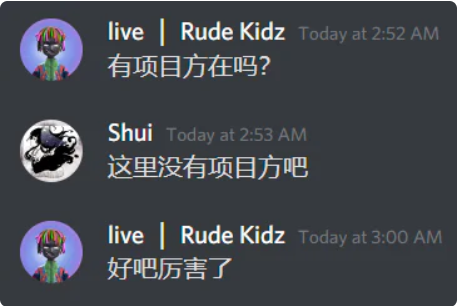
mfers was the first project in Web3.0 to actively relinquish intellectual property rights—and it has no official team. This fully proves that mfers belongs to everyone because everyone *is* an mfer. By abandoning the traditional role of project managers, power is truly distributed among every single mfer. No one controls the future of mfers—because the future of mfers rests in everyone’s hands.
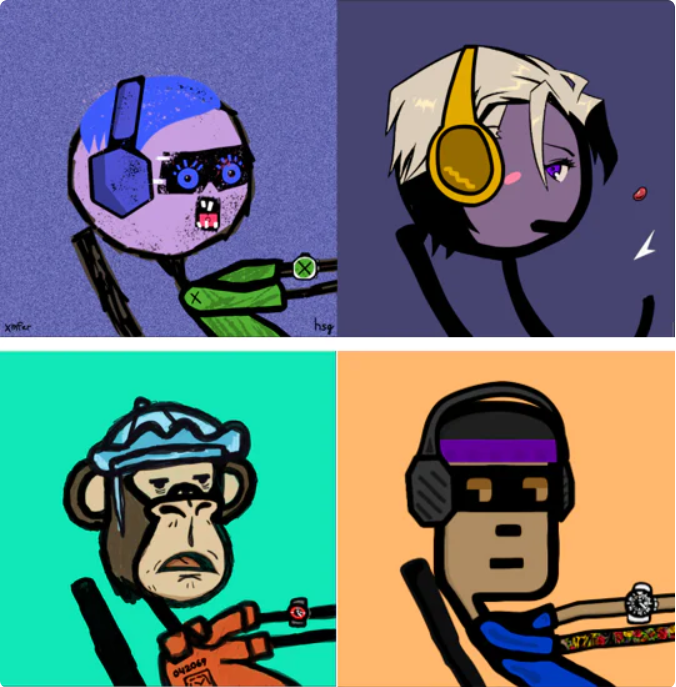
xmfer #3024, Zuki mfer #2758, ape mfer #3754, Punk Mfers #5653
In mfers’ “official unofficial” Discord channel, members are even allowed to promote their own NFT PFP projects. Even though this may potentially threaten the interests of original mfer holders, community members still encourage such behavior—and often voluntarily help promote others. All of this stems from their spontaneous desire to spread the mfer community spirit. In this light, mfers’ philosophy achieves perfect alignment with the utopian vision of Web3.0—both committed to building a decentralized world where every member is respected and enjoys equal status and rights.
As discussed above, the success of the post-subcultural NFT PFP project mfers manifests in two aspects:
First, mfers carries forward both the Asian concept of the “culture of despair” and the Western notion of “postmodernism.” Aesthetically, its rough yet sincere design challenges conventional definitions of “art.” The minimalist stick-figure style allows people—especially long-time denizens of virtual online worlds—to deeply identify with the mfer characters. Culturally, mfers inherits the values of self-mockery and passivity that resonate widely among the general public in the late-capitalist internet era. These two aspects ensure mfers enjoys meme-like viral propagation advantages and unique cultural significance.
Second, mfer community members, as a new tribe under post-subcultures, gain free and equal identities within Web3.0’s decentralized world. Inspired by the manifesto “what are mfers,” members organically build the community themselves. This organic vitality attracts countless individuals who resonate with the mfer image, fostering deep yearning for this new decentralized Web3.0 tribe.
mfers is precisely the culmination of today’s zeitgeist, autonomous post-subcultural communities, and Web3.0 decentralization.
And what Sartoshi calls “no roadmap” is, in fact, the clearest roadmap mfers could ever have.
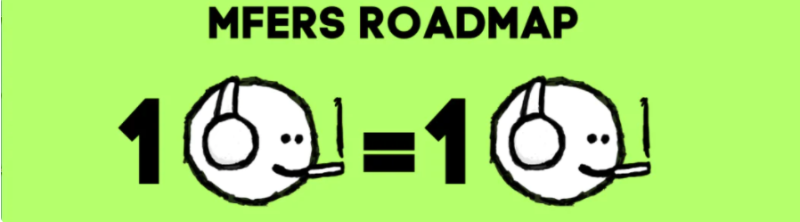 blackblizeᵐᶠᵉʳ#7979
Join TechFlow official community to stay tuned
Telegram:https://t.me/TechFlowDaily
X (Twitter):https://x.com/TechFlowPost
X (Twitter) EN:https://x.com/BlockFlow_News






