Flat-top containers and NFT running shoes: Some insights from STEPN
TechFlow Selected TechFlow Selected
Flat-top containers and NFT running shoes: Some insights from STEPN
The potential of STEPN, beyond the internet product development path of fitness, health, and social interaction, can also be explored from a brand perspective.
 Navigating Web3 tides with focused insights
Original: hongyu
STEPN is a "move-to-earn" NFT-based mixed-reality blockchain game that once ranked fourth in the gaming category at SolanaVenture’s IGNITION Hackathon IV.
In the game, players purchase NFT running shoes and use them within the app to mine daily through walking or running. These NFTs can be bought on Magic Eden or the in-app marketplace. Due to strong demand, the floor price reached 7.88 SOL (as of February 18), maintaining solid value, while GST has also shown steady growth.
Recently, the project secured $5 million in funding led by Sequoia India and Folius Ventures. Investors include Solana-affiliated entities such as Solana Venture, Solana Eco Fund, and market maker Alameda, along with funds like Spark Digital. Huofeng Capital also participated in the KOL round as an advisor.
In my view, STEPN's gameplay appeal stems from two aspects: one being its internal game design—its economy, progression mechanics, and breeding system—and the other being its stronger real-world integration compared to typical blockchain games, offering deeper compatibility with consumer-facing logic.
Therefore, beyond following the development path of internet fitness and social products, STEPN also holds potential for exploration from a brand perspective.
The Locked Flat-top Trunk
Reviewing the history of Louis Vuitton may offer valuable insights into STEPN’s future trajectory.
LV emerged between the 1840s and 1890s, shaped by three critical factors:
-
The birth of tourism
-
The spread of steam engines
-
Innovative design
In 1837, the founder left his hometown on foot to apprentice under Monsieur Maréchal, a trunk-maker in Paris, primarily assisting customers with packing luggage.
By then, about 115 years had passed since Thomas Savery invented the first commercial steam engine. Steam technology was already widely applied. Savery’s engine solved mine drainage issues, and Newcomen later improved it, leading to broad adoption across mining. After over a century of iteration, steam power expanded beyond mining into nearly all manufacturing sectors—including transportation.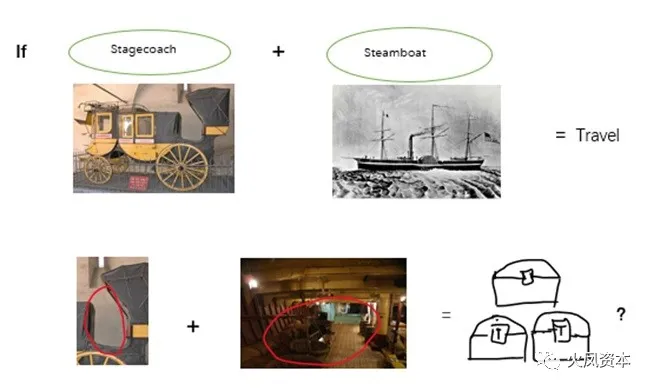
At this time, trains and steamships had become part of European life, and stagecoaches still handled much long-distance travel. However, supporting infrastructure lagged behind. Clearly, dome-shaped trunks were unsuitable for stacking and organizing large quantities of luggage—they could only be placed individually, and even when stacked, they easily slipped and damaged contents, resulting in poor space utilization.
In 1841, Thomas Cook chartered a train to transport 570 people from Leicester in central England to Loughborough for a temperance meeting. The round trip covered nearly 18 kilometers, costing one shilling per person, including a free ham lunch, snacks, and a choir. This event is recognized as the world’s first commercial tour.
This act marked the beginning of modern tourism—the tradition of the “Grand Tour,” previously accessible only to European nobility and the wealthy, began spreading to the general public. Travel became cheaper, safer, and more comfortable, opening up to everyone. Long-distance travel gradually turned into a frequent activity, revealing many unmet needs:
-
Securing personal belongings
-
Portability and stackability
-
Ease of packing
...
These needs existed across all social classes, intensified by the rise of commercial travel. While various compromises might satisfy them temporarily, people sought a more reliable and convenient solution.
Around the same time as the emergence of commercial travel, Louis Vuitton completed his 17-year apprenticeship and went on to serve as a royal packer for Empress Eugénie de Montijo. Soon after, he launched his own venture and invented the world’s first flat-top trunk. Made with waterproof canvas exterior and poplar wood frame, it was lighter and easier to stack than traditional domed trunks, quickly gaining popularity among travelers:
This invention established the standard for Steamer Trunks (steamship luggage).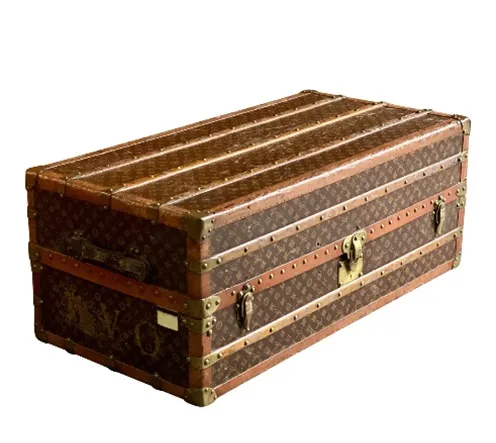
Louis Vuitton Steamer Trunk Wardrobe Trunk Chest France, circa 1920, available for purchase on chairish.
With this hit product, LV opened its workshop in Asnières in 1859. In 1886, Georges, the successor, introduced a single-lock system with dual spring clasps, marking the maturity of LV’s luggage line.
Safety, portability, and industry insight built on practicality—these enabled LV to survive over 170 years to the present day.
This reflects an outstanding founder profile—one combining bottom-up execution with top-down industry vision. Whether addressing commoners’ luggage needs or those of aristocrats and royalty, deep empathy and insight were key. LV captured the core demands of “security” and “portability” to steadily grow.
From LV’s journey, we clearly see that brand bootstrapping doesn’t start with “aesthetic identity.” Instead, it begins with a new scenario, leveraging strong utility and novel solutions—value for money—then gradually evolves toward higher-order needs. Innovation in gameplay or technology is the fuel, experience and insight are the steering wheel, and marketing is the engine.
Sneakers That Can Breed and Level Up
Clearly, top-tier brands possess new prerequisites that distinguish them from previous eras:
-
LV: Steam engines, ships, and trains
-
Stussy: Transistors, color TVs, hippies, reggae, street culture
To summarize: the first layer is technological advancement, the second is applications of that technology, and the third is new scenarios—or new ways of using those applications. For example, the steam engine is Layer One; trains and ships are Layer Two (applications); and what you do on those trains and ships constitutes Layer Three—new behaviors.
Whenever technology makes a certain need cheaper, non-productive desires rapidly become dominant. Steamships and trains enabled recreational travel; TVs and Black music elevated streetwear into a cultural phenomenon—these factors laid the foundation for new lifestyles.
STEPN dances to this rhythm too—you can think of it as a composable play pattern combining:
-
Smartphones
-
Cryptocurrency: NFTs and FTs
-
Gaming
-
Fitness and wellness awareness
...
The crucial difference is that without cryptocurrency, STEPN loses its soul and becomes just another ordinary running app. There are many homogeneous fitness apps; due to Web2’s winner-takes-all dynamic, most have already collapsed, leaving only a few dominant players who’ve built their own data–traffic–capital moats.
As Ernest Adams once noted:
The gaming industry categorizes games by playability—some derive fun from internal economies, others from physics, level progression, or social interaction.
STEPN’s appeal lies precisely in progression mechanics and internal economics. The former ensures accessibility—users understand it involves running and exercise, so entry is easy without needing to grasp complex rules. The latter, driven by tokenomics, determines whether users will keep going.
From the player’s perspective, STEPN’s core gameplay centers around running. Entry requires purchasing a sneaker NFT. Rewards come in the form of $GST and additional NFTs. Player motivation is driven by both health and profit incentives—this positioning creates clear differentiation:
-
Compared to blockchain games: Lower barrier to entry, not purely incentive-driven—health matters too
-
Compared to DeFi: Not solely APY-driven—there’s actual gameplay
-
Compared to regular walking/running apps: Move-to-earn removes boredom
...
Co-founder Yawn mentioned in MableJiang’s podcast that they realized they’d entered the market late, which led them to choose the move-to-earn niche.
“Game itself isn’t a great direction, but gamification is. We want to build a product with strong gamification—not necessarily a game.”
STEPN’s gameplay works like this: Players buy sneakers as tickets, then simply tap “Start” in the app to begin—its interface resembles many sleek Web2 micro-apps.
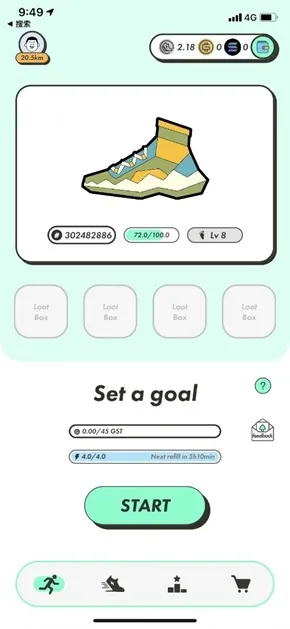
There are four types of sneakers: Walker, Sneaker, Jogger, and Trainer. They start at Level 0. A single shoe’s energy cap is 2, increasing to 3 for rare green shoes and 4 for purple ones. Different types have varying speed caps for walking/running. Daily $GST earnings start capped at 5, which can be increased by acquiring more shoes. The earning cap can also be raised via upgrades. Below is the whitepaper’s comparison table of shoe types and base returns:
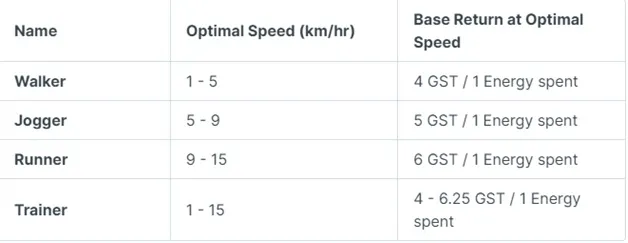
According to upgrade rules, leveling a Walker from 0 to 28 requires summing GST costs from levels 1 to 28, minus special costs at Level 5 (10 GST), Level 10 (30 GST), and Level 20 (80 GST). Thus, the total cost to reach Level 28 is approximately 491 GST. From Level 28 onward, GMT is required. Each upgrade grants 4–12 points to enhance attributes across four categories:
-
Efficiency: Determines how much GST/GMT earned per unit of energy
-
Luck: Affects chance of treasure chest drops
-
Comfort: Influences buff probability
-
Resilience: Determines repair cost
These are all consumption sinks for $GST. When the author’s Walker reached Level 7, repair cost was around 0.4 GST per durability point, while generating about 14 GST per day with 4 energy units. Theoretically, players can adopt various strategies to maximize returns:
-
Focus on Efficiency and Resilience: This doubles your shoe’s earning efficiency per level, potentially quadrupling during double-energy events. But chest drop and buff rates will be very low
-
Focus on Luck or Comfort: Suited for gamblers—less grindy, but luck-dependent
-
Drop Luck, focus on Efficiency, Resilience, and Comfort: Balances grinding with luck
...
This covers only basic upgrade strategies. Many players employ smarter tactics—for example, buying 10 sneakers at once, spending heavily to level them to 5, then pairing them to mint new shoes—producing one new shoe per day for five days, ending with 15 shoes total.
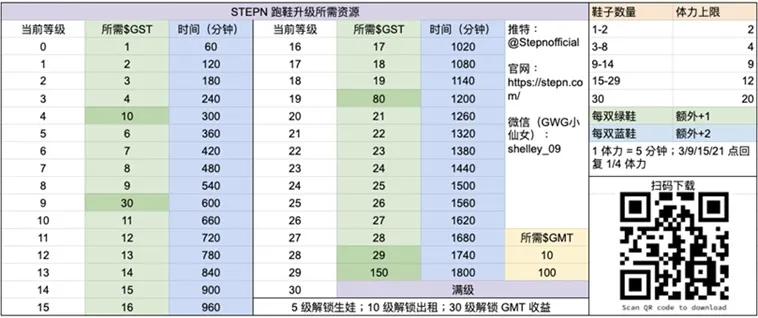
Assuming continued running, if among these 10 shoes there are 6 Walkers, 3 Joggers, and 1 Runner, total daily energy expenditure would be 20. Upgrade costs would be around 200 GST. Using the Runner as the main shoe, ideal daily earnings could reach ~120 GST—though actual income varies within a range, fluctuating like tides.
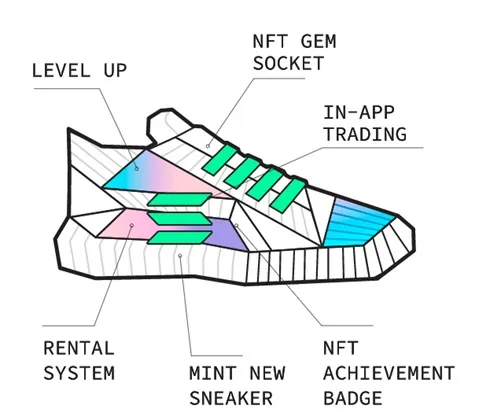
By now, it’s clear STEPN differs greatly from apps like Yuetai or Qubu. Yuetai is a standard mobile social app unrelated to tokens, constrained by compliance and technical architecture from embedding a native token economy, thus unable to create an endogenous economic loop. Users cannot benefit from token appreciation. Qubu, meanwhile, is a reckless Ponzi scheme.
STEPN’s future isn’t about how many fitness users adopt crypto, nor about replicating fitness app penetration. It’s about NFT sneakers that let you earn. The key question is whether you recognize this as a new scenario:
-
Crypto users spend long hours at computers and need more physical activity for health
-
For non-fitness enthusiasts, exercise is boring and requires external incentives
-
Crypto natives expect rewards involving both FTs and NFTs
-
Non-fitness users are mostly outsiders accustomed to app usage
...
There are also hidden needs, such as:
-
Newcomers find it hard to enter the crypto rabbit hole—user habits must shift
-
Most users in developing countries access the internet via mobile phones, requiring mobile-first design
Whether shoes or exercise, STEPN’s core lies in strong real-world integration. Not to mention the arbitrage potential of $GST.
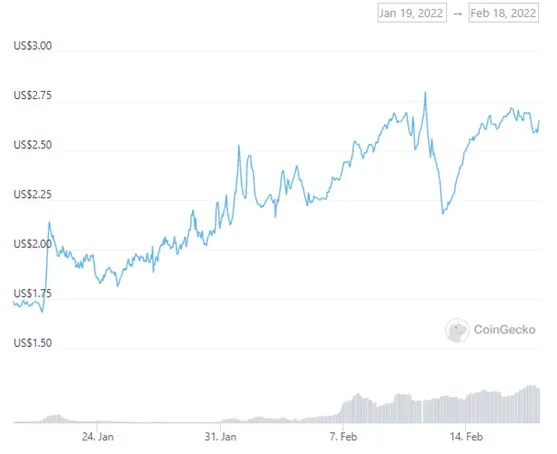
NFTs have intuitive utility. Advanced earning strategies are highly scalable. Its low-carbon, health-positive values align with mainstream ideology and self-improvement goals. Players can't easily rent-seek through simple "mine-and-dump" tactics—returns are implicitly capped and diversified.
This approach attracts users whose motivations go beyond mere profit-seeking. To some extent, it solves prior issues in blockchain gaming, helping avoid death spirals during bear markets—the biggest threat facing most blockchain games.
As an investor, I reviewed many blockchain game projects last year but remained skeptical of most:
-
What distinguishes them from gamified DeFi? Scenarios are highly homogenized, targeting only crypto-native users, yet they can’t compete with yield farming APYs
-
Where’s the gameplay? Honestly, most are pre-demo, cobbled together with no coherent narrative. Nothing suggests they’re fun—only graphics and modeling to look at. No hope of appealing to mainstream users
Poor gameplay, crude DAO and reward designs, singular and repetitive token use cases, relying on blunt methods to prevent dump-selling, lacking deep consideration for ecosystem stability—most of these games end up ignored and fade away. Even the best marketing can’t save a bad product.
Whether STEPN can continue expanding remains to be seen—it depends on its brand and community strategy in becoming a unique offering, and whether its embedded scenario can scale into a widely recognized new form of exercise, fostering new brand loyalty:
Crypto OGs don’t use Keep or Yuetai for running—they use STEPN.
Finally, I believe STEPN represents an exploration of the future of on-chain applications, raising two important questions:
-
Whether for GameFi or social apps, do on-chain applications need to seek out more undiscovered use cases?
-
To bring more people into crypto, should we propose solutions to real-world problems?
Reality remains unchanged. Those unwilling to endure boring workouts, those gamers trapped by prejudice—they need something new to prove themselves. If you don’t seize it, someone else will. As Chris Dixon said:
“Your take rate is my opportunity.”
References:
-
A Legendary History https://us.louisvuitton.com/eng-us/magazine/articles/a-legendary-history#the-begining
-
STEPN Whitepaper: https://whitepaper.stepn.com/
-
Folius Ventures Research Report: Game Special Issue – From Slavery to Independence
-
Helpful Hints for Steamboat Passengers: https://iowahist.uni.edu/Frontier_Life/Steamboat_Hints/Steamboat_Hints2.htm
Join TechFlow official community to stay tuned
Telegram:https://t.me/TechFlowDaily
X (Twitter):https://x.com/TechFlowPost
X (Twitter) EN:https://x.com/BlockFlow_News
 @shenhh88