Understanding Evmos: A Guide to Its Basics, Economic Model, and Participation Risks
TechFlow Selected TechFlow Selected
Understanding Evmos: A Guide to Its Basics, Economic Model, and Participation Risks
Evmos is a scalable, fast, Ethereum-compatible proof-of-stake blockchain built within the Cosmos ecosystem.
 Navigating Web3 tides with focused insights
Written by: Coinbase
Translated by: TechFlow
Key Points:
1) Evmos enables decentralized interoperability between Ethereum-based applications and the independent decentralized blockchain ecosystems of Cosmos, including Cosmos, Terra, Crypto.org Chain, Osmosis, and many others.
2) Evmos’s EVM compatibility and the rollout of IBC allow developers to build using Ethereum-like functionality within a Tendermint environment, enabling users and assets across the entire Cosmos ecosystem to access programs typically found on Ethereum.
3) Due to its EVM compatibility, Evmos is likely to become a hub for web3 development within the Tendermint ecosystem.
4) Validator operators can earn participation rewards by securing the network and adding new blocks to the chain, while any token holder can delegate their Evmos tokens to validators to earn rewards.
Introduction to Evmos
Evmos is a decentralized proof-of-stake blockchain in the Cosmos ecosystem. It is built on the Ethereum Virtual Machine (EVM), meaning it is fully compatible with the Ethereum network.
Evmos aims to bring the world of Ethereum-based applications and assets into the interoperable network of the Cosmos ecosystem, align incentives for developers and users, and drive innovation in the space of EVM and cross-chain composability.
Built using the Cosmos SDK with Tendermint Core consensus, Evmos provides Cosmos-based blockchains with fast finality and high throughput. By leveraging Ethereum’s EVM, developers can deploy their Ethereum-based applications in a Tendermint consensus environment, benefiting from lower transaction fees, faster transaction speeds, and security provided by proof-of-stake consensus.
Evmos also implements Cosmos’s Inter-Blockchain Communication (IBC) protocol, which allows direct sharing of tokens and data between Tendermint-based chains that use it. As a result, EVM applications deployed on Evmos become accessible to participants across the broader Cosmos ecosystem, including Cosmos, Terra, Crypto.org Chain, Osmosis, Cronos, Sentinel, and Secret Network. Users from all 28 IBC-enabled independent blockchains will be able to access various programs available on Ethereum—including decentralized exchanges, marketplaces, lending protocols, NFT applications, games, and more—thanks to developers directly deploying their mature Ethereum application logic onto Evmos.
Evmos evolved from Ethermint, a proof-of-concept launched in 2016 that demonstrated how to deploy EVM-based smart contracts on Tendermint using proof-of-stake consensus. The vision of Ethermint was to support all Ethereum tools, just as Evmos does today, providing Solidity smart contract developers on Tendermint with the same developer experience as those on Ethereum. After IBC launched in March 2021, the Tharsis core development team proposed advancing the Ethereum initiative through community governance via Cosmos Proposal #44. This proposal, now known as Evmos, passed swiftly in April 2021 with 98.31% community support.
EVMOS is the native token of Evmos, used to pay transaction fees, secure the network, and participate in governance decisions such as changes to core protocol parameters and allocation of community funds. Any EVMOS holder can submit or vote on proposals to use the Evmos community pool via the protocol's governance module. The community pool receives 10% of newly minted tokens each epoch.
Why Is EVM Compatibility Important for Evmos?
Deploying and using Ethereum-based applications in alternative blockchain environments has become a multi-billion dollar segment of the web3 ecosystem.
The deployment of Ethereum-based applications in alternative environments is driven by several factors, rooted in built-in interoperability and consistent incentive mechanisms:
1) Access to proof-of-stake consensus,
2) Faster transaction speeds,
3) Lower transaction fees,
4) Expanded user base availability.
Ethereum’s maturity and large user base make it an excellent place to build web3 applications, but this has also led to congestion, resulting in high operational costs and slow transaction speeds. EVM-compatible Layer 1 blockchains like Evmos allow developers to roll out these same applications to a broader set of token holders who can then benefit from the utility provided by the applications. While the concept of EVM compatibility on Tendermint has been prominent since 2016, Evmos is the first permissionless, proof-of-stake, EVM-compatible environment launched across the broader Tendermint ecosystem.
How to Participate in Evmos
There are two types of nodes on Evmos: validator nodes, responsible for verifying transactions and submitting new blocks to the blockchain; and full nodes, which store the complete state of the blockchain and retrieve data when queried. A validator must operate both a validator node and a full node (both included in the Coinbase Cloud validator node cluster), while read/write infrastructure only requires a full node.
The active set on Evmos consists of the top 150 validators with the highest total EVMOS stake (including self-delegated and delegated stakes). A validator is selected to propose the next block based on its total stake relative to the total stake of all validators (for example, if validator A holds 10 EVMOS stake out of 100 total EVMOS stake among all validators, validator A will be chosen to propose a block 10% of the time). A block cannot be added to the chain without at least two-thirds (66%) precommits from the previous block in the form of validator signatures.
To incentivize non-empty block proposals and better networking among validators, the percentage of rewards a validator earns for successfully proposing a block increases as the percentage of precommits included in the block rises from 66% to 100%. You can learn more in the “Rewards and Economics” section below. Delegation on Evmos requires no minimum amount of EVMOS to be staked to a validator. Delegators who do not actively participate in governance automatically inherit the voting preferences of the validator they’ve delegated to. Validators on Evmos charge their delegators a commission fee for participation services, deducted before reward distribution to delegators.
When registering a validator on the network—referred to on Evmos as "declaring candidacy"—validator operators must specify the validator’s initial commission rate, maximum daily commission rate change (the highest percentage by which the commission rate can change per day), and maximum commission rate. Once a validator declares candidacy, these parameters cannot be increased, although operators may reduce them at any time.
Evmos Rewards and Economics
These parameters are set at the protocol level and are not determined by validators or Coinbase. This information may change according to network decisions and is accurate as of 2.4.22.
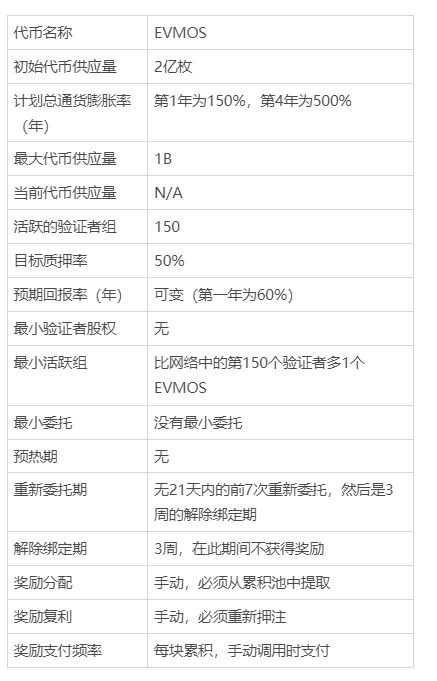
Due to the use of EVMOS to pay transaction/computational fees (gas), the current target staking rate is approximately 50%. The Evmos team notes that if liquid staking naturally emerges on Evmos in the future, the target staking rate could increase.
There are four types of rewards on Evmos: transaction fees are evenly distributed among active validators holding EVMOS, though future governance may enable payment in any Cosmos-based token. Application developers will also receive a portion of EVM transaction fees, split between the validating node and the Evmos dApp Store developer.
Inflationary rewards ("Block Provision") represent a percentage of EVMOS inflation, proportionally distributed to all active participants in the network. Proposer rewards provide 1–5% extra to the validator who successfully proposes a consensus block, increasing based on the number of precommits included from the previous block. Usage rewards account for 25% of block issuance and serve as additional incentives, including deferred gas rebates and liquidity mining, with potential for further rewards through governance.
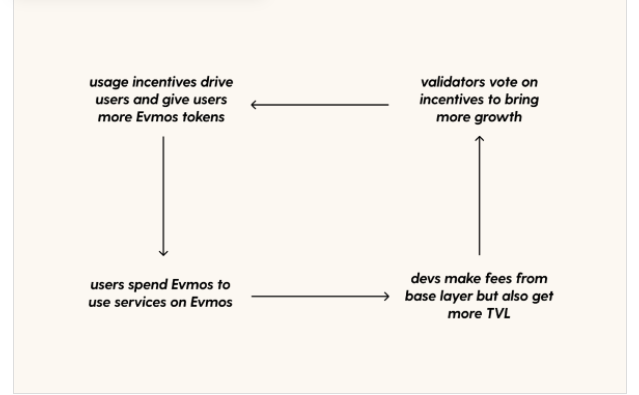
As previously mentioned, proposer rewards increase from 1% to 5% as the precommit inclusion rate in a block rises from 66% to 100%, encouraging non-empty block proposals and better validator coordination. Thus, validators can optimize their rewards by waiting long enough to include validator signatures in the proposed block, without missing the opportunity to propose the next block. The validator’s commission rate is applied to all rewards earned by delegators before they claim rewards from the protocol.
Risks of Participating in Evmos
Slashing is enabled on Evmos. If a validator behaves improperly on the network, both its self-delegated stake and its delegators’ stakes may be slashed, incentivizing delegators to stake their EVMOS with securely operated validators. Certain misbehaviors by validators can trigger slashing penalties on Evmos:
Double Signing: Signing two blocks at the same block height will result in a slashing penalty, though the exact punitive parameters for double signing have not yet been defined.
Downtime: A validator that misses more than 95% of the last 10,000 blocks will incur a 0.01% slashing penalty.
Unavailability: A validator going offline for a certain number of blocks will result in a slashing penalty. If the number of missed blocks exceeds the threshold, the validator will be unbonded and removed from the active set, although the unavailability parameters have not yet been defined.
Poor Security Leading to Malicious Behavior: If a validator is victimized by a Distributed Denial of Service (DDoS) attack, if its private key is compromised, or if other similar unintentional misconduct occurs, its total stake may still be subject to slashing—highlighting the importance of choosing secure, highly available participation infrastructure. Evmos is expected to implement Cosmos’s jail parameters, under which slashed validators will automatically enter a jail period before being eligible to rejoin consensus. On Cosmos, this jail period is currently two days, after which the validator can submit an unjail transaction to re-enter the active set.
Governance on Evmos
Governance will be a feature of the Evmos protocol, though it has not yet been fully defined. Validators will play a significant role in governance, as inactive delegators may automatically inherit the votes of the validators they delegate to. Additionally, validators on Evmos may face minor slashing penalties for neglecting to vote on governance proposals, though this remains undefined. The EVMOS token is the primary instrument for participating in Evmos governance. Any EVMOS holder will be able to submit proposals for protocol upgrades or use funds from the Evmos community pool.
Evmos is expected to adopt Cosmos’s governance parameters. Cosmos uses a "one token, one vote" system, meaning any EVMOS holder can vote on governance proposals without additional weight given to certain votes. However, because delegators who do not vote actively inherit their validator’s vote, validators naturally wield greater voting power if participation is limited. Users on Cosmos can submit governance proposals with a deposit; once the minimum deposit is reached, the proposal enters the voting period. If the proposal is accepted or never reaches the minimum threshold, the deposit is refunded; if the proposal fails, the deposit is forfeited to the Cosmos community pool.
Why Run an Evmos Node?
Validators have significant influence in governance votes on network parameters, reward rates, transaction fees, and accepted fee currencies, especially since inactive delegators automatically inherit the votes of their chosen validators. Given Evmos’s ability to connect Ethereum-based and EVM-compatible applications to the interoperable Tendermint and Cosmos ecosystems, it is poised to become a hotspot for web3 applications and asset transfers—making it ideal for developing blockchain-powered web3 applications.
Join TechFlow official community to stay tuned
Telegram:https://t.me/TechFlowDaily
X (Twitter):https://x.com/TechFlowPost
X (Twitter) EN:https://x.com/BlockFlow_News