Understanding the Evmos Token Model: A Model That Incentivizes Participants and Aligns Interests
TechFlow Selected TechFlow Selected
Understanding the Evmos Token Model: A Model That Incentivizes Participants and Aligns Interests
Evmos offers an alternative to rent-seeking in fat protocols, with network incentives that reward active users and fairly distribute transaction gas fees between deployers of important applications and providers of critical network infrastructure.
 Navigating Web3 tides with focused insights
Author: Tharsis
Translation: Alex, TechFlow
The EVM is coming to Cosmos, bringing with it battle-tested smart contracts and a new native token, offering a glimpse into how L1 networks might evolve in the future to more fairly distribute value across the stack instead of trying to capture it all.
The introduction article on the Rektdrop highlighted just how much DeFi and NFT dApps have changed the game on Ethereum. High gas fees are painful and prevent value from accruing to those who truly deserve it. But if dApps drive excitement, why can't developers and users capture more of the network's tokens? What could be done?
The Evmos incentive system and token distribution model outlined in this article represent the first step toward building an L1 that aligns stakeholders rather than alienating them. Our vision for the network starts with tokenomics and what developers can do.
Evmos Token
Ethereum’s token was described in its whitepaper as:
"Ether" is the primary internal crypto-fuel, used to pay transaction fees
From the perspective of managing blockspace scarcity, the idea of fuel is compelling. But we believe it can be expanded upon within Evmos—especially when it comes to driving broader participation through balanced economics.
Wait, isn’t that unbalanced?
L1s typically involve three participants: developers, users, and block proposers (validators or miners). Each plays a crucial role in driving and maintaining network value, yet many L1s have historically failed to equitably accumulate sustainable value among these groups. Often, block proposers accrue the largest share of network value, while users and developers—the most active participants—receive far less.
Evmos aims to correct this imbalance and offer an alternative to rent-seeking behavior in fat protocols. Its network-level incentives will reward active users and fairly redistribute transaction gas fees between deployers of important applications and providers of critical network infrastructure.
We’ve already seen other chains in the Cosmos ecosystem demonstrate how protocols can do more to create a more balanced, self-sustaining economic machine.
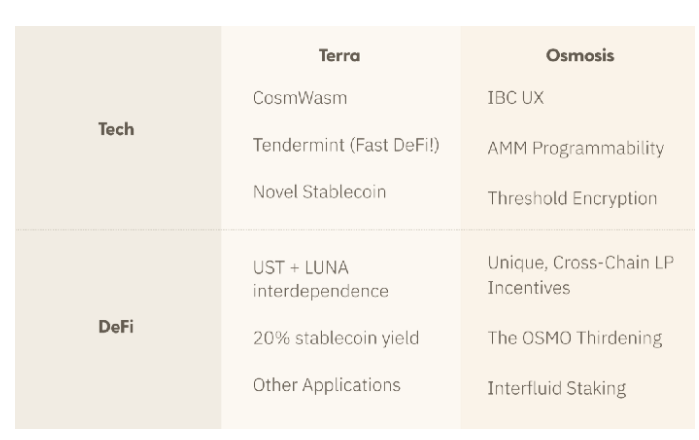
Through a combination of DeFi components and compelling technology, Osmosis and Terra have managed to build self-sustaining economic machines.
Evmos is not merely a fee and staking token. It will be the first token on the EVM to drive EVM governance outcomes. It can also serve as a tool to determine the future economic outcomes of the three main participants: developers, users, and validators.
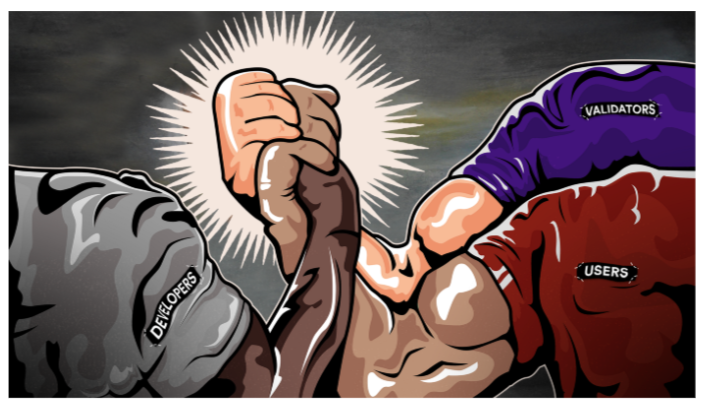
WAGMI
Token holders are responsible for guiding the DAO and deciding the fate of all on-chain assets flowing into Cosmos via Evmos. The network’s goal is for the vast majority of tokens to be owned and controlled by people outside the core team. We expect it to be used for:
1) Paying developers and network operators via a built-in shared fee revenue model (dApp Store)
2) Voting on protocol upgrades
3) Registering tokens on the ERC20 module for EVM-IBC integration with ERC20
4) Allocating usage rewards to applications on Evmo
5) Enabling precompiles for useful high-priority features
Pre-mined Evmos tokens will not be sold.
Token Issuance Schedule
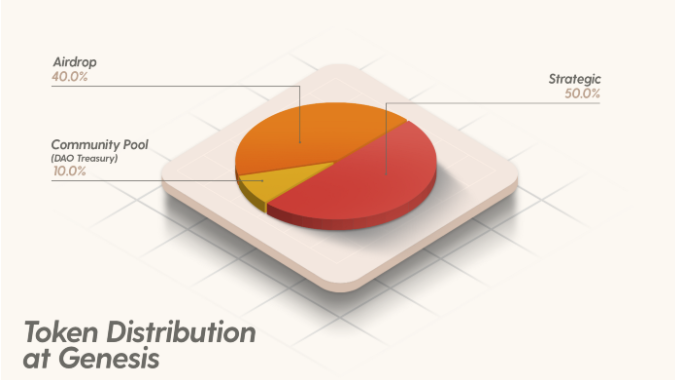
At genesis, Evmos will have an initial supply of 200 million tokens, allocated to Rektdrop participants, the community pool, and strategic reserves.
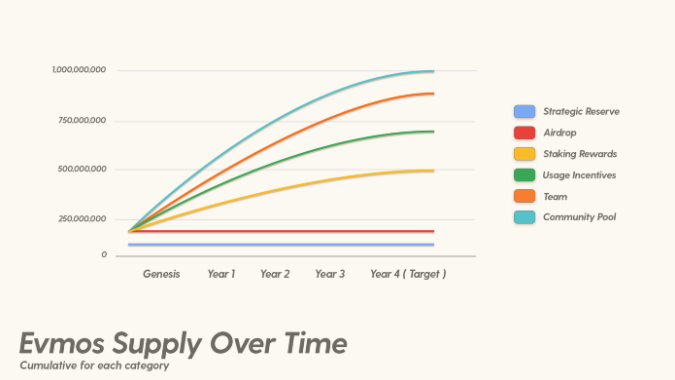
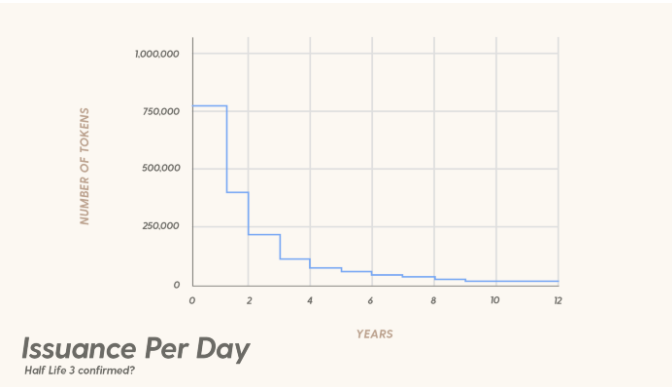
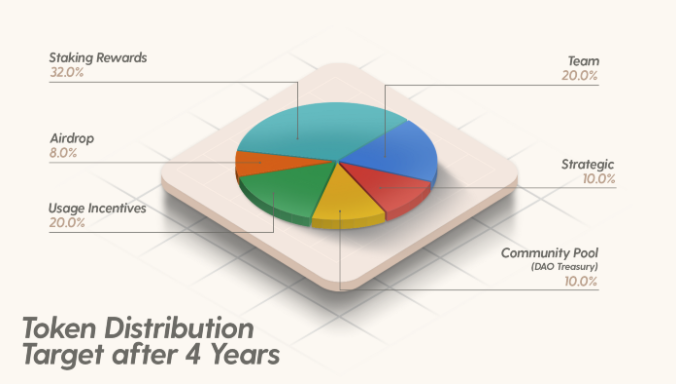
Evmos begins highly inflationary, issuing over 300 million tokens in the first year. Under the initial token model, new tokens will be issued on an exponential decay schedule, with inflation decreasing annually (over 365 periods per day). The target is to issue 1 billion Evmos tokens within four years.
We call this The Half Life.

This makes the network technically deflationary in the long run, but we view Evmos as a token with uncapped supply. We encourage the community to choose an alternative inflation model after Year 4. For example, if rewards are deemed too low, the community could propose linear or constant models.
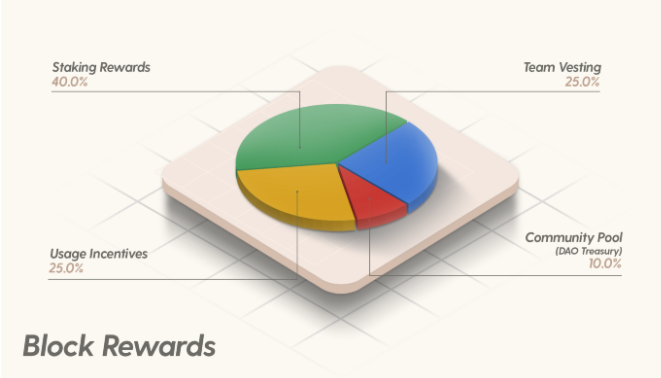
Newly issued tokens will be distributed per block as follows:
Staking rewards: 40%
Team vesting: 25%
Usage incentives: 25%
Community pool: 10%
Adoption Incentives
25% of block emissions will go to a pool dedicated to incentivizing users.
Deferred Gas Rebates
Initially, the usage incentive pool on Evmos will sponsor gas payments for end-users. The only constraint is that these incentives must be less than the fees paid.
To incentivize smart contract usage on Evmos, the community will be able to register incentives via governance for specific smart contracts to draw from a portion of the usage incentive pool over a set period. Reward distribution will occur each epoch (defaulting to one week), making them cumulative, deferred rebates of paid fees. The goal is to allocate rewards to contract users that act as fuel subsidies.
This is effectively the network deciding which dApps receive gas subsidies for their users—and token holders are best positioned to drive adoption of these dApps.
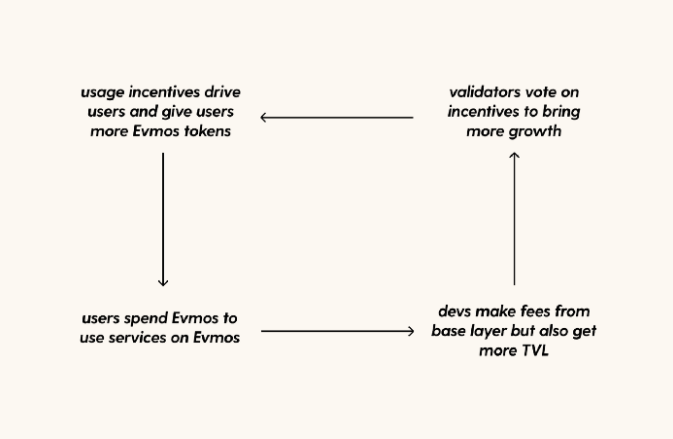
Evmos is experimenting with creating an economically driven, aligned application network by offering deferred gas subsidies and liquidity mining.
Liquidity Mining
In the near term, the plan focuses on usage incentives that drive TVL (Total Value Locked), as it serves as a mechanism to incentivize residual behaviors across multiple platforms.
The idea is to distribute Evmos tokens from the usage incentive pool into a contract where you can stake your DEX LP positions, money market IOUs, or other liquidity IOUs (e.g., UNIv2 LP positions, AAVE aTokens/Compound cTokens, or Connext liquidity). These are typically represented as ERC20 tokens.
This contract will be governed so that token holders can decide which applications on the Evmos chain qualify for usage reward farming.
This is effectively a base-layer-integrated but governance-controlled liquidity mining program. (Think decentralized Avalanche Rush.)
Over four years, this will total 200 million Evmos tokens. This pool is large because users are the backbone of any crypto project. For instance, if governance determines the network would benefit from greater user growth, we may see larger usage incentives.
Fees
Evmos fees are priced based on network usage. Gas pricing follows EIP1559. However, instead of burning the base fee, we redistribute and reinvest it.
dApp Store
On Evmos, fees are no longer simply burned or funneled solely to increase network operators’ ownership share. Evmos now distributes fees between developers and network operators via a built-in shared revenue model as rewards for their services. We call this revenue model / fee distribution the dApp Store.
It’s essentially an app store model, where a portion of app sales revenue goes to the app store operator, while the majority flows to developers. The difference here is that the network provides an ongoing, active service, and network operators rent out most of the infrastructure required to run decentralized applications.
It rewards developers based on the value and impact of their dApp, not on their ability to launch new governance tokens or leverage connections with capital (retail or institutional). Those building on Evmos gain real stakes in the development and governance of the protocol itself.
This fee distribution will initially be implemented at a 50/50 split between contract deployers and validators at genesis, and can be adjusted via governance. To prevent spam, eligible contracts must be approved by governance. Note that this works synergistically with usage incentives for gas subsidies.
Transaction fees on Cosmos chains are typically aggregated with token issuance and then distributed to validators and block proposers. Fees aren’t part of block rewards because they fluctuate based on network activity and gas price markets.
IBC Relay Fee Rebates
Relayers perform thankless work, often appearing as a loss on validator balance sheets. On Evmos, IBC transactions—specifically UpdateClient and IBC transfers—will receive at least a 50% rebate.
Note that this runs parallel to ICS-29 work on relayer incentives. The purpose is not to directly replace the standard, but to thank relayers for their continuous service, as they are the sole reason IBC can function across chains. This altruistic behavior by relayers is precisely why the Cosmos ecosystem has been able to build the most decentralized and well-functioning set of chains—we proudly call them neighbors.
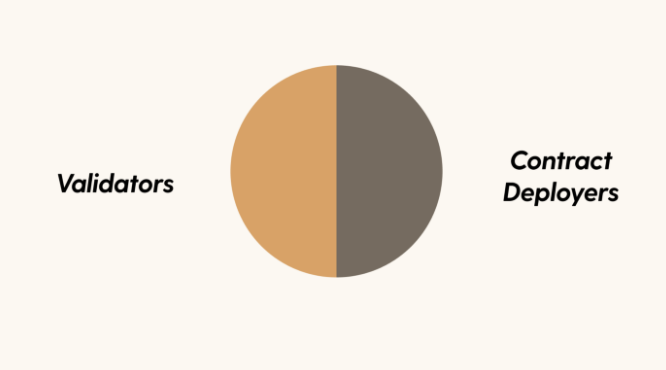
Validators and contract deployers share network fees. Contracts eligible for fee sharing must be approved by governance.
Staking Rewards
Validators and delegators are essential for securing the Evmos blockchain and helping with block proposal and validation. These roles can extend to providing oracles, secure bridges, rollup services for Celestia or other Evmo child chains, making them key participants.
At genesis, there will be 150 active validators, depending on the amount delegated to each. The maximum number of possible validators is governed and adjustable.
40% of newly issued tokens will be proportionally rewarded to active validators and their delegators based on the amount of Evmos staked. Validators charge a commission on staking rewards to their delegators. Each validator can set their own commission rate, but the network enforces a minimum rate of 5%.
Rektdrop
In 2021, many apes quickly amassed wealth around liquidity, but many others were left behind. We created the Rektdrop to reward active users in the Cosmos and Ethereum communities and stimulate the ecosystem.
By rewarding users across multiple categories rather than a single qualifier, we believe this distribution maximizes fairness, avoids sybil attacks, and selects an initial group of token holders who will help the network thrive.
The Rektdrop will contain 80 million Evmos tokens at genesis. All Rektdrop criteria snapshots were taken on November 25, 2021 at 19:00 UTC.
We will introduce a portal where you can check how many Evmos tokens you’re eligible for. Once the Evmos mainnet launches in the coming weeks, the same portal will be used to claim your rewards by completing a series of actions. A separate announcement will detail the Rektdrop claims process, explaining our work on data extraction, parameter adjustments, category breakdowns, and how to claim your Rektdrop.
Strategic Reserve
At genesis, 100 million Evmos tokens will be held in a strategic reserve. The strategic reserve will be controlled by a multisig DAO owned by the foundation, composed of members from the development team and the Cosmos community. This reserve may expand in the future, and decisions regarding it will remain transparent.
It will fund programs via grants and support validators through delegation—not just running institution-backed nodes. This could include providing relay services, building explorers, maintaining open-source tools, and deploying dashboards showing overall network market growth. Evmos contributors value enabling more active participants in the network to foster growth for everyone, including passive token holders. It will also coordinate strategic partnerships for Evmos projects through fundraising. Any fundraising conducted via the DAO will be subject to vesting periods.
The DAO will ensure decentralization is not over-maintained. The strategic reserve will not be used for market sales or network control. The community will ultimately hold more, as the reserve exists for public benefit. We hope the token release schedule leads to more active participants on the network beyond the foundation.
Community Pool
The dream of Evmos is realized through the Cosmos Community Pool. We want to ensure an active Evmos Community Pool so others can pursue their dreams too.
The community pool will initially be seeded with 40 million Evmos tokens and will continue to be funded by 10% of new token emissions.
Pool funds are governed and should be used early. They are expected to bootstrap important tools, infrastructure, educational content, and other resources. We also believe the community pool can be used for retroactive public goods funding (linked to Optimism). Our software is built atop other tools like Go-Ethereum, Cosmos SDK, and Osmosis, so we strongly encourage grant requests from fellow builders!
Team Vesting
To build a world-class team, 25% of tokens per period will be issued to developers of the Evmos protocol. Until released, these tokens will be non-transferable and non-stakable.
Token holders can decide whether they wish the current development team to remain involved in the network and can vote via governance to reclaim any unissued tokens from the team and redirect them. We truly want to collaborate with the community to achieve decentralization and commit to its long-term success.

Take the blue pill: the story ends, you keep traditional tokenomics and pay high gas fees. Take the red pill: you’re now compensated by the protocol, aligned, and empowered through network governance to attract new users to your dApp.
Conclusion
Token genesis is just the first step toward a more balanced L1 ecosystem. Evmos is expected to evolve with the needs of its community; the iteration launched on Day One may look very different from the Evmo six months, a year, or even ten years later.
The same goes for the token model. As the first greenfield deployments take root, new features will be considered to meet their needs and promote value creation. Over time, incentives will be refined and fine-tuned to ensure all participants continue to benefit. The community has the ability to steer the token model toward alternatives—even while the network is live.
Evmos plans to launch within weeks. Airdrops will be claimable shortly thereafter—stay tuned and follow us for the latest details.
Join TechFlow official community to stay tuned
Telegram:https://t.me/TechFlowDaily
X (Twitter):https://x.com/TechFlowPost
X (Twitter) EN:https://x.com/BlockFlow_News