








David vs. Goliath in the NFT World: How LooksRare Competes with OpenSea
TechFlow Selected TechFlow Selected
David vs. Goliath in the NFT World: How LooksRare Competes with OpenSea
LooksRare aims to benefit the NFT community and achieve this goal through its token mechanism design.
 Navigating Web3 tides with focused insights
Author: Nansen
Translation: TechFlow
Note: "David vs Goliath" is a biblical reference from the Old Testament, where David, a young Israeli shepherd, achieved fame by defeating the giant Goliath—a story symbolizing an underdog triumph. In this article, OpenSea is represented as Goliath, while LooksRare is portrayed as the young David.
Summary
This research article aims to separate the hype from reality surrounding the recent LooksRare token airdrop. LooksRare proudly positions itself as a "community-first, non-functional marketplace that actively rewards participating traders, collectors, and creators." While exploring its tokenomics and incentive system, we find that despite widespread concerns about apparent wash trading behavior, such activity actually benefits opportunistic traders seeking to maximize earnings from LooksRare's "trading rewards" mechanism.
This article consists of four parts.
Part one explains LooksRare’s goal of benefiting the NFT community and how this objective is achieved through token mechanism design. Here, we compare user retention rates between OpenSea and LooksRare.
Part two details the three components of the LooksRare reward system: staking rewards, liquidity provider rewards, and trading rewards.
Part three clarifies the so-called wash trading issue and what it implies for the platform and its users.
Part four uses insights from the Nansen dashboard to understand overall trends on LooksRare.
Background
Within just over a week of launching its token airdrop, market entrants on LooksRare recorded sales volume of approximately 1.5 million ETH (about $5.15 billion). Introduced to the NFT and broader crypto community on January 10, 2022, the platform aimed to provide a "community-first NFT marketplace that actively rewards participation by traders, collectors, and creators." OpenSea has largely dominated the NFT market, accounting for 3.6 million ETH worth of NFT transactions in 2021 (approximately $12.5 billion). Perhaps due to OpenSea’s success—especially after recently raising funds at a $13.3 billion valuation—other innovative competitors are now being drawn into this emerging industry.
Airdrop
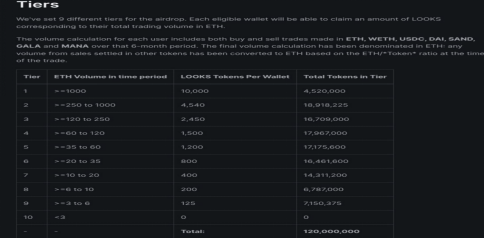
In mainstream marketing, attracting buyers (i.e., consumers) is not always a straightforward task. Blockchain has revolutionized this dynamic, enabling new projects like LooksRare to directly engage their target audience. At launch, LooksRare announced it would distribute its native token $LOOKS via an airdrop to OpenSea users. Users who had traded at least 3 ETH worth of NFTs on OpenSea over the previous six months qualified for the airdrop. The $LOOKS airdrop featured nine tiers—the more a user traded on OpenSea, the more $LOOKS tokens they could claim. Figure 1 illustrates the tiered structure of the airdrop, which incentivized active OpenSea users to migrate to LooksRare.
Figure 1: LooksRare Reward Tiers
Source: LooksRare (2021)
Commentators described LooksRare’s launch campaign as a “vampire attack” or “frontal assault,” where a new entrant directly challenges a dominant incumbent.
In short, the goal of the LooksRare airdrop was to siphon liquidity from competitors and inject it into its own platform. However, when framed as a "David vs Goliath" scenario, some observers argue that LooksRare’s “disruptive” strategy was necessary to capture the attention of the most active current users.
Figure 2: Daily Active Users Comparison Between OpenSea and LooksRare

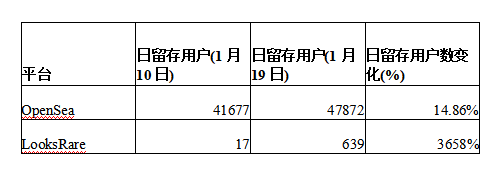
Figure 2 compares daily active users between OpenSea and LooksRare. Active users are defined as addresses conducting buys or sells. New users refer to addresses making their first transaction on the platform, while returning users are those who have conducted at least one prior transaction. A close analysis reveals that during its first nine days post-launch, LooksRare acquired new users at a slower pace than OpenSea.
Between January 10 and January 19, LooksRare saw a 5.55% increase in daily users, compared to OpenSea’s 38.17% growth (see Figure 2a).
Clearly, the initial momentum in attracting new users to the LooksRare platform was limited. However, when analyzing returning user activity, LooksRare outpaced OpenSea in returning user growth during the same period (3,658% vs. 14.86%, see Table 2b).
Table 2a: Comparing Changes in New Users Across Platforms
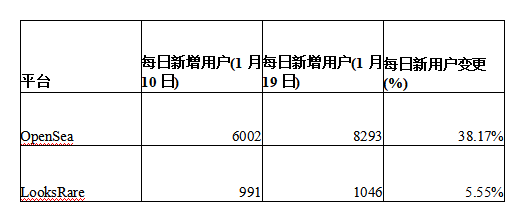
Table 2b: Comparing Changes in Returning Users Across Platforms
Platform Goals and Token Economics
Beyond distributing redeemable $LOOKS tokens via airdrop, LooksRare increased incentives for users to switch platforms by focusing intentionally on community, designing its tokenomic model, and introducing a novel reward system.
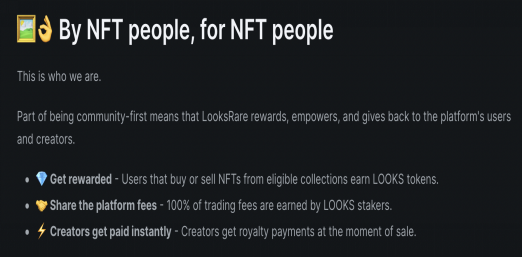
Figure 3: LooksRare's Description of Its Platform
Source: LooksRare (2021)
Figure 3 outlines the core objectives of the LooksRare platform, with the NFT community at the center of its architectural design. The founding team ensured participants contributing to this vision would be rewarded. They announced that three-quarters (75%) of the total token supply was allocated to the community. Of this 75%, 12% was reserved for the airdrop, 18.9% would circulate through staking, and the remaining 44.1% would be distributed via the trading rewards system (see Figure 4).
Figure 4: LOOKS Token Economics
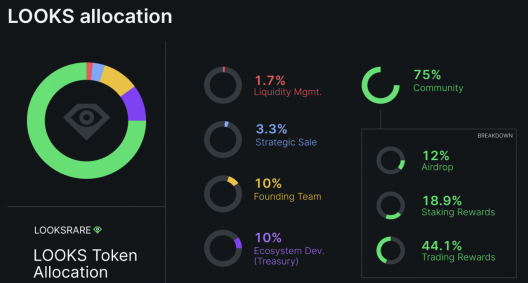
Source: LooksRare (2021)
A closer look at $LOOKS tokenomics reveals that the token distribution schedule was designed so that the founding team could only redeem the value of their allocated tokens 180 days after launch.
Observers noted similarities between $LOOKS’ distribution model and Larva Labs’ release of CryptoPunks NFTs (e.g., a tweet by moon (@MoonOverlord), an angel investor in LooksRare). The rationale behind such a vesting timeline is to align the founding team’s personal interests with the project’s post-launch success—only if the platform succeeds can the team realize the value of their allocation.
Unique Features
At first glance, the $LOOKS token issued by LooksRare clearly differentiates it from other platforms. The token is designed to incentivize NFT trading on the LooksRare platform, akin to liquidity mining practices in the NFT space.
LooksRare takes a 2% fee on every transaction. Currently, OpenSea charges 2.5%. Although the fee difference is small, the key distinction lies in “who benefits from the fees?” On LooksRare, fees are distributed to $LOOKS token holders.
Other competitive features include public offers applicable to any item within an NFT collection. This feature is particularly useful for users who want a piece from a collection but don’t have a specific item in mind.
Additionally, royalties on the LooksRare platform are paid to NFT creators in real time. In contrast, OpenSea creators must wait up to a week to receive royalties. While these features highlight the project’s “community-centric” focus, the platform’s long-term success still heavily depends on its ability to attract buyers and sustain demand.
To attract potential buyers, LooksRare deployed an attractive reward system to incentivize user engagement.
Rewards
The LooksRare website claims to offer three unique reward systems:
1. Staking
Figure 5: Cumulative Amount of $LOOKS Tokens Staked
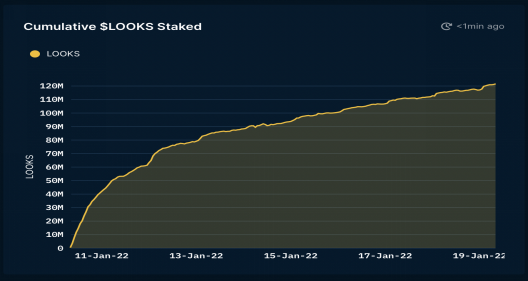
$LOOKS holders can stake their tokens to earn passive income. At the time of writing, the staking APR was 819.31%. However, this rate is variable and adjusts based on the number of participants staking and the price of the $LOOKS token. At the time of writing, approximately 120 million $LOOKS tokens were cumulatively staked (see Figure 5).
The ability to earn passive returns incentivizes token holders to lock up their supply. These returns derive from two sources: i) the tokenomics design intentionally uses staking as a reward mechanism, thus reserving part of the token supply (as discussed above), and ii) a percentage of fees collected from all trades. LooksRare breaks down the relevant staking reward information on its website.
2. Liquidity Providers
Figure 6: Cumulative Amount of LP Tokens Held by Liquidity Providers
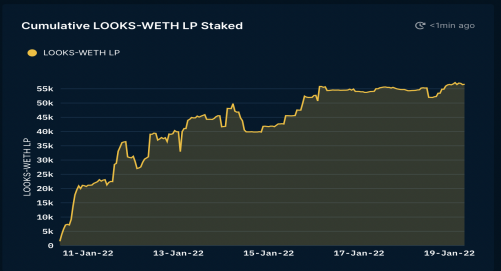
The liquidity provider option may appeal to users who do not wish to hold full exposure to $LOOKS tokens, instead choosing to mitigate volatility by pairing them with Ethereum (ETH). This reward distribution is also variable and adjusts as participants add or remove liquidity from the network. In theory, rewards paid to liquidity providers should be more consistent since they originate from transaction fees collected by the platform.
In short, in addition to earning a pro-rata share of swap fees, users who stake $LOOKS-WETH LP tokens in LooksRare’s smart contracts receive additional $LOOKS tokens. However, liquidity providers face impermanent loss risk, an important factor users must consider.
3. Trading Rewards
Among the three rewards, the most controversial is LooksRare’s “trading rewards.” Discussions around the implications of this reward system quickly gained traction on social media (e.g., tweets by djo.eth (@dylanorrell), who documented wash trading observations using Meebits).
LooksRare encourages NFT trading by offering rewards to buyers who purchase qualifying collections on its platform. This reward system allows buyers to regularly earn additional $LOOKS (within a 24-hour window). On one hand, users find this system especially appealing for those who missed the airdrop, simultaneously increasing trading volume on the platform.
However, the trading reward system has raised concerns among some opportunistic users who conduct trades solely to accumulate more $LOOKS tokens. Some argue that, in the medium to long term, platform fees serve as a deterrent against sustained wash trading, especially as trading rewards decrease over time.
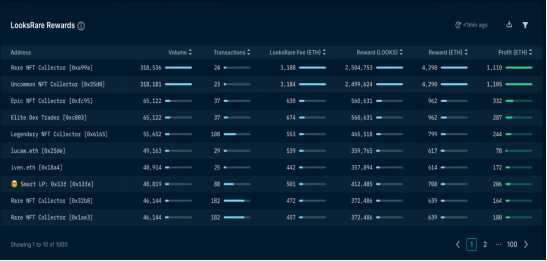
According to LooksRare’s reward schedule, trading rewards in Phase One decline significantly over time. Interestingly, one could speculate that early speculative wash traders profited handsomely, validating their decision to switch platforms. Figure 7 highlights several large addresses that benefited substantially from the LooksRare reward system.
Figure 7: Amount of $LOOKS Rewards Claimed by Addresses Compared to Volume and Fees Paid to LooksRare (actual profits may vary based on token price at time of sale)
Exploring On-Chain Activity with Nansen
Figure 8a: Transaction Volume Comparison Between LooksRare and OpenSea (January 10–19)
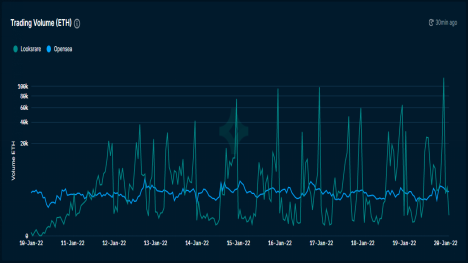
Figure 8b: LooksRare Transaction Volume Compared to OpenSea (January 10–19)
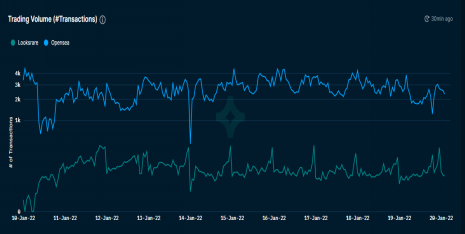
Figure 8a shows the volatility in transaction volume on LooksRare over time. Two possible reasons for this fluctuation include:
1) LooksRare is an emerging platform whose user base has not yet stabilized, potentially influencing trading behaviors. A time-based analysis shows transaction volume typically spikes one hour before the trading reward deadline (11 PM to midnight UTC). When analyzing volume by number of transactions, the chart suggests a relationship between the two platforms.
On January 10, transaction count rose on LooksRare while declining on OpenSea. This reflects LooksRare’s strategic effort to draw OpenSea users to its platform. However, starting January 12, both platforms experienced declining transaction volumes (also observed on January 20). This trend may be attributed to the overall state of the cryptocurrency market.
Figure 9: How $LOOKS Holders Used Their Airdropped Tokens (FIFO basis)
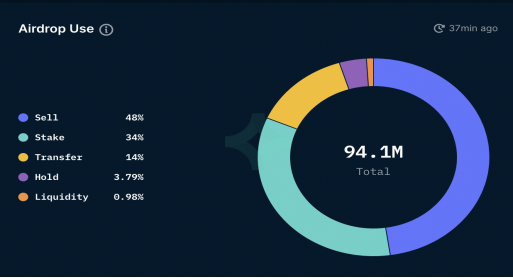
While most airdrop recipients chose to sell their $LOOKS tokens, one-third held onto them: 4.1% retained their tokens, and 0.85% deposited into liquidity pools. Figure 9 details this breakdown.
Figure 10: Comparing Smart Money Daily Activity on Both Platforms
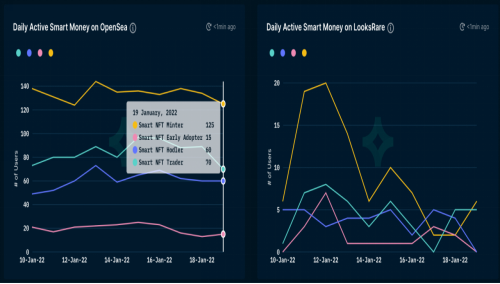
Nansen’s Smart Money label tracks wallets with a proven track record of making sound investment decisions. Since the launch of LooksRare, the number of active Smart NFT Adopters and Smart NFT Hodlers on the platform has declined. In contrast, last week, the numbers of Smart NFT Adopters and Smart NFT Hodlers on OpenSea remained relatively stable. Although the number of Smart NFT Minters initially dropped, this trend reversed on January 18.
Interestingly, Smart NFT Traders on LooksRare showed relatively consistent activity. Based on the overview of Smart Money across both platforms, we can infer that LooksRare’s reward system has indeed attracted and retained Smart NFT traders.
Conclusion
In this article, we reviewed LooksRare’s tokenomic design and reward system to understand how it positions itself as a disruptive, “community-centric” competitor to OpenSea. We argue that despite initial concerns about what appears to be wash trading, such behavior presents an opportunity for traders aiming to maximize their $LOOKS token earnings through the “trading rewards” system.
Using on-chain data from Nansen, we explored whether LooksRare’s proactive strategy to redirect users and buyers to its platform showed early signs of success. The analyzed data suggest that although the launch sparked controversy, LooksRare did manage to attract new users and retain them on the platform. Whether this trend will continue remains to be seen.
Original link:
https://www.nansen.ai/research/looksrare-and-opensea-nfts-own-case-of-david-vs-goliath
Join TechFlow official community to stay tuned
Telegram:https://t.me/TechFlowDaily
X (Twitter):https://x.com/TechFlowPost
X (Twitter) EN:https://x.com/BlockFlow_News
 Nansen






