








Vader Protocol: The ultimate fusion, a liquidity protocol integrating DeFi 1.0 and 2.0
TechFlow Selected TechFlow Selected
Vader Protocol: The ultimate fusion, a liquidity protocol integrating DeFi 1.0 and 2.0
Vader aims to expand the horizon of DeFi by providing a liquidity protocol that combines hybrid algorithmic collateralized stablecoins with liquidity pools enhanced by synthetic assets.
 Navigating Web3 tides with focused insights
Author: Everything Blockchain
Translation: TechFlow
Vader Protocol in Cryptoverse promises to unite many revolutionary ideas at the forefront of DeFi innovation.
But what exactly is Vader, and what are these revolutionary ideas?
In today’s article, we’ll explore what Vader is, its unique features, and its objectives.
Vader Protocol — The Father of Decentralized Liquidity
Vader Protocol represents the convergence of three of the most revolutionary and successful concepts in DeFi. The protocol is built upon:
1) Terra Money's burn-and-mint mechanism for LUNA/UST,
2) Thorchain’s AMM design featuring Continuous Liquidity Pools (CLP) and Impermanent Loss Protection (ILP),
3) Olympus Pro’s bond sales mechanism (Protocol-Owned Liquidity).
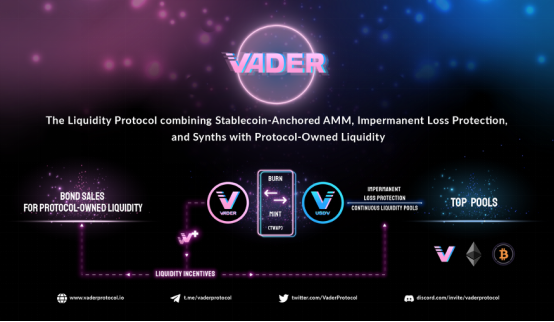
At its core, Vader aims to expand the horizons of DeFi by offering a liquidity protocol that combines algorithmically backed stablecoins with enhanced liquidity pools through synthetic assets. Given the success of each of the aforementioned projects, Vader is seen as a promising integrated protocol designed to deliver the best of DeFi to users. Let’s dive into the key features resulting from these combined innovations.
Stabilization via Burn-and-Mint Between VADER <> USDV
Why use such a mechanism, and how does it work? For those unfamiliar with how Terra achieves price stability, I recommend watching the video linked here. Essentially, Terra’s algorithmic market module incentivizes the minting and burning of LUNA through arbitrage opportunities.
In Vader’s case, users burn VADER to mint USDV, and burn USDV to mint VADER.
The system uses a TWAP function to determine the dollar price of VADER, enabling the burning or minting of the USDV stablecoin accordingly.
The VADER token and TWAP function together transmit VADER’s “pegged” price in USD. This allows anyone to burn VADER at a 1:1 TWAP price to mint USDV.
Thus, to maintain USDV’s peg, the protocol adjusts based on expansions or contractions in VADER supply. When USDV trades above $1 (high demand), the protocol incentivizes users to burn VADER and mint USDV, increasing USDV supply to stabilize the price. Conversely, when USDV trades below $1 (excess supply), the protocol encourages users to burn USDV and mint VADER, reducing USDV supply to restore the peg.
Impermanent Loss Protection (ILP), Continuous Liquidity Pools (CLP), Slippage-Based Fees, and Synthetics
Inspired by Thorchain and integrated directly into the protocol, Vader offers Impermanent Loss Protection (ILP), along with the ability to create and deposit collateralized synthetic assets for interest earning and borrowing purposes.
One major drawback of providing liquidity on DeFi protocols is impermanent loss. By deploying CLPs to address this issue, Vader provides ILP to encourage users to provide long-term liquidity (over 100 days).
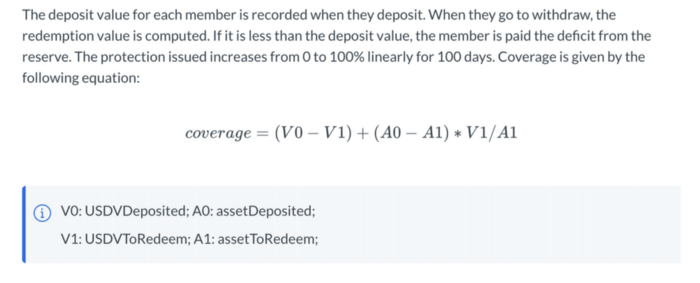
By eliminating reliance on external price oracles, Vader ensures its CLPs and AMM deliver prices consistent with oracle reports. Liquidity pools on Vader use USDV as the settlement token, allowing the system to accurately price pools and assess asset purchasing power. Additionally, using USDV as the universal settlement asset across all Vader pools removes friction associated with requiring users to hold specific risky assets. All Vader liquidity pools are anchored to their stablecoin (USDV), making impermanent loss easier to reason about.
Fees are one of the most important components of an AMM, as they reward liquidity providers (LPs) for supplying liquidity. However, fixed-rate fees are problematic because they depend solely on trade size and do not reflect the actual value of provided liquidity. To solve this, the protocol implements a liquidity-sensitive, slippage-based fee mechanism. Essentially, slippage-based fees depend on the amount of liquidity in the pool—smaller pools offer higher fees to LPs, while larger ones offer lower fees. This mechanism makes sandwich attacks extremely costly on the Vader protocol.
Another advantage of slippage-based fees is that they contribute to impermanent loss protection by paying LPs a rate proportional to price volatility, which correlates with pool depth.
Creating synthetic assets on Vader also prevents impermanent loss. Synthetics replicate the value of assets provided in the pool but do not expose LPs to price risk from other assets in the pool. An example of a synth on Vader is xVADER.
Because synthetics always maintain a 1:1 purchasing power, they do not experience impermanent loss or gains. In fact, any losses or gains are absorbed by other passive LPs.
Since synthetics are 50% backed by physical assets and 50% by USDV, widespread adoption deepens liquidity pools and enables the system to naturally expand (or contract).
In essence, Vader positions itself as the optimal AMM for liquidity providers due to the following reasons:
1) Continuous Liquidity Pools (“CLP”) maximize fees earned by LPs via slippage-based fee structures
2) Impermanent Loss Protection (“ILP”) safeguards long-term LPs beyond 100 days
3) Synth holders act as single-sided LPs and are immune to impermanent loss (“IL”)
Olympus Pro’s Bond Sales Mechanism (Protocol Owned Liquidity)
Liquidity incentives through bond sales drive demand for USDV and Protocol-Owned Liquidity (“POL”). This supports the stablecoin’s backing and purchasing power by building greater reserves within the protocol treasury.
By now, you likely understand that every feature of Vader is designed to eliminate existing problems in DeFi—and this is no exception. Protocols that rent liquidity rather than own it often lose users to platforms offering the highest rewards, leading to transient liquidity and forcing AMMs to offer unsustainable returns. Enter POL (Protocol-Owned Liquidity), which supports permanent liquidity provision for users.
Vader is the first AMM to integrate POL, making liquidity more persistent and sustainable within the protocol. POL through bond sales allows the protocol to own and be managed by VADER token holders, ensuring long-term liquidity. Bond sales, pioneered by Olympus, essentially allow users to receive discounted protocol tokens in exchange for vested liquidity pool tokens.

Why is AMM-Owned Liquidity Important?
All trading pairs within Vader’s AMM are anchored to USDV (its stablecoin), meaning the stablecoin anchors the AMM. As a result, 50% of the AMM’s total value locked (TVL) creates a permanent demand pair for USDV.
Moreover, as previously mentioned, bond sales help strengthen permanent/sustainable liquidity within the protocol, enabling the treasury to diversify its reserves into other risk assets and increase the value of the Vader token. Another benefit of growing liquidity is that it drives up trading volume, as better execution attracts a liquidity black hole effect—pulling in more POL, more volume, and more revenue.
All fees generated from liquidity positions on the AMM are eligible for distribution or buyback to xVADER stakers. xVADER holders, who represent staked VADER, have full governance rights over treasury assets, providing another incentive for users to hold the token and increase its value—which in turn helps maintain the USDV peg.
Conclusion
The Vader Protocol may seem complex at first glance, but a closer look reveals the rationale behind its design and why it can attract user attention.
In my view, Vader was created to build an AMM with permanent and sustainable liquidity, incentivizing LPs to participate while solving several existing issues. Transparency, combined with slippage-based fees and a protocol design that enhances VADER token value, appears to be the perfect strategy to achieve this goal.
Vader is launching USDV, where users can burn Vader to mint USDV.
Original link:
https://everythingblockchain.medium.com/vader-protocol-bringing-together-defi-1-0-2-0-1728a651a581
Join TechFlow official community to stay tuned
Telegram:https://t.me/TechFlowDaily
X (Twitter):https://x.com/TechFlowPost
X (Twitter) EN:https://x.com/BlockFlow_News







