








Understanding DAO Infrastructure Colony: From Corporate Bureaucracy to Algorithmic Trust
TechFlow Selected TechFlow Selected
Understanding DAO Infrastructure Colony: From Corporate Bureaucracy to Algorithmic Trust
Colony is a platform that helps teams, projects, and communities collaborate, make decisions, and manage funds together.
 Navigating Web3 tides with focused insights
Author: Rain, YBB
“The idea that order emerges not from top-down imposition by political or religious hierarchies, but rather as a self-organizing outcome among decentralized individuals, is one of the most fascinating and important insights of our time.”
Humanity has never ceased exploring ways to cooperate in pursuit of shared goals—from Roman societas peculium and societas publicanorum, to the limited partnership system originating from Italian mercantile ports known as the Commenda contract, to the widespread adoption of joint-stock companies following Britain’s Joint Stock Companies Act of 1844. To this day, our commercial activities still largely follow established paths—this is normal, as historically complex tasks required significant human effort.
However, due to the high costs involved in coordinating between individuals, we introduced the concept of managers. As the number of managers increased, so did the need for managers to manage other managers—thus forming hierarchical structures. Today, however, the widespread availability of the internet and maturing blockchain infrastructure enable group decision-making, capital formation, and allocation within DAOs to be coordinated algorithmically. In other words, existing technologies and connectivity allow us to significantly enhance our capacity for self-organization, making it easier to collaborate across internal and external organizational boundaries. The assumption that coordination via managers is more effective than self-organization may no longer hold true.
Here I reiterate Ronald Coase’s “theory of the firm”: firms exist to coordinate the production of goods and services. The extended Transaction Cost Economics (TCE) theory holds that because of incomplete information and bounded rationality, firms are more efficient than market mechanisms at coordinating production. If information were perfect, third-party intermediaries would be unnecessary, as market forces alone would provide the necessary incentives and coordination—everyone would know precisely the value of their own and others’ contributions.
Since traditional markets fall short of this ideal, knowledge and trust barriers are overcome through due diligence and contracts, backed by legal systems for recourse when issues arise. These processes are costly, leading traditional firms to often replace free-market negotiations with command-and-control hierarchies to improve efficiency and competitiveness.
Working in DAOs enables us to self-organize through diverse connection types and increases autonomy over work formats. Colony, an Ethereum-based protocol for decentralized collaboration, has made significant adjustments in its design logic and implementation regarding permissions, scalability, staking management, and reputation mining, providing a general framework for the creation, management, and operation of decentralized organizations. This article outlines Colony’s vision and structure.
1. Project Overview
Colony is a platform that helps teams, projects, and communities collaborate, make decisions, and manage funds. The Colony team plans to launch a feature later this year allowing users to deposit tokens into a lock-up contract to stake on Motion and accurately calculate voting power and reward distribution.
Colony claims to provide digital organizations with essential frameworks for ownership, structure, permissions, human resources, and financial management. It states that the mainnet already supports features such as reputation, multi-token managed domains, and modular permissions, with ongoing upgrades planned.
In Colony, scalability is achieved through an asynchronous process of continuous financial decisions, using a domain tree similar to an organizational chart, enabling relatively autonomous operations across different domains within an organization.
Colony claims its greatest achievement is implementing a permissionless resource allocation mechanism powered by time-based coordination, where reputation is earned through work rather than allocated per proposal—making reputation a carrier of market information.
2. Basic Information
Founded: 2014
Token Launch: 2021
Headquarters: Cayman Islands
Sector: DAO
Token Symbol: $CLNY
3. Team Information
CEO at Colony: Jack du Rose. Jack is also CEO of Collectively Intelligent Ltd, a software company focused on crypto-economic protocols and DApps, and a mentor at Outlier Ventures.
CMO at Colony: Leon Phang. Leon has 17 years of strategic planning experience at top advertising agencies, serving international brands including Toyota, BMW, MINI, Lexus, Google, Honor/Huawei, Moto, Lidl, PwC, EY, and Swedish local brands such as Tretti, Klättermusen, Alvedon, Löfbergs, Wasabröd, Tre, Dagens industri, TV3, Spendrups, and SVT.
LinkedIn shows the company has 11–15 employees, including two frontend developers and one product manager: Armando Graterol, Alicja Kujawa, and an anonymous individual from Gdańsk.
4. Economic Model
The Colony Network believes it must be self-sustaining. Specifically, Metacolony—the governing system controlling the Colony network—is responsible for maintaining and supporting the network and developing new functionalities. Long-term development and maintenance of the Colony Network (including the reputation system) should be funded by the network itself.
When a user requests a payout, a small portion is paid to the Colony Network. This fee goes to Metacolony if the payment is in ETH or another whitelisted “currency” token, or to the Colony Network contract if it is any other ERC20-compatible token. The flowchart is shown below:
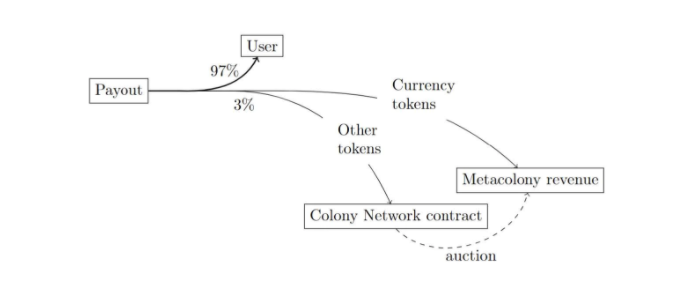
For a decentralized system, this fee model is somewhat unusual, as one appeal of Ethereum-based decentralized systems is the absence of fees beyond gas costs. However, Colony Network fees are designed to provide potential value to CLNY holders in Metacolony and ensure the security of the network’s reputation mining and governance processes. These fees are not paid to any centrally controlled entity but to Metacolony. Since anyone can contribute to Metacolony, anyone can claim a share of these fees proportional to their contribution. We believe the benefits of a secure and well-maintained network will be attractive enough that paying a small fee for such a decentralized system is justified.
5. Code Activity
As shown in the figure below, Colony’s code update frequency peaked around mid-2019 and has declined annually since, indicating that Colony Network’s codebase has gradually stabilized, possibly in preparation for the upcoming launch of Colony V2.
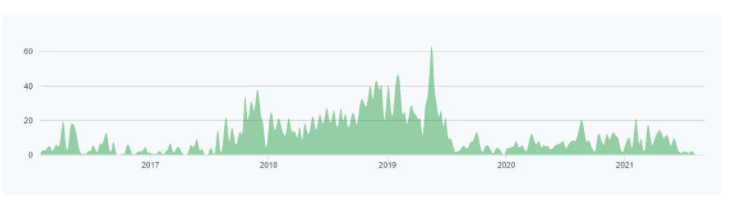
Figure showing project contributions, excluding merged commits and bot accounts
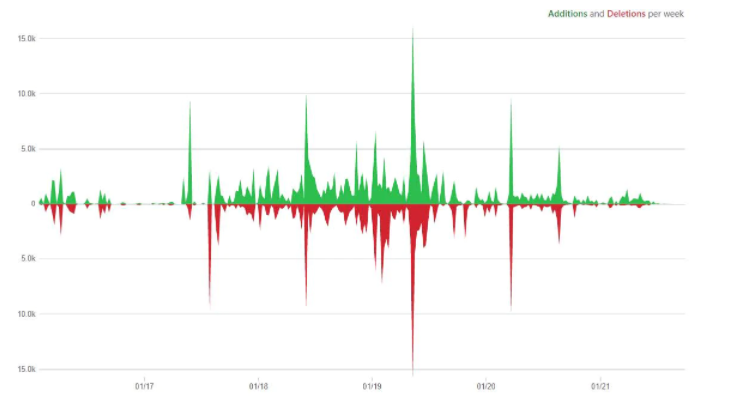
Figure showing code update frequency
6. Rights of $CLNY Holders
First is participation in the reputation mining process. Second is governance of the Colony Network itself. Permissioned functions on the contract will allow setting basic network parameters, which can only be called by Metacolony. For Metacolony to invoke these functions, a vote must be held among all CLNY and reputation holders. Metacolony earns reputation by receiving payouts in CLNY tokens, just like any other Colony. It can also earn reputation through the reputation mining process (see Section 5.8 of the whitepaper), a right exclusive to Metacolony. CLNY holders have been responsible for reputation mining from the start, but decisions on foundational network properties were initially controlled by a multisig contract managed by the Colony team. As the Colony Network matures and proves effective, control over these decisions will gradually transition to Metacolony.
Note that Colony’s decentralization of decision-making authority to Metacolony occurs in four main phases:
Phase 1: Fully controlled by the Colony multisig team
Phase 2: Approved by the Colony multisig team
Phase 3: The Colony multisig team retains veto power
Phase 4: Fully controlled by Metacolony
Once Phase 4 is reached, the specialized extension contract will be removed and replaced with a generic voting extension, allowing Metacolony to directly control the Colony Network contract. Beyond the privileges granted by CLNY holdings and reputation, the Colony team will have no further control rights.
7. Reputation System
The reputation system is a core component ensuring the decentralized nature of any Colony. By clearly defining rules for rewards and penalties, it aligns contributors’ incentives with the rules of Colony and the Colony Network. In short, because reputation can only be earned by users and cannot be transferred, the system enables a more meritocratic form of decision-making than simple token-weighted voting. Because reputation decays over time, its influence reflects recent and up-to-date contributions, preventing the emergence of a “reputation aristocracy” and enabling smooth transfer of control from one group of contributors to another over time. Given the vast and complex nature of reputation scores spanning multiple Colonies, domains, and skills, storing and computing them on-chain is impractical. Thus, all calculations occur off-chain, with results broadcast to the blockchain by participating CLNY holders—similar to the consensus process in proof-of-stake blockchains. We call this process reputation mining.
Notably, the reputation calculations submitted by miners are determined solely by on-chain actions derived deterministically from Ethereum activity within Colony. From a game-theoretic perspective, the system’s security model resembles that of TrueBit’s off-chain computation.
8. Afterword
Establishing trust online remains undeniably difficult. Traditional hierarchical or organizational forms struggle to coordinate relationships among parties on-chain, especially since blockchain addresses transcend geographical and even species boundaries. We must acknowledge that humans exhibit varying degrees of agency when tackling different problems, and power naturally dilutes as it flows downstream to more numerous and less influential participants—a structure that has functioned throughout human history. Nevertheless, new technologies and organizational models may enable us to collaborate and coordinate toward common goals in ways previously unimaginable. Therefore, networked organizations must assume a minimal common denominator: every member is rationally self-interested, fully focused on maximizing personal utility and profit, and must be incentivized accordingly. This insight touches the core of Colony: a protocol designed to foster meritocratic division of labor and power—bottom-up and error-resistant—mirroring the idealized model of corporate hierarchy.
References:
1) *The Great Disruption: Human Nature and the Reconstitution of Social Order* by Francis Fukuyama
3) http://www3.nccu.edu.tw/~jsfeng/CPEC11.pdf
4) https://colony.io/whitepaper.pdf
5) http://people.cs.uchicago.edu/~teutsch/papers/truebit.pdf
Project Websites and Communities
Website :https://Colony.io/
Blog : https://blog.Colony.io/
Github : https://github.com/joinColony
Telegram:https://t.me/joinColony
Twitter : https://twitter.com/joinColony
Discord :https://discord.com/invite/dHMJ2EK
TechFlow is a deep-content platform focused on alternative asset investment. Follow our official account for more insights, or add WeChat TechFlow01 to join the TechFlow community and participate in discussions.

Join TechFlow official community to stay tuned
Telegram:https://t.me/TechFlowDaily
X (Twitter):https://x.com/TechFlowPost
X (Twitter) EN:https://x.com/BlockFlow_News
 @YBBCapital


![Axe Compute [NASDAQ: AGPU] completes corporate restructuring (formerly POAI), enterprise-grade decentralized GPU computing power Aethir officially enters the mainstream market](https://upload.techflowpost.com/upload/images/20251212/2025121221124297058230.png?x-oss-process=image/resize,p_50/quality,q_80)






