








From URL to IRL: What Community Means for Gen Z Today?
TechFlow Selected TechFlow Selected
From URL to IRL: What Community Means for Gen Z Today?
As DAOs spark a new wave of community development, web3.0 is bound to transform the current design and management models of communities.
 Navigating Web3 tides with focused insights
Text: Michelle Fang
Translation: TechFlow
For Gen Z, in this era where offline face-to-face interactions coexist with hybrid and fully online experiences, communities are playing an increasingly prominent role in our way of life.
Communities used to be insignificant. Just a year ago, building communities was far from the top of any entrepreneur’s agenda.
Today, community is the backbone and magic behind startups, products, creators, and so much more.
Current trends and behaviors among Gen Z, combined with over a year of social isolation, have sparked incredible interest in community-driven startups and led many companies to integrate community elements into their models. For Gen Z brands, community is a sword cutting through the sea of noise.
The following explains why now is the most critical moment to prioritize community and guide Gen Z through its post-pandemic transformation.
Defining “Community” for Gen Z
An airplane brings together travelers heading in the same direction, yet each has different purposes and lacks a shared sense of belonging. Likewise, community building isn’t just about gathering an audience and putting them in one place.
A community is defined by shared attributes, the strength of belonging, and a sense of interpersonal connection. Building a real community—not just assembling an audience—leads to greater loyalty, sustained engagement, and deeper recognition.
As Greg Isenberg noted, the intention behind community-building has given rise to new roles such as community managers and community designers.
Secondly, the term "Gen Z" as a whole is extremely broad. Some of the oldest members have already graduated and entered the workforce, while the youngest are only 9 years old and just finishing fourth grade. Strong communities and connections are difficult to build at scale, resulting in countless sub-communities within Gen Z. Gen Z itself is too large to function as a single community, especially given today's technology that accelerates the diversification of preferences and tastes.
...and how it became so important.
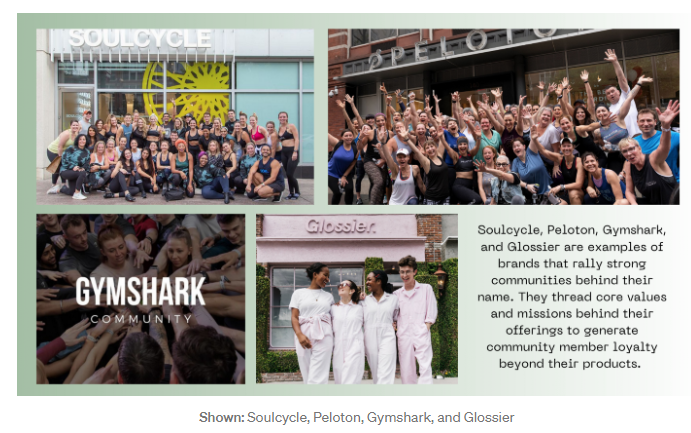
Community matters deeply to Gen Z because it fulfills our fundamental market need—for belonging and identity. Brands like SoulCycle, CrossFit, Peloton, and GymShark don’t just sell top-tier fitness products—they embed core values into their brand identity, helping customers find like-minded people. They tell authentic stories.
Over the past year, Gen Z has been hit hardest by pandemic-induced isolation. We were the furthest removed from traditional communities—interest-based activities, geographic neighborhoods, and campuses—with these experiences reduced to pixels on a screen.
Gen Z is also the least religious generation—47% identify as having no religious affiliation, and overall have weaker ties to religion. This has further accelerated the loss of communities traditionally associated with regular religious practices and rituals.
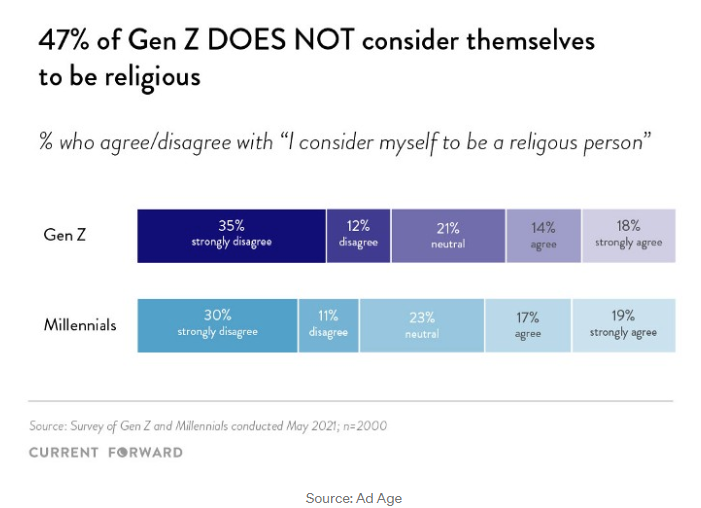
Dubbed the “loneliest generation,” this situation worsened during the pandemic. Unsurprisingly, the crisis fueled the explosive growth of online communities—the only option during lockdowns.
Among numerous brands offering similar products, those standing out are the ones that feel inclusive to Gen Z. Buying from these brands is no longer just a transaction—it’s a gateway into a tribe.
Participation is an expectation within community. It transforms customers from passive viewers into creators and network amplifiers. Gen Z enjoys initiating conversations and producing user-generated content—all of which expand a brand’s reach. We feel more connected to what we help create.
Brands that curate communities for their customers/users are essentially providing exactly what Gen Z needs.
What’s Next for Gen Z Communities?
There’s no doubt that the past year of isolation has been tough. With everything going fully virtual, online communities faced constant pressure to deliver execution, engagement, and operations on par with—or even better than—traditional in-person interactions.
Virtual fireside chats, 1:1s, webinars, and extended networking sessions have become exhausting for all parties involved.
Yet online communities possess the “superpower” of enabling participation anytime, anywhere. We constantly have opportunities to join a community, attend an event, or contribute to a cause. This has reached a point where many treat widespread commitments as normal without actually following through.
This runs counter to the essence of building strong, deep communities—when you scale up online communities, the connection between the community and its shared values and purpose tends to weaken.
Ironically, it seems the more accessible a community becomes, the more its impact starts to fade.
We’re Now Focusing on Community Events
The pillar of community growth and sustainability lies in enabling members to connect uniquely through shared interests. As we navigate this transitional period blending online, offline, and hybrid formats, community builders are increasingly expected to focus on platform-agnostic experiences that allow all members to connect meaningfully.
Events are a natural component of community, long embedded in its fabric. Whether fully virtual, hybrid, or in-person, event planning and design inherently adopt a community-first mindset. Nothing quite matches the serendipity and joy of face-to-face interaction.
That said, there remains significant opportunity for community platforms/software to adapt to the new standard of hybrid events.
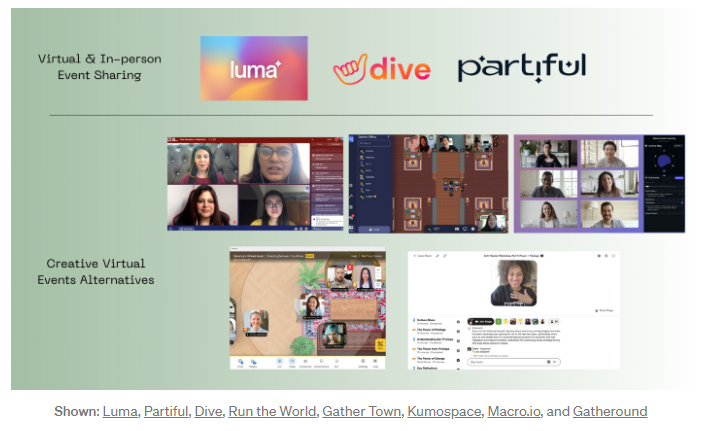
Luma, Partiful, and Dive are examples of platforms supporting management and sharing for both virtual and live events.
Platforms like Run the World, Gather Town, Kumospace, Macro.io, and Gatheround offer creative alternatives to current tools like Zoom, Hangouts, and Skype for virtual events.
Applications like Discord and Geneva, with their large Gen Z user bases, dominate the space for online community communication and messaging.
However, the next wave of community platforms will be characterized by better support and encouragement of in-community event experiences, helping bridge online communities into the physical world.
So What Does This All Mean?
Gen Z will use the post-pandemic transition as another opportunity to rethink and reshape the meaning of community for our generation. In my work building for Gen Z, one recurring theme I’ve observed is our desire to inherit from the previous generation—and then make it our own.
Web3.0 and DAOs Are Redefining Community
Web3.0 advances the concept of community through decentralized autonomous organizations (DAOs)—organizations whose charters, goals, and missions are determined by community members. DAO governance and operations are encoded via smart contracts and executed on blockchains, meaning every transaction is visible to all.
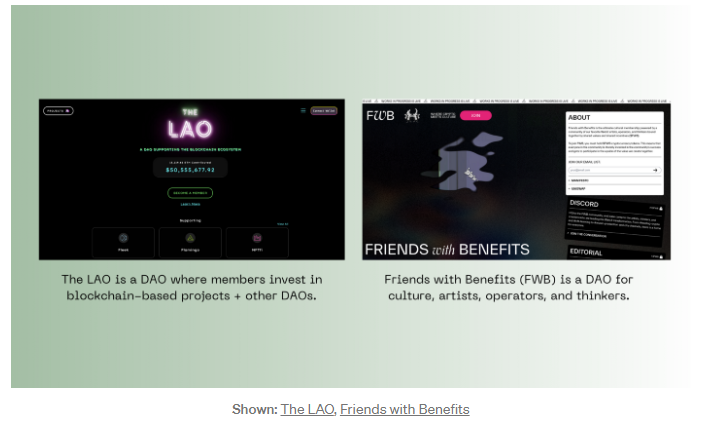
Web3.0 communities, such as “Friends with Benefits,” also mark an interesting shift in community dynamics.
1) Because DAO balance sheets exist on public blockchains rather than private audits, there are higher expectations for transparency, proactivity, and equality within the community
2) DAOs introduce lower entry barriers, reducing the switching cost of becoming a member. DAOs with similar missions are thus forced to compete by offering incentives that meet members’ needs
3) Community members gather around a shared purpose (hiring staff, funding investments, etc.) and directly control assets through tokens, reflecting active participation and ownership
4) Community members can use pseudonyms and be located anywhere in the world, meaning the community’s common bond doesn’t need to stem from geography, identity, or past experiences
We are obsessed with entrepreneurship and will actively play a role in rewriting the rules again and again. As DAOs usher in a new wave of community development, Web3.0 is certain to transform how communities are designed and managed today.
In summary, I believe today’s communities are already shaping—and will continue to shape—the following aspects of Gen Z lifestyles:
- Where we live (in community houses, co-living with like-minded peers, e.g.: Edyfi, Launch House, ADVNTR House, Together Casa)
- Where we learn (moving beyond traditional universities and institutions toward cohort-based learning, e.g.: Maven, On Deck, Monthly).
- Why we work (blurring the line between work and self, e.g.: leaving traditional corporate jobs to pursue careers in crypto, decentralized finance (DeFi), non-fungible tokens (NFTs), and Web3.0).
- What content we consume (creators, relatable personalities, short-form content)
- Who we identify with (belief in DAOs > religion, government, corporations, etc.).
The bottom line is that community builders and Gen Z brands today face increasing pressure—and opportunity—to plant the seeds of community. It all comes down to understanding Gen Z and meeting their needs.
TechFlow is a deep-content platform focused on alternative asset investment. Follow our official account for more in-depth content, or add WeChat TechFlow01 to join the TechFlow community and participate in discussions.

Join TechFlow official community to stay tuned
Telegram:https://t.me/TechFlowDaily
X (Twitter):https://x.com/TechFlowPost
X (Twitter) EN:https://x.com/BlockFlow_News






