Everything is a Meme
TechFlow Selected TechFlow Selected
Everything is a Meme
For everything else, the definition of truth is entirely controlled by authorities: the government, mainstream media, and other organizations affiliated with or controlled by the state. All information the public needs to know about objective realities comes from these canonical sources of truth.
 Navigating Web3 tides with focused insights
Author: Threebody Capital
Translation: Li Yuxuan, Mint Ventures
"What is truth?"
To many people, the ideal of truth is absolute: for example, the Earth orbits the Sun, gravity "pulls" objects toward the center of the Earth. Having an absolute standard to measure what is true and what is not gives our actions a clear foundation. Truth, in economists’ terms, consists of “positive statements”: claims about reality that can be empirically proven true or false.
Of course, on a “personal” level, everyone has the right to make arguments that cannot be proven or disproven—these are “normative” statements whose validity cannot be fully tested.
*Editor’s note: Positive statement: A description of objective reality, focusing on “what is”; Normative statement: A description of how things ought to be, involving subjective value judgments.
Historically, opinions largely remained within the personal domain. For everything else, the definition of truth was entirely controlled by authorities: governments, mainstream media, and other organizations affiliated with or controlled by the state. All objective information the public needed came from these classic sources of truth.
Then memes appeared: these concise, humorous information fragments that people can easily understand. Memes come in different forms: we mostly know them as images generated in minutes on imgflip.com, but they can be anything—from short slogans (like “Drain the swamp!” or “Full self-driving”) to longer statements (like “Only when the tide goes out do you discover who’s been swimming naked”) to entire ideologies, some of which can be quite unpleasant.
Editor’s note: meme (/miːm/) is commonly pronounced “mí mù” in Chinese, and the widely accepted Chinese translation is _“moyan”_, first introduced by evolutionary biologist Richard Dawkins in his book *The Selfish Gene*. “Drain the swamp” is a phrase often used by Western politicians; “full self-driving” is Tesla’s core narrative; “Only when the tide…” is a famous quote by Warren Buffett.
In a way, memes are crude and simple—for instance, the image of a cute smiling dog, a dirty swamp needing cleaning, or the unflattering sight of someone naked swimming—which is precisely why the message becomes so easily understood. They may oversimplify, but their conveyed message is undoubtedly far more effective—and viral—than a 60-page academic paper plus another 12 pages of references and peer reviews.
But memes are powerful: the widespread distribution of personal communication devices allows “personal subjective” opinions to enter the mainstream. Many things that once belonged in the realm of “truth” (testable, verifiable) now increasingly manifest as “opinions.”
By observing Ben Hunt’s work using Epsilon Theory to analyze news, we can see how themes like “Yay, capitalism!” or “Yay, value!” shape our perception of reality. Yes, even at the highest levels of government and corporations, memes are heavily used—whether intentionally or not.
Editor’s note: The core idea of Epsilon Theory is that the key to the market game lies in narratives—in the power of public statements that create common sense. Interested readers may visit www.epsilontheory.com/epsilon-theory-manifesto/__ for more content
The result: with an audience, meme masters can define a version of truth and reality for their followers. Now everyone has their own truth.
This is where things get tricky.
Section One The First Meme Master
At the time of writing, Elon Musk has 55.4 million Twitter followers and is arguably today’s top meme master. In creating belief systems for his followers, Musk is unmatched. But contrary to popular belief, memes are not a “modern” phenomenon—they are ancient.
To quickly grasp the power of memes, we need to go back to the 15th century and look at the first meme master—a man named Lucas Cranach the Elder.
Few have heard of him, but his close contemporary friend Martin Luther is a more familiar name.
In the 15th century, the printing press had just been invented. Before that, all texts—religious, political, or otherwise—had to be painstakingly copied by hand by the few literate individuals and stored as precious artworks in monasteries and palace libraries, accessible only to the nobility. For ordinary people, life was nearly static; truth was whatever rulers or the Church told you. So although it seems unbelievable today, becoming a priest was one of the best ways to improve social status: not only did it provide education, but since the Roman Catholic Church was Europe’s supreme political authority, priests could also gain greater power and influence.
Martin Luther was a German theology professor and priest who wrote a thesis challenging the theological basis of the Church’s practice of selling indulgences for cash. He sent this thesis to his archbishop in 1517—it later became known as the “Ninety-Five Theses.” Legend says the Ninety-Five Theses were nailed to the door of All Saints’ Church in Wittenberg. Whether this actually happened or is a romanticized version of history, we don’t know.
What we do know is that thanks to Johannes Gutenberg’s invention of the printing press in the early 14th century, Luther’s ideas—considered heretical by the Vatican, the highest authority at the time—spread rapidly across the European continent through printed materials. Translated from Latin into vernacular German, copies circulated throughout Germany by early 1518 and reached France, England, and Italy by 1519.
By medieval standards, this was viral spread at its peak. But what made these ideas go viral wasn’t necessarily the text—it was the imagery produced alongside it. Just as today, complex ideas were encapsulated into memes, simplifying the process of understanding and consumption.
It was these memes that carried the communicative force to challenge what had been established as universal truth: the infallibility of the Roman Papacy and the absolute monopoly of nobles and clergy over truth.
Here, we encounter perhaps the world’s first meme master.
One of the most famous images, now known as “The Pope’s Ass,” was a woodcut (designed for mass printing) created by Mr. Lucas Cranach the Elder after Luther was declared a heretic, depicting peasants farting at the Pope and showing him their “beauty.”
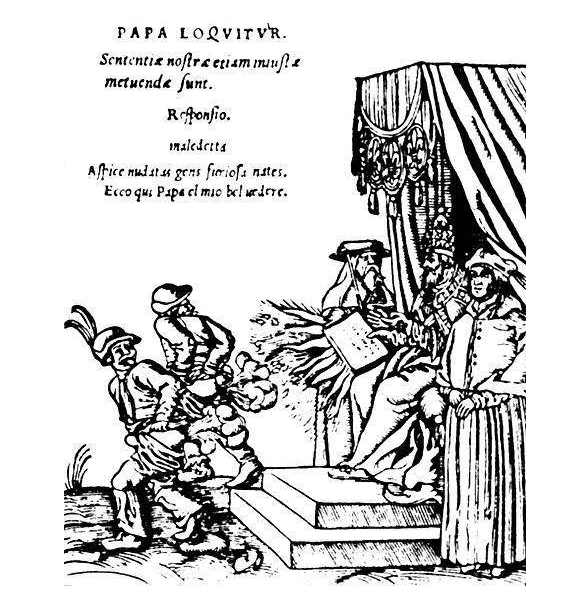
The text roughly translates as:
"Pope: Our judgment is to be feared, even if unjust.
Response: Cursed be you! Angry race, behold my buttocks!"
Despite being crude, such images carved into wood allowed them to be copied and printed across the continent’s printing presses, spreading with maximum viral effect. The rest, as they say, is history: the printing press enabled dissemination, memes enabled understanding—just one message resonating with the masses sparked one of history’s greatest political and social revolutions.
(Updated May 21, 2021: This also shows that the most effective counter to a meme is another meme.)
Section Two The Return of the Meme
In this context, meme art has arguably existed for centuries, evolving across different stages of technological development—especially technologies related to information distribution and transmission.
The difference now is that memes are not only ubiquitous but have also entered certain parts of society, sometimes without people even realizing they’re using memes. Some memes are jokes, but the most profound ones are those that don’t even look like memes: from propaganda to belief systems and stereotypes.
In the past, the ability to control narratives (and most memes) was limited to mainstream media, hence the term “Fourth Estate” (following the traditional three estates of clergy, nobility, and bourgeoisie). Now, almost anyone can potentially reach an audience. Thanks to the internet and platforms like Facebook, Twitter, Reddit, and even 4chan—along with meme-making skills at their fingertips—influencers can easily shape public opinion around nearly any topic.
Material that once served merely as clickbait now has the power to reshape truth. From political echo chambers to investment philosophies, the proliferation of memes is creating a world with multiple versions of truth—so many that there’s no longer a clear definition of what “truth” even means.
For example, is Bitcoin a “dirty currency”? Not factually. But when the claim “Bitcoin mining consumes more electricity than many countries” is repeated enough times in the media (especially in the Financial Times), Bitcoin becomes “dirty.” Facts become secondary. From “Drain the swamp” to “Make humanity a spacefaring civilization” (while spending Dogecoin on Mars?), it’s increasingly clear that whoever controls the largest audience defines the most truth—even if a statement is clearly falsifiable. And because their voice is louder than the “other side” capable of responding, they always win the argument.
*Editor’s note: “Make humanity a spacefaring civilization” is another core narrative of Musk’s company SpaceX
In financial markets, memes have rewritten the rules.
Long ago, market “truth” lay in seeking value: by understanding the intrinsic value of a company’s equity or debt, we could determine the enterprise’s worth and judge whether it was overvalued or undervalued. Techniques and methods for calculating value emerged, and university courses and textbooks were written for students wishing to learn them.
Crucially, everyone once agreed on the same standard of truth: “fundamental value.” Unfortunately, that’s no longer the case. And for anyone who still believes value is (or should be) truth, things might become disappointing.
We’ve written about how market structure has given markets a life of their own (https://threebody.capital/blog/2020/11/13/self-driving-markets): influenced by dealer hedging, passive flows, and everything in between. Flow is the outcome, and behind these flows, **the “value” meme is being replaced by other memes**—saving the world, moving to Mars, climate change, or even just a cute dog—promoted by anyone: from meme masters to scammers and their followers, even governments, regulators, and the established order.
Now everyone is playing the meme game. Maybe value will return (“Yes, value!”), maybe not, maybe only temporarily. Whatever it is, “value” is just part of the meme game—not the game itself.
This is our new reality. And to thrive, we must also play the meme game.
Because if we sit atop memes without seeing them, then we become the meme.
Everything is just a meme.
But few understand it.
Join TechFlow official community to stay tuned
Telegram:https://t.me/TechFlowDaily
X (Twitter):https://x.com/TechFlowPost
X (Twitter) EN:https://x.com/BlockFlow_News
 Mint Ventures