Why should I spend 12,000 yuan on a woman's .png?
TechFlow Selected TechFlow Selected
Why should I spend 12,000 yuan on a woman's .png?
Try to understand NFTs from the perspective of a consumer/collector, rather than that of a geek/technologist.
 Navigating Web3 tides with focused insights
Author: chenjing.claire, Co-founder of a startup, Ex TikTok PM
Trying to understand NFTs from the perspective of a consumer/collector (rather than a geek/technologist).
My NFT Timeline Milestones
April 5: I first heard the term "NFT" alongside news that Beeple's artwork sold for $69 million—an experience reminiscent of the 2017 crypto craze. The space felt utterly insane.
June 24: No matter how many articles I read or podcasts I listened to, nothing compared to diving in and minting an NFT myself. So I listed an original doodle on OpenSea starting at 0.05 WETH. It remains unsold to this day, but spending gas fees to learn how an NFT is created and understand the differences between OpenSea and other platforms was worth it.

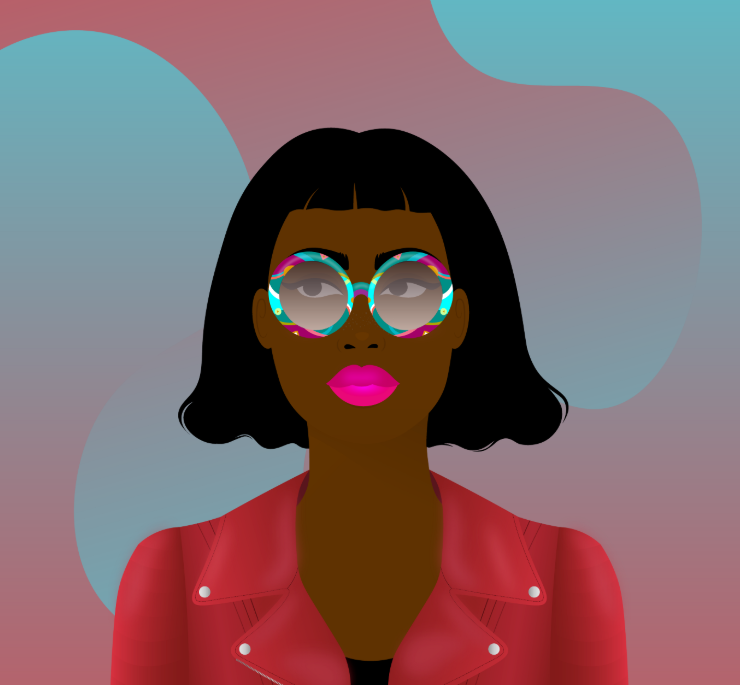
August 2: After four months of observation—from NBA Top Shot, VeeFriends, CryptoPunks, to Bored Ape Yacht Club—I still couldn't afford any of them. Finally, I found a collection I could both afford and believe in: an image titled "Woman #4877," a 4000x4000 PNG file listed at 0.175 ETH, equivalent to 12,635 NTD.
About the NFT Collection – "World of Women"
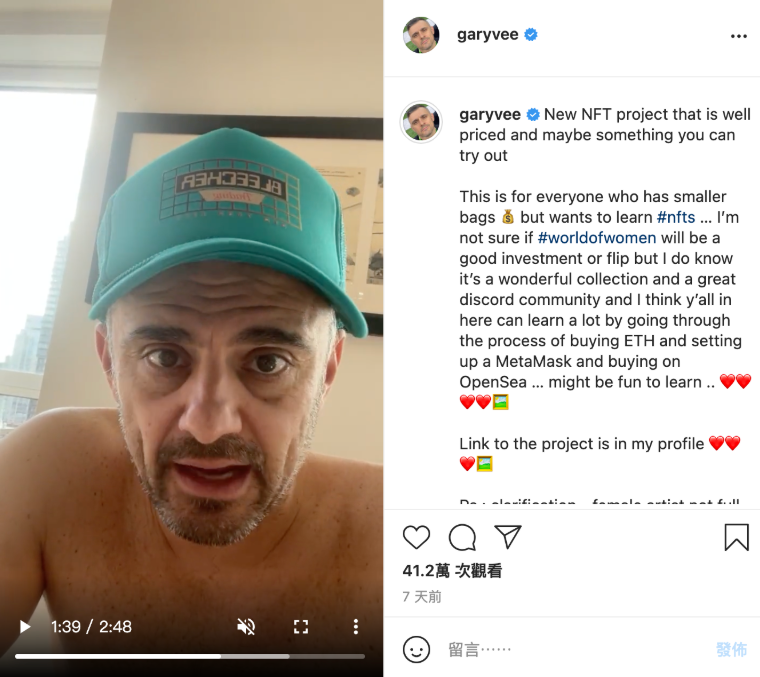
If I have any belief in NFTs, it's largely due to motivational guru GaryVee. On August 1, GaryVee posted a shirtless selfie video introducing the World of Women NFT collection, saying: "If your budget is limited but you want to learn more about NFTs, consider this project—go through the full process of buying ETH, setting up MetaMask, purchasing an NFT on OpenSea."
That’s me! While I can’t afford his VeeFriends (the cheapest now costs over 500,000 NTD), I should at least be able to afford the first project he publicly endorsed. So I began researching "World of Women."
The artist behind World of Women is Yam Karkai, “whose work has consistently centered women to highlight and empower them.”
World of Women consists of 10,000 randomly generated female figures, each with unique traits such as background, hairstyle, lips, skin tone, accessories, clothing, and facial features. Owning a Woman NFT grants holders 50% commercial rights—meaning if these images are used commercially in the future, all NFT owners receive 50% of royalties. Additionally, certain “special women” belong to one of three clubs: ROYALTIES CLUB members share 2% of secondary market trading fees monthly; INVESTORS CLUB members split 50% of WoW fund profits monthly; CURATORS CLUB members get to select an NFT artwork each month for the WoW fund to purchase, supporting their favorite crypto artists.
Beyond enabling mutual benefits among NFT holders, WoW also channels its mission back into the real world—2.5% of profits are donated to nonprofit organizations including SHE’S THE FIRST and TOO YOUNG TO WED, while 15% of profits are reinvested into the crypto art ecosystem.
It was only after learning this much that I realized most earlier NFT projects were not only unaffordable but also predominantly male-oriented (e.g., NBA Top Shot, Sorare, VeeFriends, CryptoPunks, Bored Ape Yacht Club, etc.). With World of Women, the NFT space finally gained some feminine resonance.
So after four months of watching, trusting GaryVee’s judgment, supporting WoW’s vision, and eager to dive into the NFT world, I bought my first NFT—"Woman #4877".
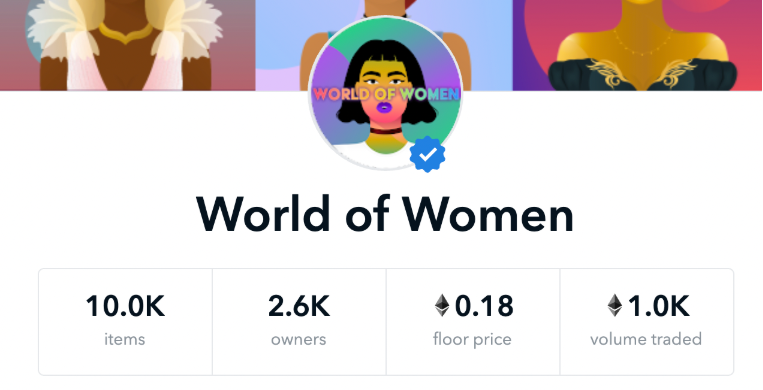
Why Spend 12,000 Yuan on a Picture of a Woman.png?
Setting aside the abstract concept of what NFTs actually are, let's treat them like ordinary collectibles. People generally buy collectibles for two reasons:
Owning and showing them off to others—for example, limited-edition sneakers, luxury goods, Yu-Gi-Oh cards.
Believing in their appreciation potential—for example, works by emerging artists.
But the examples above are tangible items. Why spend money on a digital file? Can't anyone just copy and paste the same image?
Like H&M versus Hermès, the former is mass-produced, lacks prestige, and doesn’t hold value, while the latter is scarce and carries brand value—making authenticity important to consumers. Similarly, NFTs give easily replicable digital files scarcity and verifiable authenticity, allowing consumers to buy into the underlying value—such as social status and growth potential—with a collector’s mindset.
The 12,000 yuan wasn’t just spent on the image "Woman #4877.png"—it was also invested in the emotional fulfillment of supporting WoW’s charitable causes, the sense of uniqueness from being part of the Women NFT community, and the belief that increasing adoption will drive up the value of my NFT.
For NFTs to Break Into the Mainstream, Three Key Challenges Remain…
Early 2021 marked NFTs' first breakout moment, but they’re still far from becoming mainstream. Issues around displayability, utility, and accessibility must be addressed.
The most critical step would be for mainstream social apps—Facebook, Instagram, TikTok, WhatsApp—to allow users to showcase their NFTs on personal profiles. This would dramatically boost NFTs’ visibility, bragging rights, and community value. If major platforms don’t act, new social apps might emerge and seize their dominant positions.
Next, more NFT-based products, services, and communities are needed to address the lack of practical utility. Currently, some NFTs offer exclusive content, perks, or VIP access—but these rely heavily on trust in the creator rather than systematic integration with the NFT itself. Once these features are productized, NFTs can deliver added value and services, giving practical-minded consumers—who care less about brand loyalty—a stronger incentive to buy.
Last but not least, the learning and usage barriers for NFTs must be lowered. From understanding cryptocurrency, buying ETH, setting up a crypto wallet, transferring ETH into it, learning about NFTs, to making a purchase—the entire process feels like climbing Mount Everest(?). It needs to become as easy as shopping on Shopee or Amazon for average consumers to participate effortlessly.
Finally, “Investment always involves risk. Crypto/NFT investments may result in gains or losses. Please read the offering documents carefully before purchasing.” Most current NFT collections are likely speculative bubbles inflated by traders. As we pay our tuition in this space, let’s all stay rational and objective.
Join TechFlow official community to stay tuned
Telegram:https://t.me/TechFlowDaily
X (Twitter):https://x.com/TechFlowPost
X (Twitter) EN:https://x.com/BlockFlow_News