








Uniswap and Regulation: Highlights from ChainBreaker Podcast Episode 2
TechFlow Selected TechFlow Selected
Uniswap and Regulation: Highlights from ChainBreaker Podcast Episode 2
In this episode, ChainNews Research Director Pan ZhiXiong was joined by Mr. Block Chris to dive into the hot topic "Talking about Uniswap and Regulation."
 Navigating Web3 tides with focused insights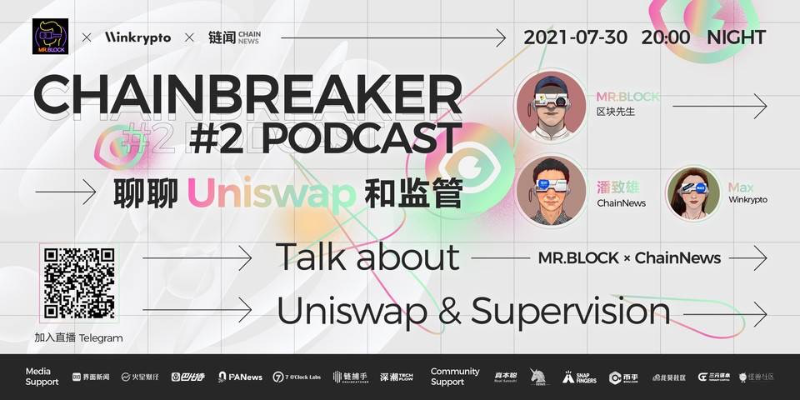
Highlights from this live session:
Background:
On July 24, Uniswap Labs—the company behind the decentralized cryptocurrency exchange Uniswap—announced it would cut off its interface and restrict access to over 100 tokens, including tokenized stocks, synthetic stocks, options, and derivatives. Uniswap Labs cited a "changing regulatory environment" as the reason for this move, noting increased scrutiny from the U.S. Securities and Exchange Commission (SEC) and the Commodity Futures Trading Commission (CFTC) on exchange-listed tokens. This decision sparked widespread discussion and reflection within the community regarding regulation and governance.
Mr. Block Chris:
DeFi will inevitably face regulatory challenges. However, DeFi's explosive growth occurred in the summer of 2020, and due to the impact of the pandemic, regulators were slow to respond, allowing DeFi space to grow rapidly and unchecked.
The viral spread of DeFi has built substantial user trust in the market. Therefore, while regulation may cause some retail investor panic, it won't significantly affect DeFi’s core user base.
For today’s DeFi market, excessive regulation could backfire—essentially pouring fuel on the fire—and ultimately make the DeFi market stronger. When incentives are strong enough, obstacles cease to be obstacles.
If regulation becomes unavoidable, wallets will likely be targeted first. However, hot wallets typically don’t hold large amounts of funds, so while this may have some market impact, it won’t damage the fundamentals.
Recently, CEXs have faced strict regulations—for example, being required to integrate tax reporting APIs. Compared to CEXs, DEXs represent the future trend. To avoid losing users, CEXs will likely need to expand into DEX offerings.
ChainNews Pan Zhixiong:
Uniswap Labs developed the original Uniswap Protocol code, but does not own or control the Uniswap Protocol itself. Upgrades and modifications to the protocol are driven by the community through UNI token voting. The official team distanced itself from operational risks early on, so we can continue using the protocol. Even in the worst-case scenario—if something happens to Uniswap—we still have other leading DEXs like Sushi. There's no need for excessive concern.
If regulation is unavoidable, front-ends, websites, and domains will likely be targeted first, meaning these components must become more compliant. Wallets are also a major regulatory focus—even though many wallets are open-source, most have centralized operating teams.
Front-ends will eventually become decentralized. There are already many solutions available today. In the future, we’ll see fully decentralized stacks, with front-ends distributed across nodes, making regulation increasingly difficult.
If we break down decentralized front-ends into layers, I’d say: the first layer is entry browsers, such as Opera; the second is decentralized domain names and resolution systems, like ENS; and below that come storage and computation layers, such as IPFS and Filecoin. Once these three layers are connected, users will be able to access any website via the front-end without any intermediary interference.
Currently, running an Ethereum node is still relatively expensive, beyond the reach of most users. As Ethereum evolves with more structural and layered advancements, we’ll need lightweight devices—like Raspberry Pi—with modest computing power and low storage requirements to run full nodes. This would greatly enhance censorship resistance for everyday Ethereum users.
Audience Q&A:
1. Are IPFS and Filecoin ready for practical applications?
Mr. Block Chris: Users have been able to store data on IPFS even before Filecoin launched. You can find many movies there, although video quality and speed aren’t always optimal. A large number of NFT archives are already stored on IPFS.
2. Could Uniswap become like Liquity, where multiple front-ends exist across different platforms?
Mr. Block Chris: Absolutely. In fact, many teams already operate Uniswap front-ends, such as 1inch and DeBank.
ChainNews Pan Zhixiong: Uniswap actually has a decentralized front-end. By visiting uniswap.eth, you can directly access it if your browser supports ENS. Otherwise, use uniswap.eth.link. Even if Uniswap Labs shuts down its web front-end, the system can survive. They update and publish each front-end version and resource to IPFS daily. They’ve also purchased the Ethereum Name Service (ENS) domain uniswap.eth and registered the corresponding IPFS resources under it—creating a fully functional system where domains point directly to front-end resources.
3. What’s your outlook on stablecoins? Is it possible for commercial banks to enter DeFi via stablecoins? Or will governments and banks stick to CBDCs and build their own centralized on-chain financing platforms?
Mr. Block Chris: I think that’s unlikely, since central bank-issued digital currencies differ fundamentally from stablecoins.
ChainNews Pan Zhixiong: For example, China’s CBDC partially uses consortium chain technology, which isn’t fully based on blockchain.
4. How can Uniswap V3 maintain liquidity without incentives? Has Uniswap V3 been successful?
Mr. Block Chris: Uniswap has sufficient brand power to attract participation. The reason many assets remain on Uniswap V2 is that at this stage of DeFi development, changing one component often triggers ripple effects across the entire ecosystem.
I believe V3 and V2 can coexist long-term: average users can opt for V2, while more sophisticated assets migrate to V3.
ChainNews Pan Zhixiong: Market-making returns on V3 are still quite attractive—that’s one key draw. Data-wise, while V3’s TVL hasn’t surpassed V2, its trading volume is already more than double that of V2. In terms of capital efficiency, V3 has clearly outperformed.
Reference article for this podcast:https://mp.weixin.qq.com/s/MPWMUpPL9fTimKqKpZ3y9w
About ChainBreaker:
The "ChainBreaker" livestream series is initiated by Winkrypto, a global blockchain integrated marketing firm, and co-launched with Mr. Block, a well-known video blogger with over 10,000 YouTube subscribers, and ChainNews, the leading Chinese-language blockchain content platform. The show aims to listen, communicate, and connect the global crypto community. Every Friday at 8:00 PM, "ChainBreaker" invites prominent figures from around the world to discuss trending topics in crypto, share insights on technological developments, uncover industry gossip, and more. Active participants in the live Q&A sessions may receive exclusive rewards such as "ChainBreaker Podcast" NFT Tickets and other surprise airdrops.
Join TechFlow official community to stay tuned
Telegram:https://t.me/TechFlowDaily
X (Twitter):https://x.com/TechFlowPost
X (Twitter) EN:https://x.com/BlockFlow_News






