








Innovation and Rebellion: How Synthetic Stocks Become the "Trojan Horse" of Traditional Finance?
TechFlow Selected TechFlow Selected
Innovation and Rebellion: How Synthetic Stocks Become the "Trojan Horse" of Traditional Finance?
In the rapidly evolving world of decentralized finance, DeFi innovators have successfully created synthetic versions of stocks to track some of the largest companies in the world.
 Navigating Web3 tides with focused insights
Author | Michael P. Regan
Translation | Anima
For years, Wall Street's establishment has debated the feasibility of moving stock markets onto blockchain—the underlying technology behind cryptocurrencies.
Innovators in the fast-moving world of decentralized finance (DeFi) haven't waited for those discussions to conclude. They've already created synthetic versions of stocks tracking some of the world’s largest companies. In essence, cryptocurrency’s anti-establishment ethos is being applied to the stock market.
Over the past year, Mirror Protocol and Synthetix have created replicas of shares in Tesla Inc., Apple Inc., Amazon.com Inc., and other major equities, as well as several popular exchange-traded funds (ETFs).
These tokens are designed to reflect the price movements of the securities they track—without requiring the actual purchase or sale of the underlying stocks or ETFs. So far, trading volumes represent only a tiny fraction of what occurs on regulated exchanges. But for crypto enthusiasts, the potential upside is enormous.
Synthetic stocks join a strange new world of assets such as digital art now traded on blockchains. However, unlike modern art, these instruments raise questions about how they will fit into the global stock market and brokerage industry governed by thousands of pages of rules across dozens of countries.
Currently, this is a case where innovation has dramatically outpaced regulation.
And that’s just how Do Kwon likes it. The co-founder and CEO of Terraform Labs, a South Korea-based company that created the Mirror Protocol on the Terra blockchain, sees himself as a kind of Robin Hood of modern finance—modeled after figures like Vlad Tenev, founder of Robinhood, or investor Chamath Palihapitiya, a leader in the WallStreetBets movement.
“DeFi is incredibly powerful in providing financial services to the disenfranchised around the world,” he said via email. “It’s better to move fast and break things. Waiting for fragmented regulatory frameworks to crystallize before innovating is wrong.”
Synthetic Assets
For Kwon and other proponents of these new synthetic assets, bypassing various rules and barriers in the financial world is a feature, not a bug.
He says it opens up wealth-creation opportunities currently available only to a privileged few. Users can trade tokens anonymously from anywhere, 24 hours a day, seven days a week, free from capital controls, broker-imposed "know your customer" (KYC) rules, and other frictions inherent in the traditional financial system.
Kwon says Terraform Labs does not earn any revenue from fees generated by the Mirror Protocol. These fees go back to users as incentives for providing liquidity. Instead, the company profits from its own cryptocurrency, which increases in value as projects like Mirror grow more popular.
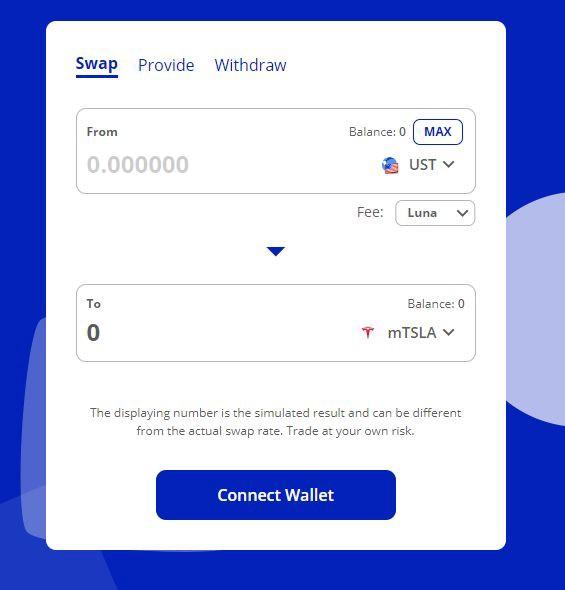
Interface for purchasing Mirror Tesla on Terraswap
So how exactly do these synthetic stocks work? Well, it’s complicated.
But simply put, under the “Mirror Protocol,” the idea is to keep synthetic stock prices aligned with real-world stocks through incentives for traders to arbitrage price differences and manage the token supply.
When prices run too high, users can create—or “mint”—new tokens by posting collateral; when prices fall too low, tokens can be destroyed—or “burned”—pushing prices back up or down accordingly.
Through these mechanisms, “synthetic assets closely track the prices of real-world assets,” Kwon says, “but they remain just tokens on a blockchain, offering pure price exposure.”
Trojan Horse
These tokens trade on decentralized automated markets like Uniswap and Terraswap, allowing users to buy and sell assets directly on the blockchain—a model distinct from centralized cryptocurrency exchanges such as Coinbase and Binance.
So far, trading volumes may not yet be high enough to keep executives at Nasdaq or the New York Stock Exchange awake at night. For example, according to Coinmarketcap.com, the market cap of the Mirror Apple token is around $34 million. By comparison, the real stock has a market cap of approximately $2.3 trillion—about 1/1000th the size of meme cryptocurrency Dogecoin.
Comparisons between various mirror stocks and their real-world counterparts at different times over the past week show discrepancies ranging from pennies to several dollars. For instance, during trading on June 30, the Mirror Tesla price listed on CoinMarketCap.com was nearly $6 higher than the actual stock price of $684.
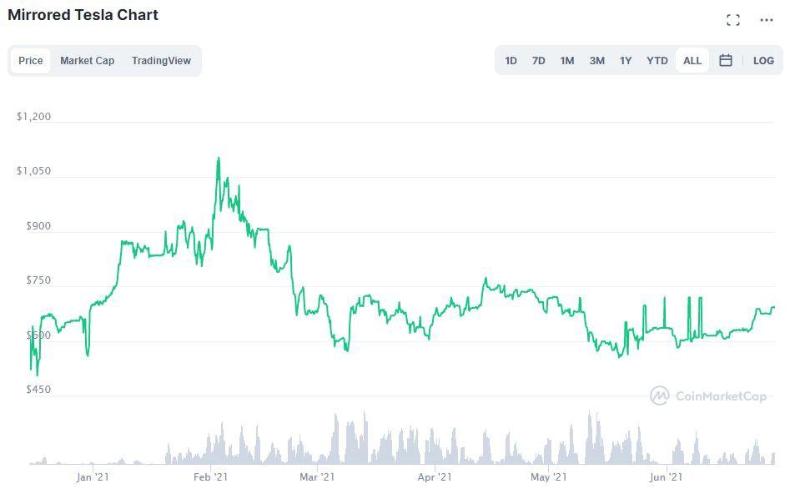
Mirror Tesla price from CoinMarketCap.com
However, given the ambitions within the DeFi space, these projects merit attention from traditional financial institutions. As digital asset management firm Arrington XRP Capital stated in an analysis outlining its support for Mirror, DeFi isn’t merely aiming to improve user experience with the banking system—it seeks to dismantle it entirely. The company wrote that these new synthetic stocks are “one of the most obvious Trojan horses for DeFi to enter traditional markets.”
A spokesperson for the U.S. Securities and Exchange Commission (SEC) and a representative from Nasdaq declined to comment. Nasdaq is the listing exchange for most of the stocks being replicated by synthetic products.
Joseph Saluzzi, co-head of stock trading at Themis Trading LLC, said: “Since these synthetic products aren’t regulated and aren’t traded on national securities exchanges, I think the SEC would have issues with them. According to the SEC’s mandate, their job is to protect investors, maintain fair, orderly, and efficient markets, and facilitate capital formation. To me, this sounds like a clear investor protection concern.”
The world’s largest cryptocurrency exchange, Binance, has already drawn scrutiny from German financial regulators for offering tokens tied to the performance of popular U.S. stocks—but backed by actual shares. In April, Germany’s Federal Financial Supervisory Authority (BaFin) said Binance may have violated securities rules when issuing tokenized stocks of Tesla, MicroStrategy Inc., and Coinbase.
Regulators could also begin taking a closer look at the broader DeFi ecosystem following the rise of stablecoins—digital currencies designed to closely track the value of national currencies (which synthetic asset traders use as collateral to mint new tokens).
Mark Cuban, owner of the Dallas Mavericks and an influential, passionate DeFi investor, recently called for regulation to address losses incurred when crypto values plummet to zero.
Billionaire cryptocurrency investor and Galaxy Digital founder and CEO Mike Novogratz recently tweeted that players in the DeFi market might regret failing to adopt so-called “know your customer” (KYC) and anti-money laundering (AML) rules.
He wrote: “Invest in compliant assets now, or pay later,” adding, “If we want this ecosystem to grow, we need to recognize that we must operate within the rules set by society.”
Kwon says Terraform Labs has had no conversations with regulators in the U.S. or elsewhere regarding synthetic stocks, nor has it communicated with exchanges like Nasdaq or ETF issuers whose products are being mirrored.
But he adds that to stop the trading of mirror stocks and other synthetic assets, one would have to shut down the open-source software code underlying blockchain itself—an infrastructure used by a global community of users, including many anonymous participants.
“As long as there are true believers who deeply understand what’s possible with this technology,” he said, “shutting down cryptocurrency, DeFi, or synthetic assets becomes a Sisyphean task.”
Join TechFlow official community to stay tuned
Telegram:https://t.me/TechFlowDaily
X (Twitter):https://x.com/TechFlowPost
X (Twitter) EN:https://x.com/BlockFlow_News
 @Bloomberg






