









58Coin exchange raided by authorities, "hundreds taken away by nearly 10 police vehicles"
TechFlow Selected TechFlow Selected
58Coin exchange raided by authorities, "hundreds taken away by nearly 10 police vehicles"
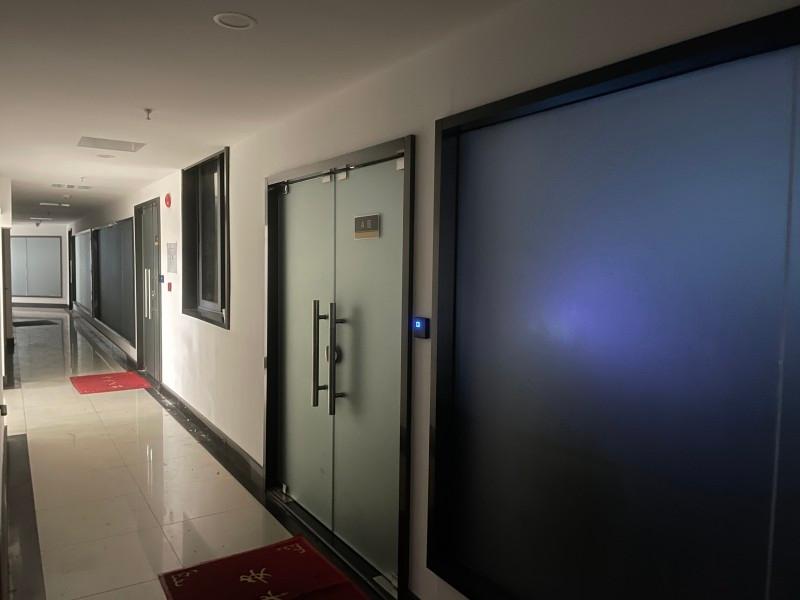
Blue Whale Finance visited a 58Coin office in Shanghai and verified that no staff were present, with the office doors tightly closed.
 Navigating Web3 tides with focused insights
Recently, users of the cryptocurrency exchange 58Coin reported being unable to withdraw funds from the platform.
A reporter from Blue Whale Finance visited a Shanghai office location associated with 58Coin and found the premises deserted, with doors tightly shut. There was no visible company name at the reception area, although leftover items bearing the 58Coin logo were spotted. According to insiders and multiple nearby residents, during midweek last week, over ten police vehicles arrived at the site and took away all employees—approximately 200 people. Blue Whale Finance has learned that some of these employees have since been released by authorities.
It is reported that staff from another local workplace linked to 58Coin were also taken into custody, with rumors suggesting around 400 employees in total across its Shanghai operations have been affected.
Additionally, 58Coin maintains offices in Xi’an and Beijing. Employees from the Xi’an branch told investors the company remains operational. Online images also suggest normal business activities continue at its Beijing office. Multiple sources informed Blue Whale Finance that during a blockchain conference held in Shenzhen in December 2020, a senior executive from 58Coin was suspected of being taken away by police. However, it remains unconfirmed whether the actual controller of 58Coin has been detained.
According to 58Coin's official website, the platform was established in November 2017 in the Marshall Islands and has set up offices in Japan, New Zealand, and Hong Kong. At the end of 2019, regulators in Shanghai conducted investigations targeting virtual currency exchanges operating locally. Binance had previously been exposed as having an office in Shanghai and currently operates a research institute in Lingang. Shortly after China issued its ICO ban in 2017, major exchanges began relocating their servers overseas and claimed headquarters located abroad.
Like other exchanges previously exposed for operating in Shanghai, 58Coin displays no identifying signs at the front desk, nor any directional signage within the building. Aside from the main entrance, interior windows are frosted glass, ensuring high privacy.
A document appearing to outline internal compliance requirements indicates 58Coin employees are prohibited from disclosing company or personal information, justified as necessary due to the nature of trading investments to avoid unnecessary complications. Based on current information, 58Coin employs a large number of sales representatives whose duties include registering multiple WeChat and QQ accounts, inviting users into groups, sharing simulated trade records, and attracting new users to register and deposit funds. According to alleged employee guidelines obtained, sales staff are required to maintain at least five WeChat accounts—including primary, business, and client accounts—with client accounts used specifically to join peer groups.
Users report that the platform primarily expands through its sales team while offering low transaction fees. 58Coin publicly claims leadership in futures trading, exchange services, and mining pools, advertising a one-sided fee of just 0.015%, said to be the lowest online. Some leading exchanges charge fees as high as 0.1%. The 58Coin app offers various futures trading products and cloud computing power services. Its Bitcoin computing platform sells mining machines, provides托管 (hosting), and offers cloud hashing power services.
Unverified reports allege that 58Coin engages in practices where it profits from user losses, collaborating with capital pool operators, "pig-butchering" scams, and contract trading mentors. When clients lose money, those who recruited them reportedly receive commissions. Related but unclear screenshots of police reports and case acceptance receipts have surfaced. Sources indicate that law enforcement may classify 58Coin’s activities as financial fraud, though no official announcement has confirmed this. Some investors have already filed police reports alleging fraud.
58Coin also issued its own platform token, the 58B coin, launched in 2018. Data from Feixiaohao shows that 58B reached a historical high of 0.16 CNY in December before declining, currently valued at 0.1 CNY. Some investors say they suffered heavy losses after purchasing 58B based on promised returns by the actual controller. As platform tokens are issued by centralized exchanges and lack transparency regarding issuance and burn quantities, there is potential for price manipulation by the issuer.
The platform’s cryptocurrency derivatives products have drawn skepticism. Publicly shared images previously highlighted instances of “spike trading” (or “needle insertion”) in several 58Coin futures pairs, causing users’ positions to liquidate abruptly. Several other exchanges have faced similar allegations in the past.
Currently, 58Coin’s online customer service appears busy, allowing only message submissions. In official user groups, some claim withdrawals have been credited, while others report waiting three days without receiving funds.
In 2019, Blue Whale Finance reported that a product named “New Third Board Leading No.5,” under Yuanpu Investment linked to 58Coin, became unredeemable, exposing related companies as unreachable—only for the exchange to re-emerge later.
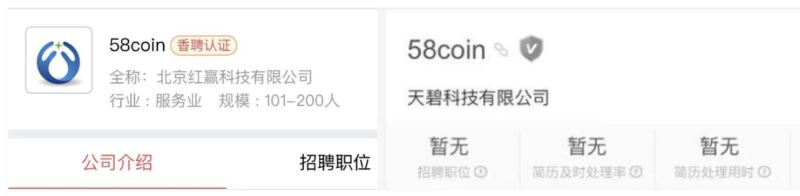
Although the office locations do not clearly identify the legal entities involved, job listings indicate companies linked to 58Coin include Beijing Hongying Technology Co., Ltd. (“Hongying Tech”) and Tianbi Technology Co., Ltd. (“Tianbi Tech”), registered in Beijing and Shanghai respectively, both ultimately pointing to Zhang Qiang. Information provided by investors visiting the scene reveals that the Xi’an office is officially tied only to two individuals, resembling a shell company structure.
Insiders describe 58Coin as a family-run operation centered around Zhang Qiang. According to Tianyancha data, Lu Qiang is the current legal representative of Hongying Tech and also serves as the legal representative of Shanghai Yuanpu Investment Management Co., Ltd. (“Yuanpu Investment”), and is a shareholder of Tianbi Tech. Xu Zuo previously served as legal representative for both Hongying Tech and Tianbi Tech, with Tianbi Tech’s current legal representative now being Xu Jingpo. Prior to 2018, Xu Zuo stepped down as legal representative of Hongying Tech, succeeded by Lu Qiang. Around the same time, original shareholders—Shanghai Qikun Information Technology Co., Ltd. (“Qikun Info”) and Shanghai Diseng Information Technology Co., Ltd. (“Diseng Info”)—were transferred to full ownership under Lu Qiang.
Diseng Info is currently managed and owned primarily by individuals surnamed Zhang. Shanghai Chuanmao Asset Management Co., Ltd. (“Chuanmao Assets”), in which Qikun Info holds investment stakes, originally had Xu Mimi as its legal representative, changed in December 2020. Both Hongying Tech and Tianbi Tech list Xu Mimi as supervisor.
Founder Zhang Qiang has resigned as legal representative of both Yuanpu Investment and Chuanmao Assets. In June 2019, the Asset Management Association of China (AMAC) published a list of suspected disconnected firms, including Chuanmao Assets. Yuanpu Investment had previously lost its private fund manager license, and neither firm now appears in AMAC’s list of registered private fund managers.
Zhang Qiang is also allegedly connected to Zhongtou Online. Tianyancha data shows that Zhongtou Online Co., Ltd. (“Zhongtou Online”) has a chairman named Zhang Qiang and is registered in Shanghai, though Tianyancha does not explicitly link him to the founder of Yuanpu Investment. Meanwhile, Chuanmao Assets once registered the brand name “Zhongtou Online.” A public article titled “How to Build 12 Billion: Seven Weapons of Yuanpu Investment Founder Zhang Qiang” details how both platforms operate under Zhang Qiang. The article states that Zhang Qiang entered precious metals investing in 2011 and later founded Zhongtou Online as a seasoned private investor during Yuanpu Investment’s development phase.
Yuanpu Investment was founded in 2014, focusing largely on the New Third Board market, with products such as the “New Third Board Leading Series.” Previously, customer service staff told Blue Whale Finance that due to poor market conditions on the New Third Board, the company was seeking transferees and intended to transfer ownership via agreement. Currently, Yuanpu Investment’s official website is inaccessible.
Join TechFlow official community to stay tuned
Telegram:https://t.me/TechFlowDaily
X (Twitter):https://x.com/TechFlowPost
X (Twitter) EN:https://x.com/BlockFlow_News






