








In a "folded" DeFi world, how do we find new value anchors?
TechFlow Selected TechFlow Selected
In a "folded" DeFi world, how do we find new value anchors?
DeFi must rediscover balance amid repeated imbalances.
 Navigating Web3 tides with focused insights
Mid-2020, DeFi entered the eye of the storm.
This is a game that deconstructs traditional rules—people interact directly with code. Centralized exchanges, investment institutions, and other intermediaries are bypassed.
This is a technological utopia: no KYC required, fully anonymous. Developers set the rules; participants voluntarily join.
It's also a volatile gold rush—annualized yields from mining and staking exceed 10,000%, governance tokens double or halve in a single day.
DeFi was seen as a white knight to rescue the market. After two months of blind momentum, however, came a sharp downturn—the Sushiswap split—and a cold autumn rain fell upon an overheated speculative world.
As the frenzy subsides, we suddenly realize this is also a folded world—whales and scientists capture profits, retail investors often become bagholders, and wealth inequality widens.
This is today’s DeFi world: people speculate on governance tokens but ignore governance value. Value lacks reference points and anchoring.
Weightless DeFi
Like the Hugo Award-winning novella "Folding Beijing," the DeFi world is being folded across different dimensions.
In an article titled "Memoirs of a DeFi Big Player," a whale recounts how he made $5 million on Sushiswap.
With a principal of $3 million, through liquidity mining and staking, he earned $5 million in just five days.
This epitomizes how whales profit in DeFi: enter early in a project, pay gas fees to obtain free governance tokens, then sell them on secondary markets—the so-called “mine-withdraw-sell” strategy.
During these past two months, Ethereum transaction fees have remained high, peaking at $70 per transaction. "Don’t even think about mining unless you have at least $50,000 capital," one DeFi miner warns.
"Just three or four contract calls cost nearly $500 in fees," complained an investor on September 3rd. Mining on Ethereum is clearly not a game for retail users.
Whales, scientists, and retail users represent three classic roles in DeFi. Whales and scientists dominate the landscape, while retail investors, lured by get-rich-quick dreams, mostly end up holding bags in secondary markets.
This is an infinitely nested game: once these tokens gain support in secondary markets, they can be used as collateral or to provide liquidity to earn more project tokens—an endless loop.
Amid the DeFi boom, funds poured in rapidly—the total value locked (TVL) in DeFi projects increased tenfold within three months. Yet we’ve also witnessed rapid capital flows accelerating wealth polarization.
Thus, decentralized finance isn't really decentralized—it's actually a game that widens the wealth gap.
Stani Kulechov, co-founder of Aave, stated that current DeFi distribution models are unfair and primarily serve whales. It's like the rich enjoying a free lunch, while ordinary people foot the bill.
At the top of the DeFi pyramid sit whales, scientists, and Ethereum miners. Below them, those buying governance tokens on secondary markets play musical chairs.
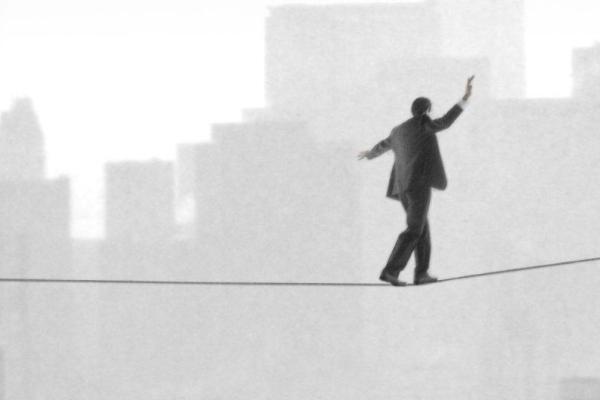
Leverage cascades layer by layer—the hotter DeFi gets, the greater the imbalance. The DeFi world gradually loses weight, and collapse could happen in an instant.
Who will ultimately bear the cost? "When the music stops, whoever is left on the dance floor pays."
Mainstream assets and stablecoins are locked in liquidity pools, draining overall market liquidity, while risks are transferred downward. Does this sound familiar? Yes—DeFi is reenacting the 2008 subprime crisis.
The 2008 financial crisis stemmed from multiple factors: mortgage lenders recklessly issuing loans, households aggressively leveraging, Wall Street banks packaging and trading securities, rating agencies turning a blind eye... At its core, it was a systemic breakdown caused by structural bubbles and investment mania.
Weiss Ratings recently tweeted: We’re almost seeing real use cases for DeFi—things previously thought impossible. Fascinating, yes—but don’t forget, many innovative uses of decentralized finance are also multiplying systemic risk.
The DeFi crisis may differ somewhat—the bubble is mainly in secondary markets, where token liquidity far exceeds that of real estate. Moreover, DeFi accounts for only 4% of the entire crypto market.
On September 4th, during a major market crash, Bitcoin briefly dropped below $10,000, and Ethereum fell by as much as 23.7%. We saw flash crashes across DeFi—SUSHI plunged up to 80%.
Overnight, the DeFi market froze. After Sushiswap, copycat projects flooded in—from "mining shitcoins" to "digging graves." Liquidity mining cycles grew shorter, collapses faster, and old anchors slowly失效.
FOMO Drives DeFi
The wave of liquidity mining launched in June ignited a DeFi craze.
Looking back, it injected new distribution mechanisms and governance models into the crypto world, fueling temporary prosperity.
dYdX categorizes early DeFi token economics into fee-based, governance-based, and re-collateralization types. Today, most DeFi tokens serve primarily governance functions.
What anchors the returns or value of governance tokens?
To some practitioners, governance tokens are like freely obtained coupons—of little intrinsic value.
"Based on rewards and transaction fees, YFI should reasonably be valued at $3," said Yearn Finance founder Andre Cronje. Now, YFI trades above Bitcoin’s price.
Setting aside whether governance tokens have value, a more important question arises: Can these tokens truly enable governance?
In terms of token distribution, DeFi may not differ much from JP Morgan or Bank of America's ownership structures—Curve’s core team controls 71% of protocol voting power; the top 10 addresses hold over 13% of Compound’s voting rights.
Moreover, whales maximize gains via recursive liquidity provisioning, concentrating governance tokens among a small group of players.
Market behavior shows most participants chase secondary-market value—whales execute “mine-withdraw-sell,” while retail traders operate in secondary markets without engaging in governance.
"The essence of the liquidity mining frenzy stems from arbitrage in primary markets and market obsession with TVL metrics, creating a resonance effect," said Yang Haipo, founder of ViaBTC.
FOMO in secondary markets dominates DeFi’s trajectory—this contradicts DeFi’s original intent, yet aligns perfectly with market dynamics.
DeFi’s Structure and Restructuring
DeFi’s explosion originated from internal resistance within the traditional crypto world.
Bitcoin and blockchain initially offered ordinary people opportunities to create wealth—that’s what attracted investors. Compared to mature markets like stock exchanges, the crypto world created possibilities for average individuals, hence its popularity.
Over the next three to four years, the crypto world developed a mature ecosystem involving VCs, exchanges, token funds, and mining operations.
DeFi’s breakout wasn’t just due to two years of industry maturation—it also arose from heightened demands for fairness after the March 12th market crash.
Fairness means rebuilding game rules without influencer endorsements, pump-and-dumps, or collusion among the powerful. The recent uproar around “Good Latitude Friends” serves as a negative example.
Both new and seasoned retail investors no longer trust the old crypto system. Compared to Bitcoin’s early egalitarianism, after a decade of development, the crypto world faces class solidification—people now demand greater fairness.
DeFi perfectly satisfies this aspiration. The main contradiction DeFi resolves is between investors’ growing demand for fairness and justice versus outdated, centralized rules.
Uniswap emerged out of nowhere, embodying all investor fantasies about a decentralized world—no central exchange, no listing fees, no need for quantitative market makers—just laissez-faire governance.
Uniswap’s total trading volume surpassed $10 billion—but problems were already brewing, as mentioned earlier: the subprime crisis is replaying in DeFi.
Last week, Sushiswap burst onto the scene. Unlike Uniswap’s VC-backed model (backed by a16z), Sushiswap positioned itself as community-driven, challenging Uniswap and claiming to be more retail-friendly—a more ultimate version of DeFi.
However, due to its anonymous founder and other issues, Sushiswap failed, transferring control to Sam Bankman-Fried, CEO of FTX (backed by Binance).
From VC-backed to community-led, then back into VC hands—DeFi still cannot escape reliance on centralized institutional backing. Decentralized governance in DeFi has a long way to go—it hasn’t shaken off human-centric interests nor attracted genuine participants in governance.
Speculating on governance tokens while neglecting actual governance—that’s the crux of the issue in DeFi. FOMO and human-controlled systems aren’t sustainable—they’ve drained liquidity mining of its last ounce of value. For DeFi to progress, it must find new value anchors.
Finding DeFi’s New Anchor
DeFi accelerates capital flow, causing new projects to emerge rapidly and attract attention. One day in DeFi equals a year in traditional crypto; one day in crypto equals a year in the real world. In half a year, DeFi seems to have traversed decades of traditional evolution.
But pause and ask: Can DeFi really change the world?
First, can DeFi truly achieve inclusive finance? Even Libra, aiming for the same goal, faced heavy resistance from governments worldwide. Meanwhile, the existence of DeFi governance tokens makes regulatory evasion impossible—traditional rule holds: who governs, who bears responsibility.
Furthermore, many DeFi projects exist solely for regulatory arbitrage—not inclusive finance. Perhaps instead of chasing fleeting new DeFi projects, we should focus on long-term builders with continuous product iteration, such as MakerDAO.
Beyond that, what is DeFi’s true value?
DeFi’s value anchor isn’t the governance token itself, but rather on-chain governance—collaboratively unlocking greater value.
Most gains from this DeFi wave have been captured by whales, scientists, and GPU miners—nomadic profit-seekers with no interest in long-term project building.
"When prices surge, they attract users who care nothing about sustainable returns, providing liquidity, or participating in governance," said Yearn Finance founder Andre Cronje.
This is an equal but unfair game. What comes next is designing fairer governance systems—not just attracting speculators.
For instance, Winter Yang, founding partner at Primitive Ventures, mentioned a project requiring prior participation in YFI’s on-chain governance voting as an entry threshold—effectively channeling traffic toward those genuinely interested in YFI’s future, resulting in high-quality engagement. Another project requires users to have interacted with several staking contracts before a certain block height, effectively deterring opportunistic yield farmers.
After this DeFi cycle, the market begins to cool down. A welcome trend is emerging: people are refocusing on blockchain ecosystems, discovering the next value plays, and seeking meaningful participation—not just leveraged speculation.
As Su Zhu, co-founder of Three Arrows Capital, put it, DeFi projects struggle to balance fundraising, talent acquisition, decentralization, and delivering products users truly want.
Whether individual projects or the broader DeFi world, equilibrium will eventually be found amid repeated imbalances.
As economist Joseph Schumpeter noted, capitalism’s core lies in creative destruction—economic structures repeatedly and often painfully reorganize as innovative solutions replace outdated methods.
*TechFlow reminds all investors to beware of high-risk speculation. Views expressed herein do not constitute investment advice.
Join TechFlow official community to stay tuned
Telegram:https://t.me/TechFlowDaily
X (Twitter):https://x.com/TechFlowPost
X (Twitter) EN:https://x.com/BlockFlow_News






