How to bid for a Polkadot parachain slot?
TechFlow Selected TechFlow Selected
How to bid for a Polkadot parachain slot?
The later the auction, the higher the failure rate.
 Navigating Web3 tides with focused insights
Polkadot's parachain slots will be sold through permissionless candle auctions, with some improvements made to this candle auction mechanism to ensure blockchain security.
Candle Auction Mechanism
A candle auction is a variant of an open ascending-price auction, where bidders submit increasingly higher bids, and the highest bidder at the end of the auction is considered the winner.
Candle auctions were originally used in the 16th century to sell ships, deriving their name from the "burning of a candle" that determined the auction’s opening period. When the flame went out and the candle extinguished, the auction would suddenly terminate, and the bidder active at that moment would win.
When implemented online, candle auctions require a random number to determine the termination time.
The parachain slot auction differs slightly from a traditional candle auction because it does not use randomness to determine the duration of its opening phase. Instead, it has a known open period, but at normal conclusion, the ending point is determined retroactively as having occurred at some earlier, randomly selected block. During the open phase, bids continue to be accepted, but later bids carry a higher risk of failure since the retroactively determined end block may precede the submission block.
Acala &Laminar Liang Ge explains: “At normal conclusion, the end is determined retroactively as having occurred at some past point” means that after the full auction period ends, a past block is randomly computed—this block marks the true cutoff time for the auction. However, this computation happens only after the entire process concludes, so no one can know in advance when the auction actually ended.
Why Use a Candle Auction?
The openness and transparency of blockchain systems expose auction mechanisms to attacks that do not exist in traditional auctions. Ordinary open auctions are especially vulnerable to manipulation when conducted over the internet or on blockchains.
An auction attack occurs when bidders delay placing bids until the last moment, hoping to win at a price below the item’s true value.
For example, Alice might value an item at $30. She starts with a $10 bid, intending to incrementally increase her offer only if necessary, stopping once she exceeds $30. Another bidder, Eve, values the same item at $11 and plans to wait until the final second to place her $11 bid. Before Alice can respond, the auction ends, and she loses the item. This mechanism is suboptimal—it fails to discover the item’s true market value and does not allocate the item to the person who values it most.
On blockchains, the problem can be worse, as block producers may exploit their position by inserting or censoring bids in the final blocks to manipulate outcomes. Malicious bidders or validators could collude to harm honest participants.
Because of these risks, the Vickrey auction—a sealed-bid second-price auction where bids are hidden and revealed only afterward—has become a favored alternative. For instance, it is used in ENS (https://ens.domains/) to auction human-readable domain names. The candle auction offers another solution that avoids the two-step commit-and-reveal process required by Vickrey auctions, thereby enabling participation by smart contracts.
In a candle auction, everyone can observe the current state of bidding, but no one knows exactly when the auction will end. This uncertainty encourages bidders to submit competitive bids early, rather than risk submitting a bid after the retroactive end block has already passed.
Implementation in Polkadot
Polkadot uses a VRF-based random beacon, which is also utilized elsewhere in the protocol. The VRF provides the source of randomness used to retroactively determine the auction’s “end time.”
When an account places a bid, they can bid for any available duration or range within a slot. However, if a parachain (with the same STF) places a bid, it must bid for a continuous sequence of periods until its desired lease interval is fully covered. It cannot bid for overlapping slots (no two parachains can occupy the same time), nor can it bid for future slots with gaps in between. If a parachain restarts after its slot lease ends, it must reinitialize from a new genesis (possibly a snapshot of all prior state) and require bidding from an external account.
The maximum lease duration per slot is two years, divided into four six-month periods. Parachains can rent a slot for any continuous range within this two-year window. Over time, parachains may lease multiple non-overlapping slots, allowing them to extend their presence beyond two years by securing consecutive leases.
How to Bid?
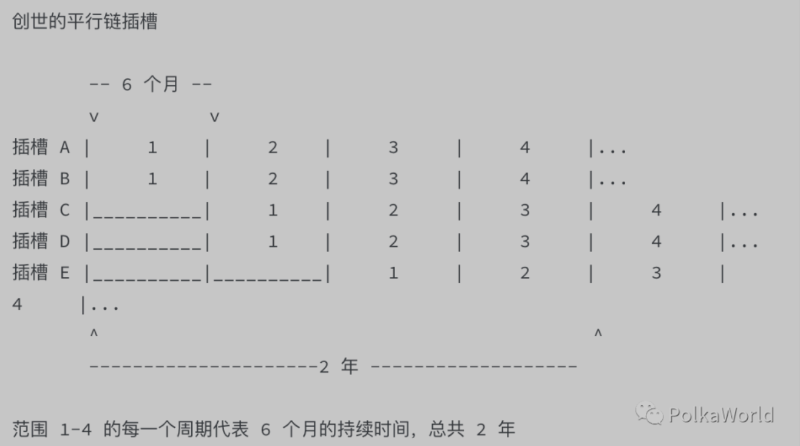
Each parachain slot has a maximum duration of two years. Each six-month interval is defined as a lease period. Multiple consecutive periods form a range.
Several auctions will be held during the six months preceding the start of a new set of parachain slot leases.
Bidders submit a configured bid specifying the amount of DOT they are willing to lock and the desired lease range. The slot range can be any contiguous sequence from period 1 to 4.
A single bidder's configuration might look like this:
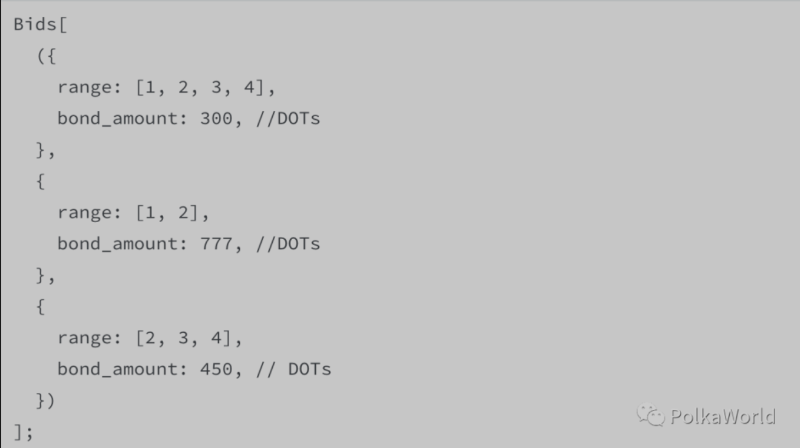
The winner-selection algorithm chooses non-overlapping bids to maximize the total DOT locked across the entire two-year lease period. This means that the highest bidder in any given lease period may not always win (see example below).
At each block, a random number is generated based on Polkadot’s VRF. Each auction also has a threshold that starts at 0 and increases toward 1. The VRF-generated random number is compared against this threshold to determine whether the current block is the auction’s end. Additionally, the VRF selects a block from the previous epoch to read the bid state from, mitigating certain types of attacks by malicious validators.
Examples
Non-competitive Scenario
One parachain slot is available.
Alice bids 20 DOT for range 1–2.
Bob bids 30 DOT for range 3–4.
The auction ends.
Alice locks 20 DOT and uses the parachain slot in the first year.
Bob locks 30 DOT and uses the parachain slot in the second year.
Competitive Scenario
One parachain slot is available.
Charlie bids 75 DOT for range 1–4.
Dave bids 100 DOT for range 3–4.
Emily bids 40 DOT for range 1–2.
Let’s calculate each bidder’s valuation using the algorithm: multiply the locked DOT amount by the number of lease periods in the specified range.
Charlie: 75 × 4 = 300, range 1–4.
Dave: 100 × 2 = 200, range 3–4.
Emily: 40 × 2 = 80, range 1–2.
Although Dave has the highest DOT bid, when we compute valuations, we see that because he only bid for two periods, his combined total with Emily (200 + 80 = 280) is still less than Charlie’s 300. Therefore, Charlie wins the full range 1–4 and secures the entire parachain slot.
Frequently Asked Questions
Why wouldn’t everyone just bid for the longest possible term?
DOT used in a bid is locked for the duration of the slot lease. This creates an opportunity cost, as those funds cannot be used elsewhere. The mechanism is designed so that parachains have aligned incentives with the Polkadot relay chain.
How does this mechanism promote parachain diversity?
Dividing the slot into six-month intervals partly aims to encourage greater parachain diversity and prevent large, well-funded parachains from hoarding slots. By setting each period to six months while keeping the full slot duration at two years, the system allows well-funded parachains to secure continuity at lease renewal while gradually enabling other parachains to enter the ecosystem and occupy unused six-month periods. For example, if a large, well-funded parachain holds range 1–4, it may strongly prefer to secure range 2–5 next. Under this mechanism, a new parachain could instead obtain period 5 (since it only requires period 5), while another parachain fills range 2–4.
Why is randomness difficult on blockchains?
Randomness is challenging in blockchain systems. Generating a trustworthy random number on a transparent, open network—where all parties must be able to verify the outcome—creates opportunities for participants to manipulate or influence the result. Several solutions have been proposed, including hash-onions like RANDAO and Verifiable Random Functions (VRFs). The latter is what Polkadot uses as the foundation for its randomness.
Resources
Parachain Allocation: In-depth mechanism description on the W3F Research page https://research.web3.foundation/en/latest/polkadot/Parachain-Allocation.html.
Code for parachain slot auctions
https://github.com/paritytech/polkadot/pull/239
Original Source
https://wiki.polkadot.network/docs/en/learn-auction
Translation: PolkaWorld
Join TechFlow official community to stay tuned
Telegram:https://t.me/TechFlowDaily
X (Twitter):https://x.com/TechFlowPost
X (Twitter) EN:https://x.com/BlockFlow_News