
Bitcoin ETFs Record Year-to-Date Net Outflow of 100,000 Coins, BlackRock IBIT Leads Decline
TechFlow Selected TechFlow Selected
Bitcoin ETFs Record Year-to-Date Net Outflow of 100,000 Coins, BlackRock IBIT Leads Decline
All "stable buy orders" promises failed to materialize.
 Navigating Web3 tides with focused insights
Author: Claude, TechFlow
TechFlow Editor's Note: Bitcoin ETFs are experiencing their most severe bleeding since listing. According to CryptoQuant data, over 100,000 BTC have withdrawn from ETFs in 2026, with cumulative outflows exceeding 160,000 coins since the high last October, marking the deepest drawdown since the ETF's inception. Net outflows in June alone were approximately $4 billion, setting a record since listing, with BlackRock's IBIT accounting for nearly 80%. The narrative of "stable institutional buying" from two years ago now hasn't even lasted two years. BTC has fallen below $60,000, hitting a yearly low of $58,190.
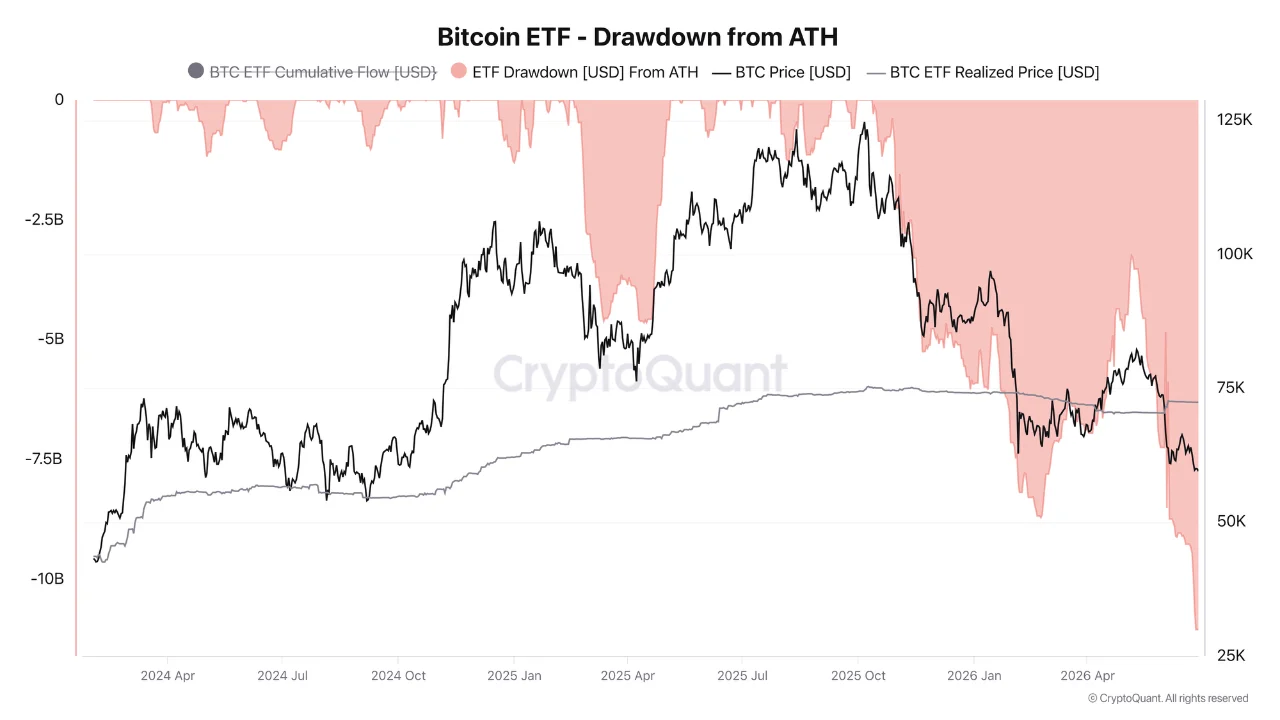
Bitcoin spot ETFs were once regarded as a stable entry point for institutional capital; now, this entry point is draining capital in reverse.
According to on-chain analysis platform CryptoQuant, analyst Darkfost pointed out in a post on platform X on June 30 that Bitcoin withdrawn from ETF issuers in 2026 has exceeded 100,000 coins, for the first time since ETFs emerged. If calculated from the historical high of ETF holdings in October 2025, cumulative outflows have exceeded 160,000 BTC. Darkfost called this the deepest drawdown for Bitcoin ETFs so far, with associated holding value losses exceeding $11 billion.
His judgment is: "The bear market spares no one, not even big players like ETFs and BlackRock." In subsequent comments, he added that the market originally expected ETFs to be a source of "continuous buying," but the result was "it couldn't even last two years."
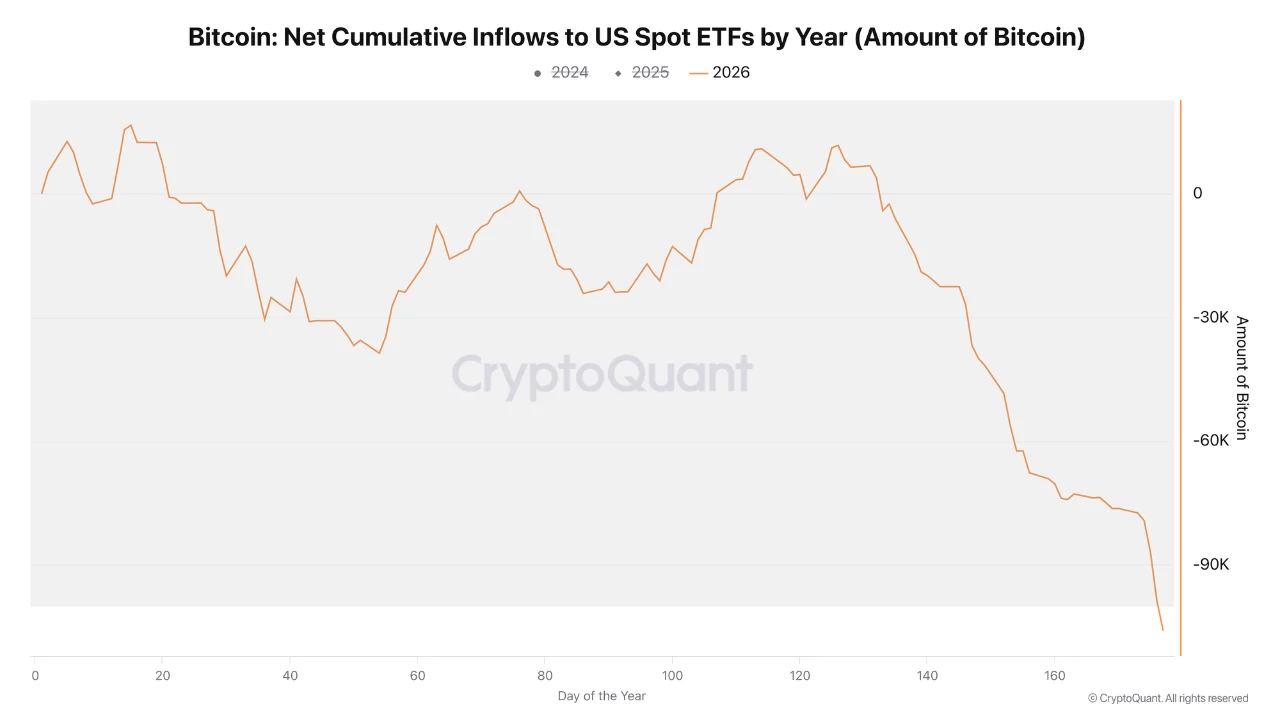
Net Outflows Exceed 100,000 Coins Within the Year, Setting ETF Listing Record
The reason why the number 100,000 is glaring is that it is the first time in the nearly two and a half years since ETFs existed.
Spot Bitcoin ETFs listed in the US in January 2024. Although there were monthly fluctuations in the first two years (2024, 2025), cumulative net inflows remained positive. The turning point occurred in 2026—according to CryptoQuant charts, cumulative capital flows within the year showed almost uninterrupted decline, finally breaking through the net outflow threshold of 100,000 BTC.
Beyond the outflow scale priced in BTC, the data in USD terms is equally brutal. According to SoSoValue data, US spot Bitcoin ETFs recorded net outflows of approximately $4.06 billion in June, the worst single-month performance since listing in January 2024, surpassing the old record of $3.56 billion set in February 2025. If May's net redemptions are included, the total outflow for the two months is approximately $6.5 billion.
The bleeding is comprehensive. June once saw 7 consecutive days of net redemptions, with a single-day peak reaching $696.3 million. As of the end of June, the combined assets under management of all US spot Bitcoin ETFs had dropped from a yearly high of approximately $104 billion to approximately $72.8 billion—this decline comes from both the capital outflows themselves and the shrinkage in Bitcoin price of remaining holdings.
BlackRock's IBIT Accounts for Nearly 80%, "Safe Bet" Also Being Sold Off
If there is a protagonist in this round of outflows, it is BlackRock's IBIT.
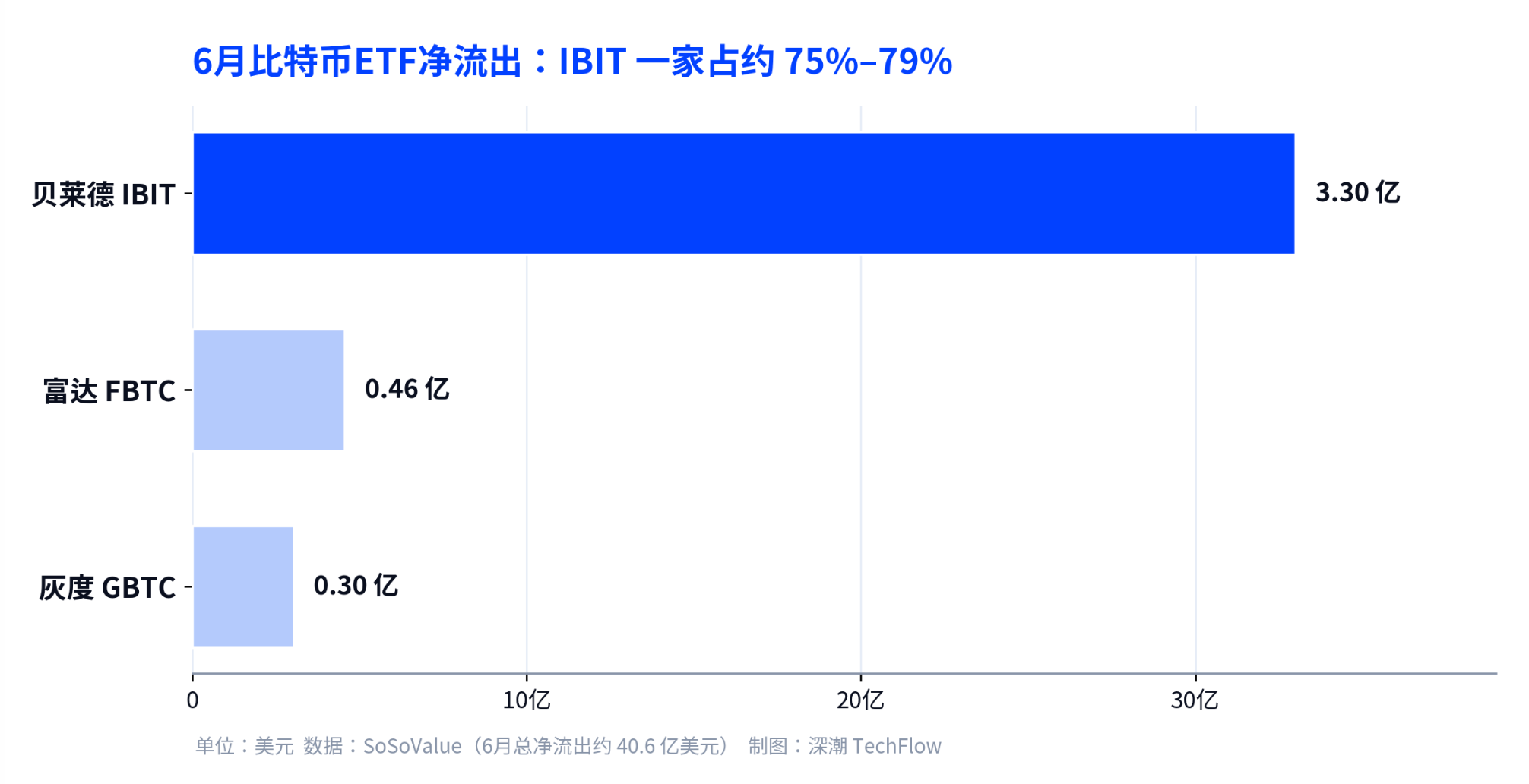
As the largest spot Bitcoin ETF, IBIT has always been a barometer of institutional demand. According to SoSoValue data, IBIT contributed approximately $3.3 billion in redemptions in June, accounting for about 75% to 79% of the total monthly outflows (statistical calibers vary slightly among different sources). In the second quarter alone, IBIT lost approximately $2.01 billion. During the same period, Fidelity's FBTC saw outflows of approximately $456 million, and Grayscale's GBTC saw outflows of approximately $303 million.
IBIT's volume makes its redemptions particularly glaring. When IBIT absorbs money, its scale reinforces the narrative of institutional demand; when it bleeds, the same scale makes it impossible for the entire market to ignore. According to data cited by KuCoin, IBIT once saw net outflows of approximately $860 million in one week, and as of June 26, the fund's net assets were approximately $44.87 billion.
Worth comparing is history. In that round of selling in February 2025, ETFs had net outflows for 8 consecutive days, which was the record at the time. In this round, the number of consecutive redemption days from mid-June to the end of the month more than doubled. Analysts generally interpret this "redeeming more as it falls" as: ETF holders' price sensitivity near Bitcoin support levels is increasing.
Behind the Selling: Interest Rates, Risk Appetite, and Strategy's Cash Pressure
ETF bleeding is not an isolated event; it is embedded in a macro environment that is "deeply unfavorable" to Bitcoin.
According to CryptoQuant, while selling pressure intensified, US macro data weakened easing expectations: the PCE price index rose 4.1% year-on-year, higher than the expected 4.0%; core PCE inflation was 3.4%, also exceeding expectations. GDP growth of 2.1% was also better than estimated. Interest rates remained high, and US Treasury yields rose, directly suppressing the willingness to allocate risk assets including Bitcoin ETFs.
There is more than one signal of slowing institutional demand. Darkfost previously pointed out that the Coinbase Premium Index has been negative for 40 consecutive days since May 15—this indicator compares the Bitcoin price difference between Coinbase Advanced and Binance; Coinbase continuing at a discount usually means selling pressure from professional investors is heavier than from retail.
Selling pressure has also spread to the "coin-hoarding company" line. According to Bitwise estimates, Strategy (formerly MicroStrategy) cumulatively bought 174,300 BTC in 2026, of which approximately 96,000 (55%) were financed through STRC preferred stock, and another 77,500 were supported by MSTR common stock additional issuance funds. According to CryptoQuant, STRC once fell to $82.5 last week, creating a record discount of 17.5% compared to the $100 par value, and slid further to approximately $73 before trading on Friday. Strategy's cash reserves have shrunk by 38% since the beginning of 2026. The capital chain of the coin-hoarding machine is being repriced by the market.
A Counter Signal: ETF Holdings Priced in BTC Still Near Peak
The numbers are scary, but there is a detail worth readers putting on the other end of the scale.
According to CryptoBriefing, although outflows in USD terms set a record, ETF holdings priced in BTC quantity remain near historical peaks.
That is to say, a significant portion of the "shrinkage" comes from the coin price decline, rather than holders actually clearing positions and leaving. At the same time, corporate treasury buyers continued to buy during the June decline; this part of offsetting demand is not reflected in ETF flow data.
For ordinary investors, this round of data does not give a "bottoming" signal. Public analysis gives an actionable observation point:
If IBIT's outflows slow down, Bitcoin stabilizes in the $50,000 high range and returns to the $59,000 to $62,000 range, this week's selling could be seen as a possible starting point for a "capitulation" clearance or flow reset. Conversely, if it falls below the support band of $58,000 to $59,300, the next target may point to $57,000, and further down is the two-year low range of approximately $54,000.
Realized price (realized price) is slightly higher than $53,000, another key observation level during deep declines.
Join TechFlow official community to stay tuned
Telegram:https://t.me/TechFlowDaily
X (Twitter):https://x.com/TechFlowPost
X (Twitter) EN:https://x.com/BlockFlow_News
 深潮TechFlow