Bitcoin 2011: Out of Control
TechFlow Selected TechFlow Selected
Bitcoin 2011: Out of Control
In 2011, Bitcoin stood in two worlds simultaneously for the first time: one world was about hashes, private keys, blocks, computing power, and the longest chain; the other world was about exchanges, drugs, donations, law enforcement, password leaks, user losses, and public opinion.
 Navigating Web3 tides with focused insights
By: Liu Honglin
On June 19, 2011, a Bitcoin player sat in front of a computer, repeatedly refreshing the Mt. Gox trading page.
The light from the screen fell on his face, but the page迟迟 did not give a reassuring answer. A few months earlier, one Bitcoin had just touched $1; by June, it had surged to over ten dollars. In the forums, some calculated wealth, some discussed mining, and some began seriously studying exchanges and wallets. A small experiment that originally belonged to cryptography mailing lists and geek forums suddenly had a price that could keep ordinary people awake at night.
That night, what he was watching was not an abstract market trend.
He saw his own account, the orders hanging on the exchange, the imagination just ignited by the price, and the most primal panic when a young market suddenly lost control. Bitcoin, which was just around $17 moments ago, was hammered down to a few cents within minutes. Some thought the webpage was erroneous, some refreshed repeatedly, some rushed to change passwords, and others stared blankly at the transaction records. Voices in chat rooms and forums quickly blended into a mess: Were accounts stolen? Was the exchange broken? Could orders still be cancelled? Did the coins in hand still count?
What was more unsettling was that the Bitcoin network did not stop.
Blocks continued to move forward at their own rhythm, transfers could still be confirmed, and the protocol operated quietly like a machine that did not understand human panic. What was broken was the world outside the protocol: exchange accounts, databases, passwords, administrator permissions, and the fragile trust users had just built.
At that moment, early players saw clearly for the first time: Bitcoin said it didn't need banks, yet people still handed their coins to some website; it said it didn't need trusted third parties, yet price, liquidity, and entry points pushed new third parties onto center stage. This new third party had no bank lobby, no tellers, no deposit insurance, and no mature audit system—only a webpage and a group of technologists not yet ready to bear financial risks.
Those two pizzas in 2010 made Bitcoin look like money for the first time. In 2011, it began to bear the weight of money. Price brought greed, the black market brought demand, media brought spectators, and non-profit organizations brought concerns. Everything began to remind people: anonymity, wealth, and security never automatically hold true just because they are written into code.
If one word were to be found for Bitcoin's 2011, it would be: Out of Control.
This loss of control was not a protocol collapse. It was all the old problems rushing at once after a new species entered the real world too early.
Bitcoin had just walked out of a small technical forum when it encountered non-profit organizations, The New Yorker, Silk Road, Mt. Gox, hackers, senators, and a batch of ordinary people dreaming of getting rich quick.
This was not Bitcoin's most glorious year, nor was it a year that could be covered up by the phrase "dark history." It was more like the crypto world's first coming-of-age ceremony: a young system still wearing an engineer's jacket was pushed onto a stage where finance, law, crime, public opinion, and commercial infrastructure were all lit up simultaneously, forced to answer what it truly was.
January, Non-Profit Organizations Test the Waters
On January 20, 2011, the Electronic Frontier Foundation published an article on its official website, with a title roughly meaning: Bitcoin is a step towards censorship-resistant digital currency.
The Electronic Frontier Foundation, abbreviated as EFF, is an American non-profit organization that has long focused on digital rights, privacy, and internet freedom. The angle from which it saw Bitcoin was different from traders. Traders would first ask how much a Bitcoin could rise; EFF cared more about: in an era where online payments increasingly relied on banks, credit cards, PayPal, Visa, Mastercard, and regulatory interfaces, could individuals still retain a bit of autonomy close to cash?
This article needs to be understood against the backdrop of the payment blockade following WikiLeaks. At the end of 2010, payment institutions such as PayPal, Visa, and Mastercard successively cut off WikiLeaks' donation channels. For many technological libertarians, this event was like a reminder: the internet could allow information to flow very quickly, but money was still stuck in the hands of a few financial intermediaries. As long as the payment entry point was shut off, an organization could be forced to suffocate commercially.
Bitcoin seemed very tempting in this context. It did not need bank approval, did not need payment companies to open merchant accounts, and users could send and receive directly after downloading the software. EFF acknowledged that this design responded to privacy and autonomy issues, and also mentioned that Bitcoin used public transaction records to prevent double spending, no longer relying on a single third party for bookkeeping.
But this article was not blindly excited. It also reminded that Bitcoin's anonymity was not solid and might touch upon legal issues such as money laundering, taxation, and consumer protection. In other words, in January 2011, the earliest people who seriously saw Bitcoin's public value had already seen its legal troubles.
The later crypto industry almost always lived within this set of tensions. The same tool was an entry point to bypass payment blockades for donors, a channel to bypass financial monitoring for law enforcement, and a reputation and legal liability issue for non-profit organizations. EFF saw Bitcoin's public value early, and also saw its troubles early.
At the beginning of 2011, Bitcoin had not truly broken out of the circle. EFF had already moved it from a programmer's small toy into public discussions on payment censorship, privacy rights, financial intermediaries, and legal liability.
That door was first opened a crack by non-profit organizations.
February, Bitcoin One Dollar
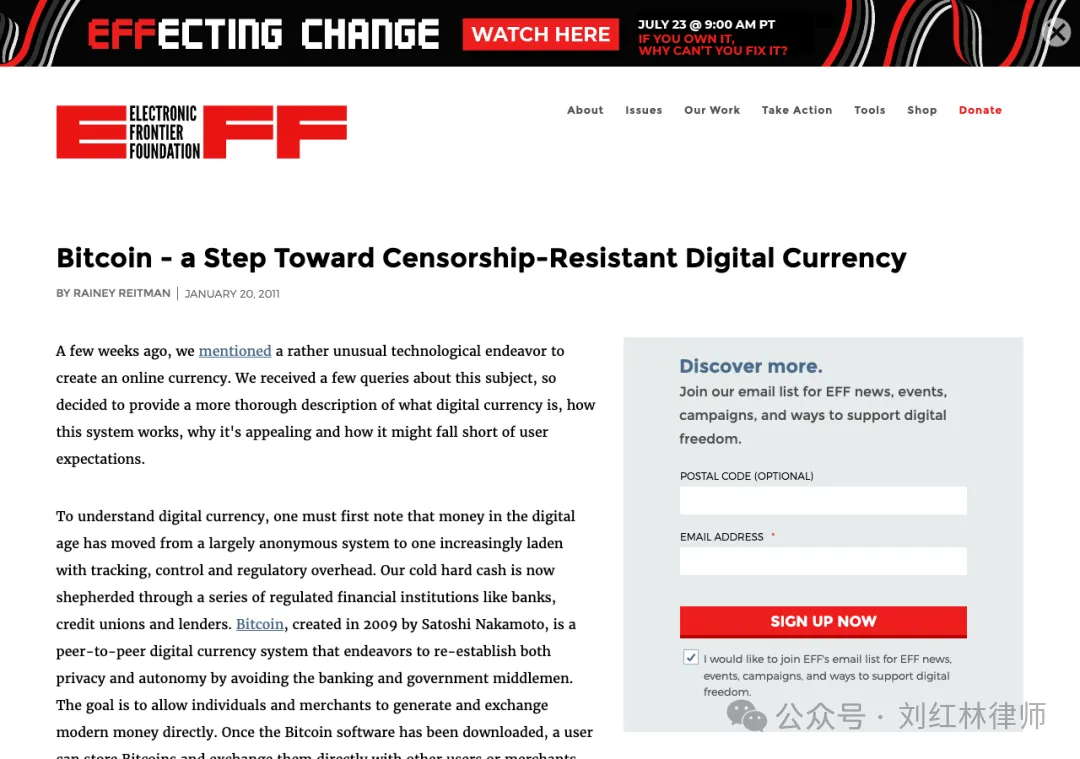
On February 10, 2011, the Bitcoin price reached $1.
In 2009, New Liberty Standard was still valuing Bitcoin using electricity costs, like looking for a minimum cost footnote for a strange species; in 2010, Laszlo bought two pizzas with 10,000 Bitcoins, and Bitcoin finally had an exchange story that could be told to ordinary people. By February 2011, the ruler of the US dollar stretched in, and the way of discussion changed accordingly. People no longer just asked if it could be used; they began to ask how much it was worth and cared more about whether it would be more expensive tomorrow.
Once the question became price, people changed.
Those who originally ran clients might have been cryptography enthusiasts, open-source users, or free currency believers. After the price appeared, new entrants would ask more directly: Is it expensive to buy now? Will it rise tomorrow? Where can I buy? Who can sell? Where do I put it after buying? Can I withdraw cash?
Bitcoin originally wanted to prove that ledgers could run without banks and payment companies. After the market came in, things immediately became less pure. Without trusted third parties, why did users put their coins on exchanges? Claiming to be peer-to-peer, why did more and more people gather in front of webpages like Mt. Gox? Without bank accounts, why did everyone still want to exchange Bitcoin back into US dollars?
The first irony also appeared here. Bitcoin wanted to reduce old intermediaries, but once the price appeared, new intermediaries grew immediately. They were not called banks, had no deposit insurance, no mature audits, and not much regulatory constraint, but users had already handed over assets, accounts, passwords, and trust to them.
One dollar made Bitcoin seen by the market, and also brought in the more chaotic things of the market together.
March, Mt. Gox Changes Owners
In the spring of 2011, Mt. Gox changed owners.
The name Mt. Gox came from "Magic: The Gathering Online Exchange" and was originally related to online Magic: The Gathering card trading. The founder, Jed McCaleb, was an American programmer who had worked on peer-to-peer file-sharing networks like eDonkey. He later transformed this old domain into a Bitcoin trading entry point: an exchange place originally prepared for card enthusiasts thus became the most important price window in the early Bitcoin world.
At that time, the Mt. Gox page was already undertaking several things: giving exchange prices for USD and BTC, accepting user registration and deposits, providing buy and sell orders, and promising that users could withdraw money again. For early players, this website might not have looked like a financial institution, but in actual use, it had become a price board, trading counter, and asset entry point.
Around March, Jed McCaleb handed Mt. Gox over to Mark Karpelès, a French developer living in Japan. Later, the Chinese community called Mt. Gox "Mengtouguo" (Headgate Ditch), a translation carrying an unexpected sense of absurdity. Coincidentally, it suited the fate of this exchange: the entry was narrow, the mountain road was steep, yet it swallowed too many people's money, trust, and panic over the years.
The true significance of this handover was not that a website transaction was completed between two programmers, but that it exposed in advance the proposition that the crypto industry would repeatedly face later: a system claiming not to need banks would soon grow its own "quasi-banks"; a network claiming to be peer-to-peer would soon re-centralize trust around exchanges, wallets, custody, and payment entry points. Users could not forever find buyers themselves, guard private keys themselves, and complete fiat currency entries and exits themselves. Convenience would lead them to platforms, and platforms would bring back security, compliance, risk control, and liability issues.
The accident in June was not a disaster falling from the sky. Its foreshadowing had already been written in this spring: a new market ran too fast, but the infrastructure earliest undertaking it still stayed in the personal website era.
April, A New Species Appears
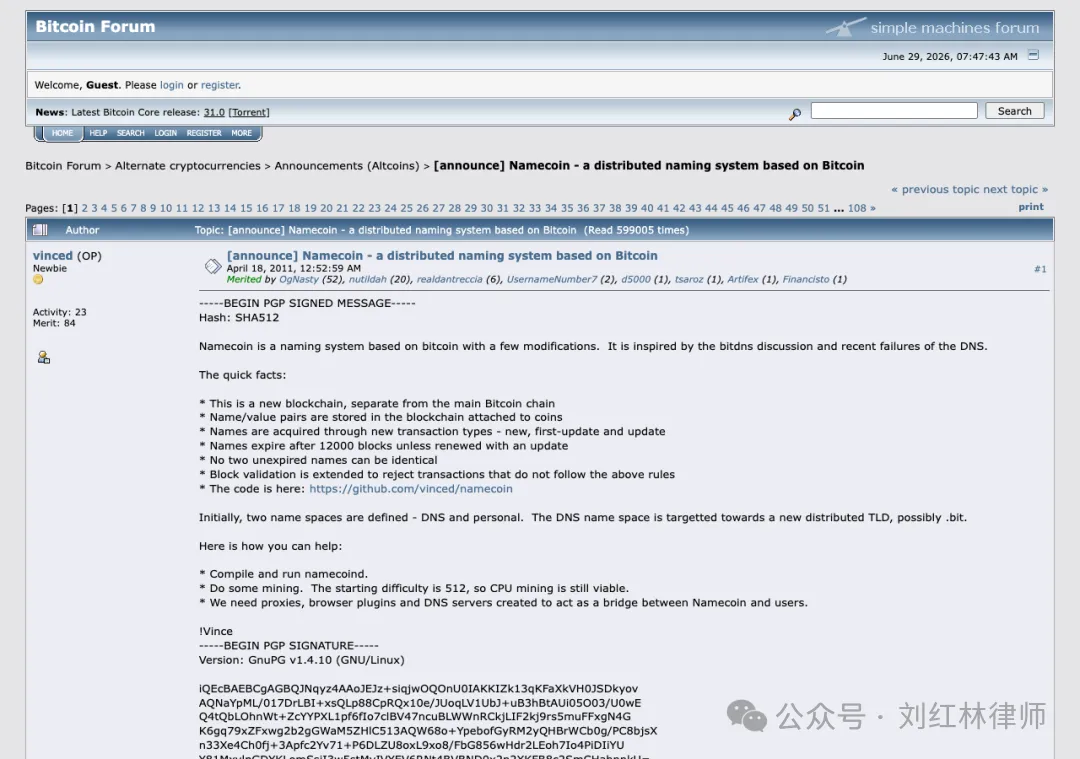
On April 18, 2011, in the "Alternate cryptocurrencies" section of BitcoinTalk, user vinced published a post titled: Namecoin, a distributed naming system based on Bitcoin.
This post itself was very much like a release note for an early open-source project. It had no commercial packaging; the body was a PGP signed message. vinced said inside that Namecoin was a naming system modified on the basis of Bitcoin, inspired by previous discussions about BitDNS, and also from failures and controversies in traditional DNS systems in recent years. It was not adding a function on the Bitcoin main chain, but creating a new blockchain separate from Bitcoin.
The problem Namecoin wanted to solve could be understood first from "names." Domain names, accounts, and identity identifiers in the internet usually rely on centralized institutions for management. Namecoin's idea was to bind names and values together and write them into the blockchain. A name was obtained by a new transaction type, and after registration, initial updates and subsequent updates had to be completed; if not renewed within 12,000 blocks, the name would expire; two names not yet expired could not be duplicated. The initially defined namespaces included DNS and personal, with the DNS direction pointing to a possible distributed top-level domain called .bit.
The post also listed what the system truly lacked at the time: someone needed to compile and run namecoind, someone needed to participate in mining, and proxies, browser plugins, and DNS servers were needed to connect this chain with ordinary users' internet experience. In other words, Namecoin was not just inventing a concept; from day one it exposed the old problem of blockchain applications: on-chain rules could be written, but off-chain entry points, user tools, and infrastructure still had to be built separately.
Namecoin later did not become the entry point for the mass internet, and .bit domains did not truly enter the daily use of ordinary users. But its significance in 2011 was still clear: Bitcoin's code and mechanisms began to be taken to solve problems beyond currency. Proof of work, distributed ledgers, public verification, and difficult-to-tamper state records were taken out from "electronic cash" and became prototypes that other blockchain projects could borrow.
Later Litecoin, Namecoin, anonymous coins, smart contract platforms, on-chain identity, NFT, DeFi, RWA, would all continue to move forward along similar questions: Is blockchain just used to record money, or can it be used to record names, identities, assets, and rights relationships?
April, Satoshi Nakamoto Exits
Also in April, Satoshi Nakamoto withdrew from daily communication.
On December 12, 2010, at 6:22 PM Greenwich Mean Time, Satoshi Nakamoto left his last public post on the Bitcoin forum, the content being just some details about new version software. Afterwards, his email replies began to become unstable. On April 26, 2011, Gavin Andresen told other developers that Satoshi Nakamoto suggested to him that morning, and also suggested the entire development team, to downplay the matter of the "mysterious founder" when talking about Bitcoin publicly. Subsequently, Satoshi Nakamoto stopped replying even to Gavin's emails.
The statement later cited by The New Yorker was: Satoshi Nakamoto told developers that he had turned to other things. From this moment on, Bitcoin's code still ran, development still continued, media and government institutions would continue to ask what it truly was, but the person who initially wrote the system and was most easily regarded as the "person in charge" by the outside world no longer appeared.
June, Silk Road
On June 1, 2011, Wired's Threat Level column published that later repeatedly mentioned Silk Road report. The title was very straightforward: An Underground Website Allows You to Buy Almost Any Drug.
The report started with a software developer pseudonymous Mark. He found a seller with good feedback on Silk Road, added LSD to the shopping cart, clicked checkout, filled in the shipping address, and then paid 50 Bitcoins, about $150 at the time. Four days later, the goods were mailed to his home from Canada. This detail turned Silk Road from an abstract underground website into a set of transaction processes that could be retold: webpage selection, user reviews, ordering, payment, mailing.
Silk Road needed to be accessed via Tor. Tor can be understood as an anonymous access network; it forwards user traffic through multi-layer relays, making it difficult for websites and external observers to directly see the visitor's real network address. Silk Road did not accept credit cards, PayPal, or other payment methods that were easy to track, freeze, and chargeback; it only accepted Bitcoin. Anonymous access networks, Bitcoin payments, seller evaluation systems, and postal mailing, pieced together, constituted the most impactful underground e-commerce model of 2011.

This report changed Bitcoin's public image.
Previously, Bitcoin could be explained as a cypherpunk experiment, electronic cash for libertarians, an open-source toy for programmers, or monetary reflection after the financial crisis. After Silk Road broke out, mainstream society recognized it for the first time in a more glaring way: If an underground drug market only accepts Bitcoin, is Bitcoin then a free currency or a criminal settlement tool?
Silk Road was certainly not all of Bitcoin, nor was it necessarily the result Bitcoin designers wanted. But from a payment function perspective, it almost completely displayed the other side of Bitcoin: cross-border, not easily frozen, addresses not directly bound to real identities, combinable with anonymous networks, suitable for transaction parties without traditional merchant accounts to complete settlements.
Technical neutrality met real consequences here. A payment network that did not ask about transaction purposes could serve dissenting organizations and could also serve black markets. It could protect donors from being arbitrarily blocked by payment institutions and could also make it harder for law enforcement agencies to track transactions along traditional account systems. It let some people see freedom and let others see loss of control.
After this report came out, the relationship between Bitcoin and Silk Road quickly entered public discussion. Wired's November review mentioned that after the Gawker/Wired report about Silk Road, the Bitcoin price rose rapidly within a week. The reason was not complex: if an underground market only accepted Bitcoin, people who wanted to enter this market had to buy Bitcoin first.
At the same time, political pressure also began to appear. US Senators Charles Schumer and Joe Manchin publicly requested law enforcement agencies to crack down on Silk Road. Schumer called Silk Road a very rampant online drug trading attempt at a press conference and described Bitcoin as a form of online money laundering. For a very young open-source currency project, this label spread faster than technical explanations in forums and was easier to stay in the public impression.
Silk Road brought Bitcoin the first use scenario that mainstream media could not ignore, and also brought a reputation burden that was hard to shake off. It proved Bitcoin could complete settlements outside the traditional payment system, but simultaneously pushed Bitcoin into the context of drugs, money laundering, and law enforcement attention. After 2011, a problem repeatedly encountered by the crypto industry had already taken shape here: real demand does not naturally equal legitimate demand; transactions can happen, but that does not mean society will accept the way they happen.
June, EFF Hits the Brakes
After Silk Road pushed Bitcoin into the public eye, the hand that reached out first in January also began to shrink back.
On June 20, 2011, EFF published an article on its official website, announcing it would no longer accept Bitcoin donations. This move was not a simple "regret." More accurately, it was like an institution deciding to remove a too-hot new button from the webpage after finishing a meeting in the office.
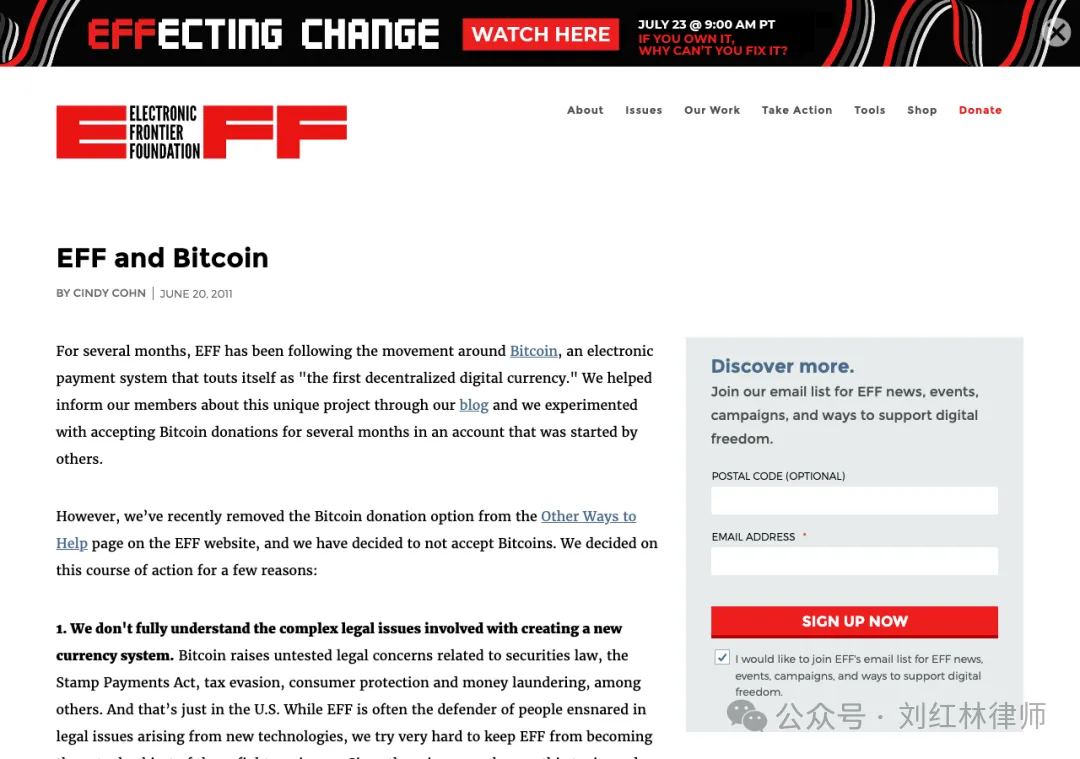
The article said very clearly: EFF had paid attention to Bitcoin for several months and had once tried to accept Bitcoin donations in an account set up for it by others. But it later removed this donation option from the help page on its official website. There were three layers of reasons.
First, legal issues were too uncertain. Securities law, taxation, consumer protection, money laundering—these issues did not yet have clear answers. EFF could defend users in new technology, but it did not want to become the object testing legal boundaries itself. Second, how to spend donations was also troublesome. Donors gave money hoping non-profit organizations would use it to support work; but if the matter of exchanging Bitcoin for cash itself was unclear, the organization would find it hard to explain. Third, it did not want outsiders to misunderstand: EFF accepting Bitcoin did not equal EFF endorsing Bitcoin, even less did it equal Bitcoin being safe, stable, and without investment risk.
Most interestingly, EFF did not sell the coins already received, nor did it return them one by one to donors, but decided to give these coins to the Bitcoin faucet, letting them continue to circulate in the community.
Many years later, companies, foundations, universities, merchants, listed companies, and payment institutions would encounter similar problems: Can cryptocurrency be accepted? How to enter assets on balance sheets? How to value them accounting-wise? How to exchange for fiat currency? These problems had already appeared in embryonic form on EFF in 2011.
Bitcoin had not yet become a financial asset, but legal issues had already caught up.
June, Mt. Gox Halts Operations
Silk Road pushed Bitcoin under media lights, and Mt. Gox dragged it back to the center of public opinion again.
On June 19, 2011, Mt. Gox's trading price crashed from around $17 to a few cents. Wired reported on the same day that the exchange suspended trading and directed visitors to a statement, claiming the accident came from accounts being breached. Subsequently, user databases were leaked, and usernames, emails, and hashed passwords circulated online.
The chain exposed by the accident was not complex. Mt. Gox was one of the main USD and Bitcoin exchange entry points at the time; users handed over accounts, passwords, orders, and assets to this website. After the attack occurred, trading prices plummeted within the platform, the exchange suspended services, administrators attempted to roll back suspicious transactions; subsequently user databases were leaked, and usernames, emails, and hashed passwords began to circulate online. The problem did not lie in the Bitcoin underlying ledger, but in the exchange system users had to rely on to enter the market.
Mt. Gox in 2011 eventually recovered, but it did not truly cure its illness. In 2014, it fell in a more tragic way, entered bankruptcy proceedings, and a large number of users waited for compensation and liquidation for many years. This line later drew out the story of Jesse Powell and Kraken: Powell had gone to Japan to assist in handling the crisis after the 2011 Mt. Gox accident, then began building an exchange that placed security control at a more core position. Coinbase after 2012 tried to answer another question in a more internet-productized way: Could ordinary people buy and store Bitcoin like using a banking App?
These companies were certainly not simply the opposite of Mt. Gox. They would later also encounter new problems such as regulation, custody, compliance, listing, user asset segregation, and market manipulation. But from an industrial evolution perspective, the Mt. Gox accident indeed left a shadow for later entrepreneurs: an exchange could not just be a website that could match buys and sells; it must handle security, risk control, audit, customer assets, abnormal transactions, and external regulation like a financial institution.
Many years later, cold and hot wallets, multi-signature permissions, internal approvals, proof of reserves, compliance officers, on-chain risk control, judicial cooperation, and custody licenses would all become common words in the industry. Users in 2011 did not have these words. They just learned a simple truth on a very bad night: Coins being on-chain did not mean risks were only on-chain.
June, 25,000 Coins Stolen
Outside exchanges, personal wallets also began to have incidents.
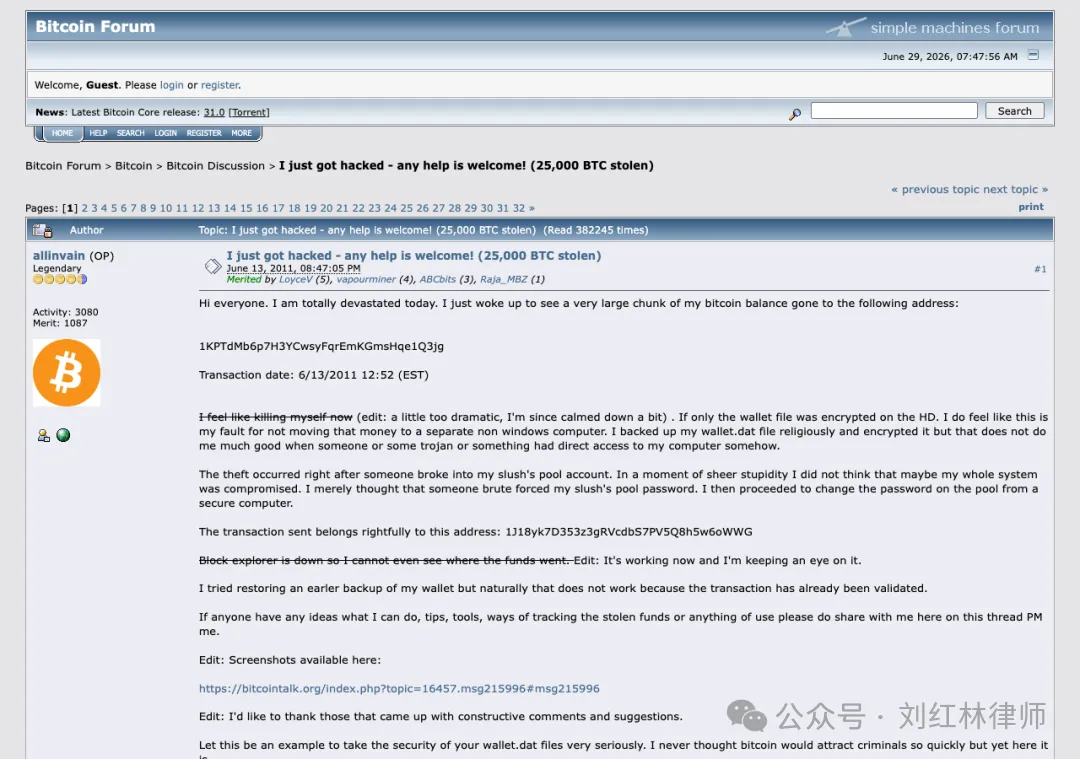
In mid-June 2011, an early user named Allinvain posted on BitcoinTalk. The title was very short but very heavy: I Just Got Hacked, Welcome Any Help, 25,000 BTC Stolen.
The picture in the post was more stinging than the numbers. He said he woke up and found a large amount of Bitcoin had been transferred from the wallet to a strange address; he tried to restore early backups, but the transaction had already been confirmed. He suspected his computer or mining pool account was breached first, and the wallet file was subsequently taken away. The most heartbreaking sentence roughly meant: I虔诚ly backed up wallet.dat and also encrypted it, but if someone had already directly entered my computer, these efforts were useless.
Calculated at the price at the time, this was already a loss at the level of hundreds of thousands of dollars. Wired's later review cautiously said that this claim could not be fully verified true or false to this day, but it indeed became one of the most representative stories in Bitcoin's early security history.
It made many people realize for the first time that owning your own money did not equal easier.
Traditional bank accounts certainly had centralization problems. Accounts could be frozen, transactions could be censored, banks could make mistakes, and user privacy could be shared. But the banking system also provided some safety buffers ordinary people were already accustomed to: password recovery, abnormal transaction monitoring, customer service appeals, judicial freezes, account loss reporting, risk control compensation.
Bitcoin returned many powers to users and also pushed many responsibilities to users.
Private keys were in your hands, assets were in your hands; private keys were lost, assets might disappear forever; computer viruses, wallet files copied, passwords too weak, backups not done well—the consequences were no longer just "change a password." This system did not have a natural customer service center waiting to bail you out.
Bitcoin's self-custody ideal began to become heavy in 2011. In the past, wallet files were just a file on the hard drive; after the price rose, it became a gold bar without safe protection.
More troublesome was that problems did not only happen inside personal computers. Wired reviewed several early accidents: Poland's Bitomat was once the third largest exchange, later because it overwrote wallet files, causing about 17,000 Bitcoins to have problems; old wallet service MyBitcoin was out of contact for a long time, triggering user panic. MyBitcoin later claimed it was hacked, but in the eyes of users at the time, the more direct problem was: I put my coins in an online wallet, and now the other party is not replying to emails.
The problem with old finance was users overly relying on banks and payment institutions; the problem with new finance was users thought after getting rid of banks, any webpage could replace a bank. Bitcoin users in 2011 swung between these two extremes. One end was self-custody, private keys held by oneself, no one bailing out if things went wrong; the other end was custody, operations slightly more convenient, but handing trust to a website that might have no qualifications, no audit, no regulation, or even no transparent real identity.
At that time, everyone did not yet have those mature words later: cold and hot wallets, multi-signature permissions, custody licenses, audit reports, on-chain risk control. Users only knew one thing: Bitcoin was truly worth money, and they did not know how to store it.
July, Anonymity Myth Dismantled
In July 2011, a paper titled "Analysis of Anonymity in the Bitcoin System" was published on arXiv. arXiv is an academic paper preprint platform; this article came from Fergal Reid and Martin Harrigan. The two authors were from the Clique Research Cluster and Complex & Adaptive Systems Laboratory at University College Dublin at the time, with research directions in network structure, complex systems, and information network analysis.
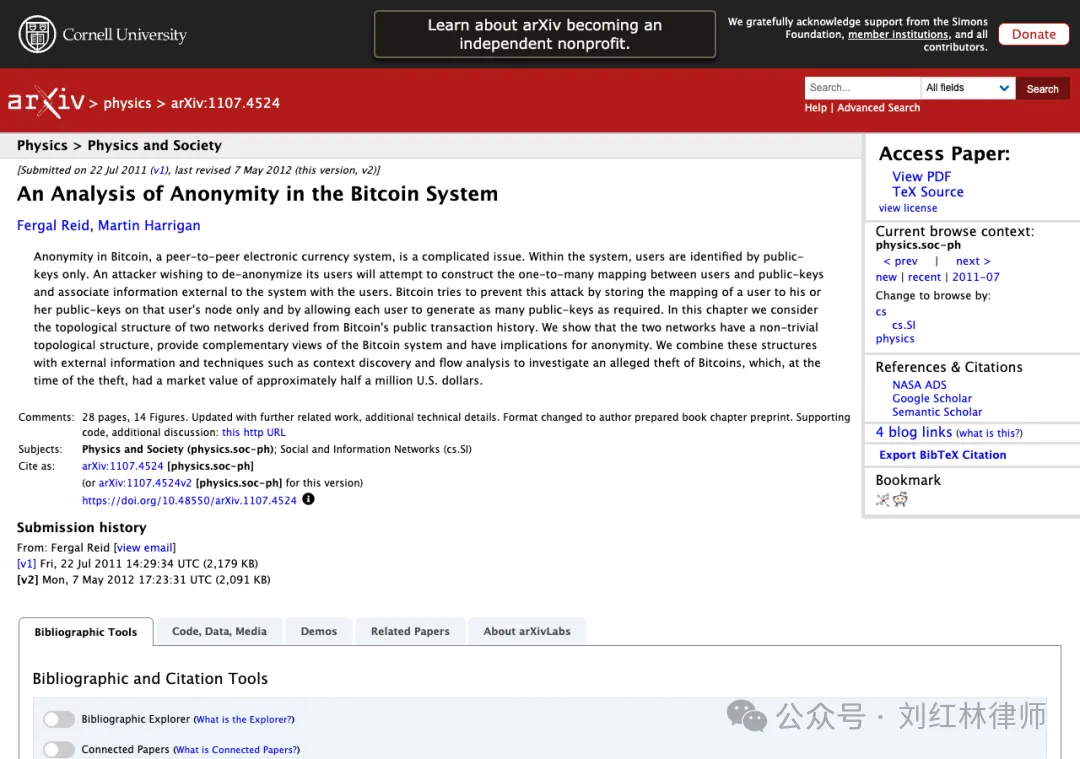
The paper pointed out that Bitcoin users used public keys for identification, and attackers could attempt to piece together the relationship between users and public keys; they also combined on-chain structure and external information to analyze a Bitcoin theft incident at the time with a market value of about $500,000.
The core conclusion of the paper was not complex: Bitcoin was not an absolute anonymous system, closer to a pseudonymous system on a public ledger. Addresses themselves did not write real names, but transaction relationships, fund paths, timelines, exchange deposits and withdrawals, forum posts, donation records, and real identities once connected by external information, anonymity would become very fragile.
This formed a contrast with the Silk Road story. Black market users thought they were hiding behind anonymous access networks and Bitcoin addresses; researchers saw the other side: on-chain records would not disappear, fund paths could be observed long-term. Once traditional cash transactions ended, it was difficult to trace complete paths; once Bitcoin transactions were on-chain, they would stay on the public ledger long-term.
Later on-chain analysis companies, exchange compliance departments, law enforcement agencies, and judicial cooperation services developed exactly along this path. This 2011 paper was still just academic analysis, but it had already made a key fact clear: Bitcoin's anonymity was not default true; it depended on how users used addresses, exchanges, network tools, and real identities. If these clues were strung together, the money's path would again become a person's story.
In 2011, the story had just begun.
October, Mainstream Media Spectators
In October 2011, The New Yorker published Joshua Davis's long article "The Crypto-Currency".
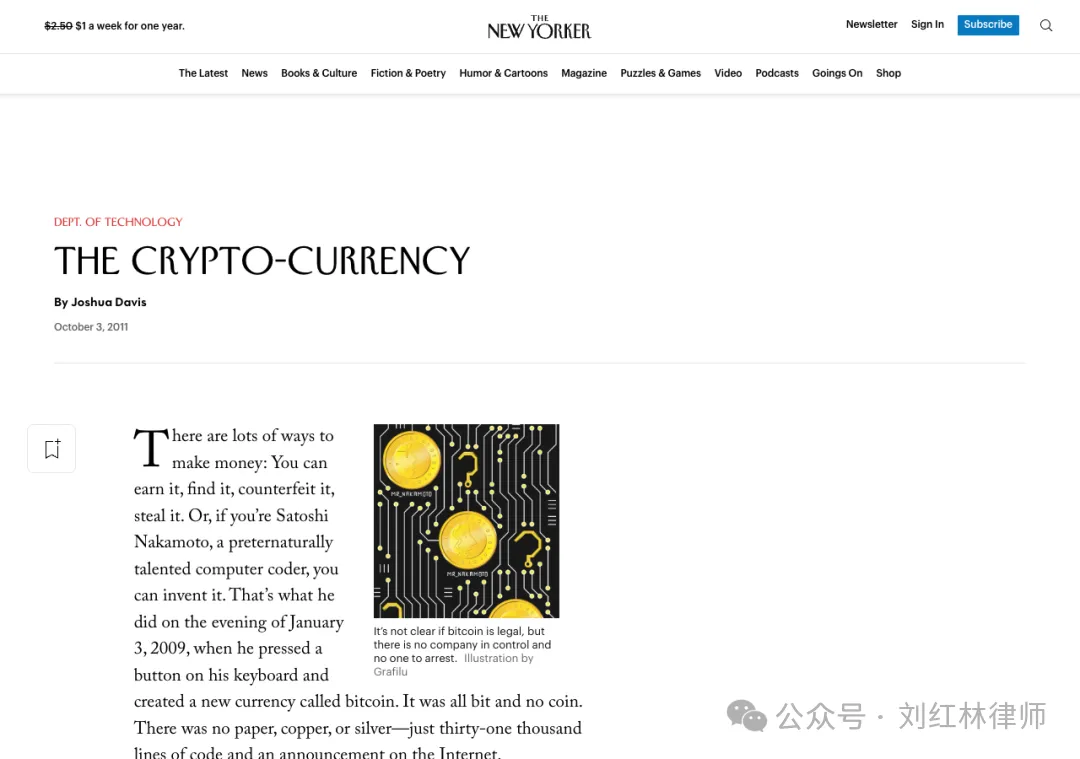
This article brought Bitcoin into the narrative framework of American mainstream magazines. It not only introduced "what is Bitcoin" but also put together several clues that had already surfaced at the time: who was Satoshi Nakamoto, could the code withstand scrutiny by security researchers, why were merchants willing to accept Bitcoin, and legally should it be seen as currency, commodity, or security.
The first thread was searching for Satoshi Nakamoto. Reporter Joshua Davis tracked candidates like Michael Clear and Vili Lehdonvirta, finally not finding a definite answer. Michael Clear was young at the time, understood cryptography, and also evaluated the elegance and limitations of Bitcoin design; Vili Lehdonvirta explicitly denied being Satoshi Nakamoto. This investigation gave no conclusion but turned "anonymous founder" into the core suspense of Bitcoin entering mass narrative.
The second thread was code scrutiny. The New Yorker wrote that security researcher Dan Kaminsky had attempted to find attack points in Bitcoin code. Kaminsky was not an ordinary user; he was a well-known internet security researcher. He initially thought he could find vulnerabilities, but found many attack paths had already been blocked by Satoshi Nakamoto in advance. For Bitcoin, this kind of scrutiny made it no longer just an ideal experiment in forums but began to accept public examination by external security experts.
The third thread was legal and commercial attributes. The article mentioned that some law professors believed Bitcoin was in a gray area, unclear whether it should be seen as currency, commodity, or possibly seen as security; some merchants treated Bitcoin as a payment tool to bypass credit card fees and chargeback risks. By October 2011, Bitcoin no longer belonged only to the technical circle. Media, merchants, scholars, security researchers, and regulatory discussions all began to treat it as a new financial phenomenon needing explanation.
November, Price Recedes
By November 2011, looking back at Bitcoin for this year, the price curve was no longer just an upward story.
Wired reviewed in its November long article that from early April to late May 2011, Bitcoin price rose from less than $1 to $8.89; after the Silk Road report in early June, it rose rapidly within a week, once approaching $27. The high point recorded by The New Yorker was higher: in June one Bitcoin exceeded $29, and by September it had fallen to $5.
Wired also wrote in that review that the gold-rush style mining phase began to end, some miners began to dump modified mining machines because electricity costs, noise, and heat were unbearable; at the same time, those who stayed more seriously began to turn to infrastructure. Mt. Gox was researching point-of-sale hardware, other entrepreneurs tried to do online merchant services similar to PayPal, someone in Colorado did BitcoinDeals, wanting to sell millions of kinds of goods with Bitcoin.
After the price receded, what remained was not just losses and arguments, but a batch of people beginning to push Bitcoin from price stories into dull links like payments, merchants, exchanges, and wallets.
The decline in 2011 did not push Bitcoin back to that无人问津 small experiment of 2009. It had already been rewritten simultaneously by media, black markets, scholars, exchanges, non-profit organizations, and ordinary users.
Year End, Out of Control
When 2011 ended, Bitcoin was already hard to explain clearly in one sentence.
It was like a question to the old monetary system after the financial crisis, and also like a settlement tool for internet black markets; like an open-source experiment for programmers, and also like a price game for speculators; making digital rights organizations heart-throbbing, yet letting these organizations quickly realize legally it was hot to touch.
Many years later, the crypto industry would invent a large bunch of mature words: exchanges, wallets, mining pools, stablecoins, DeFi, RWA, on-chain risk control, custody licenses, travel rule, mixing sanctions, judicial cooperation. But the old problems behind these words had already appeared in 2011.
Bitcoin took the ledger out of institutional credit and handed it to public networks, cryptography, and consensus rules. But it did not take people out of the real world. People would still be greedy, careless, speculative, panicked; institutions would still make mistakes, media would still amplify conflicts, governments would still ask about responsibility. Code could let the ledger continue moving forward, but could not make all people doing things around the ledger suddenly become reliable.
So what was most worth remembering in 2011 was not just Bitcoin rising to one dollar, nor just it being made red by black markets, even more not just falling for the first time at Mt. Gox. The bigger change was Bitcoin standing in two worlds simultaneously for the first time: one world talked about hashes, private keys, blocks, computing power, and longest chains; the other world talked about exchanges, drugs, donations, law enforcement, password leaks, user losses, and public opinion.
In 2008, Satoshi Nakamoto proposed an electronic cash system that did not need trusted third parties. In 2011, the real world gave it a harder to hear but more true answer: ledgers could have fewer intermediaries, but people would constantly create new intermediaries, and then test trust once again.
Bitcoin's 2011 quietly passed, leaving just two words:
Out of Control.
Join TechFlow official community to stay tuned
Telegram:https://t.me/TechFlowDaily
X (Twitter):https://x.com/TechFlowPost
X (Twitter) EN:https://x.com/BlockFlow_News