IOSG|What You Buy on CEX Is Truly Not US Stocks: Deconstructing 94% Clearing Monopoly and Equity Evaporation Under Five-Layer Pipelines
TechFlow Selected TechFlow Selected
IOSG|What You Buy on CEX Is Truly Not US Stocks: Deconstructing 94% Clearing Monopoly and Equity Evaporation Under Five-Layer Pipelines
This is a complex game of interests involving spot pricing, rights ownership, and underlying custody monopoly.
 Navigating Web3 tides with focused insights
Authors: Ethan, Xinyang, IOSG
In 2026, CEXs intensively launched U.S. stock trading products, creating a prosperous narrative of "seamlessly buying and selling NVIDIA with USDT" at the industry frontend. However, tearing open its sleek trading interface to examine the underlying legal relationships and clearing processes, you will find this is not at all a simple "RWA asset revolution," but a complex interest game involving spot pricing, equity ownership, and underlying custody monopoly.
TL;DR
- Divergence of Three Routes: Cryptocurrency exchange U.S. stock product routes have diverged into a parallel situation of traditional API, Tokenized, and perpetual contracts.
- Tokenized Model Heavily Relies on Alpaca: Monopolizes 94% of tokenized U.S. stock clearing, exists on-chain real-time vs. off-chain T+1 time lag risk, ultimately hidden costs and black swan liquidity gaps are borne by users.
- Tokenized U.S. Stocks Market Still in Blue Ocean Stage: Asset scale expanded approximately 15 times within 10 months, DeFi collateral potential initially shown, while traditional API routes are rapidly diverting funds.
Divergence of Three Paths for U.S. Stocks
In terms of capital flow, asset form, and most fundamentally legal relationships, CEX U.S. stock trading products on the market are not the same category. In the shadows of the highly homogenized trading interface at the frontend, they have diverged into three completely different evolutionary paths based on differences in underlying assets and legal relationships:
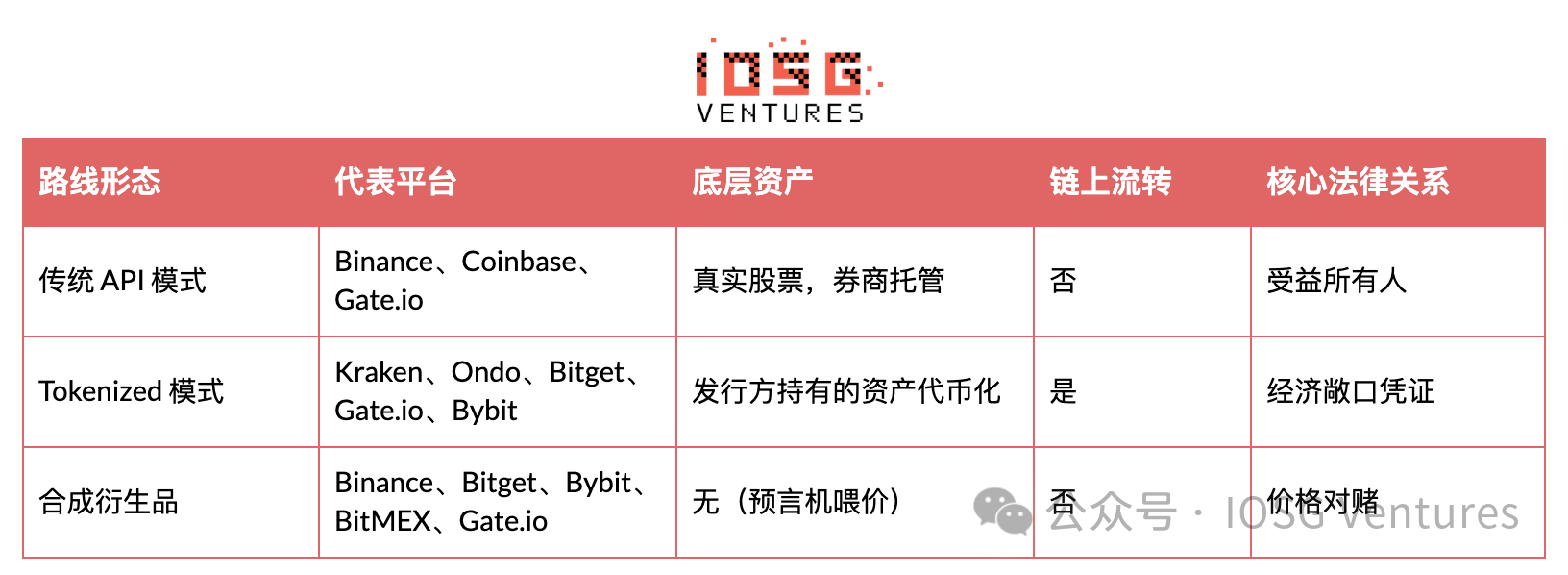
The coexistence of these three models is not the result of product design overnight, but the product of continuous compromise and iteration between on-chain ecosystem liquidity efficiency and traditional compliant clearing friction over the past few years.
Early Exploration and Liquidity Limitations of Offshore Tokenization (Tokenized)
The starting point of the track originated from 2021 to 2024, with early on-chain asset tokenization (Tokenized Securities) attempts represented by Backed Finance (xStocks) and Ondo Finance. The core business of this stage was to establish Special Purpose Vehicles (SPV) in offshore jurisdictions, mapping and minting corresponding token vouchers (such as AAPLx) on-chain by fully collateralizing real stocks off-chain. Such assets possess native characteristics of crypto assets, can be withdrawn to Web3 wallets and circulated permissionlessly on-chain, completing the paradigm validation of asset on-chain from 0 to 1.
However, during the window period when traditional financial native clearing giants had not yet substantially cut into the crypto ecosystem, this model showed severe supply scarcity and scale limitations. Due to the lack of underlying liquidity support from mainstream Centralized Exchanges (CEX), these tokenized assets could only circulate on a few decentralized protocols or second-tier platforms, causing the total asset under management (TVL) of the entire track to hover at a low level for a long time. As of August 2025, the全网 (全网 -> entire network) on-chain U.S. stock scale was less than 100m. This characteristic of "asset mapping exists, no trading friction efficiency" made early tokenized U.S. stocks inevitably become low liquidity sedimentation on-chain, failing to truly reach mainstream retail traders.
Synthetic Perpetual Contracts: Pure Price Derivative Game
To make up for the shortage of spot tokenization liquidity, U.S. stock/ETF perpetual contracts quickly became the market protagonist. In September 2025, Bitget launched U.S. stock perpetual futures first, and quickly expanded the underlying assets to over 40, with cumulative trading volume exceeding 15 billion USD. But what truly ignited the track was HIP-3 (permissionless perpetual contract deployment mechanism) launched by Hyperliquid on October 13, 2025, completely activating the all-weather equity derivatives market. As of June 2026, U.S. stock related perpetual contract Open Interest (OI) has exceeded 2.25 billion USD. Among them, Hyperliquid occupies a dominant share thanks to HIP-3, with its Nasdaq-100 (XYZ100) and S&P 500 index perpetual positions exceeding 310 million USD and 340 million USD respectively.
Binance also followed up strongly in early 2026, capturing over 56% of the CEX market share in the RWA perpetual field, especially Pre-IPO derivatives such as SpaceX (SPCX) where single-day trading volume peaks can reach billions of USD. In addition, Korean stock perpetual futures (Samsung, SK Hynix, Hyundai) launched by Binance in early June 2026 had a cumulative trading volume of about 470 million USD in the first week, among which SK Hynix contributed over 90%, and single-day trading volume often exceeded 100 million USD, showing retail leveraged traders' strong interest in global hot underlying assets such as AI semiconductors. This reflects a major advantage of crypto perpetual contract platforms: the ability to quickly integrate international hot assets that traditional brokers find difficult to serve or cover insufficiently, providing timely leveraged trading channels for global retail.
Such synthetic perpetual contracts do not involve any off-chain stock actual delivery, relying entirely on oracle real-time price feeding, completing long-short games within crypto exchanges. This design brings extremely high capital efficiency and continuity, especially providing efficient price discovery and liquidity during U.S. stock market closed hours. In contrast, real tokenized spot due to needing to dock traditional T+1 clearing, custody and underwriting processes, often shows obvious liquidity gaps, large slippage and price distortion on-chain. This contrast of "derivative pricing efficiency 反而 (instead)优于 (better than) spot" has become a structural pain point that the current tokenized stock model cannot avoid.
Traditional API Model: Exchanges Return to Internet Brokerages
Entering 2026, although the U.S. Securities and Exchange Commission (SEC) continues to advance the "Project Crypto Innovation Exemption Framework" aimed at providing regulatory sandboxes for digital assets, due to uncontrollable delays in legal characterization and full compliance implementation of native on-chain securities (Tokenized Securities), mainstream exchanges began to turn their eyes to a more pragmatic path. In June 2026, Binance officially announced deep cooperation with U.S. licensed self-clearing broker Alpaca, launching U.S. stock and ETF trading services.
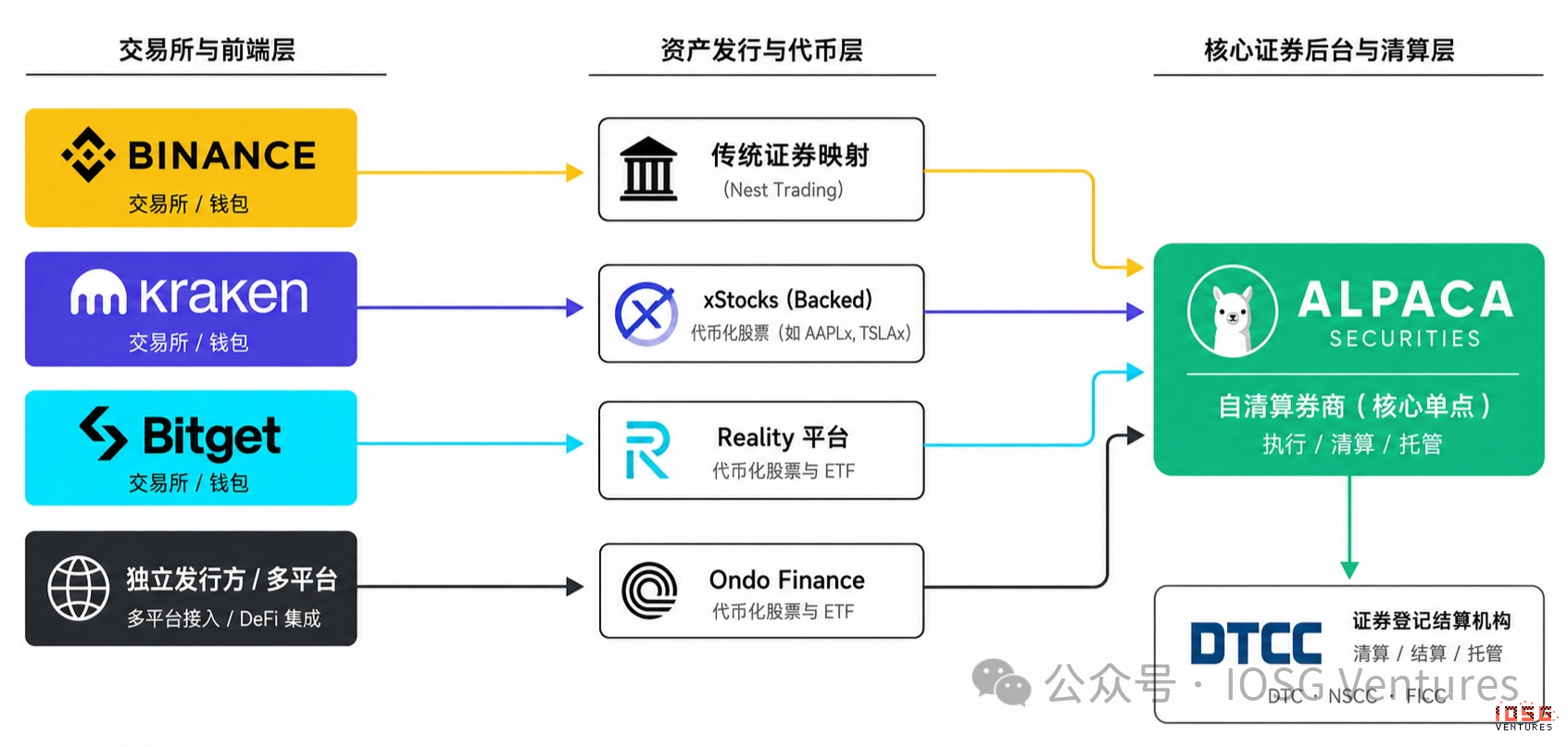
This "Traditional API Routing Model" is essentially an extension of the traditional retail broker architecture at the crypto exchange frontend. Through its affiliated broker Nest Trading routing, blockchain technology plays no settlement role in the product's full lifecycle—user positions are just a line of data mapping within the exchange App, orders are ultimately executed on NYSE or NASDAQ, and underlying securities are custodied in Alpaca accounts.
The cost of this model is sacrificing all native characteristics of crypto assets: stocks cannot be withdrawn to Web3 wallets, cannot be transferred on-chain, and 更不可能 (even more impossible) cross-platform transferred, user "positions" are just a line of digital mapping in the exchange App. But its underlying logic is the most solid, users are legally the "beneficial owner (Beneficial Owner)" of the security, not only enjoying complete dividends and nominal voting rights, but also protected by the Securities Investor Protection Corporation (SIPC). This seems to be a compromise and atavism of crypto exchanges, but it is the only path that currently allows users to truly own "stocks".
Multi-line Parallelism of Exchanges
Looking at the current mainstream U.S. stock product lines, a deeper industry consensus lies in: the vast majority of head exchanges have not placed all chips on a single path, but adopted a multi-mode parallel product layout. For example, Binance, Bitget, Bybit and other platforms often simultaneously possess multiple underlying sets such as traditional API routing, tokenized assets, and synthetic perpetual contracts. This multi-line parallel design is not product redundancy, the core reason lies in being able to hit the actual needs of different customer groups in the crypto ecosystem—high-frequency speculators value the high capital utilization rate and leverage of synthetic contracts, while long-term allocation type large funds (whales) value the compliance protection and SIPC legal shelter brought by the traditional API model more.
This hybrid layout is also a hedging measure for exchanges to cope with regulatory uncertainty. The traditional API model is borrowing and compromising on the existing Web2 securities compliance system, the Tokenized model is pulling the limits of RWA innovation boundaries in offshore jurisdictions, while synthetic derivatives are purely digesting risks within the crypto intranet. By preparing multiple channels, exchanges can flexibly adjust product focus according to regulatory policies in different regions, dispersing policy risks.
Architecture Levels: Stripping of Rights Under Five-Layer Pipeline
To understand the essence of on-chain U.S. stock equity dilution, one must shift 视线 (vision) away from the sleek experience at the frontend, and audit all the way down along the data pipeline. The root of the difference does not lie in the name of the token or the narrative on-chain, but in how many layers of intermediaries are padded between the end user and the final underlying asset.
The reason why the traditional API model can fully retain shareholder rights is because it follows an extremely clean Web2 three-layer architecture:
User → Broker → Securities Depository and Clearing Corporation (DTCC)
In this path, the broker is just a custodial pipeline, the law extends the protection of ownership directly through to the end user, ensuring their "beneficial owner" legal status.
However, the Tokenized model, in order to forcibly "move stocks on-chain", introduced multiple intermediary nesting in architecture. It was forced to stretch into a complex five-layer structure:
[End User] ──> [Crypto Exchange] ──> [Token Issuer] ──> [Intermediary Broker (Alpaca)] ──> [DTCC]
This increase in layers is by no means harmless engineering cost, it is a high-frequency consumption of asset rights during transmission. In this structure, every layer is intercepting or distorting the legal rights originally belonging to shareholders.
Idling and Evaporation of Voting Rights
At the foundation of the traditional securities system, all underlying stocks of U.S. stocks are actually registered under the nominal holder Cede & Co of DTCC. Alpaca or Apex as participants of DTCC are holders at the actual beneficial ownership level. This means that corporate actions such as shareholder meeting notices, voting right guidelines, etc., at the end of the traditional clearing network, will only be sent to licensed brokers such as Alpaca.
When the architecture is stretched to five layers, the rights transmission chain breaks directly here. Alpaca as a standard broker, its legal obligations and system interfaces only dock with its direct customers—namely token issuers like Backed Finance or Ondo. Alpaca has no legal obligation to develop a complex voting right look-through system for these crypto entities.
And the issuer layer similarly faces a systemic vacuum of technology and compliance: they simply have not established infrastructure that can map the daily voting decisions of underlying thousands of stocks to on-chain token holders in real-time and securely. The result is that voting rights stop transmission at the bridge broker layer, and completely idle and evaporate at the issuer layer.
Redistribution of Dividends and Contractualization
Different from the direct extinction of voting rights, dividends, the most attractive economic right, evolved into an indirect, repackaged distribution mechanism in the complex five-layer architecture.
When Apple or NVIDIA distributes cash dividends, USD first flows into Alpaca's account. Alpaca deducts corresponding taxes and fees, then allocates funds to its account nominal owner—the token issuer. From this moment on, this fund departs from the jurisdiction of securities law, becoming the issuer's corporate asset. Whether on-chain token holders can get money, and in what form, depends entirely on the contract agreements and operational processes signed by the issuer itself in offshore jurisdictions.
In actual operation, to avoid complex cross-border clearing and securities regulatory risks that direct distribution of USD might touch, mainstream projects such as xStocks and Ondo generally adopted an "Automatic Reinvestment" mechanism. After receiving cash dividends off-chain, they will automatically reinvest them in the secondary market to buy more underlying stocks, then reflect this part of income non-intuitively in user token balances or token prices by adjusting on-chain smart contract multipliers (multiplier) or token Net Asset Value (NAV) prices.
Currently in the market, only extremely few platforms like Bitget Reality attempt to distribute dividends directly on-chain in the form of USDT. But both models in essence are not shareholder dividends granted by securities law, but a contract claim between you and the offshore token issuer, relying on whether their technical nodes can operate normally.
Failure of SIPC Protection
In the five-layer architecture, the most fatal hidden danger lies in the legal vacuum when extreme risks occur. In the U.S. traditional securities market, SIPC (Securities Investor Protection Corporation) provides up to 500,000 USD bankruptcy protection for broker customers, this is the trust cornerstone for retail daring to entrust assets to emerging brokers.
But in the Tokenized model, Alpaca's direct customers on the account are Backed, Ondo or Bitget registered Special Purpose Vehicles (SPV) in Cayman or Seychelles, not every specific user on-chain. This means, SIPC's protection net can at most cover the "token issuer" layer.
If Alpaca itself encounters a clearing crisis, the issuer may appeal to SIPC as a customer; but if bankruptcy, running away, or encountering hacker attacks is the token issuer itself, the traditional securities law protection umbrella will completely fail. In the current bankruptcy law and securities law systems, there is no clear legal precedent supporting "penetrating" exemption of SIPC protection to on-chain end holders holding Solana SPL tokens on one end but having no record in the securities system on the other.
This cruel legal reality is plainly disclosed in official compliance documents of major issuers. Ondo Finance's legal terms write very clearly: tokens provide exposure (Economic Exposure) to underlying asset economic performance, holders do not possess rights to hold or receive underlying assets.
This clearly defines the final physical reality of on-chain U.S. stocks: you are not the owner of the stock, you are just a holder of digital IOUs issued by some offshore entity, tracking U.S. stock prices.
Potential Risks Under U.S. SEC Compliance Regulation
Under the five-layer architecture of multi-layer intermediary nesting, the outbreak of risks will not follow the traditional securities law compensation path, but is directly subject to the compliance game between offshore Special Purpose Vehicles (SPV) and upstream clearing brokers. When regulatory agencies such as the U.S. Securities and Exchange Commission (SEC) conduct look-through enforcement on cross-border securities tokenization (Tokenized), its potential default and risk transmission paths usually present three clear stages:
First, upstream licensed self-clearing brokers, in order to avoid compliance reputation risks, usually choose to cut off API routing with offshore Special Purpose Vehicles (SPV). Since offshore issuers lose actual clearing and delivery channels off-chain, their on-chain smart contracts will be forced to terminate all minting and redemption functions.
Second, since on-chain anonymous addresses lack compliance confirmation records in the traditional securities settlement system (DTCC), SIPC's bankruptcy protection umbrella will completely stop at the issuer entity, unable to penetrate downwards to exempt end holders, once the issuer goes bankrupt, tokens held by users will face default risk of being unable to recover underlying assets.
Facing this legal fault, the current on-chain U.S. stock tokenized spot path is gradually evolving towards contractual trustification. Platforms represented by Ondo Finance are gradually diluting the primary form of pure SPV mapping, turning to embrace a more rigorous off-chain compliant Trust Fund architecture, legalizing dividends and clearing rights through contractual realization forms. This design, under the premise of being unable to bypass regulatory friction, maximizes retaining the legal creditor status in traditional financial courts for holders, currently the best solution for this model to combat legal vacuum.
On-chain Financial Clearing Giant: Alpaca's Single-Point Monopoly and Liquidity Gap
In the current five-layer architecture, if all pipelines of Tokenized U.S. stocks and traditional API trading products are dissected, a shocking fact will be found: almost the entire crypto industry's underground pipeline通往 (leading to) U.S. stocks, at the most core execution and custody layer, all converges at the same single point—Alpaca.
Whether Ondo Finance focused on on-chain RWA (Real World Assets), Backed Finance (xStocks), or exchange-background Bitget Reality, even Binance's traditional U.S. stock trading launched in June, the underlying asset buying, clearing and securities custody, without exception, are independently borne by Alpaca. According to Alpaca's official announcement on 2025.12.04, Alpaca actually monopolizes over 94% of the clearing and custody share of tokenized U.S. stocks and ETF assets on the market currently (Source: Alpaca Official).
Why Alpaca: Self-Clearing Qualifications and Traditional Brokerages' 'Risk Aversion'
This highly concentrated single-point monopoly is not because Alpaca provides how irreplaceable Web3 cutting-edge technology, but is determined by the extreme scarcity of traditional financial supply side and natural compliance gap.
Within the U.S. securities system, brokers have extremely strict hierarchy classification. One type is the numerous Introducing Broker, they only have order taking ability, must outsource clearing, settlement and custody to third parties; the other type is the extremely few Self-Clearing Broker. Alpaca belongs to the latter, it is a formal member of DTCC, OCC and FICC, able to independently complete the full link from order execution to final asset registration. For crypto asset issuers, accessing Alpaca means not needing to dock cumbersome execution, clearing and custody institutions separately, one broker can provide full-link service.
And Alpaca's core barrier lies in, other traditional large licensed institutions out of compliance and reputation compliance risk considerations, generally are unwilling to cooperate with offshore crypto exchanges. Like Interactive Brokers这类 (such as) traditional listed giants with market value of hundreds of billions of USD, possess extremely high reputation costs, they absolutely will not want to risk offending regulators to cooperate with crypto exchanges registered in offshore tax havens for slight API access fees; while giants in vertical fields like DriveWealth have already earned plenty in Web2 traffic pools (such as Revolut, Cash App), similarly have no motivation to cross boundaries and involve risks.
Licensed brokers willing to serve crypto tokenization companies, while possessing self-clearing ability and open API architecture, for a long period were almost only Alpaca. For token issuers, Alpaca not only provides trading execution, clearing and custody capabilities required by traditional brokers, but further reduces conversion costs between securities assets and on-chain tokens through standardized API and ITN (Instant Tokenization Network).
Illusion of Efficiency: 'Time Lag Asymmetric Risk' of On-chain Real-time Minting and Off-chain T+1
To consolidate its infrastructure status, Alpaca launched Instant Tokenization Network (ITN) in 2025. This system does not directly responsible for token issuance, but standardizes inventory verification, asset transfer (Journal), minting notifications and redemption settlement processes in the traditional securities world, and automatically connects to token issuers via API.
In the traditional model, from stock buying, custody confirmation to token minting, often requires multiple rounds of manual confirmation between issuers and brokers; while in ITN mode, Alpaca can verify in real-time whether underlying securities have been warehoused, and automatically issue minting or redemption instructions to issuers, thereby compressing processes originally needing several hours or even days to near real-time.
But this precisely creates a huge settlement efficiency illusion: ITN shortens the "information synchronization time between securities and tokens", rather than changing the settlement cycle of the underlying securities market itself. Upper layer token minting and on-chain circulation are 7x24 hours, calculated in seconds; but lower layer underlying securities settlement remains locked in the traditional financial system's T+1 (or even future same-day settlement) clearing clock.
This "upper layer fast, lower layer slow" settlement time mismatch risk, is covered by Alpaca and issuer's liquidity advancing during market stability, but will expose fatal Liquidity Gap in extreme black swan events. In actual clearing and trading workflows, price differences and time risks generated thereby follow clear responsibility and cost transfer paths.
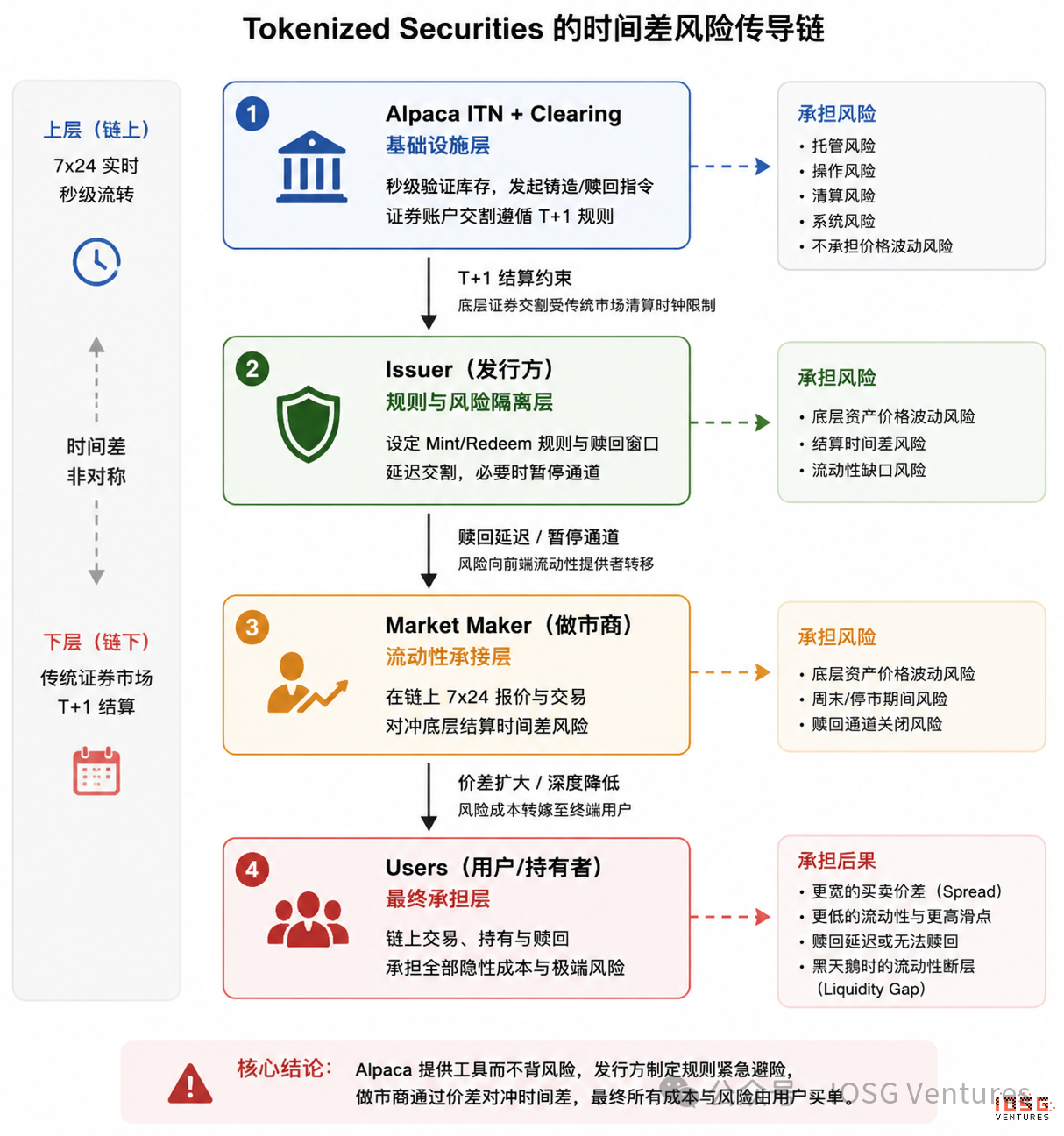
Alpaca at the bottom layer conducted absolute responsibility cutting: as a licensed clearing broker, its ITN network only responsible for "second-level inventory verification and issuing instructions", securities account delivery completely complies with traditional T+1 clearing rules. This means, absolute price differences generated due to market violent fluctuations during traditional market closures or delivery periods, Alpaca is not responsible legally and financially.
This time lag risk subsequently transfers to the token issuer (Issuer) layer. Since underlying securities are still constrained by traditional market trading hours and settlement cycles, issuers usually manage time mismatch between on-chain liquidity and underlying assets through mechanisms such as setting subscription and redemption windows, delayed delivery arrangements, and emergency permissions to pause Mint/Redeem. For example, xStocks restricts primary market subscription and redemption to specific market hours, while some issuers explicitly reserve rights to delay, suspend or even cancel subscription and redemption transactions in abnormal market environments in legal documents.
Issuers isolate risks through delayed delivery and closing gates at any time, the resulting liquidity pressure is directly shifted to frontend Market Makers. Market makers, in order to continue maintaining on-chain 7x24 hour quotes when underlying clearing networks are closed, usually through expanding quote spreads, reducing quote depth, limiting inventory exposure or using related markets for risk hedging etc., convert this part of time lag risk into liquidity costs.
Ultimately, this interlocked chain goes to the logical endpoint: Alpaca provides tools without bearing risks, issuers set rules for emergency risk avoidance, market makers will expand quote spreads to hedge time mismatch risks, these hidden trading costs are ultimately borne by retail.
Therefore ITN created is not truly Instant Settlement, but a kind of Instant Liquidity built upon the traditional securities clearing system. When markets run smoothly, the two have almost no difference; but under extreme market conditions, liquidity can disappear instantly, while settlement cycles always exist.
Cutting of Responsibilities: Compliance Safe Island Under Precise Calculation
Facing such structural hidden dangers, Alpaca's management exhibited extremely precise compliance calculation. After completing 150 million USD Series D financing in early 2026 (valuation reached 1.15 billion USD, investors including Citadel Securities, Kraken, BNP Paribas etc.), capital markets priced its current irreplaceable throat status, but its compliance logic from beginning to end only has one line: strict responsibility cutting.
Alpaca's compliance logic is not simply staying away from the on-chain world, but while participating in the tokenization process, strictly avoiding becoming the token issuing entity (Issuer).
Through ITN, Alpaca has deeply participated in key links such as inventory verification, asset transfer, minting notifications and redemption settlement in the process of securities assets going on-chain; but in legal structure design, it always retains token issuance, destruction, holder management and on-chain compliance obligations for issuers like Backed, Ondo etc. to bear themselves.
Alpaca's responsibility boundary usually stops at the securities account system. It is responsible for confirming whether underlying securities exist, whether transfers have been completed and whether minting conditions are met; while who ultimately holds the tokens, on which chain they circulate, whether they are used for DeFi protocols or cross-chain bridges, and whether on-chain participants meet relevant regulatory requirements, are usually responsible by issuers and their partners.
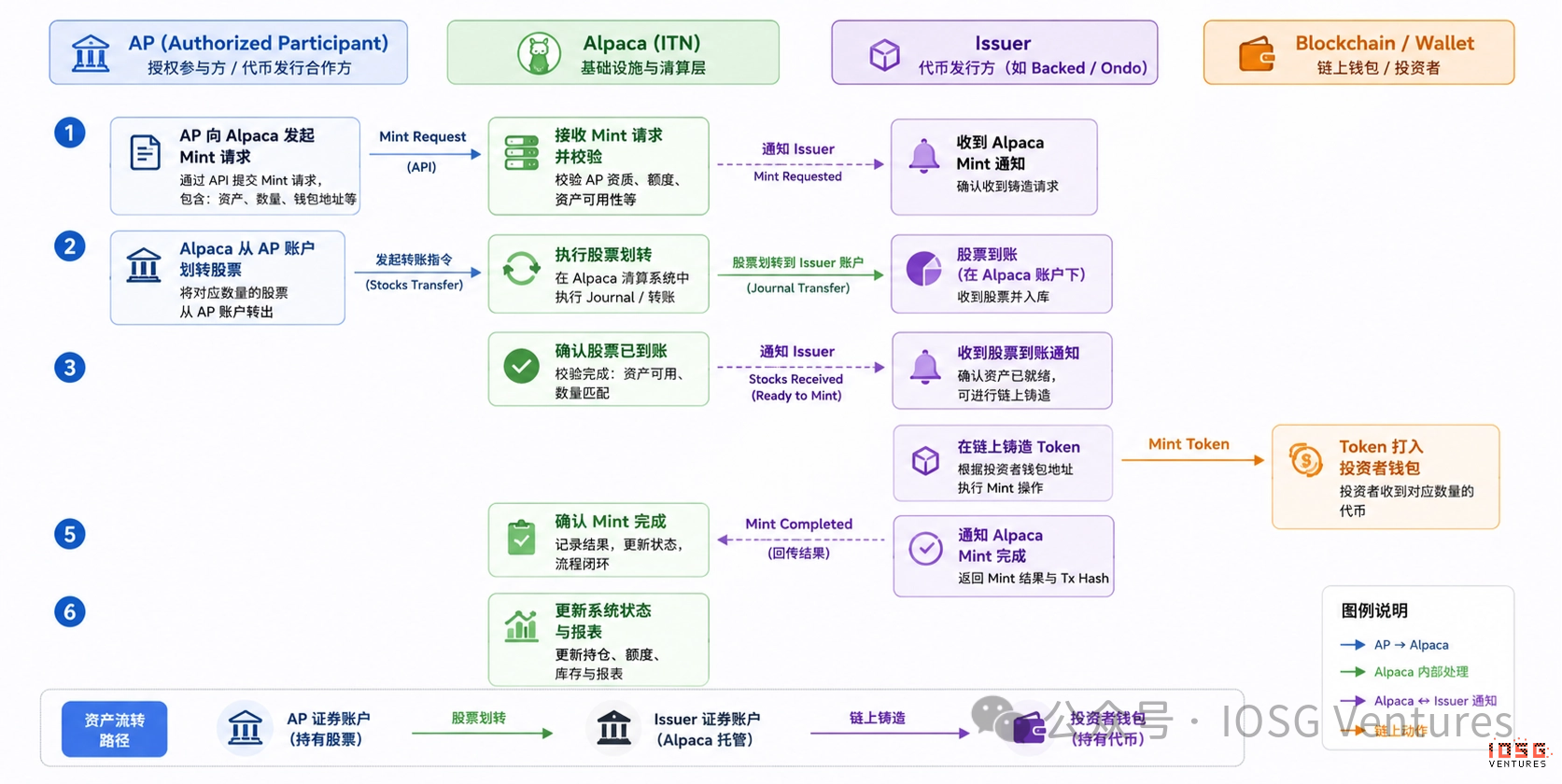
▲ TN Mint process
The current entire model is built upon a delicate responsibility layering: Alpaca provides securities infrastructure, issuers provide tokenization structures, while exchanges provide distribution channels. As long as regulators continue to recognize this division of responsibilities, all parties can operate within relatively clear boundaries; but if SEC believes in the future that part of on-chain behaviors in the securities tokenization process should belong to the regulatory responsibility scope of brokers or clearing institutions, then the risk isolation belt currently established by Alpaca will face re-examination.
In this sense, Alpaca's competitive advantage both originates from the existence of regulatory boundaries, and relies on regulatory boundaries being able to continue to exist.
On-chain Landscape: Real Trading Demand of Tokenized US Stocks
As of June 2026, the overall scale of trading U.S. stocks through the crypto ecosystem is still in an early stage. Among them, total Open Interest of U.S. stock perpetual contracts with Hyperliquid as the main force is about $2.25B USD (tiger research 2026 Q1); publicly observable Tokenized U.S. Stocks TVL (RWA.xyz) is around $1.5B, and presents a highly concentrated situation. In addition, since May-June 2026, the traditional API routing model driven by Alpaca launched intensively on mainstream CEXs, Binance launched 7000+ U.S. stock trading and bStocks tokenized products, cumulative trading volume reached hundreds of millions of USD level in the short term, but corresponding positions and TVL scale remain relatively limited. Comprehensively looking, this total exposure developed by the entire industry over several years, is still less than the single-day trading volume of a single leading large-cap stock on Nasdaq.
Scale and Pattern of On-chain U.S. Stocks
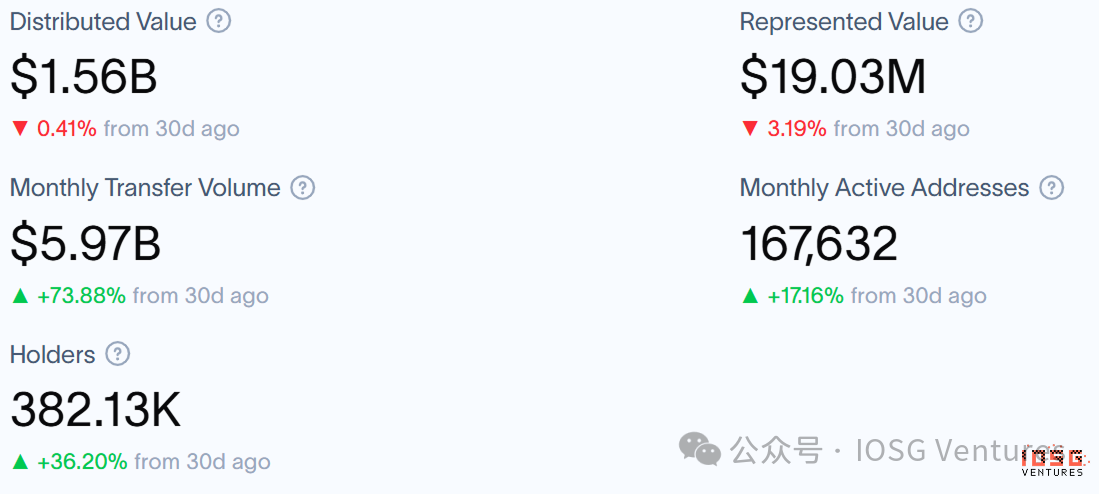
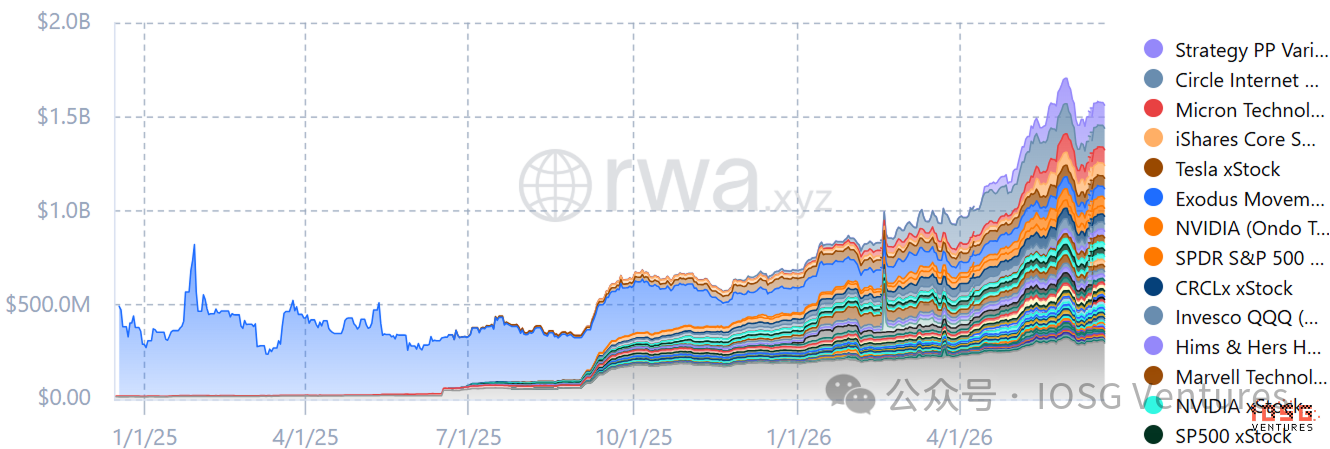
According to RWA.xyz data, as of June 23, 2026, the total scale of on-chain U.S. stock tokens is $1.56B, looking from the growth curve, the entire track market scale grows rapidly, trading volume and TVL quickly rise driven by hot stocks, from less than $100M level in August 2025 to current volume, asset scale expanded approximately 15 times within 10 months.
From a time series perspective, on-chain tokenized U.S. stocks present phased capital games. According to RWA.xyz data,全网 (entire network) spot TVL touched a high point of $1.6B at the end of May 2026, subsequently quickly fell back 250 million USD in early June. This outflow window highly overlaps with head CEXs like Binance, Gate intensively launching "Traditional API U.S. Stock Products", confirming the initial substitution effect—part of retail pursuing real ownership and SIPC legal shelter, chose to defensively migrate large-cap stock positions to off-chain real securities accounts. However, with binance officially launching bstocks on 2026.6.11, current total trading volume reached $91.5 M scale (calculated by summing 2026.6.24 binance bstocks official data). On-chain U.S. stock token total scale currently also returned to $1.56B.
Tokenized US Stocks as DeFi Collateral: Early Exploration of Lending Functions
The true potential of on-chain tokenized U.S. stocks lies far beyond trading itself, but in whether it can become programmable assets in DeFi. On June 20, 2026, Venus Protocol officially included bStocks (TSLAB, NVDAB, SPCXB etc.) issued by Binance into collateral support scope in BNB Chain Core Pool, Collateral Factor set around 60%, 60% and 50% respectively. This marks mainstream CEX issued tokenized U.S. stocks achieving deep integration with BNB Chain mainstream lending protocols for the first time, users can already Supply bStocks as collateral, obtaining liquidity while retaining stock price exposure.
This step although still in early validation stage, its significance lies in opening a door. In the past few years, crypto native market has already developed a whole set of mature DeFi product systems around BTC, ETH and mainstream altcoins, including high utilization rate staking lending pools, automated strategy Vault, and option products based on spot. Now, with real anchored tokenized U.S. stocks appearing, these mature mechanisms naturally begin to extend to stock assets.
For example, staking lending pools can take tokenized U.S. stocks as main collateral, users can borrow stablecoins for other strategies without selling positions; strategy Vault then有望 (有望 -> is expected to) bundle multiple tokenized tech stocks, through algorithms perform automatic rebalancing, leverage or hedging, generating products with different risk-return characteristics; while option Vault and on-chain stock ETF form innovations, may let investors directly trade "stock baskets" or obtain structured returns on-chain. If these products land on tokenized U.S. stocks, in form likely not simply copying crypto native versions, but combining stock dividend mechanisms, financial report event pricing and traditional market volatility characteristics, evolving into new forms closer to equity asset characteristics.
From this perspective, the true value of tokenized U.S. stock lending lies in, it opens composability space of DeFi for RWA, turning originally isolated stock exposures into productivity tools that can interact with other crypto assets. Of course, currently these still remain at concept and early experiment stages, actual landing also faces oracle, volatility matching, liquidation safety and multiple challenges. But if Venus and other protocols can successfully complete the transition from Supply to substantive lending, and attract more developers to build upper-layer applications, such innovations are expected to become a key step for tokenized U.S. stocks moving from "trading substitutes" to "financial infrastructure".
DTCC Tokenization Service: Overwhelming Disruption of Underlying Innovation
Up to now, what we see is a multi-layer parallel but fragmented market: CEXs quickly launch various U.S. stock products (including bStocks) through APIs like Alpaca, providing urgently needed 24/7 exposure and leverage channels for non-U.S. users; DeFi side then attempts to take tokenized stocks as collateral, to enhance capital efficiency. But these innovations essentially still remain at "wrapper" stage—weaker regulatory protection, real ownership fragmentation, liquidity highly dependent on incentives, overall scale relatively niche, far lower than traditional market single-day trading levels.
The current prosperity of tokenized U.S. stocks, in essence is the crypto ecosystem's spontaneous filling of structural imbalance in global capital allocation. Emerging markets and crypto-native users face local currency depreciation pressure, capital controls and cross-border investment friction, what they truly need is not only U.S. stock price exposure, but a more efficient USD asset anchoring and wealth preservation channel. CEX and tokenized products compress "currency exchange—investment—self-custody" three things into one account completion, greatly reducing behavioral friction and cognitive costs, therefore users are willing to bear wrapper credit risk and regulatory grayness for this. However, this model is difficult to solve underlying structural contradictions: fragmentation of real ownership and economic exposure, mismatch of off-hour pricing and traditional clearing settlement networks, and fragility of lacking centralized risk absorption mechanisms. This also directly explains why synthetic perpetual contract trading volume is far easier to explode—perps completely abandoned "real asset" collateral requirements, only doing price games, capital efficiency and continuity higher; while real spot tokenized always has to struggle between "on-chain convenience" and "traditional underlying anchoring", leading to liquidity depth and user trust always limited, appearing lively but not thick enough.
The true turning point is likely to appear in the second half of 2026—DTCC plans to launch tokenized securities pilot in July, and officially launch services in October. This service targets Russell 1000 components, major ETFs and U.S. Treasuries, with 50+ institutions including BlackRock, JPMorgan, Nasdaq etc. participating jointly, core is achieving tokenization within DTC existing custody system, letting tokenized versions enjoy same legal rights, investor protection and settlement mechanisms as traditional securities.
If DTCC pilot lands smoothly and gradually expands, it will inject traditional market level trust anchors and liquidity docking for tokenized U.S. stocks. At that time, CEX/Alpaca style wrapper products may face clearer layering: part continuing to serve crypto-native and global retail users (emphasizing 24/7 and DeFi composability), while institutional level and large capital will more turn to DTCC supported compliant paths. This is not crypto "victory" or TradFi "incorporation", but gradual fusion and long-term coexistence of two systems—crypto channels difficult to obtain traditional level investor protection and systemic risk buffering in short term, while traditional infrastructure also needs to borrow crypto technology to achieve higher global accessibility and efficiency enhancement. Before this, current tokenized U.S. stock wave still remains at validation and boundary exploration stage. Its growth potential truly exists, but to truly move from "niche supplement" to mainstream infrastructure, also needs DTCC level clearing settlement layer landing, and regulators' further clear definition of "economic exposure vs. real ownership". Only when traditional market core infrastructure begins to systematically embrace tokenization, does this wave count as moving from "crypto experiment" to "digital evolution of capital markets".
Join TechFlow official community to stay tuned
Telegram:https://t.me/TechFlowDaily
X (Twitter):https://x.com/TechFlowPost
X (Twitter) EN:https://x.com/BlockFlow_News
 IOSG Ventures