








Who Really Holds Your U.S. Stocks? 83% of All Market Shares Are Nominal Holdings of This Institution
TechFlow Selected TechFlow Selected
Who Really Holds Your U.S. Stocks? 83% of All Market Shares Are Nominal Holdings of This Institution
Ghost shares, irregularities in securities lending, and tokenized stocks are merely rebranded solutions.
 Navigating Web3 tides with focused insights
By Vaidik Mandloi
Translated by Saoirse, Foresight News
Did you know that a New York-based partnership named Cede & Co. is the legal record holder for approximately 83% of all publicly traded U.S. equities? Even if you buy Apple shares through brokers like Charles Schwab or Robinhood, the legal owner of those shares remains Cede & Co.
Cede serves as the nominee holder for the Depository Trust Company (DTC). Its authorization letter filed with the U.S. Securities and Exchange Commission (SEC) explicitly states that the institution “does not know the identity of the actual beneficial owners of the securities.” In simple terms, Apple has no idea you own its stock—the only entity aware of your ownership is your broker, because you are its client. Yet within the full chain of ownership, your identity simply does not exist. The name “Cede” derives from Latin, meaning “to surrender power” or “to relinquish rights”—a remarkably apt designation for this entity.
I therefore undertook an in-depth examination of how this system originated, what it means for ordinary investors, and whether so-called “tokenized stock” models promoted by the crypto industry truly break free from this framework—or merely replicate it.
The Ownership Chain and Systemic Risks
When you purchase stocks through a U.S. broker, strictly speaking, what you hold is merely a “beneficial interest in securities”—in plain language, nothing more than a claim against your broker.
The full process of buying stock works essentially like this: The Depository Trust Company (DTC) updates its ledger to record that the shares belong to your broker; your broker then updates its internal records to reflect that those shares belong to you. Between you and the underlying stock lies a three-layer stack of debt instruments—you hold only a promise of settlement from intermediaries, with no direct control over the underlying asset.
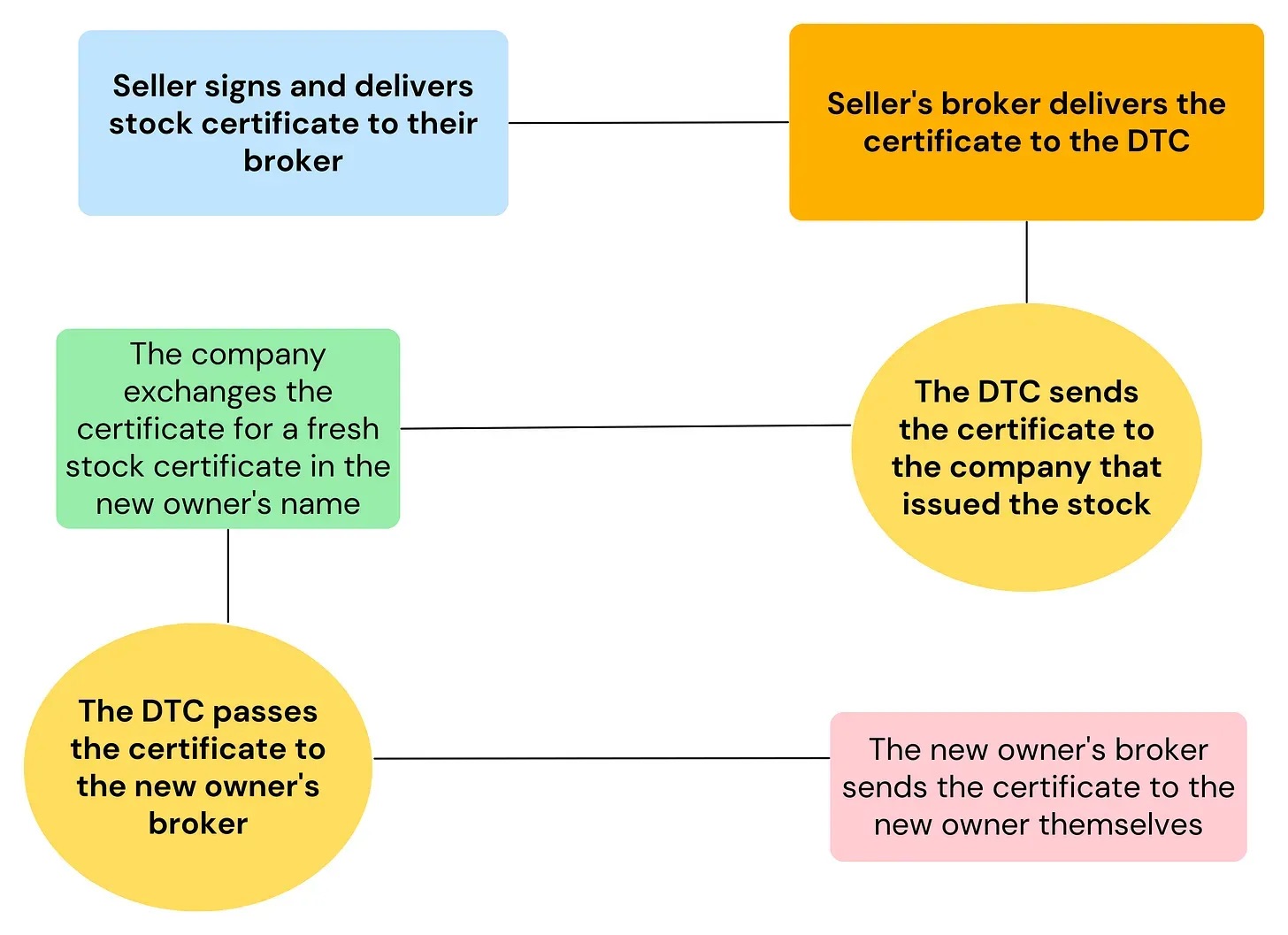
This multi-tiered title-recognition system gives rise to numerous problems: Brokers may lend your shares to short sellers without your consent. That means someone can borrow the very shares you purchased to bet against the stock’s price—and you remain entirely unaware. Likewise, voting rights at shareholder meetings cannot be exercised directly by you; instead, voting authority flows down through layers of intermediaries. Moreover, securities are repeatedly pledged as collateral throughout the trading day, with multiple institutions simultaneously registering claims to the same asset.
Estimates suggest that only one-third of U.S. Treasury securities have actual holders—while the remaining two-thirds hold only debt certificates already pledged elsewhere. And the origins of this distorted system are even more sobering.
In the late 1960s, U.S. equity trading relied entirely on physical paper certificates. Transferring ownership meant physically moving paper stock certificates among institutions—a single transfer could require up to 33 different forms. Every afternoon, hundreds of couriers—mostly retired police officers and firefighters—dragged suitcases and large wooden crates filled with stock certificates across Lower Manhattan, shuttling between brokerage firms for settlement. One firm later acquired by Merrill Lynch once employed 600 staff members whose sole job was processing paper stock certificates.
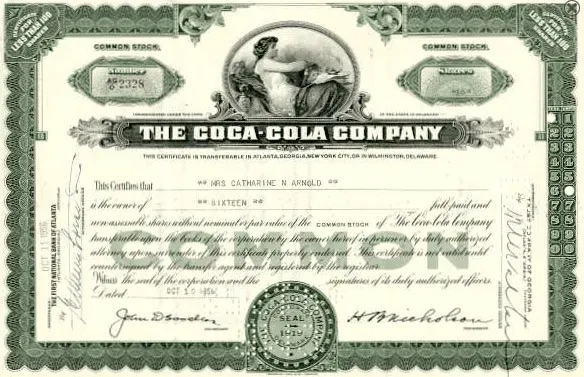
Source: Investopedia
In 1968, daily U.S. stock market volume reached 20 million shares—an astronomical figure at the time, equivalent to just 1% of today’s average daily volume. This deluge of settlement paperwork overwhelmed broker back offices. To cope, the New York Stock Exchange (NYSE) was forced to close every Wednesday and shorten trading hours on other days—just to clear the mountain of paper documents.
The immense settlement pressure ultimately bankrupted Goodbody & Co., a decades-old brokerage firm. The chaotic paper-based settlement system also bred widespread financial crime. In 1971, the U.S. Attorney General testified before the Senate that, over just three years, stolen securities totaled over $400 million; a 22-year-old stock clerk at one brokerage was prosecuted for stealing $900,000 worth of IBM paper certificates.
At the time, Congress even proposed centralizing all market settlement and clearing operations under federal government control. To avoid this outcome, Wall Street scrapped the entire paper-based system: It established a centralized depository vault, locking away all physical stock certificates and recording ownership changes solely via electronic ledgers—no more physical movement of certificates. This mechanism became known as the “immobilization system,” and the Depository Trust Company (DTC) was founded in 1973 to serve as that central vault.
There was actually another alternative proposal back then—the “fully paperless, dematerialized” model—which would have abolished paper certificates altogether, allowing each investor to hold shares electronically in their own name. But regulators opted for immobilization, purely because it could be implemented faster amid crisis conditions—intended only as a temporary stopgap. Yet in 1994, the Uniform Commercial Code (UCC) amendment was adopted across all 50 U.S. states, permanently enshrining this temporary mechanism into law—where it remains today.
“Ghost Shares”: A Flaw Shared by Old and New Systems
This new model—relying on ledger updates rather than physical certificates for title verification—created a novel vulnerability: Multiple parties can simultaneously assert ownership over the same share. For example, when a short seller borrows shares and sells them, the buyer sees a full position recorded in their broker account—but the lender’s original holding remains unchanged in their account.
Both systems display ownership of those shares, which can then be re-lent again for further short selling. Repeating this cycle generates a total registered claim exceeding the issuer’s actual outstanding shares—creating “ghost shares.”
During Dole Food’s 2017 privatization, shareholders claimed holdings totaling 49.1 million shares—yet the company’s actual outstanding shares amounted to only 36.8 million, meaning registered claims exceeded real shares by 33%. These ghost shares do not stem from fraud or market manipulation but arise directly from design flaws inherent in the Cede & Co.-led settlement architecture. Only during privatization did the DTC’s ledger expose the layered, duplicated title-recognition loopholes embedded throughout the system.
The GameStop episode exposed this problem even more severely. In early 2021, short interest in GameStop exceeded 140% of its float—meaning more shares had been sold short than actually existed in public circulation. This epic short squeeze dominated global headlines. At peak volatility, brokers including Robinhood restricted users from buying—but not selling. Reddit’s r/WallStreetBets community immediately questioned why brokers held such unilateral control. That’s when investors realized: Their shares weren’t registered in their names at all—they were all held by Cede & Co., continuously lent out to short sellers betting against them.
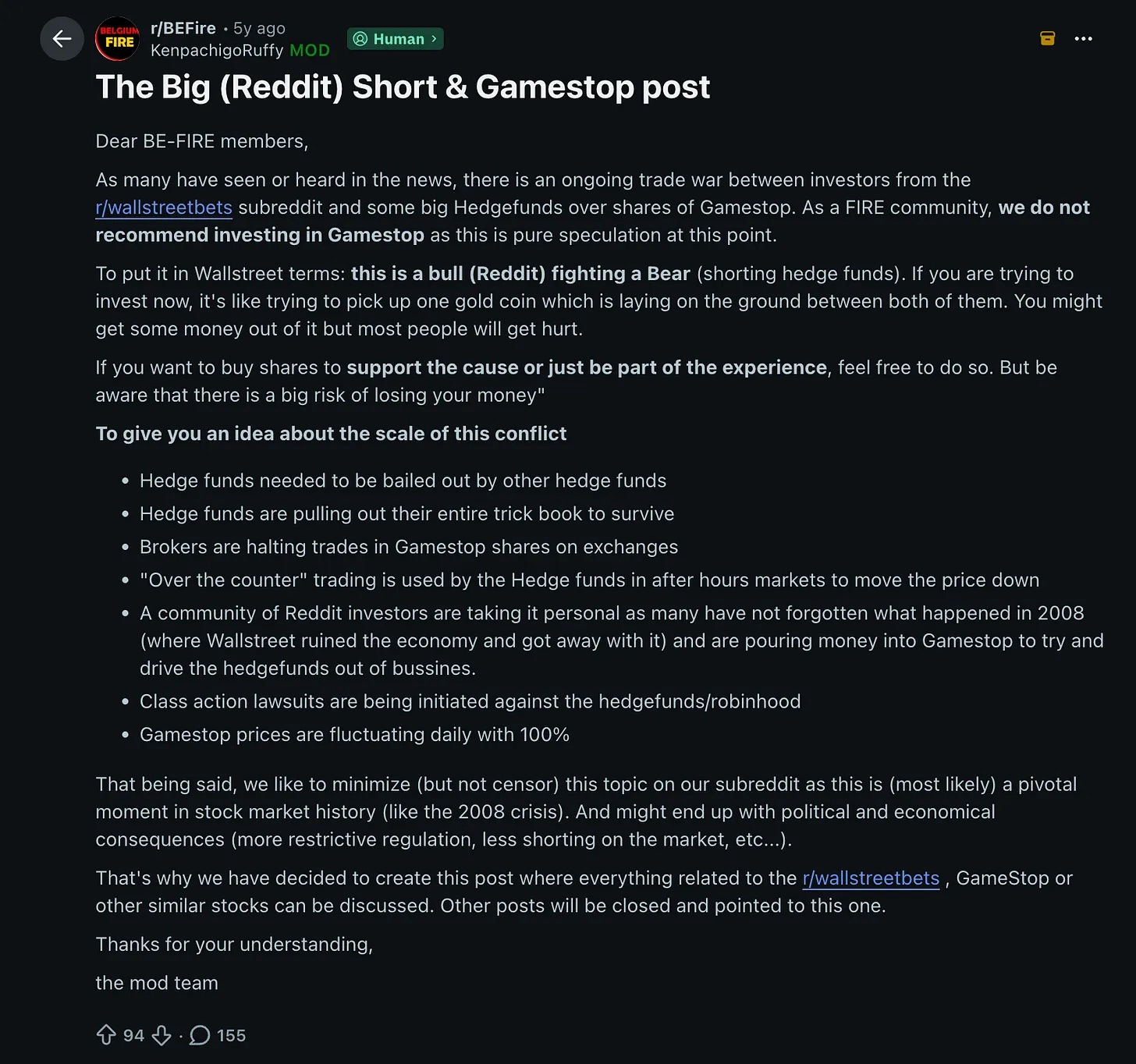
Source: reddit
Subsequently, many investors withdrew all shares from their brokers and transferred them directly to GameStop’s official transfer agent—registering their names directly on the company’s shareholder register. By 2023, roughly 76 million shares had been directly registered, accounting for about one-quarter of the company’s total outstanding shares.
Recently, Coinbase launched tokenized stock products claiming to deliver “true equity ownership,” guaranteeing full shareholder voting rights and dividend entitlements. Yet dissecting the underlying operational logic reveals: Tokens backed one-to-one by stocks held by third-party custodians remain, fundamentally, claims against the custodian. The only change is swapping DTC’s internal ledger for a blockchain ledger—leaving the number of intermediaries between you and the underlying stock completely unchanged—and adding yet another layer: the token issuance platform.
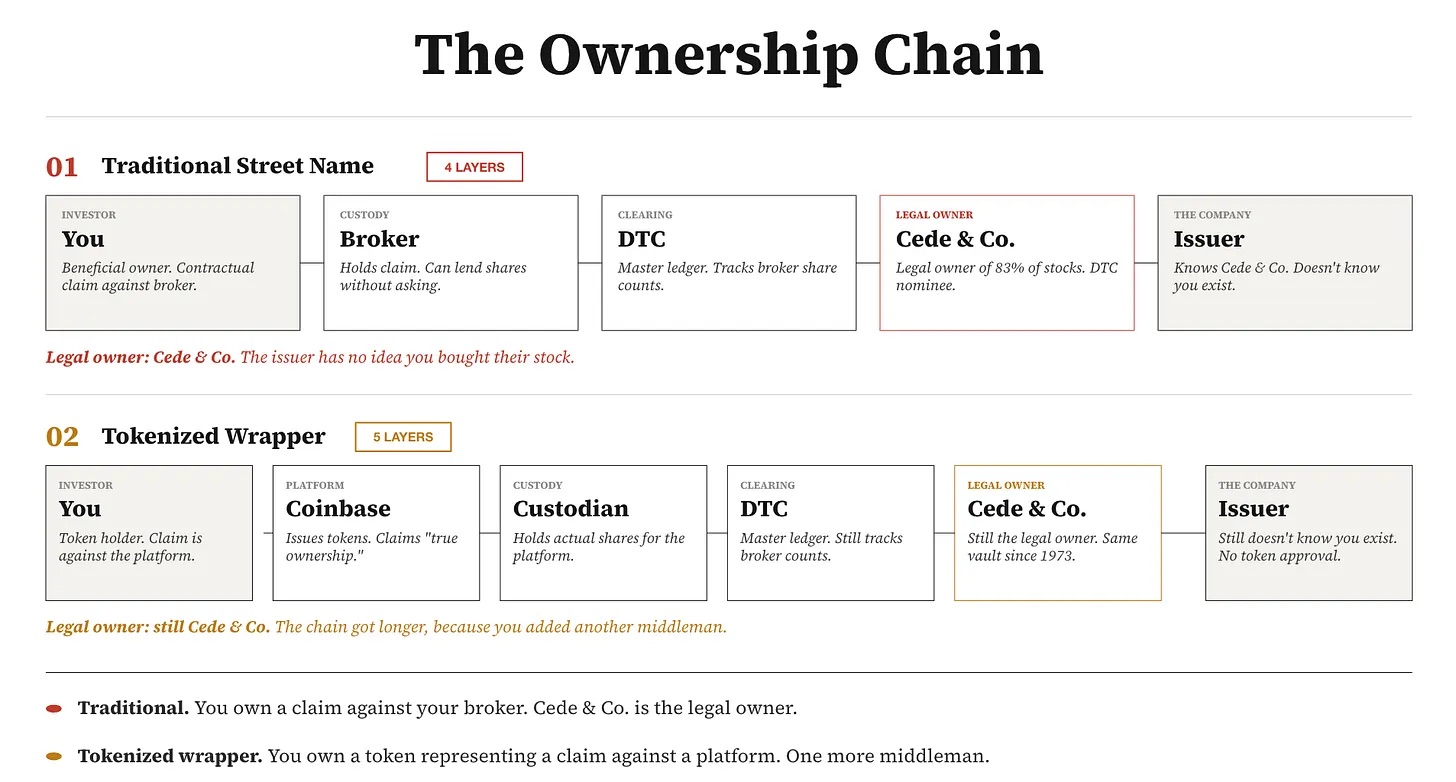
Traditional ownership hierarchy:
- Shareholder register holder: Cede & Co.
- Cede holds shares on behalf of the Depository Trust Company (DTC)
- DTC ledger records aggregate holdings per broker
- Broker internal ledgers allocate portions to individual retail investors
You sit four layers removed from the issuing company—and the company has zero awareness of your existence.
Coinbase’s and Robinhood’s tokenized stock models offer no fundamental breakthrough: Custodians still hold shares via DTC, with Cede & Co. remaining the legal record holder; token platforms issue debt instruments backed by those custodied assets; and your tokens represent only claims against the token platform itself.
Last year, Robinhood launched its OpenAI tokenized investment product in Europe using precisely this model. These tokens do not represent direct ownership of OpenAI equity but rather stakes in a special-purpose vehicle (SPV) that holds the underlying shares. You own rights in a shell company—not in OpenAI itself—and OpenAI has no knowledge of your identity whatsoever. Within hours of launch, OpenAI issued an official statement declaring it had never authorized any fractionalization or transfer of its equity—and had no association with the token product.
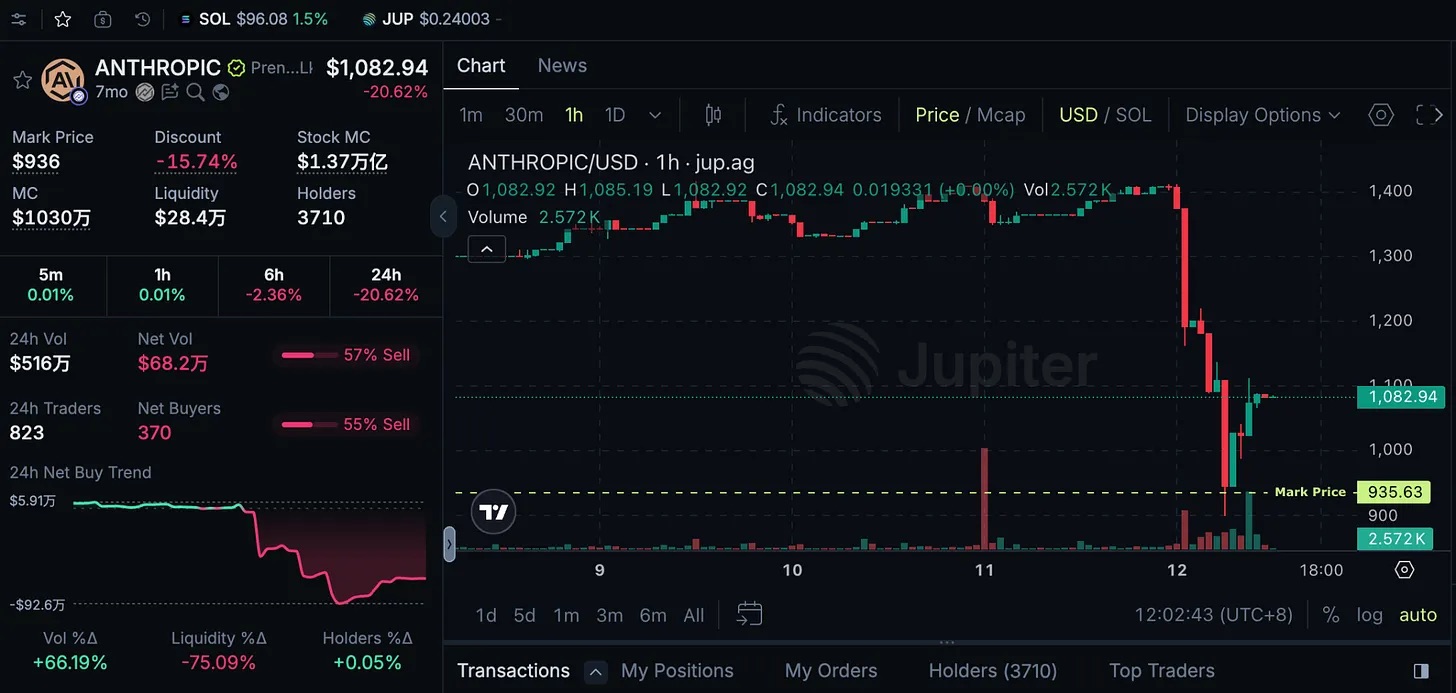
Anthropic took an even firmer stance in May 2026, announcing outright: “Any equity transaction not approved by the Board of Directors is invalid.” Prior to this announcement, PreStocks had operated an Anthropic token trading market for months. Following the announcement, the token’s price plunged 27% in a single day.
Source: Kucoin
This underscores a critical distinction: tracking a stock’s price movements is entirely different from owning the stock outright. The former merely enables profit from price appreciation; the latter confers statutory shareholder rights—including voting rights—and legally enforceable proof of full ownership recognized by courts.
The most extreme example is SpaceX. Multiple crypto exchanges launched tokenized “pre-IPO” shares of SpaceX and marketed them publicly—generating over $1 billion in orders. Market hype reached unprecedented levels, since ordinary retail investors previously had no access to SpaceX investments; these tokens appeared to fulfill crypto’s long-promised promise of inclusive investing. Yet subsequent leading service provider XStocks failed entirely to deliver the underlying shares—forcing all exchanges to cancel orders and issue full refunds.
These products lacked any genuine underlying asset to tokenize. The entire business rested on a debt instrument—with no party along the value chain able to obtain actual shares.
Of course, exceptions do exist—offering true direct ownership—and constitute a third viable model. Superstate is a transfer agent registered with the U.S. Securities and Exchange Commission (SEC) that registers legal equity directly on the Solana blockchain. Tokens held by users are equivalent to direct share ownership—eliminating all custodial intermediaries between investors and the issuing company. This is precisely the fully dematerialized registration model envisioned fifty years ago—and the only model where “ownership” truly lives up to its name.
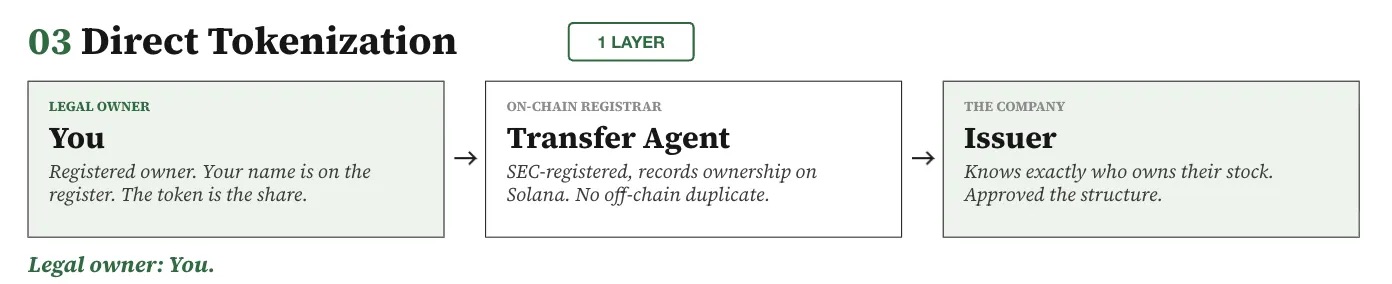
Kraken also operates its tokenized stock business through its own licensed broker-dealer—enabling it to sustain operations while peers collapsed. Meanwhile, Singapore’s Central Depository (CDP) has already implemented such mechanisms: All retail investors can legally hold shares directly and exercise voting rights without nominee intermediaries.
The regulatory pathway is already clear. In May 2025, the SEC formally confirmed that licensed transfer agents may use blockchain directly as the official shareholder register—eliminating the need for separate off-chain paper ledgers. Superstate has already deployed this mechanism on Solana’s public blockchain: Users holding tokens have their names recorded as registered shareholders in the transfer agent’s core registry. Securitize employs the same architecture, powering BlackRock’s BUIDL Fund—managing over $4 billion in tokenized assets—and the NYSE selected Securitize in March 2026 to build its own tokenized securities exchange.
Switzerland, Germany, Liechtenstein, and other jurisdictions have likewise enacted laws recognizing on-chain records as legally valid ownership instruments. Yet practical barriers persist: In the U.S. alone, this multi-layered intermediary ecosystem generates $200 billion annually. Just two services—proxy voting material distribution and investor data integration—generate roughly $3.4 billion yearly for Broadridge. Even in late 2025, when DTC launched its own tokenization pilot, it retained the existing architecture—keeping Cede & Co. as the legal record holder and preserving every intermediary link in the chain.
Objectively, tokenized products do offer some value. For investors in Lagos, Jakarta, or similar regions—previously unable to purchase Apple or NVIDIA shares—even SPV-backed token claims open a new investment channel. Yet OpenAI’s ability to disavow token validity within hours of launch—and Anthropic’s single board resolution rendering all such tokens void—demonstrates that stability hinges entirely on the weakest link in the chain. As the SpaceX case shows, if no real underlying stock exists anywhere in the chain, the “investment channel” becomes meaningless. The core objective should be achieving both global accessibility and full statutory ownership—without forcing investors to choose between them.
That is the full picture. Today, the vast majority of so-called “tokenized stocks” merely replace the 1973-originated debt-based claims with blockchain databases. Technologically sound solutions enabling direct title registration already exist—and a few teams have successfully implemented them. Yet most industry participants have chosen instead to become next-generation intermediaries—because lucrative profits reside precisely within those intermediary services.
Join TechFlow official community to stay tuned
Telegram:https://t.me/TechFlowDaily
X (Twitter):https://x.com/TechFlowPost
X (Twitter) EN:https://x.com/BlockFlow_News


