








When Smart Contracts Become Memecoins: alt.fun, HyperEVM, and the HYPE Pump Spiral
TechFlow Selected TechFlow Selected
When Smart Contracts Become Memecoins: alt.fun, HyperEVM, and the HYPE Pump Spiral
You think you’re trading memes—but you’re actually providing liquidity for Hyperliquid’s perpetual contracts.
 Navigating Web3 tides with focused insights
By Emily, Researcher at Bitget Wallet
While the market remains anxious over the exhaustion of crypto narratives, HYPE has surged past its all-time high at $64.50, reigniting long-dormant on-chain sentiment.
If your understanding of this rally still rests solely on conventional mechanisms like “buybacks and burns” or “staking nodes for base yield,” you’re vastly underestimating the true power of this financial machine. HYPE’s ultimate value lies not in basic governance—but in maximizing “capital efficiency.” Across Hyperliquid’s vast ecosystem, whale- and institution-led leveraged trading is almost entirely centered around HYPE. It is precisely this unique underlying leverage engine that has transformed HYPE from a standard platform token into the supercharged heart powering HyperEVM’s massive liquidity and derivative hedging闭环 (closed loop).
Yet any leverage engine reliant solely on whales will inevitably collapse into a liquidity death spiral if capital merely circulates internally. To shift HYPE’s capital flywheel into genuine “operational mode,” it requires continuous external fuel: an influx of highly active new retail users, frenetic trading frequency, and the resulting flood of transaction fees. This is precisely the critical role played by alt.fun—the breakout altcoin recently driving explosive on-chain metrics across HyperEVM. Its emergence has fully bridged the gap between retail frenzy and professional-grade derivatives, injecting the strongest possible momentum into HYPE’s upward spiral.
The alt.fun craze may fade—but it won’t be Hyperliquid’s first or last hot trend. Rather than chasing the next alt.fun, it’s more worthwhile to pause and reflect: Why did a contract-trading platform suddenly sprout Meme culture? Why did alt.fun ignite an entire chain—HyperEVM—and even lift the broader ecosystem’s token prices? Why can Hyperliquid consistently incubate novel mechanism designs? And why does HYPE retain price elasticity across successive narrative shifts?
Dressing “Contract Positions” in Meme Clothing
Most are familiar with pump.fun’s one-click token launch—and equally familiar with Hyperliquid’s one-click contract opening. What if these two were fused? That’s alt.fun’s core innovation: pump.fun + Hyperliquid.
Bonding Curves Filled Not With SOL—but With “Leverage”
On traditional pump.fun, users deposit SOL during the bonding curve phase to mint purely speculative Meme tokens.
On alt.fun, anyone can launch a token—but creators must make an extra choice at launch: select an underlying asset, direction (long/short), and leverage multiple (2x, 3x, or 5x).
Currently supported assets include not only crypto-native ones like BTC, ETH, HYPE, and SOL—but also cross-domain traditional assets such as silver, NVIDIA stock, and the S&P 500 Index.
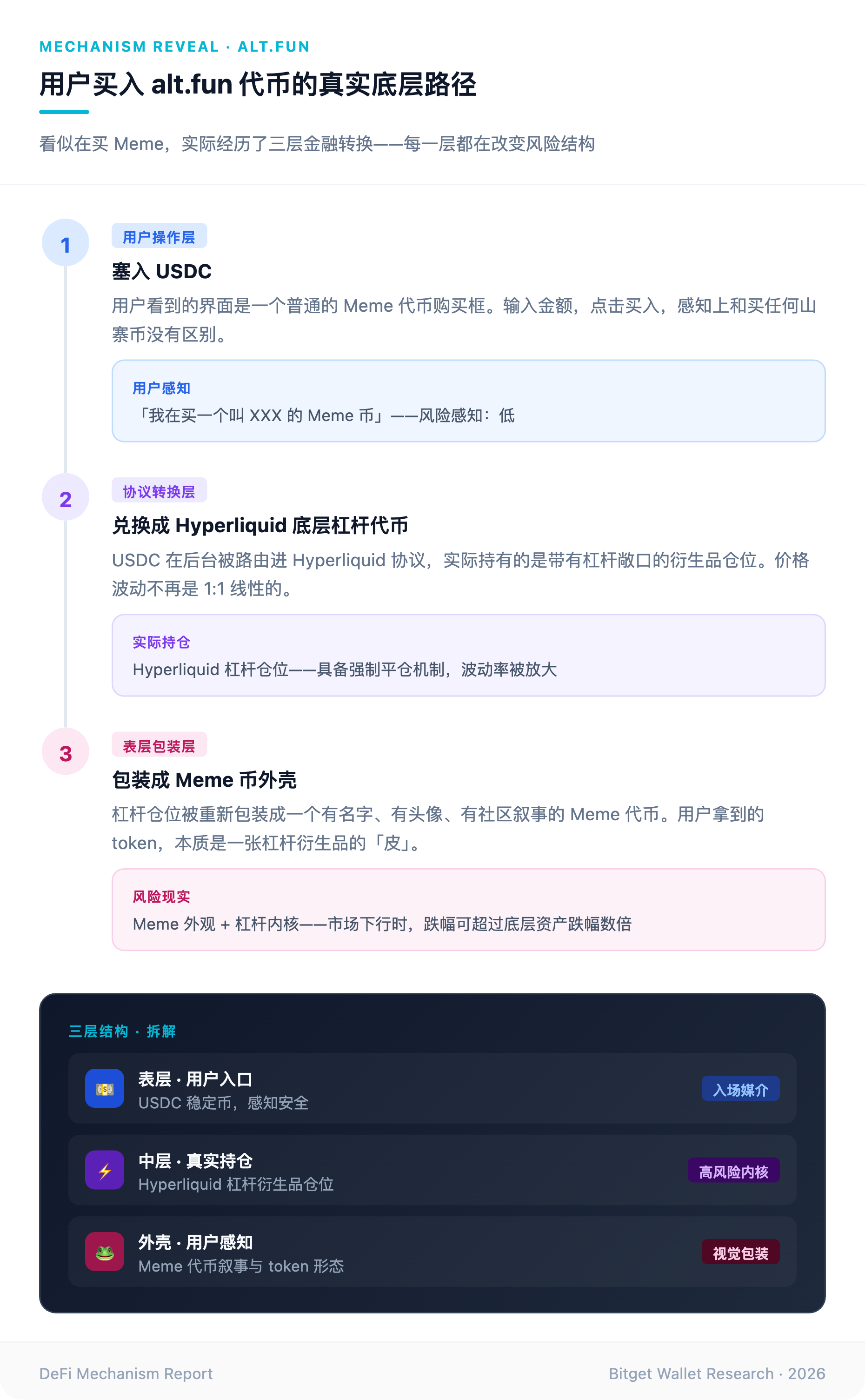
What alt.fun calls “Meme tokens” are, in reality, tokenized and crowd-funded contract positions on Hyperliquid. When you buy one, you’re not purchasing meaningless code—you’re collectively buying and holding a specific leveraged position.
Since the underlying is a real contract position, the Meme token carries a real Net Asset Value (NAV). For example: A Meme token named $ALT is built on a 5x long position in $HYPE and raises $10,000 USDC at launch. Over the next week, assume zero trading activity and zero turnover—but $HYPE rises 20%. Under 5x leverage, the position gains 100%. Thus, the token’s NAV climbs from $10,000 to $20,000—even though no one bought or sold it.
Of course, leverage is a double-edged sword: the underlying position may liquidate, wiping out the Memecoin entirely. Hyperliquid mitigates this risk via BounceTech’s Leveraged Token (LT) protocol, which introduces dynamic rebalancing—akin to U.S. leveraged ETFs. When the underlying asset declines, the smart contract automatically reduces exposure (i.e., sells) to forcibly maintain the preset leverage ratio (e.g., 5x). For instance, a 5x long $HYPE token sees its effective leverage rise above 6x once $HYPE drops 5%—approaching liquidation. At that point, the system auto-sells part of the $HYPE perpetual contract to lower risk exposure and re-anchor leverage back to exactly 5x.
Here’s how it works end-to-end: When you buy a Meme token on alt.fun, your USDC is converted into the underlying leveraged token, then mapped to the Meme token; selling reverses the process. Before and after “graduation,” the token’s backing reserve remains the underlying leveraged position. This leads to a counterintuitive phenomenon: Even if a Meme token sees zero community trading activity, its price still fluctuates with changes in the underlying contract’s price.
Cross-Chain Retail Traffic Acquisition
Fueled by this explosive spiral, alt.fun triggered massive FOMO upon launch.
Per Dune on-chain data, alt.fun’s debut on May 15 brought 2,441 brand-new interacting addresses directly to HyperEVM. As of May 26, alt.fun’s daily trading volume remained steady at $3,466,108—remarkable for a nascent ecosystem project. Such sustained high turnover directly boosts HyperEVM’s foundational activity levels.
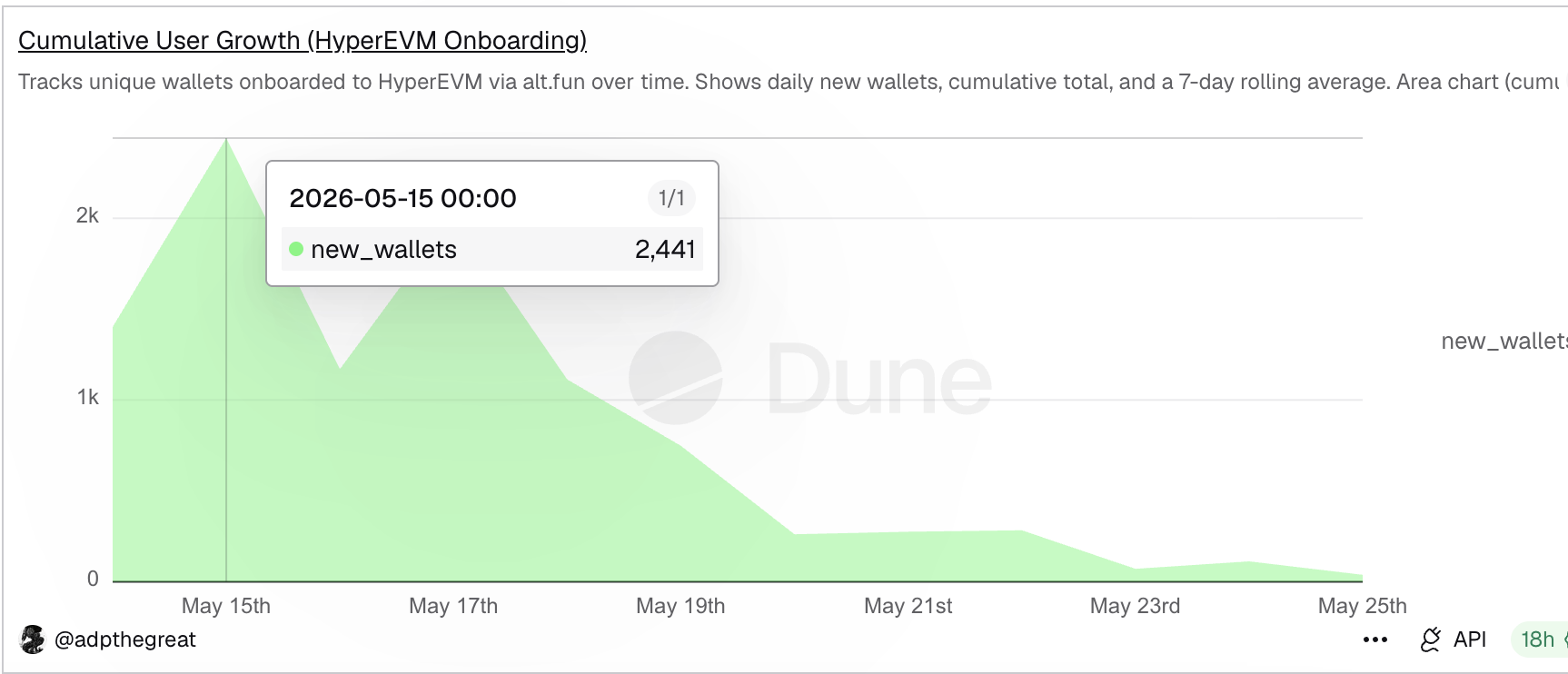
User-source analysis shows alt.fun successfully attracted large numbers of fervent Meme traders migrating cross-chain from Solana, BSC, and other ecosystems.
Notably, Hyperliquid itself has not officially promoted alt.fun. This is because these Meme-focused retail users behave fundamentally differently from Hyperliquid’s existing user base—“trading-oriented retail” and institutional professionals. Converting high-frequency Meme buyers into margin-savvy, liquidation-line-aware perpetual contract traders presents a massive conversion barrier. For Hyperliquid, alt.fun’s true function is that of a perfect “external blood transfusion pump” for the ecosystem.
HyperEVM Ecosystem Analysis: Built Entirely for Trading
Viewing HyperEVM merely as a competitor to Ethereum or Solana would be a mistake. Within Hyperliquid’s architecture, two core components exist:
- HyperCore (the Core Trading Venue): HyperCore is Hyperliquid’s proprietary Layer-1 trading engine (written in C++, EVM-incompatible). Its sole purpose is ultra-fast order-book matching, margin settlement, forced liquidations, and funding rate distribution for decentralized perpetual contracts (Perps). It hosts professional traders, market makers, hedge funds, and API bots—over 60% of volume flows through APIs, with average monthly per-user volume nearing $10 million and ARPU approaching $3,000. Its bottleneck is clear: lack of a retail user base at the scale of centralized exchanges (CEXs).
- HyperEVM (leveraged infrastructure serving trading): Because HyperCore prioritizes performance so heavily, it cannot natively execute complex smart contracts (e.g., Meme launches or on-chain mini-games). Hence, Hyperliquid deployed HyperEVM alongside HyperCore as a complementary layer.
alt.fun is deployed on HyperEVM—but its real purpose is to drive traffic to HyperCore. It essentially repackages professional “leveraged position opening” into the retail-favorite format of “buying dog coins.” When retail users purchase a Meme token on the frontend, alt.fun’s smart contract aggregates their scattered USDC into margin, then opens a corresponding perpetual contract on HyperCore’s order book—exactly as preconfigured (e.g., 5x long $HYPE). Once the position is established, the protocol mints proportional Meme tokens and distributes them to users’ wallets. These tokens effectively serve as micro-receipts for those underlying contracts. Every front-end trade by a retail user corresponds to a real open/close action and dynamic rebalance on HyperCore’s backend—generating friction-based USDC fees that flow back to HYPE via buybacks or real yield distribution.
Thus, in terms of user count and “active address count,” HyperEVM’s retail address volume has rapidly surpassed HyperCore’s professional trader count—making it the ecosystem’s largest traffic funnel.
In essence, alt.fun is Hyperliquid’s tacitly endorsed “super blood-generation funnel.” Within this structure, it functions not as a standalone product—but as HyperCore’s retail acquisition layer: letting Solana- and BSC-based Meme players think they’re chasing dogs, while actually contributing real trading volume and fees to the underlying derivatives market—and ultimately channeling profits back into HYPE buybacks. A seamless cross-ecosystem extraction loop.
Shell Listing: Where Does alt.fun Token Liquidity Go?
Per Dune data, HyperEVM’s TVL has reached $1.6 billion—but shockingly, conventional DEXs (e.g., HyperSwap) hold only $15 million in TVL. By standard logic, shallow pools mean high slippage and untradeable assets—so how do alt.fun projects, routinely generating multi-million-dollar daily volumes, actually function?
Many perceive HyperEVM’s spot liquidity as weak because they only examine surface-level AMM pool mechanics. To understand alt.fun’s structural reinvention, we must trace where funds go post-token “graduation”:
- Traditional pump.fun model: Raised SOL + tokens are automatically bundled and sent to standard AMM spot pools (e.g., Raydium). This creates an “isolated spot pool”—its depth depends entirely on how much capital resides within it. A single whale dump can instantly drain it.
- alt.fun model (“shell listing”): Tokens graduate in two ways: either the bonding curve completes (e.g., $9,000 raised), or the underlying contract position surges in value—pushing total token valuation above $9,000 despite unchanged token supply. Regardless of trigger, graduation doesn’t involve bundling into an AMM pool. Instead, the underlying protocol maps liquidity—via minting—directly onto HyperCore’s perpetual and spot order books (CLOB), turning it into real bid/ask orders.
In other words, every large front-end trade on such a Meme token alters the LT (leveraged token) quantity in its pool—and the BounceTech protocol instantly mints or burns corresponding LT positions in the background.
Analogy: A traditional DEX pool is like a village corner store with just 10 bottles of Coke ($9,000 liquidity). One big order wipes it out. In contrast, an alt.fun “graduated” pool appears to hold the same 10 bottles—but behind the register runs a conveyor belt straight to the Coke factory (BounceTech’s mint protocol). When a whale dumps $5,000, arbitrageurs and the underlying protocol instantly activate the mint mechanism—channeling the sell pressure through the leveraged token intermediary and dispersing it across HyperCore’s multi-billion-dollar-per-day BTC, ETH, and $HYPE perpetual order books.
This means alt.fun tokens require no dedicated spot pool—their counterparty isn’t a shallow retail pool but Hyperliquid’s entire margin depth and market-maker network. From a user experience perspective, liquidity feels near-infinite.
HYPE’s Circular Lending Engine
If capital isn’t sitting in DEX pools, where is HyperEVM’s $1.6B TVL? The answer: over 80% is locked in restaking and lending protocols.
The “shell listing” mechanism handles liquidity mapping—so HyperEVM’s native spot DEX doesn’t need to compete with lending/staking products for capital. Large sums can safely remain in lending and staking protocols to earn real yield. On most public chains, platform tokens stop at governance and basic staking rewards. But on Hyperliquid, HYPE’s core function is boosting capital efficiency—helping whales amplify leverage.
Take a whale with $1M initial capital. A typical looping path looks like this:
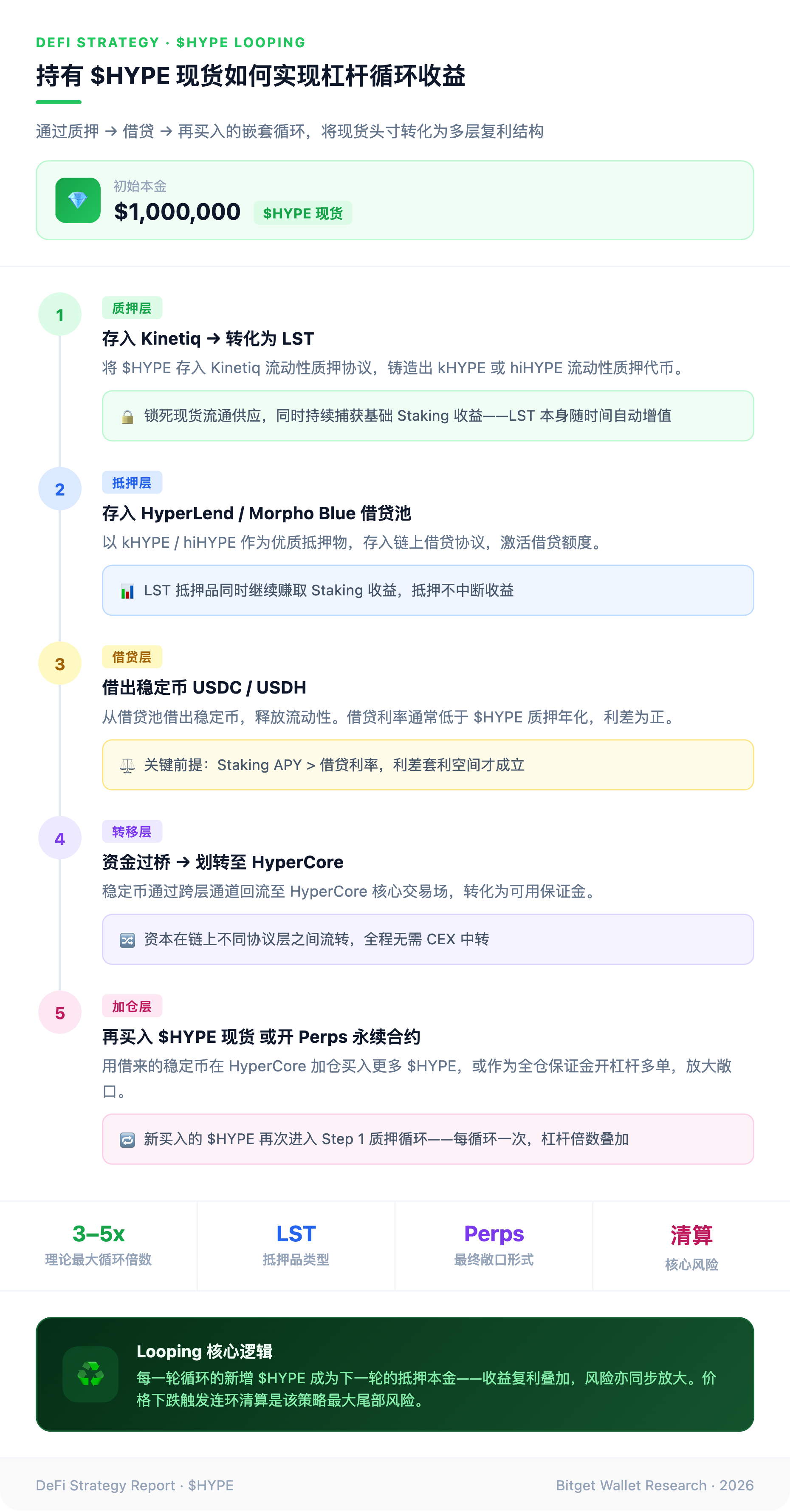
Each loop simultaneously achieves two things: reducing HYPE’s circulating supply in secondary markets, and amplifying the holder’s long exposure to HYPE. When HYPE rises, collateral appreciates and borrowing capacity expands—allowing loops to stack further upward. But the cost is direct: if price reverses, shrinking collateral triggers cascading liquidations along the loop—this is Looping’s greatest tail risk.
This mechanism also explains functional segmentation across HyperEVM applications. From retail traffic entry points to trading tools to capital amplifiers, the ecosystem divides neatly into three concentric layers:
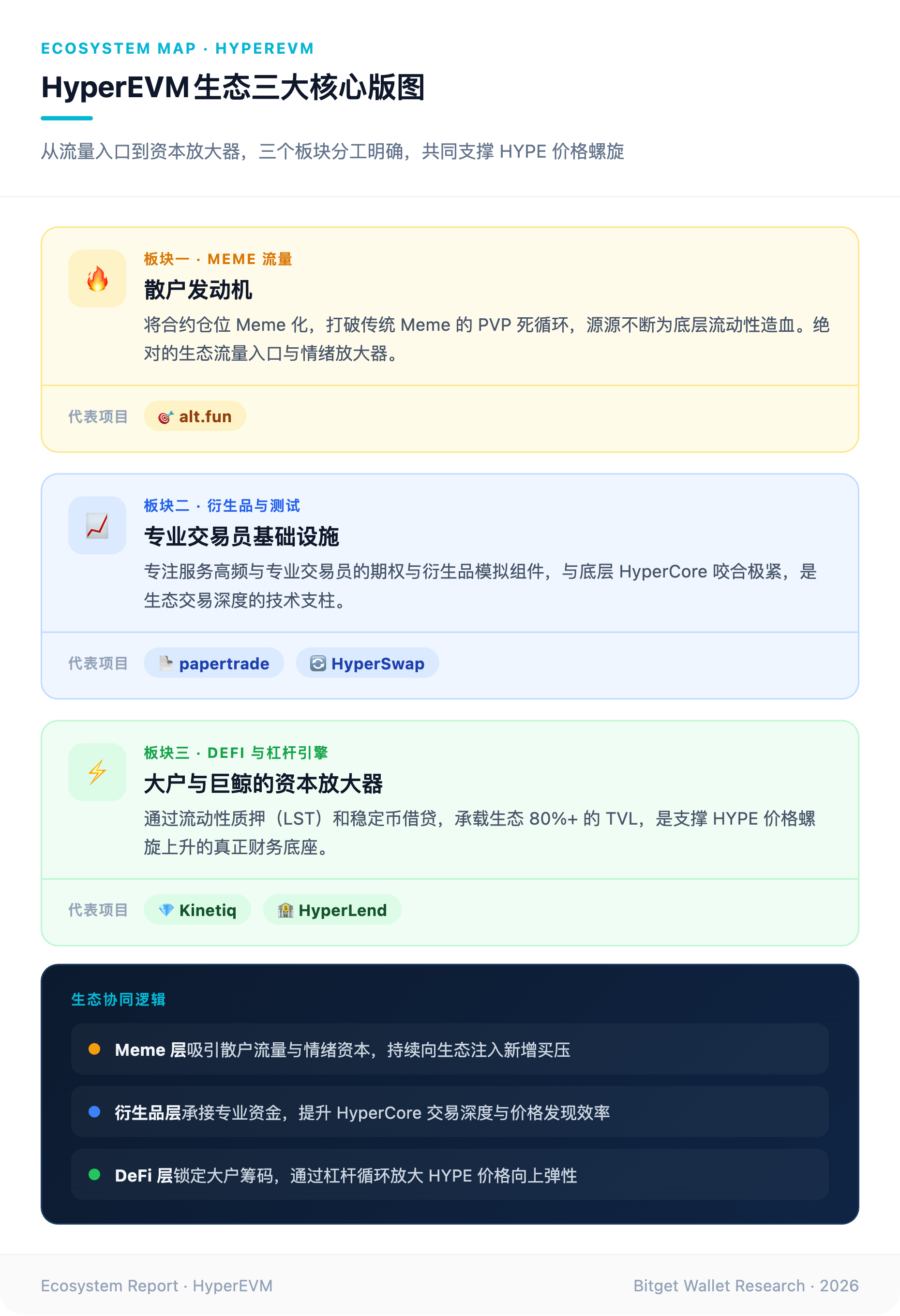
Each layer plays a distinct role: Kinetiq, HyperLend, and Morpho Blue form the core capital-leveraging gears—holding the overwhelming majority of funds; HyperSwap and papertrade handle routine trading friction and derivative experimentation on the periphery; and alt.fun sits on the outermost ring—aggressively sourcing retail capital externally (from Solana/BSC), converting it into transaction fees, and continuously feeding hard-cash fuel into HyperCore.
At its core, HyperEVM is a DeFi-powered engine designed to maximize capital efficiency for professional traders—then recycle profits back into the broader market, forming a self-reinforcing, right-tailed bullish spiral.
How to Capture HyperEVM’s Next Wave of Opportunity?
So how should ordinary investors navigate—and mitigate risk within—a behemoth engineered to extract capital efficiency to its absolute limit?
Choose the Smoothest Ecosystem Entry Point
Bitget Wallet is currently the earliest, most comprehensively integrated, and smoothest wallet interface supporting the HyperEVM ecosystem—giving you a head start in this millisecond-scale capital race.
Risk Guide for HyperEVM Ecosystem Participants
Every high-capital-efficiency system carries commensurate risk on its flip side. When investing in the HyperEVM ecosystem, pay close attention to two key points:
- Beware the lethal invisible killer: Rebalancing drag. Take $ALT—the breakout alt on alt.fun (a 5x long $HYPE Meme-ified asset)—as an example. Many assume passive holding is sufficient—a major misconception. You hold a contract position, and to prevent liquidation, the system frequently performs “dynamic rebalancing” in the background—automatically reducing exposure when markets fall. This means: If $HYPE enters a choppy sideways range (e.g., down 10%, then up 10% back to baseline), your position gets forcibly trimmed at the low—so when price rebounds, your token’s NAV never recovers fully, generating serious hidden losses. Higher leverage multiples intensify this drag. In extreme volatile one-way moves, the underlying asset may even fail to rebalance fast enough—leading directly to full liquidation.
- Enforce strict liquidation-risk isolation. Since the inner circle revolves around looping lending, everything thrives when $HYPE surges—but if a black swan hits and underlying assets sharply correct, on-chain lending liquidations can cascade like dominoes.
To all on-chain participants: chasing dogs on alt.fun bets on strong one-way trends and high volatility—avoid frequent friction in choppy markets. Meanwhile, conservative DeFi participants engaging the inner-circle protocols must maintain ample liquidation buffers in their lending positions.
Only by recognizing HyperEVM for what it truly is—a novel species engineered exclusively for “derivatives trading”—can you truly harness HYPE’s capital upside.
Join TechFlow official community to stay tuned
Telegram:https://t.me/TechFlowDaily
X (Twitter):https://x.com/TechFlowPost
X (Twitter) EN:https://x.com/BlockFlow_News
 @BitgetWallet






