








Crypto Morning Brief: Strategy Completes $1.5 Billion Debt Buyback; Sharplink and Forward to Be Added to Russell Index
TechFlow Selected TechFlow Selected
Crypto Morning Brief: Strategy Completes $1.5 Billion Debt Buyback; Sharplink and Forward to Be Added to Russell Index
U.S. SEC Proposes Revising IPO “Jumping the Gun” Rules to Boost Number of U.S. Listed Companies
 Navigating Web3 tides with focused insights
Author: TechFlow
Yesterday’s Market Highlights
Israel Seeks to Preserve Freedom of Action Against Lebanon in Proposed Iran Deal
According to informed sources, Israel is urging the United States to explicitly preserve Israel’s freedom of action against Lebanon within the proposed Iran peace agreement. This demand could pose a new obstacle to negotiations, as Iran insists any ceasefire agreement must include an end to hostilities in Lebanon.
Trump Appoints Former Attorney General Pam Bondi to White House AI Council
According to Axios, U.S. President Donald Trump has appointed former Attorney General Pam Bondi to an advisory council focused on artificial intelligence policy. Bondi was dismissed from her role as Attorney General by Trump last month and will now join the President’s Council of Advisors on Science and Technology (PCAST).
The council is co-chaired by former White House AI advisor David Sacks and White House Science Advisor Michael Kratsios. Its members also include over a dozen tech executives, such as NVIDIA co-founder Jensen Huang, Meta CEO Mark Zuckerberg, and Oracle co-founder Larry Ellison. Bondi is expected to facilitate coordination between the government and the tech giants represented on the council.
U.S. SEC Proposes Overhaul of “Gun-Jumping” IPO Rules to Boost Number of Public Companies
The U.S. Securities and Exchange Commission (SEC) is considering revising decades-old rules that restrict certain communications by companies during the IPO process, aiming to revitalize initial public offerings. SEC Chair Paul Atkins stated on Tuesday at a Stanford University event that he welcomes reform of the so-called “gun-jumping” rules—unchanged for over two decades.
Atkins said: “The ways companies communicate with employees, customers, and potential investors today bear almost no resemblance to those of the past. I look forward to establishing a more coherent framework—one that delivers clarity, simplicity, and alignment with modern technology.” Atkins has previously expressed regret over the decline in the number of U.S. public companies since the 1990s and pledged to relax regulations and adopt industry-friendly policies to stimulate market activity. Last week, the agency released a comprehensive proposal that could temporarily exempt new large issuers from many of its strictest disclosure requirements. A portion of the proposal would allow “large accelerated filers” to skip certain requirements for up to five years. The agency will solicit public comments on the proposal for 60 days.
Resolv Foundation Announces Recovery Plan and Launches RWA Business Line Vault Street
The Resolv Foundation has announced its recovery plan following the protocol security incident. USR/wstUSR tokens held prior to the incident and captured in the snapshot will be redeemed 1:1 for USDC; USR/wstUSR acquired after the incident will be redeemed at a 1:0.5 ratio for USDC. RLP holdings will be restored at a rate of $0.71 per token, with additional RESOLV token allocations based on a reference price of $0.03. Eligible users may claim their recovery proceeds between May 26 and August 26, 2026.
Meanwhile, Resolv has launched Vault Street—a real-world assets (RWA) business line governed by the Foundation. Its first product, primeUSD, has entered private testing and is scheduled for official launch in June.
Umbra and Streamflow Launch Private Token Vesting Function on Solana
According to The Block, Umbra—the privacy layer for Solana—and Streamflow—the token distribution platform—have jointly launched a private token vesting function, enabling projects to conduct confidential, on-chain token vesting and distribution.
The solution is powered by Arcium’s cryptographic execution engine. It preserves time-locks, price conditions, and other distribution mechanisms while keeping actual token transfers private. The initiative aims to reduce front-running and on-chain surveillance risks during token unlock events. Streamflow reports that its platform currently serves over 1.3 million users and more than 40,000 projects.
Babylon Proposal Seeks Integration of Trustless BTC Vault into Aave v4 to Enable Native Bitcoin Collateral
Aave founder Stani revealed on X that Babylon has published a governance proposal on the Aave Forum to integrate the Trustless BTC Vault into Aave v4. The proposal introduces two new Aave v4 Spokes to enable native Bitcoin as collateral, inviting community feedback. Its goal is to establish a trustless Bitcoin collateralization model—allowing participation in the Aave v4 lending ecosystem without leaving the Bitcoin network.
Previously, the Aave DAO also launched a governance proposal to integrate the Babylon protocol into Aave v4, enabling users to borrow and lend using native Bitcoin as collateral—without relying on wrapped BTC or centralized custodial solutions.
Robinhood’s Acquisition of WonderFi Approved by Canadian Regulator
The Canadian Investment Regulatory Organization (CIRO) has approved Robinhood’s acquisition of WonderFi, a digital asset products and services company. WonderFi stated that the deal will enhance Robinhood’s programmable financial product capabilities and expand Canadian users’ access to cryptocurrency trading. Originally slated for completion in the second half of last year, the acquisition has been extended to June 1, 2026, to allow Robinhood time to deploy its proprietary technology and complete regulatory approvals in Canada. WonderFi’s portfolio includes Bitbuy and Coinsquare, covering cryptocurrency trading, staking, and custody.
Strategy Completes $1.5B Debt Buyback, Achieving 13.3% BTC Yield YTD
According to an official announcement by Strategy (@Strategy), Strategy has repurchased $1.5 billion in convertible bonds maturing in 2029 at approximately an 8% discount, generating an additional 0.7% BTC yield. As a result, the company’s total debt has declined to $6.7 billion.
Year-to-date in 2026, Strategy has achieved a 13.3% BTC yield, adding 89,378 BTC—valued at approximately $6.8 billion. As of May 25, 2026, the company holds a total of 843,738 BTC, with a cumulative acquisition cost of roughly $63.87 billion and an average purchase price of approximately $75,700 per BTC.
Sharplink and Forward to Be Added to Russell Indexes, Offering Indirect ETH and SOL Exposure
According to The Block, Sharplink and Forward Industries—both employing crypto-asset reserve strategies—will be added to the Russell 2000 and Russell 3000 indexes following FTSE Russell’s annual reconstitution, effective at the open of U.S. markets on June 29. This means index investors will gain indirect exposure to ETH and SOL through these two companies.
The report notes that Sharplink currently holds 868,699 ETH, valued at nearly $1.8 billion; Forward Industries holds approximately $585 million worth of SOL. FTSE Russell previously reported that roughly $12.2 trillion in assets are benchmarked to Russell U.S. indexes.
Quantum Computing Firm Quantinuum Files for $1.05B IPO
According to Bloomberg, Quantinuum Inc.—a quantum computing company spun off from Honeywell International—has filed for an initial public offering with the U.S. Securities and Exchange Commission (SEC). The company plans to offer approximately 21 million shares at $45–$50 per share, targeting $1.05 billion in proceeds. At the upper end of the price range, the company’s valuation would reach $12.7 billion.
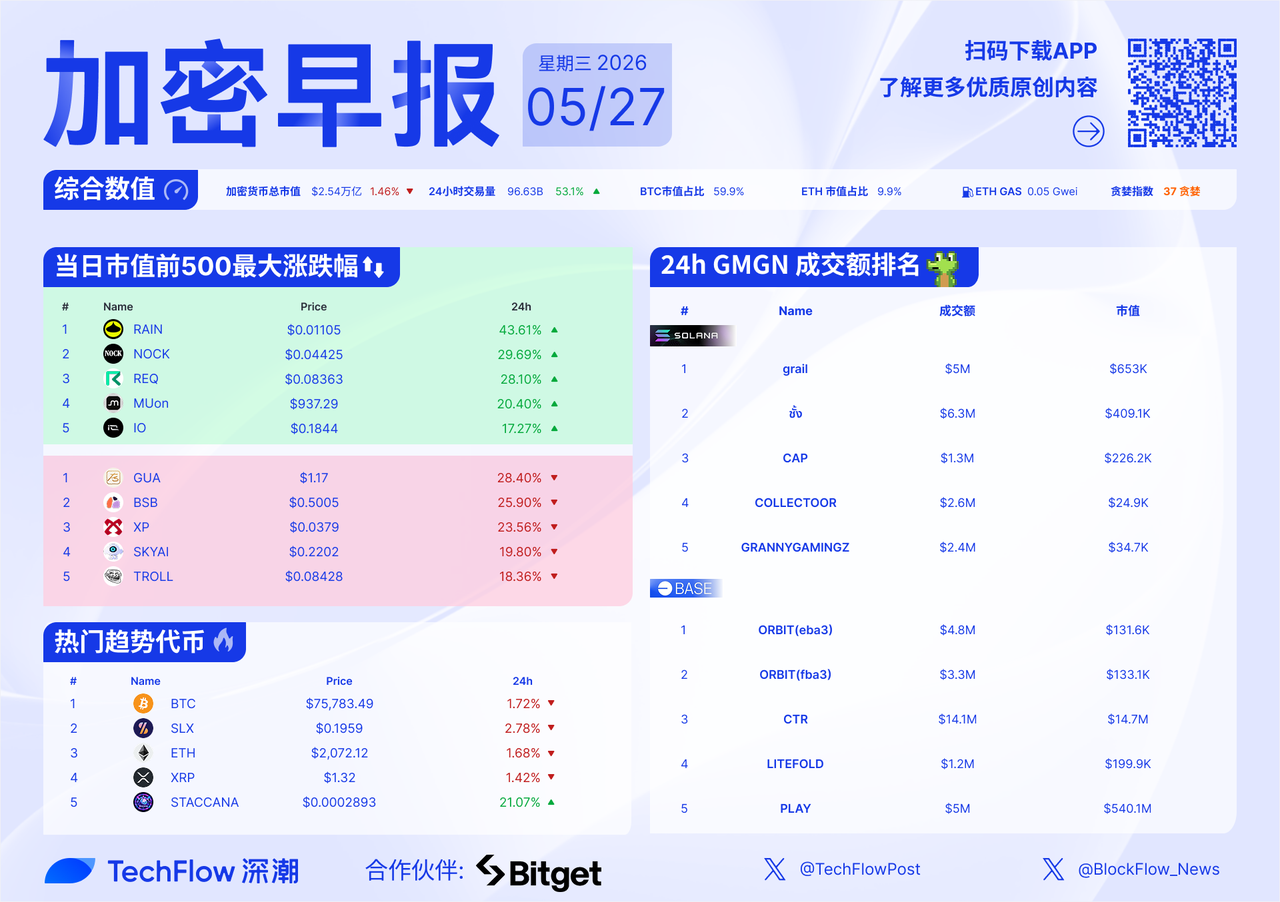
Market Data
Recommended Reading
Tether’s New Business: Helping Small Countries Issue Stablecoins
https://www.techflowpost.com/zh-CN/article/31755
Tether announced a partnership with the Government of Georgia to issue GEL₮, a stablecoin pegged to the Georgian lari, aiming to reduce costs, accelerate settlement, and advance cross-border payments. Tether’s strategy is to gradually build a global financial infrastructure network by issuing local-currency stablecoins for smaller nations. While this model may pose potential implications for national monetary sovereignty and financial stability, it also offers smaller countries a convenient pathway toward currency internationalization and efficient cross-border payments.
While Suing the Pentagon, Did Anthropic’s Co-Founder Seek the Pope’s Endorsement at the Vatican?
https://www.techflowpost.com/zh-CN/article/31757
This article primarily discusses Chris Olah, co-founder of AI firm Anthropic, and his remarks delivered at the Vatican during Pope Leo XIV’s release of the encyclical Magnifica Humanitas. The encyclical focuses on AI’s threats to human dignity and calls for a global slowdown in AI development. The article further details Anthropic’s engagement with religious groups and outlines the company’s current political situation.
Interview with Arthur Hayes & NEAR Co-Founder: Is HYPE Targeting $150? Does NEAR Still Have 20x Upside?
https://www.techflowpost.com/zh-CN/article/31758
This article explores future trends in the crypto market, the importance of privacy assets, and the potential convergence of AI and blockchain technologies. Through in-depth analysis of NEAR, Zcash (ZEC), and Hyperliquid (HYPE), it argues that privacy is key to mainstream crypto adoption—and examines how AI may disrupt labor markets and introduce new political risks.
Semiconductors Up 78% Year-to-Date, Software Down 12%: “Liquidity Siphoning” Underway Within Tech Stocks
https://www.techflowpost.com/zh-CN/article/31759
This article analyzes divergent market performances across the semiconductor and software sectors, noting that semiconductors have surged due to capital inflows and technological innovation, while software stocks have tumbled amid narratives of AI-driven substitution and capital outflows. It further describes the cyclical trends currently shaping the tech industry—and potential shifts ahead.
Microsoft’s AI Strategy Faces Threefold Dilemma: From Leader to Laggard
https://www.techflowpost.com/zh-CN/article/31763
This article examines Microsoft’s AI strategic challenges in 2026—including overreliance on OpenAI, defensive thinking in enterprise markets, and failures in security and cost control. It argues that Microsoft has slid from “AI leader” to “AI laggard,” and discusses the future potential of its in-house model MAI—and how it might reshape Microsoft’s AI narrative.
Join TechFlow official community to stay tuned
Telegram:https://t.me/TechFlowDaily
X (Twitter):https://x.com/TechFlowPost
X (Twitter) EN:https://x.com/BlockFlow_News
 深潮TechFlow











