AI Mega-Cap Companies Line Up for IPOs—Is This the “Last Party” for U.S. Stocks?
TechFlow Selected TechFlow Selected
AI Mega-Cap Companies Line Up for IPOs—Is This the “Last Party” for U.S. Stocks?
This unprecedented wave of IPOs serves as the ultimate stress test for AI investment logic and will also be the biggest variable influencing the trajectory of risk assets this year.
 Navigating Web3 tides with focused insights
By Dong Jing
Source: WallStreetCN
An IPO frenzy rivaling the peak of the dot-com bubble is taking shape. Three AI giants—OpenAI, Anthropic, and SpaceX—are racing toward public listings, each targeting a valuation exceeding $1 trillion. Combined, their scale could reshape the U.S. equity market. This unprecedented wave of listings represents both the ultimate stress test of AI investment logic and the single largest determinant of risk-asset performance this year.
On May 22, according to a WallStreetCN article, OpenAI has prepared to file its IPO application confidentially with regulators and could go public as early as September this year, targeting a valuation above $1 trillion and aiming to raise approximately $60 billion—more than double Saudi Aramco’s $25.6 billion IPO record set in 2019.
Meanwhile, competitor Anthropic is also advancing its own listing plans and disclosed that its Q2 revenue is expected to double sequentially to $10.9 billion, potentially achieving quarterly operating profitability for the first time. Deutsche Bank noted in a research report that the execution of these two IPOs “could become a major swing factor for risk assets this year,” making it a macro theme demanding close attention.
Yet beneath the dazzling valuations lie starkly divergent financial foundations. OpenAI posted $5.7 billion in Q1 revenue but reported an adjusted operating profit margin of -122%—meaning it lost $1.22 for every $1 of revenue generated—and is not projected to achieve positive cash flow until 2029–2030. Anthropic, by contrast, generated $4.8 billion in revenue during the same period; its Q2 revenue is expected to surge to $10.9 billion, with an estimated operating profit of approximately $559 million—already crossing the threshold into profitability.
Analysts point out that while these two companies compete head-to-head, they embody fundamentally different business models—presenting public-market investors with a rare and difficult choice.
The Largest IPO in History: How Staggering Are the Numbers?
Deutsche Bank noted in a research report that whether OpenAI or Anthropic goes public, each IPO would exceed twice the amount raised in Saudi Aramco’s 2019 offering—even after inflation adjustment—making either one the largest IPO in history.
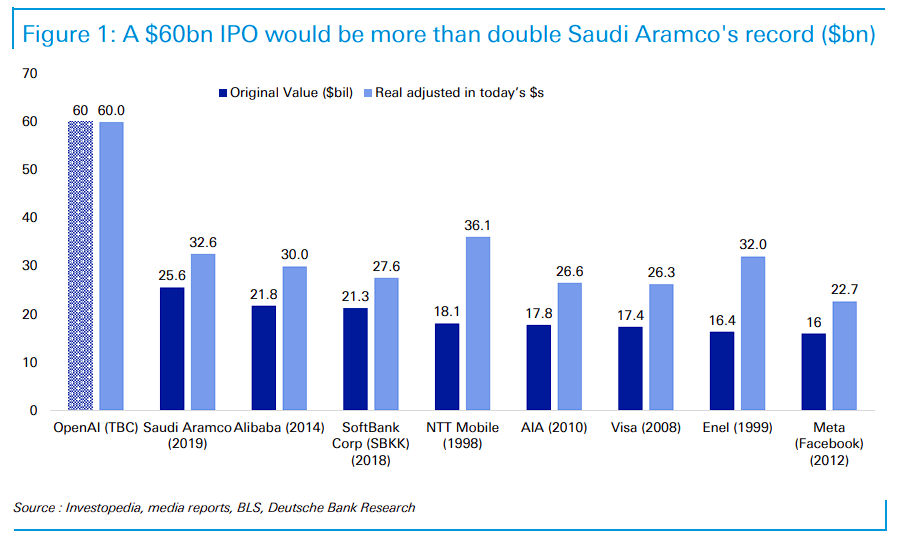
In another report, Deutsche Bank stated that if OpenAI achieves its target valuation of over $1 trillion, it would become the world’s 14th-largest company by market capitalization—ranking just below Berkshire Hathaway and ahead of Eli Lilly.
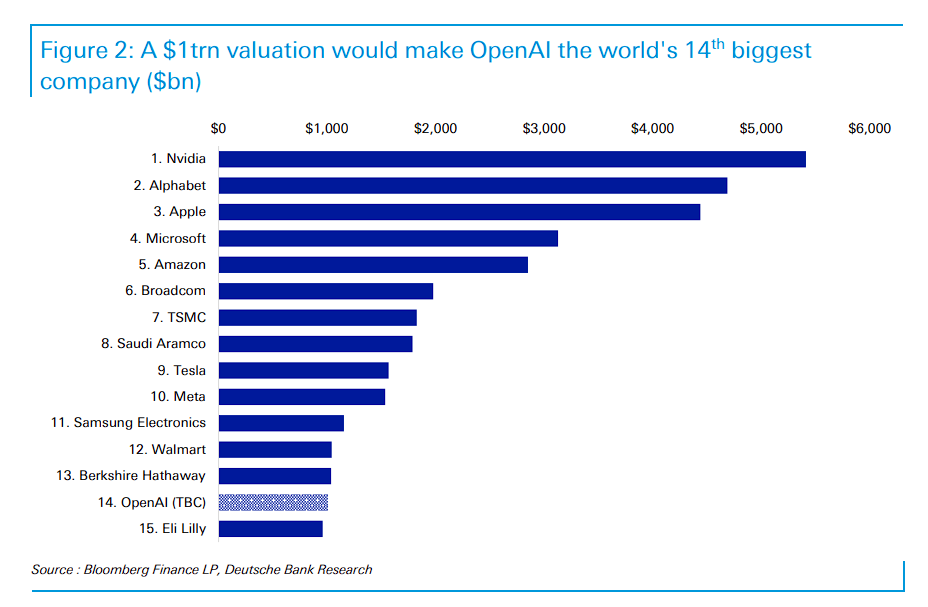
For comparison, Berkshire reported over $370 billion in revenue and $67 billion in net income last year; Eli Lilly recorded sales exceeding $65 billion and profits of $21 billion. OpenAI, however, remains unprofitable, with annualized revenue of roughly $30 billion and only several thousand employees.
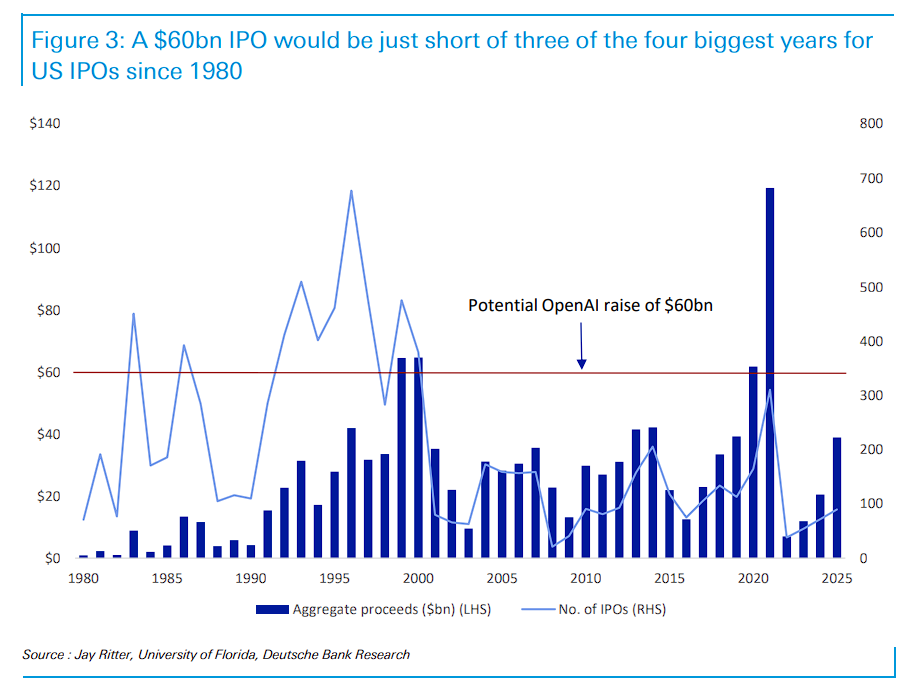
From a market-capacity perspective, Deutsche Bank estimates that today’s U.S. equity market—valued at approximately $70 trillion—is five times larger than at the peak of the dot-com bubble, giving it far greater absorption capacity than the late 1990s.
Back then, nearly 500 companies went public annually; this decade, the average stands at only around 120, and today’s listed firms are generally far more mature.
Moreover, a single $60 billion IPO would slightly fall short of the total U.S. IPO fundraising in 1999 and 2000 (both around $65 billion), yet still amount to half of the record-setting $119 billion raised in 2021.
The “Suction Effect” of Mega-Caps and Massive Passive-Fund Rebalancing
As these giants enter the public market, concerns about their liquidity drain on U.S. equities have drawn heightened vigilance from Wall Street.
The clustered listings of SpaceX, OpenAI, and Anthropic—combined with Nasdaq’s newly introduced “fast-track index inclusion” mechanism—are setting the stage for an unprecedented wave of passive-fund rebalancing: the “suction effect” of AI mega-caps.
According to the WallStreetCN article, JPMorgan estimates that if SpaceX achieves its $2 trillion valuation target and 50% of its shares become publicly tradable, passive funds would be forced to sell approximately $95 billion worth of positions in the current eight largest Wall Street tech stocks (NVIDIA, Apple, Microsoft, Amazon, Google, Broadcom, Meta, and Tesla) to make room for the new addition.
Todd Sohn, Chief ETF Strategist at Strategas, pointed out that since initial free-float ratios for IPOs typically stand at just 5%, while ETFs track multi-trillion-dollar indices, such extreme supply-demand imbalances will render the index-inclusion process “slightly chaotic,” leaving passive investors with little choice but to buy at elevated prices.
Valérie Noël, Head of Trading at Syz Group, noted that markets have already begun pricing in downward pressure on existing large-cap stocks.
Per information disclosed on March 28, OpenAI’s public listing will serve as a substantive referendum on the entire AI investment thesis. That disclosure revealed OpenAI’s 2025 revenue reached $13.1 billion, yet its 2026 net loss is projected to hit $14 billion.
At the same time, OpenAI has committed to investing approximately $140 billion in infrastructure through 2033. If S&P Global, FTSE Russell, and Nasdaq adopt fast-track inclusion rules, passive funds may be compelled to purchase between $24 billion and $48 billion worth of OpenAI shares immediately following its listing.
Faced with such massive portfolio restructuring, ordinary investors—whether active or passive—will see their portfolios reshaped automatically by rule changes.
Deutsche Bank observed in its report that the manner in which these IPOs are executed will be a major swing factor for risk assets this year. PitchBook’s analysis was even more direct:
A “systemic quality inversion” has emerged in the private market—the highest-valued companies score lowest on actual business-quality metrics once priced transparently in public markets.
For ordinary investors holding index funds or ETFs, this contest is impossible to avoid: regardless of intent, their portfolios will be passively reshaped by changes to index rules.
For active investors, once S-1 filings go public and all financial secrets are laid bare, the market faces a clear choice: Do you back a company that has already found a path to profitability—or one asking the market for several more years and tens of billions of dollars to explore the possibility of profit?
The answer will determine whether this celebration marks the dawn of a new cycle—or the final dance before the party ends.
Fire and Ice: Anthropic’s Profitability vs. OpenAI’s Massive Losses
Despite soaring valuations, the financial realities of these two AI leaders could hardly be more different. Anthropic has already turned profitable—shattering the conventional view that massive spending inevitably drags down near-term profitability for AI firms.
As reported by WallStreetCN, citing The Wall Street Journal on Wednesday, Anthropic’s Q2 revenue is expected to more than double to $10.9 billion, with an operating profit of approximately $559 million.
Anthropic’s gross margin has surged from 38% to over 70%. CEO Dario Amodei joked that revenue growth has become “too hard to handle.”
Its success stems primarily from explosive enterprise demand for its programming tools: roughly 85% of its revenue comes from enterprise and developer customers—a model marked by strong willingness-to-pay and low service costs.
OpenAI, by contrast, remains deeply unprofitable.
According to WallStreetCN, OpenAI posted $5.7 billion in Q1 revenue but reported an adjusted operating profit margin of -122%—losing $1.22 for every $1 earned.
Approximately 85% of OpenAI’s revenue comes from ChatGPT consumer subscriptions. Though it boasts 55 million paying users, its weekly active user base exceeds 900 million—creating a massive inference-cost black hole from its enormous free-user pool.
OpenAI expects to achieve positive cash flow only in 2029 or 2030. CEO Sam Altman and Applications CEO Fidji Simo are now shifting focus toward commercial clients capable of generating direct revenue.
At the narrative level, the two companies tell radically different stories. Anthropic holds verified quarterly profitability data—its story aligns with enterprise software peers like Salesforce or ServiceNow.
OpenAI, meanwhile, must convince the market that AI agents, image generation, and advertising businesses will ultimately convert its massive consumer traffic into profit.
Under Sam Altman’s plan, ChatGPT’s advertising business alone could generate ~$102 billion in revenue by 2030—but time is precisely the scarcest resource OpenAI is burning through its losses-as-growth strategy.
Are AI Giants’ Clustered IPOs Essentially Passing the “Hot Potato” to Retail Investors?
According to WallStreetCN, Panmure Liberum Managing Director Joachim Klement views this AI-IPO wave as fundamentally a “risk transfer”—a large-scale shift of early-stage investment risk onto retail investors, pension funds, and other institutions via exit transactions.
He argues that companies like OpenAI and Anthropic are accelerating listings amid surging investor sentiment—aiming to lock in high valuations before speculative fervor cools. Early institutional investors can thus exit cleanly in the public market, while retail investors and pension funds inherit the risk that financial fundamentals will eventually revert to reality.
He explicitly labels this process “a large-scale transfer of investment risk from current holders to those willing to pay for the story.”
Klement cites Alan Greenspan’s 1996 “irrational exuberance” warning as a reference point—the bubble did not burst until three years later. He judges that AI hype could persist through 2026, with no imminent signs of massive cloud providers cutting back investment. Yet “impossible math” will inevitably return to reality—“perhaps not in 2026, but possibly in 2027 or 2028.”
Join TechFlow official community to stay tuned
Telegram:https://t.me/TechFlowDaily
X (Twitter):https://x.com/TechFlowPost
X (Twitter) EN:https://x.com/BlockFlow_News