








Crypto Morning Brief: U.S. Treasury Repurchases $15 Billion in Treasury Bonds; Aave Suspends rsETH Reserve Operations on Ethereum, Arbitrum, and Other Networks
TechFlow Selected TechFlow Selected
Crypto Morning Brief: U.S. Treasury Repurchases $15 Billion in Treasury Bonds; Aave Suspends rsETH Reserve Operations on Ethereum, Arbitrum, and Other Networks
Microsoft had considered acquiring Cursor but ultimately locked in a partnership with SpaceX.
 Navigating Web3 tides with focused insights
Author: TechFlow
Yesterday’s Market Highlights
U.S. initial jobless claims for the week ending April 18 totaled 214,000, versus an expected 210,000.
U.S. initial jobless claims for the week ending April 18 totaled 214,000, versus an expected 210,000 and a prior figure revised upward from 207,000 to 208,000.
Trump extends Israel-Lebanon ceasefire by three weeks; warns Iran that refusal to negotiate will trigger military action
According to JIN10 Data, U.S. President Trump announced a three-week extension of the ceasefire agreement between Israel and Lebanon (originally set to expire on April 26) and plans to invite Israeli Prime Minister Netanyahu and Lebanese President Joseph Aoun for visits to the U.S. in the near term. Trump stated this move helps clear a key obstacle for the U.S. to end hostilities with Iran. On Iran, he warned that if Tehran refuses negotiations, the U.S. will resort to military means. He noted that Iran may have slightly replenished its weapons stockpile during the ceasefire but emphasized that U.S. forces could destroy them within approximately one day. Trump explicitly ruled out using nuclear weapons in the conflict and expressed hope for achieving a lasting peace agreement.
U.S. Treasury repurchases $1.5 billion in Treasury securities—the largest such operation in history
According to CoinDesk, the U.S. Treasury repurchased $1.5 billion in outstanding Treasury securities, setting a record for the largest Treasury buyback in U.S. history.
Trump announces investigation into federal employees’ betting on prediction markets using classified information
According to Bloomberg, U.S. President Trump said he would launch an investigation into federal employees’ betting activity on event prediction markets, citing concerns that individuals may be exploiting government-classified information for profit. Previously, federal authorities arrested a soldier involved in the operation to capture Venezuelan leader Maduro; the soldier had successfully bet on Maduro’s imminent ouster and earned approximately $400,000.
Aave founder personally donates 5,000 ETH to support DeFi United, pledging to restore market stability
Aave founder and CEO Stani Kulechov disclosed on X that he personally contributed 5,000 ETH to DeFi United and is actively collaborating with partners to secure additional funding commitments, aiming to resolve current issues and restore normal market conditions as soon as possible. Stani stated that Aave represents his life’s work and that the team is fully committed to identifying solutions most beneficial to users.
Aave suspends rsETH reserve operations on Ethereum, Arbitrum, and other networks
Aave announced the latest update regarding the rsETH security incident on X, stating it has suspended all rsETH reserve-related operations on Ethereum mainnet as well as on Arbitrum, Base, Mantle, and Linea. This measure aims to preserve as much capital as possible and minimize systemic risk while recovery efforts proceed. Aave pledged to continue providing transparent updates and disclosures to the community regarding further developments and resolution plans.
Aave proposal: Sharply increase USDC Slope 2 to 50% to alleviate liquidity crisis
According to the Aave Governance Forum, Gordon Liao of Circle published an ARFC proposal recommending a two-step adjustment to the USDC interest rate model parameters on Aave v3 Ethereum Core to address the current pool liquidity shortage.
Current context: Following the rsETH incident on April 18, USDC pool utilization has remained near 100%, with available liquidity falling below $3 million. The borrowing rate has been persistently capped at 14%, and total pool supply contracted by approximately $60 million over the past 24 hours—rendering the market unable to clear via price mechanisms.
Core elements of the proposal:
Step 1 (to be executed immediately by Risk Administrators): Raise Slope 2 from 10% to 40%, lower the optimal utilization rate from 92% to 87%, and suspend the Slope 2 risk oracle for USDC.
Step 2 (to be completed via governance vote within 5–7 days): Further raise Slope 2 to 50% and lower the optimal utilization rate to 85%.
The proposal argues that many current borrowers are insensitive to interest rates and instead borrow primarily to bypass withdrawal queues and exit positions. Active leverage is essential to attract new suppliers. Raising the maximum supply rate to the 40%–50% range is expected to draw USDC inflows within hours, driving utilization back below the kink point and restoring normal market clearing functionality. Additionally, the proposal recommends suspending the Slope 2 risk oracle developed by Chaos Labs due to its historically slow response during stress events and because Chaos Labs officially exited the Aave ecosystem on April 6, raising uncertainty about future maintenance.
Tether freezes over $344 million in USDT in coordination with U.S. law enforcement
According to official announcements, Tether stated it has frozen over $344 million in USDT held across two addresses, following identification of those addresses as linked to illicit activities, to prevent further fund transfers. Tether noted this action was based on intelligence provided by multiple U.S. agencies and reiterated its long-standing adherence to OFAC sanctions guidelines, as well as its collaboration with over 340 law enforcement agencies across 65 countries. To date, Tether has assisted in over 2,300 cases, freezing more than $4.4 billion in assets—including over $2.1 billion tied to U.S. agencies.
Earlier reports indicated Tether froze 344 million USDT held in two addresses on the TRON blockchain.
Binance launches debit card registration page, accepting expressions of interest until April 30
According to crypto KOL AB Kuai.Dong, cryptocurrency exchange Binance recently launched a registration page for its Binance Debit Card and opened sign-ups for expressions of interest, with the deadline set for April 30.
After registration, users will receive a notification once the card becomes available in their region. According to the product description, users can spend assets such as USDC, USDT, FDUSD, and BNB held in their Binance Earn accounts for everyday purchases, earning up to 3% cashback without impacting their Earn yields.
Robinhood receives in-principle approval from MAS to launch brokerage services in Singapore
According to an official announcement, Robinhood has received in-principle approval (IPA) from the Monetary Authority of Singapore (MAS) to launch brokerage services in Singapore, covering equity trading, exchange-traded derivatives, custody, product financing, and collective investment schemes. Robinhood stated Singapore will serve as its Asia-Pacific headquarters to support international expansion. Its subsidiary Bitstamp Asia Pte. Ltd. already holds a Major Payment Institution (MPI) license issued by MAS. Note that IPA does not constitute formal licensing—Robinhood Singapore Pte. Ltd. must still satisfy all regulatory conditions before commencing operations.
Microsoft considered acquiring Cursor, but SpaceX ultimately secured acquisition rights
According to Techstartups, Microsoft explored acquiring AI programming tools company Cursor but ultimately did not pursue the deal. Subsequently, SpaceX swiftly secured an option to acquire Cursor at a $60 billion valuation.
Cursor has now become a major player in the AI programming space, benefiting from strong developer demand for automation and productivity tools—while OpenAI and Anthropic compete intensely in this domain. Meanwhile, Microsoft faces mounting pressure elsewhere: its stock has declined 10% year-to-date, underperforming peers in the hyperscale data center sector.
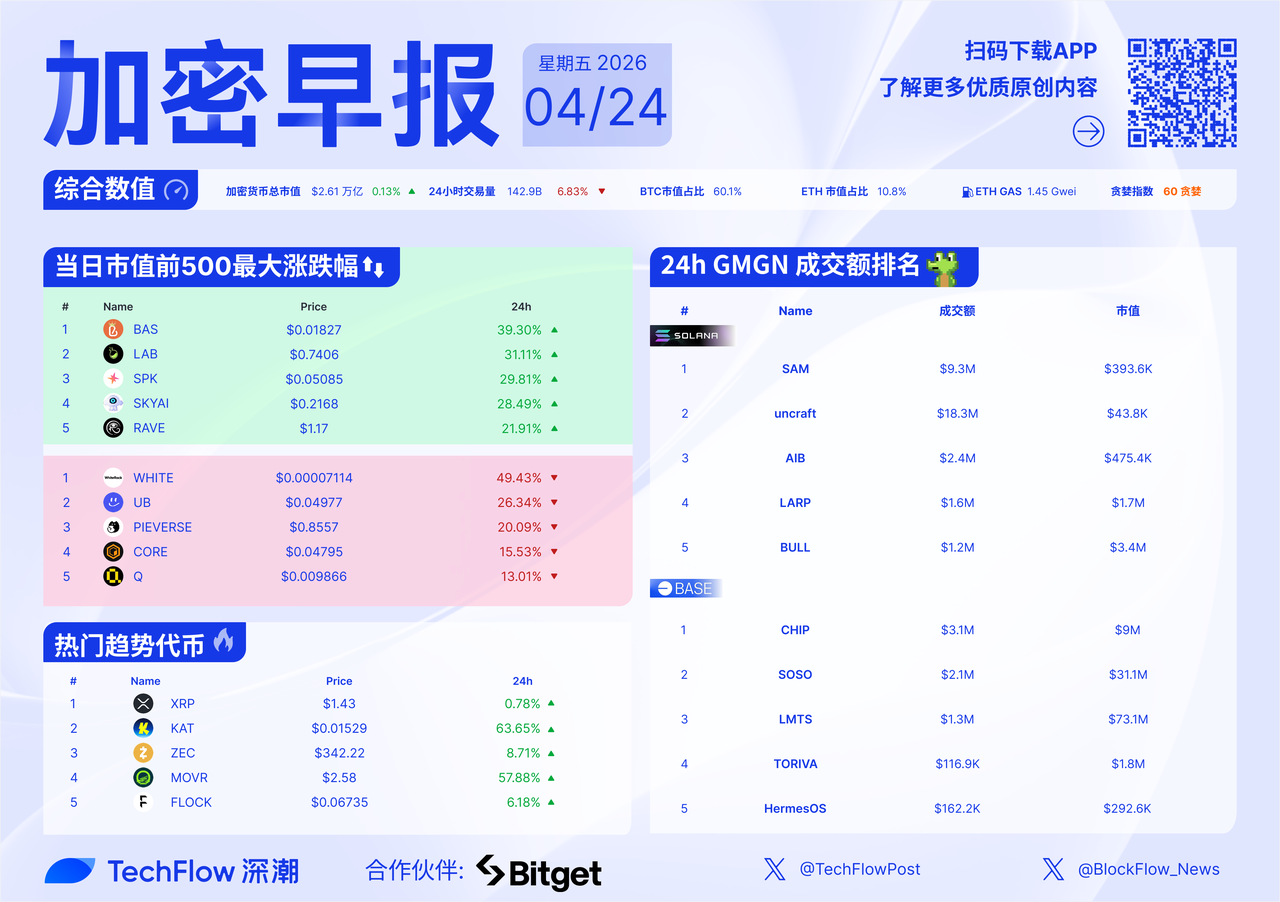
Market Data
Recommended Reading
Interview with Cobie: The crypto industry is delivering on its promises—so why aren’t you profiting?
https://www.techflowpost.com/zh-CN/article/31274
This article features an in-depth interview with Cobie, covering the current state and future trajectory of the crypto industry, AI’s impact on DeFi, inequities in private markets, and the historical evolution and potential future directions of crypto. Cobie shares his optimistic outlook on the industry, personal experiences, and advice for younger professionals.
U.S. military confirms running Bitcoin nodes; four-star general calls it a “tool of power projection”
https://www.techflowpost.com/zh-CN/article/31278
This article details how Admiral Paparo, Commander of U.S. Indo-Pacific Command, confirmed that the U.S. military operates Bitcoin network nodes and conducts live cybersecurity testing—defining Bitcoin as a “computer science tool” and “instrument of power projection,” rather than merely a financial asset. During Senate testimony, Paparo stated that Bitcoin’s underlying technologies—including cryptography, blockchain, and proof-of-work—are valuable to U.S. national power instruments and hold significant applications for cybersecurity. The Bitcoin Policy Institute observes that Bitcoin has become an undeniable geopolitical asset, and the Pentagon’s involvement signals deep institutional recognition of its technological importance.
$500 gets you OpenAI stock—the Silicon Valley’s most polished “bagholder invitation”
https://www.techflowpost.com/zh-CN/article/31280
This article examines AngelList’s newly launched fund product, USVC, which enables retail investors to invest in shares of seven AI companies—including OpenAI—with a minimum entry threshold of $500. However, this model has drawn criticism for facilitating early investors’ liquidity exits, potentially exposing retail participants to high fees, low liquidity, and difficulty exiting investments. Similarly, Robinhood announced it will offer OpenAI investment access to retail investors through its own fund. This approach is seen as analogous to the crypto industry’s “low liquidity, high FDV” model.
Sun Yuchen sues the Trump family: “$75 million bought me nothing but a blacklist”
https://www.techflowpost.com/zh-CN/article/31281
This article recounts Sun Yuchen’s $75 million investment in the crypto project World Liberty Financial (WLF), which culminated in a breakdown of relations with the project team, resulting in frozen tokens and substantial losses. It reveals internal operational flaws within WLF and its ties to the Trump family, while also examining the incident’s broader implications for the cryptocurrency industry.
Exclusive interview with Arbitrum Security Council member: Why did we activate “God Mode” to freeze $72 million stolen by North Korean hackers?
https://www.techflowpost.com/zh-CN/article/31292
This article explores the Arbitrum Security Council’s decision to freeze and recover $72 million in assets allegedly stolen by North Korean hackers—a first-of-its-kind use of “God Mode” authority by an L2 chain. Controversy centers on balancing blockchain decentralization principles against emergency intervention needs. The article also compares Circle’s and Tether’s differing responses to North Korean hacking incidents and discusses broader themes including decentralization, blockchain security, and the industry’s future development path.
Join TechFlow official community to stay tuned
Telegram:https://t.me/TechFlowDaily
X (Twitter):https://x.com/TechFlowPost
X (Twitter) EN:https://x.com/BlockFlow_News
 深潮TechFlow











