Huobi Growth Academy | In-Depth Research Report on the On-Chain Lending Market: When Off-Chain Credit Meets On-Chain Liquidation
TechFlow Selected TechFlow Selected
Huobi Growth Academy | In-Depth Research Report on the On-Chain Lending Market: When Off-Chain Credit Meets On-Chain Liquidation
This research report systematically outlines the evolution of the definition of on-chain lending markets, competitive landscape, core risks, and future trends, providing investors and industry practitioners with comprehensive industry insights.
 Navigating Web3 tides with focused insights
Executive Summary
On-chain lending markets are rapidly evolving from a peripheral DeFi niche into core infrastructure. As of early 2026, total value locked (TVL) across on-chain lending protocols has reached $64.3 billion—accounting for 53.54% of the entire DeFi ecosystem’s TVL—making it the largest and most mature subsector in decentralized finance by both scale and business model viability. Aave dominates the lending space with approximately $32.9 billion in TVL, commanding roughly half the market; its leadership position appears unassailable in the foreseeable future. Yet on-chain lending is far from risk-free: liquidation cascades triggering chain-reaction sell-offs, credit defaults posing systemic threats, and cross-chain bridge vulnerabilities collectively constitute a Damoclean sword hanging over the industry. Simultaneously, a deeper transformation is underway: on-chain lending is shifting from “a leveraged tool for crypto natives” to “a compliant on-ramp for traditional financial institutions.” Real-world asset (RWA) lending has surpassed $18.5 billion, with U.S. Treasuries and Treasury bills emerging as central collateral types—marking a structural shift in user composition and risk appetite driven by institutional capital inflows. This report systematically examines the conceptual evolution, competitive landscape, core risks, and future trends of on-chain lending, delivering a panoramic industry analysis for investors and practitioners. Key findings indicate that the “one-dominant, multiple-strong” market structure will persist in the near term, while fixed-rate lending, compliant asset-backed collateralization, and institutional-grade credit assessment will define the next generation of on-chain lending protocols. For investors focused on DeFi infrastructure, three high-potential value vectors stand out: the Aave ecosystem (Morpho, Spark), RWA lending (Ondo, Maple), and fixed-rate innovation (Notional, Pendle).
I. Conceptual Evolution: From Crypto Leverage Tool to Mainstream Financial Infrastructure
On-chain lending is not new. In 2020, Compound’s introduction of liquidity mining propelled DeFi beyond niche tech circles into mainstream awareness—ushering in the so-called “DeFi Summer.” At that time, on-chain lending functioned primarily as a crypto-native, highly leveraged instrument: users over-collateralized crypto assets to access liquidity, then deployed that liquidity into yield aggregators or automated market makers to chase annualized returns multiples higher than traditional finance. This model operated smoothly during bull markets—but the Terra/Luna collapse and FTX bankruptcy in 2022 exposed critical fragilities in ultra-high collateral ratios and cascading liquidations. After two years of bear-market consolidation, on-chain lending completed a pivotal transition—from “leverage tool” to “allocation infrastructure.” This shift was driven by three converging forces: first, improving regulatory clarity—such as the EU’s MiCA framework and the SEC’s gradual ETF approvals—has lowered compliance barriers for traditional capital entering on-chain ecosystems; second, the tokenization wave of real-world assets (RWAs)—including U.S. Treasuries, tokenized corporate bonds, and real estate income rights—is transforming on-chain lending’s collateral composition and user profile; third, maturing interest rate marketization—from purely floating-rate models to dedicated fixed-rate protocols (e.g., Notional, Yield Protocol) and hybrid frameworks (e.g., Pendle)—is aligning on-chain interest pricing more closely with traditional financial markets.
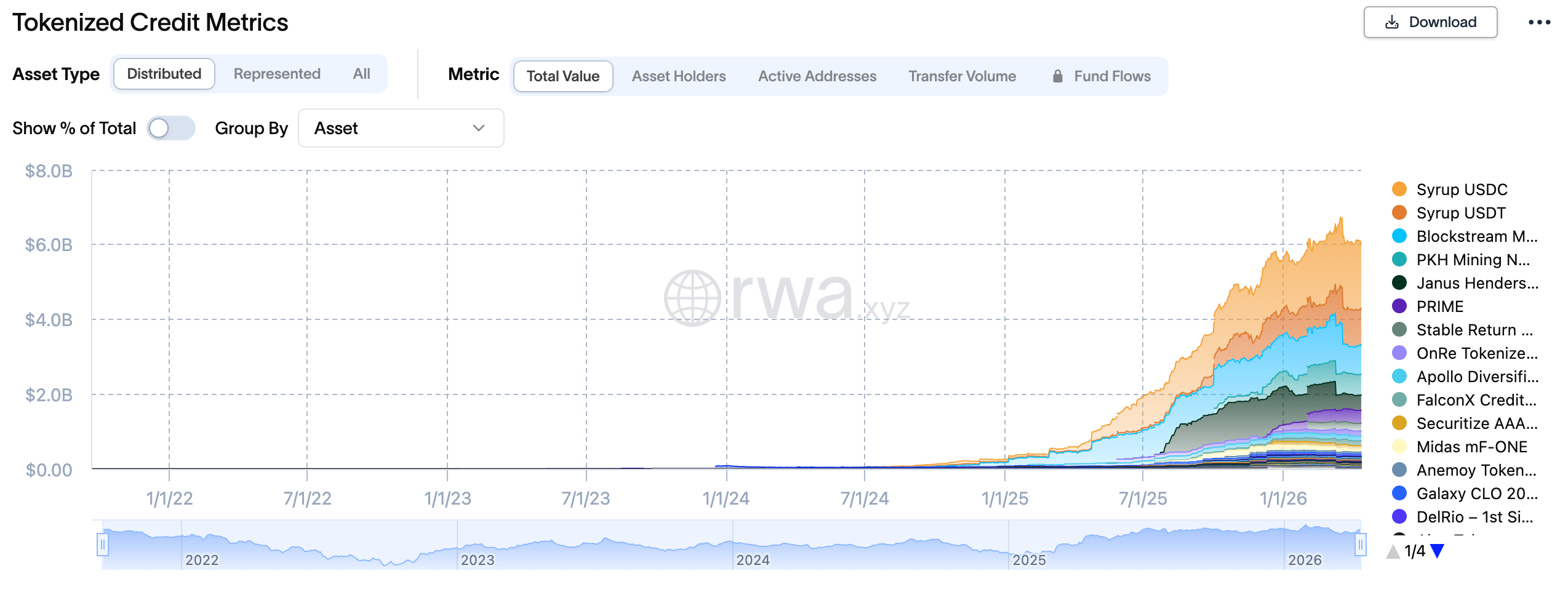
As of early 2026, on-chain lending’s asset classification has crystallized into a clear three-tier architecture: at the base lies stablecoin lending—dominated by USDC, DAI, and USDT—which represents the largest, lowest-risk segment, with typical loan-to-value (LTV) ratios reaching 80–90%; the middle layer consists of volatile-asset lending backed by major cryptocurrencies like ETH and BTC, where LTVs are typically capped at 50–70% to mitigate liquidation risk amid sharp price swings; at the apex sits RWA-backed lending—including tokenized U.S. Treasuries (e.g., Ondo Finance’s OUSG), corporate credit (e.g., Maple Finance’s private debt), and real estate income rights—which is rapidly emerging as on-chain lending’s new growth engine, particularly attractive to institutional investors seeking compliant capital entry points. Geographically, user composition is undergoing profound change: Asian markets remain dominated by retail investors and arbitrageurs who favor high leverage and complex strategies; European and U.S. markets exhibit clear institutionalization trends, with heightened demand for compliant custody, KYC verification, and audit transparency. This divergence directly shapes regional protocol design priorities.
II. Competitive Landscape: “One-Dominant, Multiple-Strong” and Technical Divergence
The on-chain lending market exhibits a classic “one-dominant, multiple-strong” competitive structure. Aave commands absolute dominance with ~$32.9 billion in TVL—a figure over ten times larger than runner-up Compound (~$2.6 billion) and representing more than 50% of the entire lending sector’s TVL. Yet Aave’s moat does not stem from network effects or brand recognition—largely irrelevant in open-source protocol ecosystems—but rather from relentless technical iteration and ecosystem expansion. From Aave V1’s floating-rate model, to V2’s credit delegation and flash loans, to V3’s Portal cross-chain liquidity and isolation mode, each Aave generation precisely addresses prevailing market pain points. The upcoming V4 release—scheduled for mid-2026—will further enhance cross-chain liquidation capabilities and embed institutional-grade compliance frameworks. Beneath Aave’s shadow, differentiated protocols are carving out distinct niches. Morpho Labs pursued an unconventional evolutionary path: beginning as an optimization layer atop Aave and Compound (boosting capital efficiency via peer-to-peer matching), it gradually evolved into independent offerings—Morpho Blue (oracle-free, governance-free lending) and Morpho Vaults (professional risk managers curating yield strategies)—transitioning from “optimization layer” to “standalone protocol.” Spark Finance, meanwhile, leverages MakerDAO’s DSR (DAI Savings Rate) ecosystem to establish a robust user base in stablecoin lending, with its technical synergy with Aave V3 positioning it as a key conduit for institutional adoption.
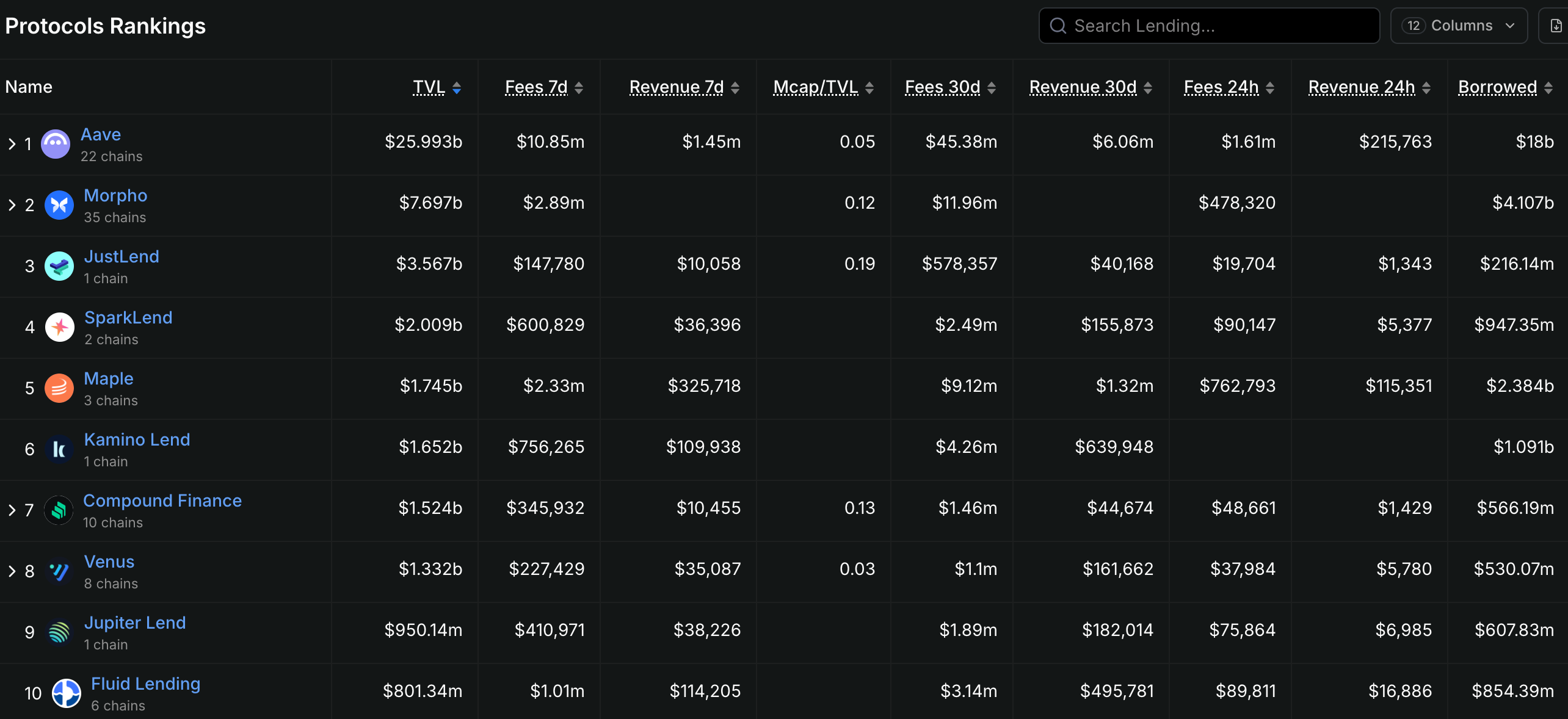
Technologically, on-chain lending protocols are diverging along three distinct paths. First is the “liquidity aggregation” path (P2Pool), represented by Aave, Compound, and Kamino Finance. Its core premise is pooling lenders’ funds into shared liquidity reserves, dynamically adjusting interest rates algorithmically based on utilization—enabling efficient capital allocation. Advantages include deep liquidity and streamlined UX; drawbacks include relatively lower capital efficiency (lenders cannot negotiate terms directly with borrowers). Second is the “peer-to-peer matching” path (P2P), exemplified by Notional Finance and Myso Finance. Its core idea is direct lender-borrower matching to deliver fixed-term, fixed-rate borrowing experiences. While offering superior rate stability, this path suffers from comparatively thin liquidity—better suited for borrowers with clearly defined funding timelines. Third is the “permissionless pool” path, led by Euler Finance (V2) and Ajna Finance. Its philosophy fully delegates risk management to the market—no oracles, no governance votes—allowing borrowers and lenders to set parameters autonomously and bear risks individually. Though maximally decentralized, this approach entails higher user education costs and elevated smart contract risk.
III. Core Risks: The Triple Challenge of Liquidation, Credit, and Cross-Chain Security
The risk landscape of on-chain lending is significantly more complex than traditional finance. Unlike banking systems, on-chain protocols lack deposit insurance, central bank lender-of-last-resort facilities, or regulatory window guidance—when crises strike, liquidation mechanisms become the sole price discovery mechanism, and their “ruthless automation” often amplifies downturns during market panic. Liquidation cascades represent the most typical systemic risk. On March 12, 2020—the “Black Thursday”—Ethereum’s price plunged 37% in a single day, triggering massive MakerDAO liquidations; insufficient liquidity led to zero-price auction executions, with ETH collateral clearing at just 50–60% of market price. Similar events recurred during the May 2022 UST/LUNA collapse, forcing forced liquidations of highly leveraged positions on Aave and Compound—further intensifying market sell pressure. To counter liquidation cascade risk, protocols have adopted varied strategies: Aave V3 introduced “Efficiency Mode,” enabling borrowers to optimize collateral efficiency for specific asset pairs; Isolation Mode quarantines high-risk assets in separate pools, preventing contagion across the protocol; Ajna Finance completely eliminated oracles, instead using supply-demand dynamics between collateral and debt for automatic pricing—fully delegating price discovery to the market.
Credit default risk forms the second major challenge. Unlike over-collateralized “machine-executed” models, uncollateralized or under-collateralized on-chain credit lending inherently faces evaluation difficulties. Goldfinch and Maple Finance employ a hybrid off-chain KYC + on-chain settlement model, leveraging real-world credit assessment firms (e.g., Blackstone Credit Partners, Van Eck) to score borrowers—resolving on-chain information asymmetry. However, this “centralized endorsement” fundamentally contradicts DeFi’s permissionless ethos. In November 2022, crypto trading firm Orthogonal Trading defaulted on Maple Finance, leaving ~$36 million in non-performing debt—an event exposing the fragility of on-chain credit lending: when borrowers are institutions rather than individuals, their asset allocation and risk management capabilities vary widely, undermining the reliability of “credit scoring.” A deeper tension arises: on-chain credit lending attempts to replicate traditional finance’s credit assessment systems within a decentralized world, yet this path confronts inherent friction between regulatory compliance (GDPR, KYC/AML) and on-chain anonymity. Building effective credit assessment mechanisms while preserving user privacy remains a core long-term challenge.
Cross-chain security constitutes the third major challenge. Aave’s Portal functionality, Morpho’s cross-chain deployment, and Ajna’s multi-chain expansion reflect how leading protocols are extending on-chain lending beyond single chains into multi-chain ecosystems. Yet this expansion exponentially increases complexity—and thus security risk. The 2022 Ronin Bridge hack ($625M loss) and Harmony Horizon Bridge attack ($100M loss) revealed how cross-chain bridge vulnerabilities propagate throughout the DeFi ecosystem. When Aave V3 incorporates assets from BNB Chain, Avalanche, and Arbitrum into its lending pools, those assets must be transferred across chains via bridges whose security is often weaker than the underlying chains themselves. More critically, cross-chain assets depend on price oracles: if an oracle on any connected chain malfunctions or lags, positions collateralized by that asset may face untimely liquidation. This “weakest-link effect” means an on-chain lending protocol’s overall security hinges on the most vulnerable chain in its expanded footprint. For investors, evaluating a protocol’s cross-chain expansion strategy and bridge security is a critical dimension for assessing long-term risk.
IV. Innovation Trends: Fixed Rates, RWAs, and Institutionalization
Despite persistent risks, the on-chain lending innovation engine remains active. Between 2024 and 2026, three forces are reshaping the sector’s rules of engagement. First is the breakthrough in fixed-rate lending. Traditional P2Pool models are inherently floating-rate—interest rates adjust dynamically with pool utilization—exposing borrowers to surging interest costs when market rates spike. Such uncertainty is unacceptable for enterprises and institutions seeking stable financing. Notional Finance pioneered fixed-term, fixed-rate loans, enabling borrowers to lock in rates for 12 months or longer upon loan creation, while lenders achieve term-matching by purchasing complementary yield tokens (fCash). Pendle Finance took an alternative route—tokenizing yield rights: splitting future asset yields into “Principal Tokens” (PT) and “Yield Tokens” (YT), allowing lenders to purchase PTs for guaranteed returns while transferring rate volatility risk to speculative YT holders. Both approaches jointly advance on-chain interest rate marketization.
The second force is the explosive growth of RWA lending. In early 2024, BlackRock’s tokenized fund BUIDL surpassed $5 billion, while Ondo Finance’s OUSG (U.S. Treasury yield token) exceeded $1 billion—these compliant assets are now being integrated into on-chain lending protocols as core collateral. Compared to the extreme volatility of ETH and BTC, U.S. Treasuries offer low volatility, strong liquidity, and regulatory compliance—making them a “green lane” for institutional capital entering on-chain lending. Protocols including Maple Finance, Pendle, and Flux Finance already support borrowing against tokenized U.S. Treasuries, enabling users to unlock liquidity while retaining Treasury yield. Aave’s V4 specifically introduces an “Institutional Market” (Horizon Institutional Market) tailored for RWA assets, providing on-chain lending services to SEC-registered compliant borrowers. As of early 2026, on-chain RWA lending volume has surpassed $18.5 billion and is projected to exceed $50 billion by 2027.
The third force is accelerating institutionalization. Unlike DeFi natives’ preferences for anonymity, permissionlessness, and complex strategies, institutional capital demands compliance, auditability, and risk control. RWA lending platforms such as Centrifuge and RWA.xyz have designed product frameworks explicitly meeting institutional needs: KYC/AML verification, off-chain credit assessment, custodial clearing, and regulatory reporting—transplanting traditional finance’s infrastructure onto-chain. A deeper shift is underway: institutional participation is altering on-chain lending’s strategic dynamics. Traditional DeFi players habitually exploit leverage, flash loans, and arbitrage to extract protocol value, whereas institutional capital favors conservative “hold-lend-rehold” strategies. This divergence will fundamentally reshape lending protocols’ capital structures and yield curves—driving more long-term locked capital, more stable rates, and fewer speculative liquidations. For protocols, balancing institutional service excellence with retail liquidity retention remains a persistent, delicate challenge.
V. Participation Strategies: Three Value Vectors and Risk Warnings
For investors and practitioners targeting the on-chain lending sector, the current market offers three clear value participation vectors. The first vector is investment extension within the Aave ecosystem. Beyond holding AAVE tokens directly, monitoring Morpho Labs (an independent protocol evolving from Aave’s optimization layer, with Morpho Blue pioneering oracle-free lending), Spark Finance (a stablecoin lending protocol deeply integrated with MakerDAO’s DSR ecosystem, benefiting from DSR’s expansion), and new functionalities enabled by Aave V4 (e.g., Institutional Market, cross-chain liquidation) offers superior risk-adjusted returns. Historical data shows AAVE tokens consistently generate significant alpha following major Aave version upgrades or record-high TVL milestones.
The second vector is beta exposure to the RWA lending sector. Ondo Finance (OUSG), Maple Finance (institutional credit), and Centrifuge (physical asset financing) represent three distinct RWA entry points. Ondo’s advantage lies in deep integration with BlackRock’s BUIDL fund and stable yield from compliant U.S. Treasuries; Maple’s strength stems from established credit files with real institutional borrowers (e.g., Coinbase Ventures, Framework Ventures); Centrifuge’s edge resides in genuine physical asset financing demand and low default rates. Investors seeking RWA exposure should adopt diversified allocation strategies to mitigate black-swan risks tied to any single protocol.
The third vector is structural opportunities in fixed-rate innovation protocols. Pendle Finance and Notional Finance represent two distinct fixed-rate approaches: Pendle achieves “yield separation” through yield-tokenization, catering to advanced users fluent in DeFi Lego logic; Notional delivers “rate locking” via traditional fixed-term loans, better suited for institutions prioritizing stability. Notably, Pendle’s TVL surged tenfold in 2024—from under $100 million to over $1 billion—with its highly volatile YT tokens creating fertile ground for arbitrage and speculative strategies.
While pursuing these opportunities, three risks warrant close attention. First is smart contract risk—lending protocols’ massive TVL makes them high-value targets for hackers. The 2023 Euler Finance hack ($197M loss) serves as a stark reminder that even top-tier protocols may harbor undiscovered vulnerabilities. Second is liquidity concentration risk—if a single collateral type (e.g., stETH, Lido’s staked ETH) comprises an excessive share of a protocol’s TVL, extreme volatility in that asset could trigger systemic liquidations. Third is regulatory policy risk—the “permissionless lending” functionality of on-chain protocols may be classified by regulators as unregistered securities issuance or illegal fundraising, especially under U.S. and EU MiCA frameworks—significantly raising compliance costs. For portfolio allocation, we recommend capping on-chain lending exposure at 20–30% of overall DeFi allocations, prioritizing mature protocols with extensive audits, stable TVL, and transparent team backgrounds.
VI. Conclusion: Infrastructure Value and Investment Clock
On-chain lending is the DeFi sector closest to embodying the definition of “infrastructure.” Unlike perpetual futures chasing extreme leverage, liquidity mining dependent on token-incentive-driven artificial booms, or NFT markets facing cyclical asset obsolescence, its value is rooted in authentic financing demand, steady interest income, and gradually built institutional trust. Behind the $64.3 billion TVL lies countless individual and institutional acts of borrowing, depositing, and risk management—the scale effect of this “grassroots finance” represents DeFi’s most fundamental and powerful value proposition. Looking ahead, the on-chain lending investment clock is transitioning from the “proof-of-concept phase” into the “institutional adoption phase.” RWA inflows, institutional market formation, and regulatory framework refinement are collectively transforming this sector from a playground for crypto natives into an extension battlefield for traditional finance. In this transition, striking the right balance between “DeFi-native innovation” and “institutional compliance requirements” will determine the rise and fall of individual protocols. For long-term investors, on-chain lending merits strategic allocation: core positions should focus on Aave ecosystem’s foundational assets, satellite positions can moderately capture alpha from RWA and fixed-rate innovations, while maintaining disciplined risk management and healthy respect for smart contract vulnerabilities.
Join TechFlow official community to stay tuned
Telegram:https://t.me/TechFlowDaily
X (Twitter):https://x.com/TechFlowPost
X (Twitter) EN:https://x.com/BlockFlow_News
 @HTXAcademy