








Filecoin’s 2025 Year-in-Review and 2026 Strategy: From Scaling Infrastructure to Delivering Demand
TechFlow Selected TechFlow Selected
Filecoin’s 2025 Year-in-Review and 2026 Strategy: From Scaling Infrastructure to Delivering Demand
“This year, we completed critical strategic groundwork. In 2026, we will convert these capabilities into genuine market demand and sustainable revenue.”
 Navigating Web3 tides with focused insights
Over the past five years, we have built Filecoin from a vision into the world’s largest decentralized storage network—boasting exabyte-scale storage capacity and a global community of storage providers and developers.
In 2025, the urgency of this mission was repeatedly confirmed by reality: frequent global internet outages exposed the structural fragility of centralized cloud infrastructure; and the explosive growth of AI agents is creating unprecedented, real-world demand for verifiable data infrastructure. Coincidentally, on the very day Filecoin Onchain Cloud (FOC) officially launched, Cloudflare suffered a major outage—this timing may be the most powerful real-world illustration of “why decentralized storage is necessary.”
This year, we completed critical strategic groundwork. In 2026, we will convert these capabilities into genuine market demand and sustainable revenue.
2025 Year in Review: Five Parallel Tracks of Progress
1) Product Milestone: FOC Launch — Evolving Filecoin from “Storage Network” to “Programmable Cloud”
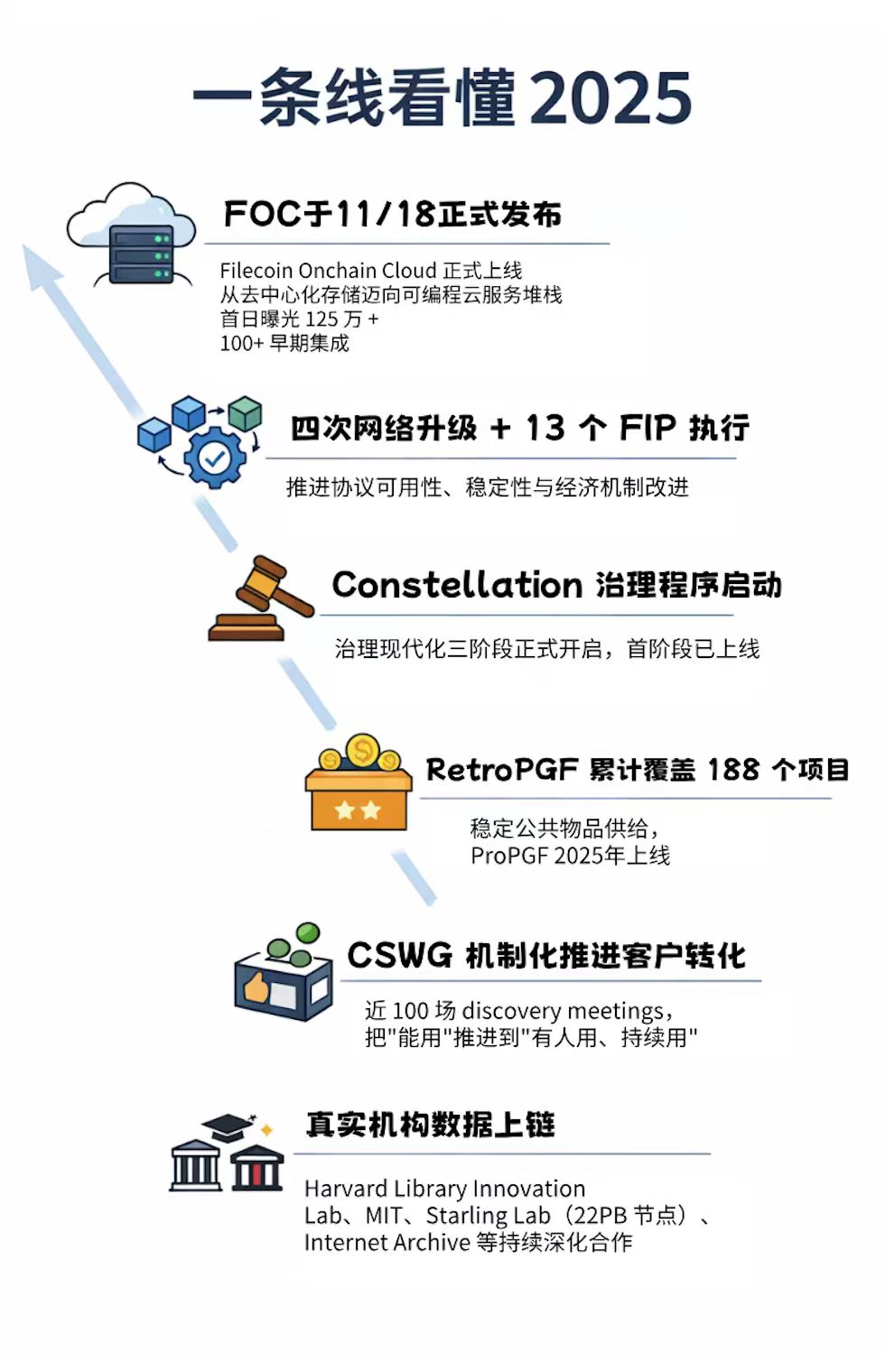
If there is one event from 2025 that must be highlighted, it is the official launch of Filecoin Onchain Cloud (FOC) on November 18.
FOC expands Filecoin beyond “providing decentralized storage capacity” into a “verifiable, programmable, and settleable cloud service platform,” introducing a composable suite of cloud service modules: Warm Storage Service, Filecoin Pay (onchain payment layer), Filecoin Pin (IPFS-compatible storage), Filecoin Beam (high-speed data transfer), and the Synapse SDK for developers (downloaded 17,900 times post-launch). Every storage, retrieval, and payment interaction is transparent, auditable, and backed by strong onchain guarantees.
On launch day: Over 100 early builders completed integrations; total social media impressions exceeded 1.25M; CoinDesk’s live stream reached 430k+ viewers; over 280 attendees and 30+ media partners joined in person. Among the first integration partners: Monad integrated Filecoin to support onchain AI workflows; KYVE leveraged FOC to archive Celestia and Story Protocol chain data at petabyte scale; Akave Cloud and Storacha Forge respectively built enterprise-grade decentralized backup and warm storage services. ENS, Safe, and ERC-8004 have also completed integration.
The significance of FOC goes beyond a product release—it packages “network capabilities” into “cloud service interfaces” closely aligned with developer and customer workflows, establishing an executable product path for 2026’s goal of “bringing real demand onchain and enabling payment.”
2) Protocol & Governance: Predictable Upgrade Cadence + Modernized Governance
We executed four mainnet upgrades (NV24 to NV27) throughout the year, implementing 13 FIPs and 1 FRC, covering core improvements such as FVM optimizations, simplification of storage provider economic mechanisms, and reduced gas costs. The Fil+ program distributed over 780+ PiB of DataCap in total. These metrics reflect the engineering maturity of a production-ready public blockchain: upgrade schedules are predictable, and key changes undergo open discussion, testing, and deployment.
At the end of 2025, we officially launched the Constellation governance program—a three-phase initiative to modernize governance (Nebula: building infrastructure and incentives → Nexus: expanding distributed participation → Galaxy: institutionalizing long-term structure). The first Nebula phase launched at the FDS-7 Summit. This is our systematic response to the question: “How can a decentralized protocol truly enable open, shared governance?”
3) Public Goods Incentives: The Enduring Foundation of Ecosystem Health
RetroPGF completed two rounds of distribution—the second round (December 2024) awarded 270,000 FIL to 97 projects; the third round (December 2025) awarded 500,000 FIL to 91 projects, spanning core areas including storage operations, developer infrastructure, programmable data, and retrieval markets. Top recipients included FilOz, Filecoin Onchain Cloud, go-libp2p, FIL-Builders, and Filecoin Data Portal.
Public goods are not “nice-to-have”—they form the foundational bedrock for the network’s commercialization. As the network enters its demand-validation phase, tooling, protocol implementations, and retrieval infrastructure must stabilize first; otherwise, any B2B or B2C productization efforts lack a reliable foundation. In 2026, we will introduce ProPGF (forward-looking public goods funding), offering upfront grants to teams actively advancing measurable network KPIs.
4) Real Data onchain: Reading Network Value Through Institutional Names
Our Quality Engineering team maintained and onboarded over 3.5 PiB of culturally and scientifically valuable datasets throughout the year, partnering with institutions including Harvard Library Innovation Lab, Internet Archive, MIT OpenCourseWare, NASA GEDI geospatial datasets, and USC Shoah Foundation.
High-value collaborations also emerged in media and news archiving: every article on The Defiant now displays a “Preserved on Filecoin” badge; MuckRock uploaded over 500,000 documents via DocumentCloud; Starling Lab deployed a 22 PB Filecoin storage node at USC Libraries, preserving Holocaust survivor testimonies and frontline photo documentation; DPLA, Flickr Foundation, and Earth Species Project also completed significant data onboarding in 2025. At the cross-chain level, we jointly launched the Avalanche C-Chain × Filecoin native cross-chain data bridge with Ava Labs—further cementing Filecoin’s role as Web3’s decentralized data layer.
These institution names themselves are the strongest testament to Filecoin’s mission: “preserving humanity’s most important information.”
5) Customer Conversion & Global Connection: Shifting from R&D-Driven to Growth-Driven
In 2025, we launched the Client Success Working Group (CSWG), instituting systematic mechanisms for pain-point tracking, customer profiling, and project progress dashboards—conducting nearly 100 discovery meetings across the year. Such work may not be as visible as “launching a new protocol,” but it reflects the essential organizational capability required as the ecosystem transitions toward growth-driven execution.
In APAC, we hosted four AMAs reaching over 100,000+ attendees, organized or supported 26 global events throughout the year, engaged over 5,000+ builders through the Orbit program, added 10 new regional ambassadors—including chapters at Zhejiang University, Northwestern University, Purdue University, and regional nodes across Ghana, India, Vietnam, and Nigeria. These activity and developer engagement metrics don’t merely reflect the buzz of a single conference—they demonstrate that the ecosystem’s growth flywheel remains firmly in motion.
A One-Pager Summary of 2025
2026: From “Capability Exists” to “Value Realized”
In infrastructure sectors, the true inflection point is never the day a technology launches—it is the moment the first sustainable, paying customers appear.
In 2026, both market and network conditions have matured simultaneously. On the market side, demand for storage infrastructure driven by AI is growing exponentially—training datasets, agent memory layers, and model archives each require large-scale, verifiable, low-cost persistent storage; and recurring outages in centralized cloud services continue pushing enterprises and institutions to reevaluate the value proposition of decentralized alternatives. On the network side, FOC has delivered composable cloud service interfaces to developers; client success mechanisms are now systematized; and by end-2026, the final batch of network vesting periods will conclude, triggering a pivotal restructuring of incentive design—shifting rewards toward paid usage and effective workloads, rather than mere capacity provisioning.
This is not a slogan-driven transformation—it is a necessary leap enabled by converging conditions. The Filecoin ecosystem will collectively focus on three network-level objectives:
Objective 1: Drive Paid Onchain Storage Transactions
Historically, much of Filecoin’s storage demand relied on free or subsidized data—validating technical feasibility, but not commercial viability. In 2026, the central question for the Filecoin ecosystem is: Will real customers pay continuously for Filecoin’s storage, retrieval, and verification capabilities? To answer it, FOC will launch its production-grade mainnet version supporting stablecoin payments and introduce an enterprise-oriented horizontal storage console—designed to plug directly into existing business systems. The ecosystem will concentrate resources on targeted breakthroughs across five high-value verticals: AI agents, DePIN, chain data, real-world assets (RWA), and enterprise infrastructure. Simultaneously, network incentives will systematically favor participants generating real paid activity—shifting storage providers’ competitive logic from raw capacity to service quality and customer retention.
Objective 2: Strengthen Network Profitability & Cryptoeconomic Health
The conclusion of vesting periods presents a rare window—calibrating incentive structures before this milestone will directly determine Filecoin’s economic health as it enters market-driven pricing. In 2026, the network will design and implement long-term alignment mechanisms, redirecting rewards toward paid usage and effective workloads; ProPGF will officially launch, ensuring every public goods grant corresponds to quantifiable network KPIs; and institutional-grade investment tools will enter the ecosystem, broadening the network’s long-term capital base.
Objective 3: Expand Onchain Adoption by Paying Flagship Customers
A single technical capability is insufficient to build market trust—what truly drives further adoption is visible, referenceable flagship use cases. Filecoin already serves world-class institutions like Internet Archive, MIT, and Starling Lab; in 2026, these collaborations will advance fully to “fully paid, onchain-verifiable” depth—and around each successful case, we will build shareable user stories and integration documentation, forming a credibility flywheel to accelerate the next wave of customer decisions.
How You Can Join This Ecosystem
The strategic core of 2026 is converting globally scaled network capacity into globally scaled real demand. This is not a task for the Filecoin Foundation alone—it is a collective effort driven by every participant across the ecosystem. Below are concrete pathways for different roles:
Developers & Application Teams
What you can do: Build real, paying applications on Filecoin Onchain Cloud, integrating storage, retrieval, and payments into your product workflows.
Key focus areas: AI agent storage & memory layers, DePIN data infrastructure, chain data archiving, real-world asset (RWA) provenance, decentralized media & content archiving.
Ecosystem support:
- Quickly integrate with FOC using the Synapse SDK—comprehensive documentation and regularly updated reference implementations → docs.filecoin.cloud
- Join the FIL-Builders developer community for roadmaps, technical deep dives, and hackathon opportunities → fil.builders
- Participate in global hackathons like PL Genesis—early-stage projects gain direct visibility and funding support
- Apply for project grants via Ecosystem Grants, covering tool development, protocol integrations, research, and more → fil.org/grants
- After generating real network contributions, earn retrospective or forward-looking incentives via RetroPGF / ProPGF
Storage Providers (SPs)
What you can do: Shift from competing purely on capacity to delivering paid, verifiable storage services—and reliably serving real enterprise workloads.
Key focus areas: Join the Filecoin Warm Storage Service as a certified provider; offer compute colocation services; deliver high-quality storage supporting PDP (Proof of Data Possession).
Ecosystem support:
- Apply to join the Filecoin Warm Storage Service SP Whitelist to directly serve paying customers → filecoin.cloud/service-providers
- Access operational support and early adopter incentives via VenusHub and the PDP SPX Program
- Participate in the Fil+ allocation mechanism to consistently access high-quality data clients
- Engage with the APAC SP Community and Global SP Working Group for direct communication on network upgrades and operational resources
Enterprise & Institutional Data Customers
What you can do: Migrate persistent-storage workloads to Filecoin to obtain onchain-verifiable, tamper-proof, and cost-controlled storage services.
Ideal use cases: Archiving AI training datasets; public storage of government and academic data; preservation of news and media archives; protection of human rights and historical documentation; archiving chain data for Web3 protocols; RWA asset provenance.
Ecosystem support:
- Join the Filecoin Flagship Customer Conversion Program for dedicated technical onboarding and support
- Establish direct communication channels via the Client Success Working Group, with end-to-end support from needs assessment to go-live
- Use Singularity (an open-source data onboarding tool) for self-managed, large-scale dataset onboarding
- Upon onboarding enterprise data, receive the "Preserved on Filecoin" badge—a publicly verifiable attestation of data integrity
Ecosystem Contributors & Governance Participants
What you can do: Directly shape the network’s evolution through protocol research, tool development, community building, and governance proposals.
Ecosystem support:
- Participate in the Constellation governance program (Nebula phase launched)—engage in protocol decision-making via the FIP process → github.com/filecoin-project/FIPs
- Join specialized working groups such as the APAC Marketing & Governance Working Group and CSWG
- Apply to become a Filecoin Orbit Ambassador, growing local developer communities in your region → fil.org/orbit
- Earn recognition and FIL incentives for substantive contributions via RetroPGF / ProPGF
The market no longer prices “potential capability”—it prices “sustainable revenue and effective usage.”
From scaling up, to application; from capability, to demand; from existence, to realization.
This article synthesizes insights from the Filecoin Foundation 2025 Annual Report and the 2026 Filecoin Network Strategy. For the full original texts, visit:
Learn more: filecoin.cloud | fil.org | Subscribe to Filecoin News
Join TechFlow official community to stay tuned
Telegram:https://t.me/TechFlowDaily
X (Twitter):https://x.com/TechFlowPost
X (Twitter) EN:https://x.com/BlockFlow_News
 @Filecoin


