Filecoin and Arweave: From Storage to Computing, the Revival of Decentralized Storage
TechFlow Selected TechFlow Selected
Filecoin and Arweave: From Storage to Computing, the Revival of Decentralized Storage
There are many decentralized data storage protocols, but the most notable are Filecoin and Arweave.
 Navigating Web3 tides with focused insights
Author: Leo, IOSG Ventures
This article is original content by IOSG, intended solely for industry learning and exchange. It does not constitute any investment advice. If quoting is necessary, please credit the source. Republishing requires authorization from the IOSG team and adherence to republishing guidelines.
Summary:
-
The Arweave protocol design technically guarantees permanent storage, making it particularly suitable for high-value digital assets such as NFT metadata.
-
Beyond data storage, computation is even more critical. With the introduction of smart contracts and programmability, decentralized storage networks have entered a new phase of "more than just storage."
-
Filecoin relies on economic incentives to achieve data redundancy, whereas Arweave leverages protocol design.
-
FVM brings financialization to Filecoin by commoditizing storage space and time. Users can lock in costs upfront, storage providers can recover capital early, and plan inventory, hardware, and operations based on forward demand.
The mainstream evolution of computer networks revolves around three directions: data computation, transmission, and storage. As Web3 has evolved to this day, the progress of decentralized data storage protocols is evident.
On March 14, 2023, at epoch 2,683,348, Filecoin officially launched the EVM-compatible Filecoin Virtual Machine (FVM) on its mainnet, bringing smart contracts and programmability to the Filecoin network. This marks that decentralized data storage protocols have entered a new stage of "more than just storage."
There are many decentralized data storage protocols, but Filecoin and Arweave stand out. In this article, we will discuss in detail the new features enabled by the FVM launch on Filecoin.
Perpetual Storage
Permanent storage holds special significance and demand in Web3—high-value digital assets like NFT metadata require permanent preservation.
Filecoin
After the FVM launch, Filecoin emphasized its "permanent storage" capability. We understand Filecoin’s approach to permanent storage as theoretically achieving long-term retention through economic mechanisms, with minimal changes to the core protocol design.
Under Filecoin's current design, storage deals are negotiated off-chain between storage providers and clients, then recorded on-chain. A deal includes data size, storage duration, price, and collateral. To retain data beyond the agreed period, the client must manually submit a renewal deal.
However, with FVM, these deals can now be automatically renewed on-chain.
Lighthouse
Lighthouse is a project dedicated to enabling permanent file storage on Filecoin. Users pay once, and their files are stored “permanently.” Lighthouse uses a smart contract-based endowment pool to continuously pay for storage fees. When a user creates and pays for a deal, part of the payment goes to the storage provider, while the remainder is deposited into the endowment pool. The endowment pool’s smart contract automatically renews the deal upon expiration using funds from the pool, thus achieving "permanent storage." The feasibility lies in the pool’s ability to grow its assets via staking and farming, where appreciation over time covers ongoing storage costs.
This aligns with Arweave’s whitepaper assumption—that declining storage costs mean invested funds can appreciate enough to cover perpetual storage expenses.
Arweave
"Over the past 50 years, storage costs have declined at an average annual rate of 30.57%."
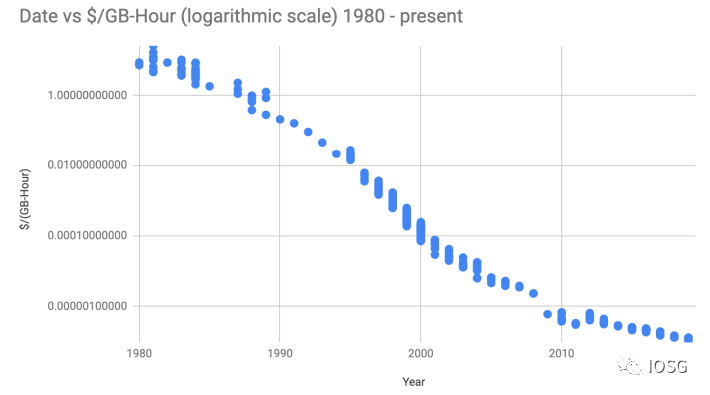
Arweave Yellow Paper: Cost per hour to store 1GB of data since 1980 (log scale)
Arweave introduces a structure called Blockweave atop traditional blockchain architecture, using protocol-level design to fundamentally ensure data permanence.
In Blockweave, each block (except the latest confirmed and candidate blocks) connects to three other blocks: the previous block, the next block, and a recall block.
For any given block height, the recall block can be any historical block prior to that height within the Blockweave. The selection of the recall block during mining is determined randomly based on the previous block’s height and hash.
Recall blocks play a key role in Arweave’s consensus mechanism—Succinct Proof of Random Access (SPoRA).
In Arweave, miners are not required to store all historical blocks (i.e., storing all history is not mandatory for participation). However, possessing locally stored, randomly selected recall blocks is essential for miners to participate in mining new candidate blocks. Recall blocks function like random audits, verifying whether miners actually preserve historical data, thereby ensuring permanent storage.
Arweave’s permanent storage is technologically guaranteed by its protocol design, making it a more robust solution compared to Filecoin. This is also why Web2 tech giants like Meta and Instagram, as well as Web3 applications like Mirror, choose Arweave for storing their NFTs and content.
Decentralized Computation
Storing data is important, but using it is even more so. The visions of Filecoin and Arweave extend far beyond being mere "decentralized hard drives" (though currently most users treat them as such), aiming instead to become blockchain protocols combining low-cost storage with high-throughput computing.
Beyond data storage, Web3 dApps also need computation.
Filecoin
Filecoin and IPFS distribute content-addressed datasets across storage providers worldwide, increasing data redundancy and resilience. This decentralized distribution offers advantages in cost, availability, and reliability. However, it also means parts of a single dataset may be stored across geographically distant providers. This fragmentation makes performing computations or queries over the data inefficient. Reassembling widely dispersed data into a central location for processing is expensive, wasteful, performance-limited, and contradicts the principles of decentralized storage.
Filecoin’s EVM-compatible FVM proposes a solution combining edge computing with on-chain coordination.
Contracts in FVM can broker computational resources, incentivize execution, distribute workloads among available storage providers, and prove the validity of results to claim rewards.
Storage providers can register via FVM contracts to join the decentralized computing network. Computing clients post tasks to the contract, which then assigns workloads to registered providers. Upon completion, providers submit proofs to receive payment.
Arweave
Decentralized computation on Arweave is achieved through the SmartWeave smart contract protocol, capable of directly processing rich data. The key difference between SmartWeave and other blockchain smart contract systems is "Lazy Evaluation," shifting the computational burden from network nodes to end users. This decoupling of storage and computation means nodes do not need to maintain ever-growing global states.
Smart contracts are only computed and verified for their latest state when used by a user, rather than requiring every node in consensus to perform redundant calculations. Offloading computation to users significantly improves blockchain scalability.
Warp
Warp has developed a Warp SDK based on the initial version of SmartWeave, enhancing performance and modularity while supporting multiple execution environments.
Warp recently released its 2023 roadmap, with development goals including:
1) Layer 1 Synchronizer: Enable efficient synchronization between Warp contracts and the base Arweave layer;
2) Layer 2 Sequencer: Instead of sending data directly to the Arweave mainnet (which may wait 2–3 minutes until included in a block), transactions are routed through the Warp sequencer and settled instantly via the Bunder network, offering users immediate access and near-instant finality;
3) Contract Enhancements: Warp contracts aim to provide Web3 dApps with a fully functional technical stack competitive with Web2 services;
4) Development of Delegated Resolution Environment and Aggregation Nodes: The delegated resolution environment allows delegation of computation for highly interactive or potentially unsafe contracts, while aggregation nodes offer monitoring and insights into contract state.
Storage Redundancy
Decentralized storage networks avoid single points of failure. But how can we ensure nodes/storage providers truly and effectively preserve uploaded data? And how can multiple nodes/providers independently store copies to achieve redundancy and reliability?
Filecoin and Arweave adopt different approaches: Filecoin relies on economic incentives, while Arweave leverages protocol design.
Filecoin
Among the highlights of the FVM launch were the introduction of Replication Workers and Repair Workers.
Before FVM, if a client wanted to back up their data across multiple network nodes to maximize survival chances in case of provider failures, they had to manually negotiate N deals off-chain, execute N on-chain transactions, and transfer data N times—an extremely tedious and resource-intensive process.
With FVM, replication workers act as intermediaries, charging minimal fees to achieve data redundancy, saving clients time and costs. These workers automatically match and generate storage deals on the Filecoin network based on criteria such as desired number of replicas, geographic regions, latency requirements, and price range. Repair workers act as agents for clients, monitoring whether stored data is lost or expired. They can automatically replicate data falling below redundancy thresholds to additional providers and renew expired or terminated deals on behalf of clients.
Arweave
Arweave achieves storage redundancy naturally through protocol design. Arweave incorporates recall blocks into the SPoRA proof-of-work algorithm, ensuring that miners who mine new blocks indeed possess the full data of the recall block. The SPoRA consensus incentivizes miners to store as many historical blocks and Blockweave data as possible within their storage capacity. When a miner cannot store all historical data, they prioritize storing blocks that are less commonly held by others. This is because when a widely stored recall block is selected, many miners compete to mine the next block; conversely, when a rarely stored block is selected, competition is lower. Since recall block selection is highly random and uniformly distributed, rational miners under storage constraints should prioritize storing less common blocks to increase their odds of earning block rewards. Through elegant protocol design and aligned incentives, Arweave maximizes the backup of any historical block across the entire network, ensuring reliability and redundancy.
Data Retrieval
Once data is stored, efficiently, accurately, and quickly retrieving it becomes another challenge.
Filecoin features a separate economic incentive system for data retrieval. Retrieval Providers (RPs) deliver fast access to data for clients. RPs focus on rapid data access rather than long-term storage. Most storage providers also serve as retrieval providers. Clients pay RPs to retrieve their data. Projects like retrieval.market and Saturn Network already enable fast retrieval and content delivery within the Filecoin ecosystem.
Beyond enabling permanent storage and redundancy, Arweave’s SPoRA consensus also enhances data retrieval speed. Before SPoRA, Arweave used Proof-of-Access (PoA), which incentivized miners to store more data but did not encourage fast retrieval. In fact, during the PoA era, miners pooled storage resources—keeping historical blocks in centralized pools—and sent requested recall blocks upon request. This undermined decentralization. Network statistics once showed hash power rising while node count dropped, indirectly proving the existence of such pools. To address this and encourage local data storage, Arweave upgraded PoA to SPoRA. After the upgrade, miners who don’t store recall blocks locally face high costs and delays in fetching them from pools, while those storing data locally have higher chances of successfully mining new blocks. This design eliminates storage pools. With miners across the globe storing historical data locally, data retrieval speed for clients is significantly improved.
Financialization of Storage
With the launch of FVM, Filecoin can now support various Web3 applications including DeFi—such as staking protocols, insurance protocols, and storage derivatives.
Filecoin storage providers must pledge a certain amount of FIL as collateral to offer services. Previously, providers either raised funds to buy FIL or relied on off-chain lending agreements. Now, with staking protocols built on FVM, FIL holders can deposit idle tokens into the protocol under defined rules. Storage providers of any size can then obtain FIL on-chain to meet collateral requirements and begin offering services.
Storage derivatives represent another exciting application. Fluctuating storage costs pose budgeting challenges for both clients and providers. By commoditizing storage space and time, clients can lock in costs upfront, while providers gain early revenue and can plan inventory, hardware, operations, and finances based on forward-looking demand.
Project Positioning and Current Status
Filecoin currently has approximately 3,678 nodes providing about 19.544 EiB of storage, while Arweave has 112 nodes collectively storing 125.62 TiB of data.
In terms of scale, Filecoin’s network is larger. However, despite both being decentralized storage protocols, Filecoin and Arweave have distinct positioning—making it inappropriate to compare them simply by node count or total capacity.
Protocol Labs positions Filecoin as a Storage Marketplace and Incentive Layer, building comprehensive ecosystems around storage markets, retrieval markets, and financial products. Through economic incentive design, Filecoin delivers rich functionalities (e.g., permanent storage, replication, repair) and aims to become the largest and most important decentralized data storage, distribution, and computation protocol.
Arweave’s core mission is the permanent preservation of data, building smart contract protocols on top of the foundational Arweave layer to enable computation over stored data. Every mechanism is designed to serve this primary goal. As seen in earlier sections, Arweave’s design is both elegant and cohesive.
Outlook
Compared to the rapid advancements in the Ethereum ecosystem and Ethereum Virtual Machine, the development of decentralized storage networks has been relatively quiet over the past few years.
Both Filecoin and Arweave host many excellent projects and entrepreneurs. Yet, Web3 dApps have not widely adopted Filecoin or Arweave for storage—many still rely on Web2 solutions. Performing computation on blockchain-based storage is a novel path. Whether through FVM or SmartWeave, both hold the potential to unlock unprecedented decentralized applications.
For developers and users, choosing a decentralized storage protocol is not an either-or decision—it should depend on the specific storage needs of the application and content.
Although Filecoin and Arweave share some overlapping goals, each excels in its unique strengths, allowing them to advance independently and meet evolving demands of decentralized storage networks—moving from "decentralized hard drives" toward becoming true decentralized servers.
Join TechFlow official community to stay tuned
Telegram:https://t.me/TechFlowDaily
X (Twitter):https://x.com/TechFlowPost
X (Twitter) EN:https://x.com/BlockFlow_News
 IOSG Ventures