A decade-old cryptocurrency, Zcash is also facing a midlife crisis
TechFlow Selected TechFlow Selected
A decade-old cryptocurrency, Zcash is also facing a midlife crisis
Young and restrained for compliance, middle-aged and wealthy wanting divorce.
 Navigating Web3 tides with focused insights
Author: Curry, TechFlow
On January 7, the core development team of Zcash collectively resigned.
This wasn’t just one or two people having a tantrum. The entire Electric Coin Company—around 25 people, led by the CEO—left together.
The company, commonly known as ECC, is the primary developer behind Zcash. Think of them as the coders—the ones who actually built it. And now they're gone.
When news broke, ZEC plummeted 20%.
Here’s a fun fact: Zcash is nearly ten years old.
It launched on October 28, 2016—earlier than many people even entered the crypto space. Its original selling point was “private transactions”: senders, receivers, and amounts all encrypted, invisible on-chain.
But in reality, after nine years, less than 1% of ZEC transactions actually use this privacy feature.
The other 99% are still transacting in plain sight.
For nine years, the product went largely unused. The team kept pushing through. The price crashed from over $3,000 at launch in 2016 to just $15 by July 2024.
Then, at the end of 2025, ZEC suddenly surged.
It was hovering around $40 at the start of the year. On November 7, it spiked to $744. Market cap exceeded $10 billion, re-entering the top 20 cryptocurrencies.
The long-dormant narrative around privacy coins suddenly became sexy again.
Great—price up nearly 800%. And then… “the dev team left.”
This story sounds like a midlife crisis script: bought a Porsche, then got divorced. Got your bonus, then the team disbanded.
When money is tight, everyone's comrades. When money flows, power struggles begin.
What were they fighting over? A wallet called Zashi.
Zashi is a mobile wallet launched by ECC in early 2024, designed with privacy features enabled by default. It’s the most critical user gateway in the Zcash ecosystem.
The ECC team wanted to privatize Zashi—bring in outside investment, spin it off into an independent startup capable of fundraising and rapid iteration.
But ECC isn’t an independent company. In 2020, it was folded into a nonprofit organization called Bootstrap, structured as a U.S. 501(c)(3).
In simple terms, this structure is meant for charities and public interest groups. The upside: tax-exempt status. The downside: profits can’t be distributed to individuals, and asset control lies with the board.
Back then, this move was about compliance—avoiding regulatory pressure from the SEC. During bear markets, no one cared about these details because there was no profit to split anyway.
Now, the Bootstrap board said no.
Their reasoning:
We’re a nonprofit with a legal duty to protect donor interests. Privatizing Zashi could be illegal, open us to lawsuits, or invite political attacks. They cited OpenAI as an example: how many lawsuits emerged when it tried shifting from nonprofit to for-profit?
Josh Swihart, former CEO of ECC, sees it differently. He called the board’s actions “malicious governance,” saying it made it impossible for the team to “perform their duties effectively and with dignity.”
He used a legal term: “constructive discharge”—meaning although not formally fired, working conditions were made so unbearable that resignation became inevitable.
Twenty-five people, all pushed out the same way.
Swihart also named four board members: Zaki, Christina, Alan, and Michelle. He combined their initials into “ZCAM.”
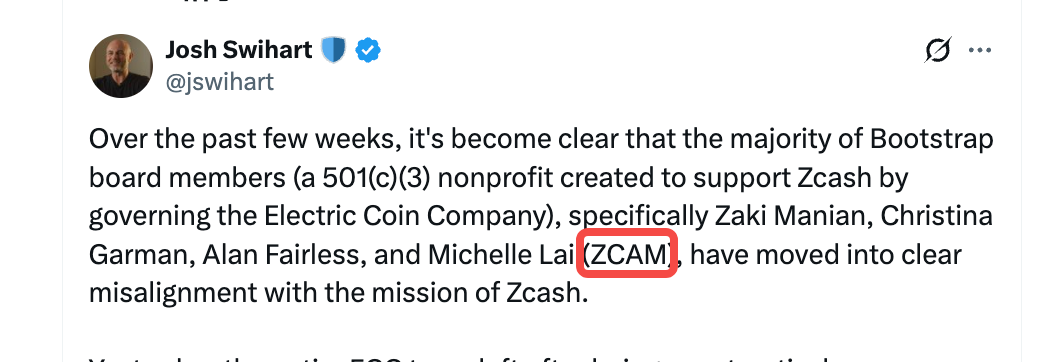
ZCAM. Sounds like SCAM. Whether intentional, we don’t know.
Among them, Zaki Manian has the most dramatic backstory.
He’s a veteran of the Cosmos ecosystem, once a core member of Tendermint. He publicly clashed with founder Jae Kwon and resigned in 2020.
In 2023, the FBI informed him that two developers on a project he oversaw were North Korean agents. He knew—but concealed this for 16 months before going public. In October 2024, Jae Kwon publicly accused him of “gross negligence” and “betraying community trust.”
Now, he’s a board member of Zcash.
The day after the resignation, the ex-ECC team announced a new company, codenamed CashZ.
They plan to build a new wallet using Zashi’s codebase, launching within weeks. Existing Zashi users will be able to migrate seamlessly.

“We remain the same team, the same mission: building unstoppable private money.”
No new token, no fork—just a new shell, same work.
The most ironic part? The timing.
When ZEC was $15, no one cared who controlled the wallet. But when it hit $500, the value of Zashi became a matter of life and death.
Only when there's money do you find out who’s family.
Same conflict—nonprofit oversight vs. entrepreneurial drive. In OpenAI’s case, the board lost. In Zcash’s case, the team walked.
Who won? Unclear. But this tension is widespread across crypto projects.
Swihart wrote on CashZ’s website explaining why they left:
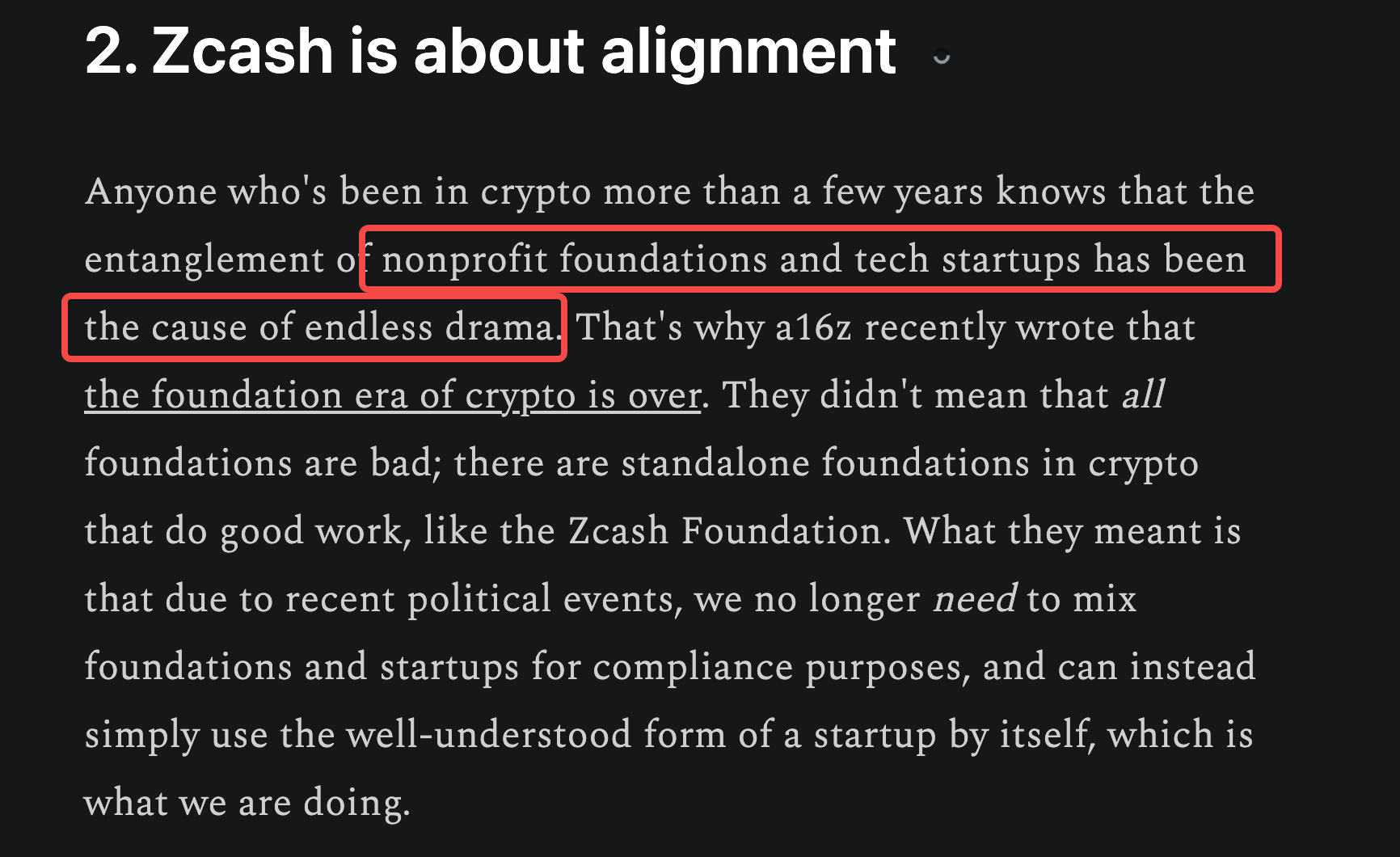
“The nonprofit foundation model is a relic of crypto’s compliance era. Back then, projects needed ‘compliance buffers’ for protection. But those buffers brought bureaucracy and strategic misalignment. Startups can scale fast. Nonprofits cannot.”
He added: “Anyone who’s been in crypto for a few years knows entanglement between nonprofit foundations and tech startups is an endless source of drama.”
Indeed, endless drama.
In 2023, rumors surfaced about disagreements between Zooko and Swihart when Zooko stepped down as CEO. In January 2025, Peter Van Valkenburgh, a director at the Zcash Foundation, also resigned.
A decade-old project—most of the original figures have already left.
Somewhere on Twitter, someone asked: Is Zcash going to die?
The chain still runs. The code still exists. It’s just that the people writing it have changed.
But Swihart is right: the clash between nonprofits and startups is an industry-wide disease. Cosmos had it. Ethereum Foundation had it. Solana Foundation had it too.
The difference is only in how—and how badly—they fought.
Zcash chose the cleanest path.
Break up.
Join TechFlow official community to stay tuned
Telegram:https://t.me/TechFlowDaily
X (Twitter):https://x.com/TechFlowPost
X (Twitter) EN:https://x.com/BlockFlow_News
 深潮TechFlow